Oral Mucocele: Understanding Mucous Cysts, Causes, and Care

Updated: 2 days ago
Medically reviewed by Dr. Baraa Alnahhal, MD · Last reviewed: October 2026
Editorial note: This article is for general education. See a dentist or doctor for any bump in your mouth that lasts more than a few weeks.
Quick Answer
An oral mucocele is a soft, dome-shaped, harmless cyst filled with mucus that forms in the mouth, usually on the inner lower lip. It occurs when a salivary gland is damaged or blocked, often from lip biting. Most clear up without treatment, while persistent cysts can be removed by a provider. Never pop one at home. [1]
What the research says
Mucoceles mostly affect young people and the lower lip. In a multicenter Brazilian series, the mean age was 19.8 years, the lower lip was the most common site (67.4%), followed by the floor of the mouth (10.0%), and 6.2% of cases were recurrent (Miranda et al., Braz Dent J, 2022) [2]
Excision, CO2 laser and marsupialization performed similarly. A meta-analysis of 5 randomized trials found recurrence with CO2 laser was 0.60 times that of scalpel excision and with micro-marsupialization 1.30 times, and neither difference was statistically significant (Hashemi et al., Med Oral Patol Oral Cir Bucal, 2023) [3]
For ranulas, removing the gland lowered recurrence. A review of 71 studies and 809 patients reported recurrence below 10% with excision plus removal of the sublingual gland, versus 15–30% for excision without gland removal or marsupialization. Most recurrences occurred within 3–6 months (Nguyen et al., Oral Dis, 2026) [4]
According to PubMed, these are a descriptive case series and systematic reviews; results describe groups of patients, not individual outcomes.
What Is an Oral Mucocele?
An oral mucocele is a common, benign lesion that appears as a smooth, round bump on the inner lining of the mouth. These cysts are filled with saliva and are generally painless. While they most frequently develop on the inner part of the lower lip, they can also be found on the tongue, gums, inner cheeks, and the floor of the mouth. A mucocele that specifically occurs on the floor of the mouth is referred to as a ranula. [1]
Prevalence and Demographics
Oral mucoceles are quite common, affecting approximately 2.4 out of every 1,000 people in the general population. They can occur at any age, but they are most frequently seen in children and young adults. Statistics show that 70% of cases involve individuals between the ages of 3 and 20, with the peak occurrence happening between 10 and 20 years of age. [1]

What are the symptoms of an oral mucocele, and how is it identified?
Identifying an oral mucocele is usually straightforward, as they have a distinct appearance. They typically look like soft, dome-shaped lesions that may appear clear or have a slightly bluish tint due to the fluid inside. [1]
Common Characteristics
Size: They can range from a tiny 1 millimeter to as large as 2 centimeters in width. [1]
Texture: The lesions feel soft and fluid-filled to the touch. [1]
Pain Level: Most mucoceles are completely painless, though larger ones can cause a feeling of pressure or discomfort. [1]
Functional Impact: If a cyst grows large enough, it may interfere with normal activities such as speaking, chewing, or swallowing. [1]
Feature | Description |
Appearance | Smooth, round, dome-shaped bump |
Color | Clear, translucent, or bluish tone |
Location | Primarily inner lower lip; also cheeks, tongue, gums |
Ranula | A specific mucocele located on the floor of the mouth |
What causes an oral mucocele?
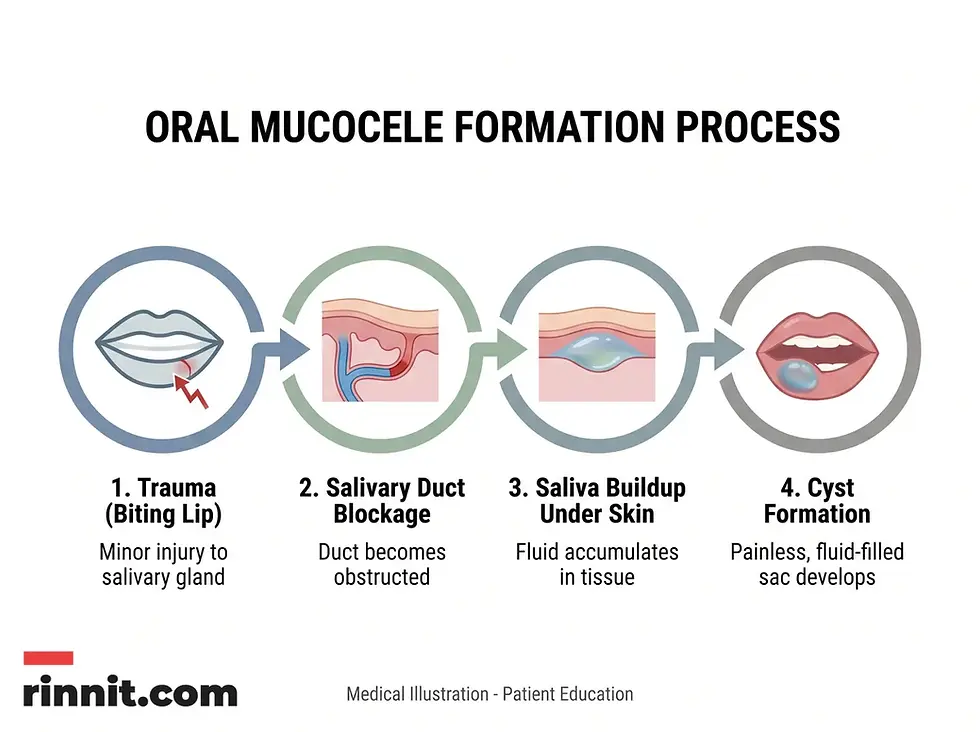
The development of a mucocele is almost always linked to the salivary glands. These glands produce saliva that drains into the mouth through small tubes called ducts. When these ducts are damaged or blocked, saliva builds up under the skin, forming a cyst. [1]
How Trauma Leads to Cysts
Accidental Biting: The most frequent cause is accidentally biting the lower lip or inner cheek while eating. [1]
Habitual Biting: Chronic lip-biting or lip-sucking habits can lead to repeated gland damage. [1]
Salivary Duct Blockage: Thickened saliva or a damaged duct can prevent normal drainage. [1]
Inflammation: Long-term irritation from smoking or using tobacco products can inflame the oral tissues. [1]
Medical Trauma: In rare cases, trauma from medical procedures like intubation can cause a mucocele. [1]
How is an oral mucocele diagnosed?
In most cases, a healthcare provider can diagnose an oral mucocele through a simple visual and physical examination. [1] They will look at the size, color, and location of the lesion and ask about any history of lip biting.
Diagnostic Tools
While a visual exam is usually sufficient, providers may occasionally use additional tests to confirm the diagnosis or rule out other conditions:
How is an oral mucocele treated, and what is recovery like?
Many oral mucoceles will eventually rupture on their own and disappear without any treatment. [1] However, if a cyst is persistent, large, or causes significant discomfort, professional intervention is necessary. It is critical to never attempt to pop or drain a mucocele at home, as this can lead to infection and permanent tissue damage.
Professional Removal Methods
Cryotherapy: The application of extreme cold to freeze and destroy the cyst tissue. [1]
Laser Treatment: Using a precise laser beam to remove the lesion with minimal bleeding.
Surgical Excision: A minor procedure where an oral surgeon or dentist removes the cyst and sometimes the associated salivary gland to prevent recurrence. [1] [4]
Post-Treatment Recovery
Recovery time varies depending on the method used. [1] Patients are often advised to follow a liquid or soft-food diet for several days to allow the oral tissues to heal. [1] Strenuous exercise should be avoided for a short period, and maintaining excellent oral hygiene is essential to prevent infection during the healing process.

Can an oral mucocele be prevented, and what is the outlook?
The long-term outlook for individuals with oral mucoceles is excellent, as the condition is entirely benign. [1] Prevention focuses on reducing oral trauma. Breaking habits such as lip-biting and cheek-sucking is the most effective way to avoid future cysts. [1] Additionally, quitting tobacco use can reduce chronic inflammation in the mouth, further lowering the risk of salivary gland issues. [1]
If you have a persistent bump in your mouth that interferes with your ability to eat or speak, do not wait for it to resolve on its own. Contact your healthcare provider or dentist today for a professional evaluation and to discuss the best removal options for your comfort.
Frequently Asked Questions
1. Can I pop an oral mucocele at home?
No. You should never attempt to pop or drain a mucocele yourself. [1] Doing so increases the risk of infection, causes unnecessary pain, and often leads to the cyst returning.
2. How long does it take for a mucocele to go away?
Many mucoceles rupture and heal on their own within a few days to a few weeks. However, some may persist for months and require professional removal.
3. Is an oral mucocele a sign of cancer?
No. Oral mucoceles are benign (non-cancerous) cysts. [1] However, any new or persistent growth in the mouth should be evaluated by a professional to ensure an accurate diagnosis.
4. Are mucoceles painful?
Most mucoceles are completely painless. [1] Discomfort typically only occurs if the cyst grows large enough to be bitten accidentally or if it interferes with chewing and speaking.
5. What is a ranula?
A ranula is a specific type of mucocele that forms on the floor of the mouth. [1] It is usually larger than a standard lip mucocele and can sometimes cause more significant issues with speech and breathing.
6. Can smoking cause mucoceles?
Yes. Chronic inflammation from smoking or tobacco use can damage the salivary ducts, leading to blockages and the formation of mucous cysts. [1]
7. Will a mucocele come back after surgery?
Recurrence is possible, but it is significantly reduced if the healthcare provider removes the affected salivary gland along with the cyst during the surgical procedure. [4]
8. Is an oral mucocele contagious?
No. Oral mucoceles are caused by physical trauma or duct blockages, not by a virus or bacteria, so they cannot be spread to other people.
9. Do I need to see a doctor for a small mucocele?
If the cyst is small and not causing discomfort, you can often wait for it to resolve on its own. However, if it lasts longer than a few weeks, it is best to have it checked.
How do dentists remove a mucocele?
Options include freezing it (cryotherapy), laser treatment, or a minor surgery to cut it out. The provider may also remove the small salivary gland involved to lower the chance it comes back.
Related Reading
Understanding Ranulas: Causes, Symptoms, and Treatment Options explains the mucocele type that forms on the floor of the mouth.
Salivary Glands: Location, Function, Symptoms and Care covers the glands involved in mucoceles and their common problems.
Salivary Gland Stones: Causes, Symptoms, and Removal Options describes stones that block saliva flow and how they are removed.
Oral Cancer: Symptoms, Risk Factors, and Treatment Pathways explains warning signs of mouth growths that need prompt checking.
References
Cleveland Clinic. Oral Mucocele. Cleveland Clinic. Last updated July 1, 2022. https://my.clevelandclinic.org/health/diseases/23406-oral-mucocele
Miranda GGB, Chaves-Junior SC, Lopes MP, et al. Oral mucoceles: a Brazilian multicenter study of 1,901 cases. Braz Dent J. 2022;33(5):81-90. PMID: 36287502. https://doi.org/10.1590/0103-6440202204965
Hashemi M, Zohdi M, Zakeri E, et al. Comparison of the recurrence rate of different surgical techniques for oral mucocele: a systematic review and meta-analysis. Med Oral Patol Oral Cir Bucal. 2023;28(6):e614-e621. PMID: 37330953. https://doi.org/10.4317/medoral.26015
Nguyen K, Goodman E, Vibhute M, et al. Systematic review and meta-analysis of the management and outcomes of recurrent ranulas. Oral Dis. 2026;32(7):1816-1827. PMID: 41841403. https://doi.org/10.1111/odi.70274
Medical disclaimer
This article is for informational purposes only and is not a substitute for professional medical advice, diagnosis, or treatment. Always seek the advice of your physician or other qualified health provider with any questions about a medical condition.



Comments