Pubic Symphysis: Anatomy, Function, Pain and Care

Updated: 2 days ago
Medically reviewed by Dr. Baraa Alnahhal, MD · Last reviewed: October 2026
Quick Answer: What is the pubic symphysis?
The pubic symphysis is a slightly flexible joint where the left and right pubic bones meet at the front of the pelvis. Its small movements help stabilize the pelvis, absorb shock, transfer weight and allow pelvic widening during pregnancy and vaginal childbirth. [1]
Core idea | Plain-language meaning |
Location | Bottom-front of the pelvis, where the pubic bones meet. |
Movement | It does not move much, but allows a little flexibility. |
Main roles | Stability, shock absorption, weight transfer and pelvic widening. |
Main tissues | Fibrocartilage, hyaline cartilage and four pubic ligaments. |
Common contexts | Pregnancy, sports injury and bone or joint conditions. |
Evaluation | Physical exam and, when appropriate, imaging. |

What the research says
Pelvic girdle pain is common in pregnancy and often overlaps with low mood. Pregnancy-related pelvic girdle pain is estimated to affect 20% to 70% of pregnant women, with about 10% still affected more than 3 months after birth. A systematic review of 11 studies (3,172 participants), 9 of which were pooled in a meta-analysis, found that about 24% of women with this pain also had depression (95% CI 15%–37%), a figure similar to the general perinatal population. Two-thirds of the studies were from Scandinavian populations (Halliday et al., Health Sci Rep, 2024). [2]
Exercise has moderate-quality support for preventing low back pain in pregnancy. A meta-analysis of 6 randomized trials (2,231 participants) found that stand-alone exercise prevented episodes of low back pain in the long term (RR 0.92, 95% CI 0.85–0.99). The authors concluded that high-quality evidence for prevention strategies for lumbopelvic pain is still lacking and that larger trials are needed (Santos et al., Physiotherapy, 2022). [3]
Shockwave therapy is being studied for osteitis pubis in athletes. A systematic review of 56 studies (1,874 athletes or physically active people) found that, based on the highest-level studies, extracorporeal shockwave therapy may help as an add-on to exercise treatment in osteitis pubis. The authors call for further high-level research to define its role (Rhim et al., Br J Sports Med, 2024). [4]
What is the pubic symphysis?
The pubic symphysis is the joint that connects the left and right pubic bones in the pelvis. Unlike many other joints, it moves very little. Its main job is to hold the pubic bones in place while making small movements that help absorb upper-body weight. [1]
It may become more noticeable when pregnancy, a sports injury or another bone or joint condition affects it.
What does the pubic symphysis do?
The pubic symphysis has several related roles.
Function | What it means |
Holds the pubic bones in place | Helps maintain the front connection of the pelvis. |
Absorbs shock | Helps manage forces during walking and running. |
Transfers weight | Passes upper-body weight toward the legs and feet. |
Allows pelvic widening | Helps the pelvis widen during pregnancy and vaginal childbirth. |
Where is the pubic symphysis located?
The pubic symphysis is at the bottom of the pelvis, where the left and right pubic bones meet. It is wider in front than in back, sits in front of the bladder and is above the genitals. For the bigger picture, see our guide to the pelvis and how a joint is built. [1]
Several tendons connect with ligaments in this region. They include tendons of the gracilis muscle in the thigh (see thigh muscles), the oblique muscles and the rectus abdominis abdominal muscle. [1]
What is the pubic symphysis made of?
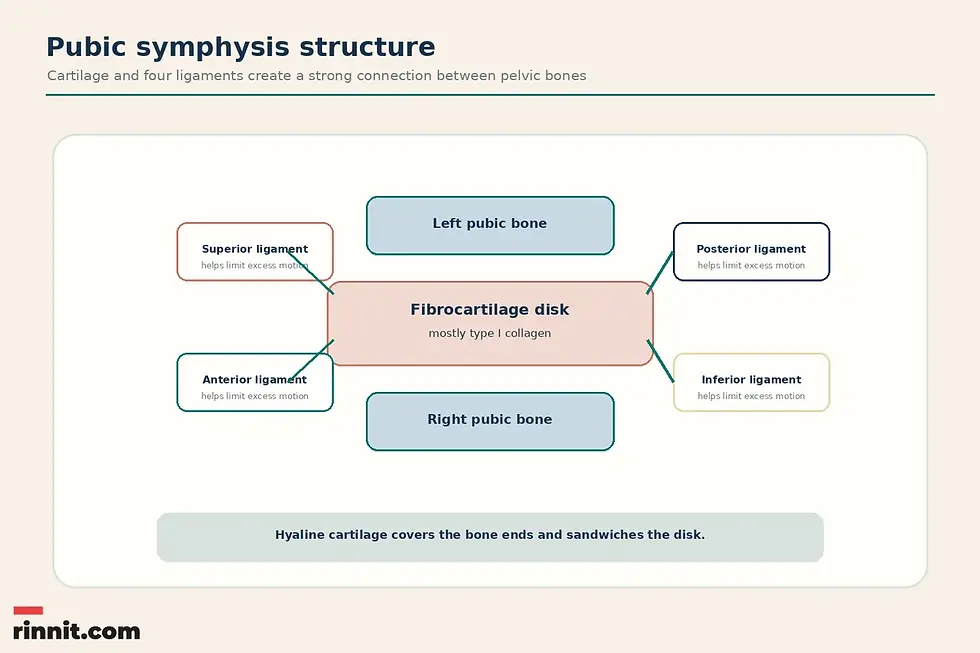
The joint has two types of cartilage and four ligaments. Together, these tissues create a strong but flexible connection that allows a small amount of movement. [1]
Fibrocartilage disk
The fibrocartilage disk is a thick mesh of fibers made mostly of type I collagen. It forms a sturdy fibrous disk, and ligaments and tendons attach to it to help hold the joint in place. [1]
Hyaline cartilage coating
Hyaline cartilage is made mostly of type II collagen. It covers the ends of the pubic bones and sits on either side of the fibrocartilage disk. [1]
Four pubic ligaments
Four ligaments attach to the fibrocartilage disk and help keep it from slipping or moving more than it should. They are the superior, inferior, anterior and posterior pubic ligaments. [1]
What conditions affect the pubic symphysis?
Symphysis pubis dysfunction (SPD) is an umbrella term for symptoms caused by changes in the pubic symphysis. Two types are pubic diastasis and osteitis pubis. Read more in our guide to symphysis pubis dysfunction during pregnancy. [1]
Condition or category | Description |
Symphysis pubis dysfunction | Umbrella term for symptoms caused by changes in the pubic symphysis. |
Pubic diastasis | The joint separates by more than 1 centimeter without a pubic fracture. |
Osteitis pubis | Inflammation of the joint that is not caused by an infection. |
Pregnancy-related change | Relaxin loosens the ligaments holding the joint in place. |
Sports injury | Quick, sharp changes in movement can affect the joint. |
Other bone or joint conditions | Osteoarthritis, fractures, metabolic bone diseases such as osteoporosis, pseudogout, rheumatoid arthritis and tumors or cancer may affect it. |
Related conditions include osteoporosis and rheumatoid arthritis. [1]
Why can pregnancy affect the pubic symphysis?
Pregnancy is a common cause of symphysis pubis dysfunction. During pregnancy, the hormone relaxin loosens the ligaments that hold the pubic symphysis in place. This can contribute to symptoms or changes in the joint. [1]
The pubic symphysis also helps the pelvis widen during pregnancy and vaginal childbirth. [1]
Pregnancy-related pelvic pain has many possible explanations, so symptoms should be discussed with a qualified healthcare professional rather than self-diagnosed.
How can sports injuries affect it?
Sports injuries are another common cause of pubic-symphysis problems, especially when movement involves quick, sharp changes. [1]
Activities that involve running, kicking, twisting or sudden direction changes may make symptoms more noticeable. However, a symptom pattern cannot identify the cause on its own.
What does pubic-symphysis pain feel like?
Issues with the pubic symphysis often cause pain and an unstable pelvis. Pain may be sharp in the pelvis or groin and may spread across the abdomen, hips and back. Learn more about chronic pelvic pain. [1]
Movement-related symptoms can include less flexibility in the groin, a grinding feeling when moving the pelvis, pain or clicking while walking, groin aching when running, kicking, standing or sitting, and pain when twisting or reaching. [1]

How is a pubic-symphysis problem evaluated?
A healthcare professional can assess whether the pubic symphysis is causing symptoms. Evaluation includes a physical examination and possibly imaging tests. [1]
Evaluation may be especially useful when pain is new, persistent, follows an injury, occurs during pregnancy or is associated with pelvic instability or difficulty moving.
An online symptom list cannot distinguish among symphysis pubis dysfunction, a fracture, inflammation, arthritis, a metabolic bone disease or another condition. Professional evaluation is needed for that distinction.
How can you support pubic-symphysis health?
Strengthening and moving the body mindfully can help avoid injury. A healthcare professional may recommend pelvic-floor exercises and core strengthening. [1]
Other helpful habits include wearing comfortable shoes that are right for your feet, easing into exercise and exercising on soft, even surfaces. [1]
Habit | Purpose |
Pelvic-floor exercises | May be recommended as part of strengthening. |
Core strengthening | May support mindful strengthening and movement. |
Comfortable, suitable shoes | May support movement and reduce injury risk. |
Ease into exercise | Avoids sudden, sharp increases in movement demand. |
Soft, even surfaces | May help create a more predictable exercise environment. |
These are general habits, not an individualized rehabilitation plan. Ask a healthcare professional which activities are appropriate for your symptoms, pregnancy status or injury.
When should you contact a healthcare professional?
Contact a healthcare professional for new or persistent pelvic or groin pain, pelvic instability, pain that spreads to the abdomen, hips or back, grinding or clicking, reduced flexibility, or pain with walking, running, kicking, standing, sitting, twisting or reaching.
Professional review is also appropriate after a sports injury, during pregnancy when pelvic symptoms are concerning or when symptoms interfere with movement.
Seek prompt medical assessment for severe pain after trauma, inability to move normally or rapidly worsening symptoms. This article cannot determine whether an injury is urgent.
Conclusion: a small joint with a large job
The pubic symphysis joins the left and right pubic bones at the front of the pelvis. It stabilizes the pelvis, absorbs shock, transfers weight and helps the pelvis widen during pregnancy and vaginal childbirth. [1]
Its fibrocartilage disk, hyaline cartilage and four ligaments create a strong yet slightly flexible connection. Pregnancy-related ligament loosening, sports injuries and other bone or joint conditions can affect it. [1]
Pelvic or groin pain, instability, grinding, clicking and movement-related aching deserve context-based evaluation. A healthcare professional can perform a physical exam and may recommend imaging. [1]
Use this guide to prepare questions for a qualified healthcare professional. Clear anatomy information is a starting point for better care, not a diagnosis or personal rehabilitation plan. [1]
Frequently Asked Questions
What is the pubic symphysis?
It is the joint connecting the left and right pubic bones at the front of the pelvis. It moves very little but allows some flexibility.
Where is the pubic symphysis located?
It is at the bottom of the pelvis, in front of the bladder and above the genitals.
What does the pubic symphysis do?
It holds the pubic bones in place, absorbs shock, transfers upper-body weight to the legs and feet and allows the pelvis to widen during pregnancy and vaginal childbirth.
Is the pubic symphysis a joint?
Yes. It is a joint between the left and right pubic bones.
Does the pubic symphysis move?
It does not move much, but its small movements help absorb upper-body weight and allow some flexibility.
What tissues make up the pubic symphysis?
It contains a fibrocartilage disk, hyaline cartilage and four ligaments: the superior, inferior, anterior and posterior pubic ligaments.
What is symphysis pubis dysfunction?
It is an umbrella term for symptoms caused by changes in the pubic symphysis.
What is pubic diastasis?
It is separation of the joint by more than 1 centimeter without a pubic fracture.
What is osteitis pubis?
It is inflammation of the pubic-symphysis joint that is not caused by infection.
Why can pregnancy affect the pubic symphysis?
The hormone relaxin loosens the ligaments that hold the joint in place during pregnancy. Pregnancy is a common cause of symphysis pubis dysfunction.
Can a sports injury affect the pubic symphysis?
Yes. Sports injuries are another common cause, especially when movement involves quick, sharp changes.
What are symptoms of a pubic-symphysis problem?
Symptoms can include pelvic or groin pain, an unstable pelvis, less groin flexibility, grinding, clicking while walking and aching or pain with running, kicking, standing, sitting, twisting or reaching.
Can pain spread beyond the groin?
Yes. Pain may spread across the abdomen, hips and back.
How is a pubic-symphysis problem checked?
A healthcare professional may perform a physical exam and may recommend imaging tests.
What habits may support pubic-symphysis health?
Pelvic-floor exercises, core strengthening, comfortable shoes, easing into exercise and exercising on soft, even surfaces.
Should I exercise with pubic-symphysis pain?
Ask a healthcare professional which activities are appropriate. Mindful movement and easing into exercise are general principles, but this article does not provide an individualized exercise plan.
When should I seek care?
Contact a healthcare professional for new or persistent pain, instability, movement-related symptoms, pregnancy-related concerns or symptoms after a sports injury. Severe or rapidly worsening symptoms need prompt assessment.
Can an online article diagnose symphysis pubis dysfunction?
No. Similar symptoms can have different causes, and evaluation involves a professional examination and possibly imaging.
Related reading
Symphysis Pubis Dysfunction: Managing Pelvic Girdle Pain During Pregnancy
Pelvis: Anatomy, Bones, Function, Shapes and Common Conditions
Cartilage: Complete Guide to Types, Function, and Joint Health
Understanding Ligaments: The Connective Bands of the Human Body
Chronic Pelvic Pain: Symptoms, Causes & Treatment — A Clear Guide
Osteoporosis: Causes, Symptoms, Diagnosis and Treatment Explained
Rheumatoid Arthritis — Symptoms, Causes, Diagnosis, Treatment & Complete Guide
References
Cleveland Clinic. Pubic Symphysis: What Is It, Function & Anatomy. Cleveland Clinic. Updated October 6, 2025. https://my.clevelandclinic.org/health/body/23025-pubic-symphysis
Halliday B, Chatfield S, Hosking J, et al. The prevalence of depression in women with pregnancy-related pelvic girdle pain: A systematic review and meta-analysis. Health Sci Rep. 2024;7(8):e2308. PMID 39144405. https://doi.org/10.1002/hsr2.2308
Santos FF, Lourenço BM, Souza MB, et al. Prevention of low back and pelvic girdle pain during pregnancy: a systematic review and meta-analysis of randomised controlled trials with GRADE recommendations. Physiotherapy. 2022;118:1-11. PMID 36288631. https://doi.org/10.1016/j.physio.2022.09.004
Rhim HC, Shin J, Kang J, et al. Use of extracorporeal shockwave therapies for athletes and physically active individuals: a systematic review. Br J Sports Med. 2024;58(3):154-163. PMID 38228375. https://doi.org/10.1136/bjsports-2023-107567
Disclaimer
This article is for general educational purposes and is not a substitute for professional medical advice, diagnosis or treatment. Always seek the advice of a qualified healthcare professional with any questions about a medical condition or treatment.



Comments