Plantar Fasciitis: Why Your Heel Hurts, How It Heals, and the Habits That Keep It Away

Updated: 2 days ago
Medically reviewed by Dr. Baraa Alnahhal, MD · Last reviewed: October 2026
Plantar fasciitis is inflammation of the thick tissue band (the plantar fascia) that runs along the bottom of your foot from heel to toes. It causes sharp heel pain that is worst with your first morning steps, eases as you move, and returns after long standing. [1] Most people recover within months using non-surgical care: icing, stretching, supportive shoes, and activity changes. Surgery is rarely needed. [2]
Quick Answer: What is plantar fasciitis and how is it treated?
Plantar fasciitis is irritation and inflammation of the plantar fascia, the thick band of tissue along the bottom of the foot connecting the heel bone to the toes. It causes sharp, stabbing heel pain that is worst with the first morning steps. [1] Most people recover within a few months with ice, stretching, pain relievers and supportive shoes; surgery is rare. [2]
What the research says
Adding hands-on or needle-based therapy to home exercises can ease pain faster. A network meta-analysis of 24 randomized trials (1,240 participants) found that dry needling (SMD -1.26, 95% CI -2.25 to -0.28), low-level laser therapy, and manual therapy, each added to a home exercise program, gave clinically significant short-term pain relief compared with home exercises alone. Dry needling and taping also improved short-term function (Li et al., Phys Ther, 2026) [3].
Steroid injections work faster than prolotherapy, but the gap closes by 3 months. A meta-analysis of 5 randomized trials and 2 cohort studies (567 patients) found corticosteroid injections lowered first-step morning pain more than dextrose prolotherapy at 1 month (mean difference 1.26, 95% CI 0.49 to 2.02). By 3 months, pain scores were similar between the two (Qafesha et al., J Foot Ankle Res, 2026) [4].
When surgery is needed, endoscopic release is quicker with fewer complications. A meta-analysis of 19 studies (646 patients) found both endoscopic and open plantar fasciotomy produced excellent pain and function scores. Endoscopic surgery took about 15.8 minutes versus 36.8 minutes for open surgery, with a lower complication rate (5% vs 11%) (Saghir et al., J Orthop Surg Res, 2026) [5].
Research summaries are based on article abstracts retrieved from PubMed.
What Is Plantar Fasciitis?
Plantar fasciitis (say PLAN-tur fas-e-I-tis) is one of the most common causes of heel pain. It happens when the thick band of tissue on the bottom of your foot becomes irritated or inflamed. [1]
That band of tissue is called the plantar fascia. It connects your heel bone to your toes. Along the way it supports the arch of your foot and absorbs shock every time you take a step. [1]
Plantar fasciitis typically causes a sharp, stabbing pain in the heel, especially with your first steps in the morning. The pain usually eases as you move around. But it can return after standing for a long time or when you get up from sitting. [1]
The exact cause is different for each person. Foot shape, activity level, and the shoes you wear can all contribute. It is more common in runners, people who are overweight, and those who spend long hours walking or standing on hard surfaces. [1]
What are the 3 symptoms of plantar fasciitis?
Plantar fasciitis has a recognizable pattern. The location and timing of the pain are the main clues that set it apart from other kinds of heel pain.
The good news about this pattern: the pain usually gets better as you move around. [1] That is the classic signature of plantar fasciitis, and it is one of the things healthcare professionals look for when making the diagnosis.
How does the plantar fascia become irritated in plantar fasciitis?
The plantar fascia is a thick band of tissue that connects your heel bone to the base of your toes. It does two jobs: it helps support the arch of the foot, and it absorbs shock when you walk. [1]
Too much tension or stress on the fascia can cause tiny tears in the tissue. Repeated stretching and tearing may then lead to irritation or inflammation. That irritated, inflamed tissue is what hurts. [1]
So plantar fasciitis is not really a mystery disease. It is an overuse injury of a tissue under repeated stress. Understanding that helps explain why the risk factors look the way they do.
What are the 6 risk factors for plantar fasciitis?
Plantar fasciitis can sometimes happen for no clear reason. [1] But several factors measurably increase your risk by loading the fascia with more tension than it can handle.
Risk Factor | Why It Matters |
Age | Most common between ages 40 and 60 [1] |
Exercise type | Running, ballet, and high-intensity workouts (CrossFit, boot camps) stress heels and arches; so do basketball, tennis, golf, and sports with jumping or quick movements [1] |
Foot shape | Flat feet, high arches, or an unusual walking pattern change weight distribution and strain the fascia [1] |
Shoes | Old or worn-out shoes lose support and stability; wearing the wrong shoes for your activity (for example, running shoes for court sports) adds risk [1] |
Weight | Being overweight adds extra pressure on the heel and foot [1] |
Jobs requiring long standing or prolonged sitting | Teachers, factory workers, and healthcare workers on their feet for hours are at higher risk; sitting at a desk for long periods also increases risk [1] |
Notice the pattern: every risk factor is ultimately about load. More load, more stretch, more tiny tears. That is also the logic behind every treatment and prevention step in this article.
What happens if you ignore plantar fasciitis?
If left untreated, plantar fasciitis can lead to chronic heel pain that makes daily activities difficult. [1]
There is a second problem. To avoid the pain, you may change the way you walk. That altered walking pattern can cause problems in your feet, knees, hips, or back. [1]
Treating it early is not just about the heel. It protects the rest of your body from compensating for pain.
How is plantar fasciitis diagnosed?
Your healthcare professional typically can diagnose plantar fasciitis by reviewing your medical history and doing a physical exam. During the exam, they check for tender spots on your foot. [2]
The location of the pain helps identify whether it is plantar fasciitis or another condition. [2]
When Imaging Tests Are Used
Most people do not need tests. However, your healthcare professional may order an X-ray or MRI to rule out other problems, such as a stress fracture. [2]
Sometimes an X-ray may show a bone spur, a small piece of bone that sticks out from the heel bone. Important point: those bone spurs do not cause pain, so removing them typically is not necessary. [2]

How is plantar fasciitis treated, and how long does recovery take?
Most people who have plantar fasciitis recover within a few months using simple treatments that do not involve surgery. The core self-care is icing the heel, stretching, and avoiding activities that cause pain. [2]
Beyond that, treatment moves through a graduated ladder, from medicines and therapies to procedures reserved for cases that do not improve.
Medicines
Over-the-counter pain relievers such as ibuprofen (Advil, Motrin IB, others) and naproxen sodium (Aleve) can help ease the pain and inflammation of plantar fasciitis. [2]
Therapies
Several treatments can help relieve symptoms and support healing:
Therapy | What It Does |
Physical therapy | Teaches stretches for the plantar fascia and Achilles tendon plus strengthening exercises for the lower leg; may show how to use athletic tape to support the foot [2] |
Night splints | Keeps the foot in a stretched position while you sleep, lessening morning pain [2] |
Orthotics | Arch supports, store-bought or custom-made, distribute pressure more evenly across your feet [2] |
Walking boot, cane, or crutches | Short-term use to lessen pressure on the foot and help it heal [2] |
Procedures for Stubborn Cases
If symptoms do not improve after several months of other treatments, your healthcare professional may suggest one of these options: [2]
Procedure | How It Works |
Steroid injection | Temporarily reduces pain and inflammation; repeated injections are not advised because they can weaken the plantar fascia and thin the heel's cushioning [2] |
PRP injection | Platelet-rich plasma from your own blood may be injected to help tissue healing; ultrasound guidance ensures accurate placement [2] |
Shock wave therapy | Uses sound waves to increase blood flow to the plantar fascia to support healing; can be used early, but is typically used for long-lasting cases unresponsive to other treatment [2] |
Ultrasonic tissue repair | Minimally invasive; ultrasound guides a small probe into the damaged tissue, where it vibrates rapidly to break up the damaged tissue, which is suctioned out [2] |
Surgery | Rarely needed; considered only when pain is serious and other treatments have failed; releases the plantar fascia from the heel bone through a small incision with local anesthesia [2] |

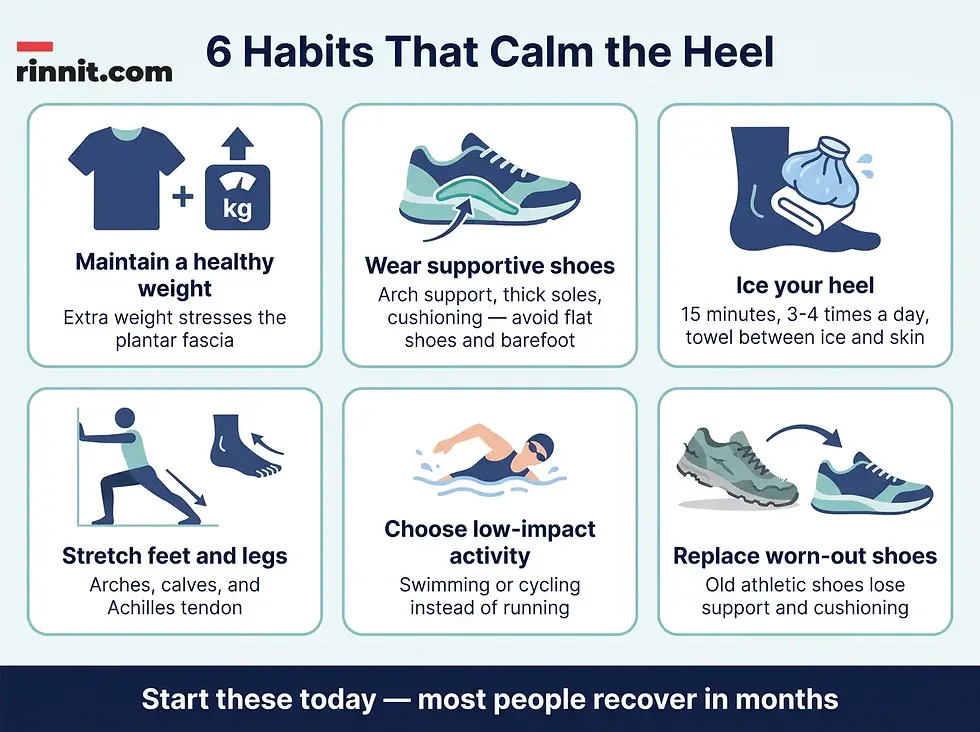
Which six home care habits help calm plantar fasciitis heel pain?
Plantar fasciitis pain can often be eased with self-care steps, especially icing the heel and stretching the arches, calves and Achilles. [2]
Home Remedy | How to Do It |
Maintain a healthy weight | Extra weight puts more stress on your feet, especially the plantar fascia [2] |
Wear supportive shoes | Choose good arch support, thick soles, and plenty of cushioning; avoid flat shoes and walking barefoot [2] |
Replace worn-out shoes | Old or worn athletic shoes lose support and cushioning; replace them regularly [2] |
Choose low-impact activities | Try swimming, cycling, or other low-impact exercises instead of running or high-impact sports [2] |
Use ice | Apply ice to your heel for 15 minutes, three or four times a day; put a thin towel between your skin and the ice; rolling a frozen water bottle under your foot gives an ice massage [2] |
Stretch feet and legs | Simple stretches for your arches, calves, and Achilles tendon relieve pain and improve flexibility [2] |
The ice and stretching rows deserve emphasis. Icing your heel 15 minutes three or four times a day is one of the most direct ways to calm inflammation. And stretching the arches, calves, and Achilles targets the tissue chain that puts tension on the fascia in the first place.
How should you prepare for a plantar fasciitis appointment?
Your healthcare professional may refer you to a foot specialist, called a podiatrist, or a sports medicine specialist. A little preparation makes the visit more productive. [2]
What You Can Do
If you wear inserts in your shoes, bring them with you. Before your appointment, it can help to make a list of your symptoms and when they began, your medical history (including family history and activities that might have caused your symptoms), and all medicines, vitamins, or supplements you take with doses. [2]
Write down your questions too. Helpful ones include: What is likely causing my symptoms? What tests do I need? Is my condition likely temporary or long term? What treatment do you recommend? Are there other options? Are there activities I should avoid? [2]
What to Expect From Your Doctor
Expect questions about your pain patterns and your daily load: When does your pain usually occur? What types of shoes do you wear most often? Do you run or play sports involving running or jumping? Does your job require standing or walking for long periods? Have you had foot problems in the past? Do you have pain anywhere else in your body? What helps relieve your symptoms, and what makes the pain worse? [2]
Conclusion: The Morning Pain Usually Wins
Plantar fasciitis announces itself in a very specific way: sharp heel pain with your first steps in the morning, easing as you move, returning after long standing. The cause is mechanical: repeated tension and tiny tears in the tissue that supports your arch. And the treatment is mostly mechanical too: ice, stretch, rest, and shoes that share the load.
Most people recover within a few months with simple, non-surgical care. Surgery is rarely needed. [2] The fastest way through this is starting early, before the pain becomes chronic or your walk changes to compensate.
If you have been waking up to heel pain for more than a couple of weeks, that is your cue to act. Start the home-care steps today, and book an evaluation if the pain persists.
Related Reading
Frequently Asked Questions
What is plantar fasciitis?
Plantar fasciitis is inflammation of the plantar fascia, the thick band of tissue along the bottom of your foot that connects your heel bone to your toes. It supports the arch and absorbs shock while walking, and it becomes irritated and painful when overloaded with repeated tension. [1]
What does plantar fasciitis feel like?
Plantar fasciitis typically causes a sharp, stabbing pain in the bottom of the foot near the heel. The pain is usually worst with the first few steps in the morning, gets better as you move around, and can return after long periods of standing or when you get up from sitting. [1]
What causes plantar fasciitis?
Too much tension or stress on the plantar fascia causes tiny tears in the tissue. Repeated stretching and tearing then lead to irritation or inflammation. Contributing factors include foot shape, activity level, footwear, and body weight. [1]
Who is most at risk of plantar fasciitis?
Plantar fasciitis is most common between ages 40 and 60. Risk rises with running, ballet, high-intensity workouts, and jumping sports; flat feet, high arches, or unusual walking patterns; worn-out or wrong-activity shoes; being overweight; and jobs involving long hours standing or prolonged sitting. [1]
How is plantar fasciitis diagnosed?
A healthcare professional typically diagnoses it through a medical history review and a physical exam that checks for tender spots on the foot. Most people do not need tests, though an X-ray or MRI may be ordered to rule out problems such as a stress fracture. [2]
Do heel bone spurs cause plantar fasciitis pain?
No. An X-ray sometimes shows a bone spur sticking out from the heel bone, but those bone spurs do not cause pain, so removing them typically is not necessary. [2]
How long does it take to recover from plantar fasciitis?
Most people recover within a few months using simple treatments that do not involve surgery: icing the heel, stretching, and avoiding activities that cause pain. [2]
What home treatments work for plantar fasciitis?
Ice your heel for 15 minutes three or four times a day with a thin towel between skin and ice, stretch your arches, calves, and Achilles tendon, wear supportive shoes with arch support, avoid flat shoes and barefoot walking, replace worn-out athletic shoes, and choose low-impact activities like swimming or cycling. [2]
When is surgery needed for plantar fasciitis?
Surgery is rarely needed. It may be considered only when pain is serious and other treatments have not helped after several months. The procedure releases the plantar fascia from the heel bone through a small incision with local anesthesia. [2]
Should I get steroid injections for plantar fasciitis?
A steroid injection can temporarily reduce pain and inflammation, but repeated injections are not advised because they can weaken the plantar fascia and thin the cushioning in your heel. [2] Your healthcare professional will weigh the trade-offs with you.
References
Mayo Clinic Staff. Plantar fasciitis: Symptoms and causes. Mayo Clinic. Updated August 7, 2026. https://www.mayoclinic.org/diseases-conditions/plantar-fasciitis/symptoms-causes/syc-20354846
Mayo Clinic Staff. Plantar fasciitis: Diagnosis and treatment. Mayo Clinic. Updated August 7, 2026. https://www.mayoclinic.org/diseases-conditions/plantar-fasciitis/diagnosis-treatment/drc-20354851
Li Z, He S, Wu J, et al. Efficacy of physical therapy interventions delivered with home exercise programs for pain and function in plantar fasciitis: a systematic review and network meta-analysis of randomized controlled trials. Phys Ther. 2026;106(6):pzag056. PMID: 42176209. https://doi.org/10.1093/ptj/pzag056
Qafesha RM, Ishreiteh HA, Nassourah AL, et al. Efficacy and safety of dextrose prolotherapy versus corticosteroid injections in plantar fasciitis: a systematic review and meta-analysis. J Foot Ankle Res. 2026;19(1):e70135. PMID: 41703400. https://doi.org/10.1002/jfa2.70135
Saghir MA, Bashandy AS, Kholeif AM. Endoscopic plantar fasciotomy versus open plantar fasciotomy for treatment of plantar fasciitis: a systematic review and meta-analysis. J Orthop Surg Res. 2026;21(1):449. PMID: 42204579. https://doi.org/10.1186/s13018-026-06975-1
Medical disclaimer
This article is for informational purposes only and is not a substitute for professional medical advice, diagnosis, or treatment. Always seek the advice of your physician or other qualified health provider with any questions you may have about a medical condition.



Comments