Pharyngoplasty: Surgical Correction for Speech and Airway Function

Updated: 2 days ago
Medically reviewed by Dr. Baraa Alnahhal, MD · Last reviewed: October 2026
Pharyngoplasty is a surgical procedure designed to modify the soft palate and throat tissue to improve speech clarity or expand the airway. It is primarily used to treat velopharyngeal insufficiency (VPI) and obstructive sleep apnea. Recovery typically involves a week of rest and a temporary soft food diet, with high success rates for both speech improvement and airway expansion.
Quick Answer
Pharyngoplasty is a surgery that reshapes the soft palate and pharynx. For velopharyngeal insufficiency, it narrows the throat opening so less air escapes through the nose during speech, reducing hypernasality. For sleep apnea, it expands the airway to improve breathing. It is done under general anesthesia, usually with a short hospital stay and possibly speech therapy afterward. sleep apnea [1]
What the research says
Pharyngeal flap and sphincter pharyngoplasty fix VPI about equally well. A meta-analysis of 10 studies and 531 cleft palate patients found no significant difference between the two operations in VPI resolution, hypernasality, complications, or reoperation, but sleep apnea was significantly higher after pharyngeal flap (Shah et al., J Craniofac Surg, 2026).
Pharyngeal flap carries more than double the sleep apnea risk of other speech operations. A meta-analysis of 4 studies and 751 patients found a pooled risk ratio of 2.45 (95% CI 1.20 to 5.01) for postoperative obstructive sleep apnea after pharyngeal flap, with no difference between pharyngeal flap and dynamic sphincter pharyngoplasty (Best et al., J Oral Maxillofac Surg, 2026).
For sleep apnea, a newer barbed pharyngoplasty cut events by about two-thirds. A meta-analysis of 20 articles and 762 participants found a mean success rate of 85.2% as a single-level surgery and a 69% drop in the apnea-hypopnea index (about 24 fewer events per hour), with dysphagia (20%) and suture extrusion (18%) the most common complications over a median follow-up of 6 months (Saenwandee et al., Am J Otolaryngol, 2022).
Research summaries are based on article abstracts retrieved from PubMed.
Pharyngoplasty is most commonly performed to address velopharyngeal insufficiency (VPI), a condition where the soft palate does not close properly against the back of the throat during speech. This results in hypernasality, making speech difficult to understand. While frequently associated with cleft palate repair, the procedure also effectively treats adults with obstructive sleep apnea by expanding the upper airway. [1] For other causes of unclear speech, see our guide to speech impairment.
Common Indications for Pharyngoplasty
The decision to undergo pharyngoplasty is typically based on the underlying cause of airway or speech dysfunction. The following table outlines the primary conditions that may necessitate this surgical intervention.
Category | Specific Conditions |
Congenital | Cleft palate, Down syndrome, DiGeorge syndrome |
Neurological | Cerebral palsy, Stroke, Brain tumors |
Post-Surgical | Following adenoidectomy or tonsillectomy |
Respiratory | Obstructive sleep apnea (adults) |
Other | Radiation therapy to the pharynx |

What are the types of pharyngoplasty procedures?
Pharyngoplasty includes several procedures, such as pharyngeal flap, sphincter pharyngoplasty and lateral pharyngoplasty, each tailored to the patient's needs. The choice of procedure depends on whether the goal is to improve speech or to treat sleep apnea.
Pharyngeal Flap
This is a common procedure for treating VPI. A flap of tissue is taken from the back of the throat and attached to the soft palate. This creates a bridge that closes the gap while leaving small side ports to allow for normal nasal breathing. [1]
Sphincter Pharyngoplasty
In this version, flaps of tissue are taken from behind the tonsils and sutured across the back of the throat. This narrows the space behind the palate, effectively preventing air leakage during speech. It typically leaves a single central port for nasal airflow. [1]
Lateral Pharyngoplasty
Unlike the procedures for VPI, lateral pharyngoplasty is designed to treat sleep apnea. It involves removing and repositioning tissue in the palate and the sides of the throat to expand the airway and improve nighttime breathing. [1] Other surgical options for sleep apnea include upper airway stimulation implants.
Procedure Type | Primary Goal | Mechanism |
Pharyngeal Flap | Treat VPI | Attaches throat tissue to the soft palate |
Sphincter Pharyngoplasty | Treat VPI | Narrows the throat opening using tonsillar tissue |
Lateral Pharyngoplasty | Treat Sleep Apnea | Expands the lateral pharyngeal walls |
What is pharyngoplasty surgery and recovery like?
Pharyngoplasty is performed under general anesthesia and typically lasts up to two hours. Most patients remain in the hospital for one to three nights for monitoring. Post-operative side effects often include nasal congestion, a sore throat, and minor bloody discharge, all of which generally resolve within a few days. [1] If the tonsils are involved, you may also want to read about tonsillitis.
Post-Operative Care Requirements
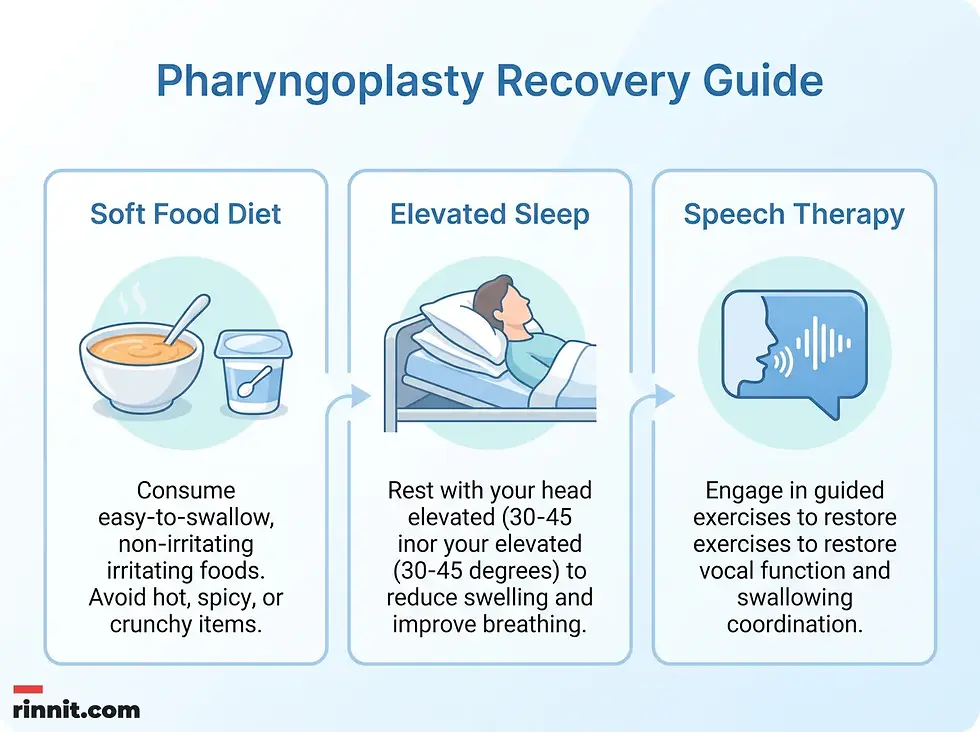
Recovery requires a commitment to specific care instructions to ensure optimal healing and functional outcomes.
Dietary Restrictions: Patients must follow a liquid or soft food diet for one to three weeks.
Activity Level: Strenuous physical activity and heavy lifting should be avoided for several weeks.
Sleep Position: Keeping the head elevated while sleeping helps reduce swelling.
Speech Therapy: Many patients, particularly children, require speech therapy to adapt to the anatomical changes. [1]

What are the long-term outlook and success rates for pharyngoplasty?
The success of pharyngoplasty is generally high, though it varies by procedure type. Pharyngeal flap surgery and sphincter pharyngoplasty resolve VPI at similar rates in pooled studies, although pharyngeal flap is linked to more sleep apnea afterward. Lateral pharyngoplasty typically achieves a 50% reduction in sleep apnea symptoms. [1]
In some cases, a minor follow-up procedure may be necessary to adjust the size of the ports if VPI persists or if new symptoms like snoring or sleep apnea develop. A sleep study is often recommended six months post-surgery to monitor these potential issues. [1] Children who already have breathing problems at night should be assessed carefully; see our guide to pediatric sleep apnea.
Conclusion
Pharyngoplasty is a highly effective surgical solution for individuals struggling with hypernasality or obstructive sleep apnea. By reshaping the tissues of the soft palate and throat, surgeons can significantly improve speech clarity and respiratory function. If you or your child are experiencing symptoms of VPI or sleep apnea, consult with a specialist to determine if pharyngoplasty is the right path forward.
Related Reading
Frequently Asked Questions
What is the primary purpose of pharyngoplasty?
The primary purpose is to change the shape and function of the soft palate and throat to improve speech clarity or expand the airway for better breathing.
Who is a candidate for this surgery?
Candidates include children and adults with velopharyngeal insufficiency (VPI), hypernasality, or obstructive sleep apnea that has not responded to other treatments.
How long does the procedure take?
A pharyngoplasty procedure typically takes up to two hours and is performed under general anesthesia.
Is a hospital stay required?
Yes, most patients stay in the hospital for one to three nights following the surgery for observation and pain management.
What are the common side effects after surgery?
Common side effects include a sore throat, neck pain, nasal congestion, and minor bloody discharge from the nose or mouth.
How long is the recovery period?
Most patients need at least one week off from school or work, with full recovery and dietary restrictions lasting up to three weeks.
Will I need speech therapy after the operation?
Many patients, especially those treated for VPI, require speech therapy to learn how to use their newly reshaped palate effectively.
What is the success rate for speech improvement?
Pharyngeal flap surgery and sphincter pharyngoplasty resolve VPI at similar rates in pooled studies; the best choice depends on the child's anatomy and sleep apnea risk.
Can pharyngoplasty treat sleep apnea?
Yes, lateral pharyngoplasty is specifically designed to expand the airway and reduce sleep apnea symptoms in adults.
Are there risks of developing new symptoms?
Some patients may develop snoring or sleep apnea after surgery for VPI, which may require a follow-up sleep study or minor adjustment.
References
Cleveland Clinic. Pharyngoplasty. Cleveland Clinic Health Library. Last updated June 6, 2023. https://my.clevelandclinic.org/health/treatments/21041-pharyngoplasty
Shah P, Patil D, Pande R, Ovadia S. Pharyngeal flap and sphincter pharyngoplasty for velopharyngeal insufficiency in cleft patients: a systematic review and meta-analysis. J Craniofac Surg. 2026;37(7-8):1879-1884. PMID: 41562452. DOI: 10.1097/SCS.0000000000012460
Best DL, Yau V, Farsio F, Markiewicz MR. Do pharyngeal flaps have a greater risk of obstructive sleep apnea than other speech procedures? A systematic review and meta-analysis. J Oral Maxillofac Surg. 2026;84(4):492-500. PMID: 41478302. DOI: 10.1016/j.joms.2025.12.007
Saenwandee P, Neruntarat C, Saengthong P, et al. Barbed pharyngoplasty for obstructive sleep apnea: a meta-analysis. Am J Otolaryngol. 2022;43(2):103306. PMID: 34906825. DOI: 10.1016/j.amjoto.2021.103306
Medical disclaimer
This article is for informational purposes only and is not a substitute for professional medical advice, diagnosis, or treatment. Always seek the advice of your physician or other qualified health provider with any questions you may have about a medical condition.



Comments