Peritubular Capillaries: Function, Location, Kidney Health and Tests

Updated: 3 days ago
Medically reviewed by Dr. Baraa Alnahhal, MD · Last reviewed: October 2026
Quick Answer: What are peritubular capillaries?
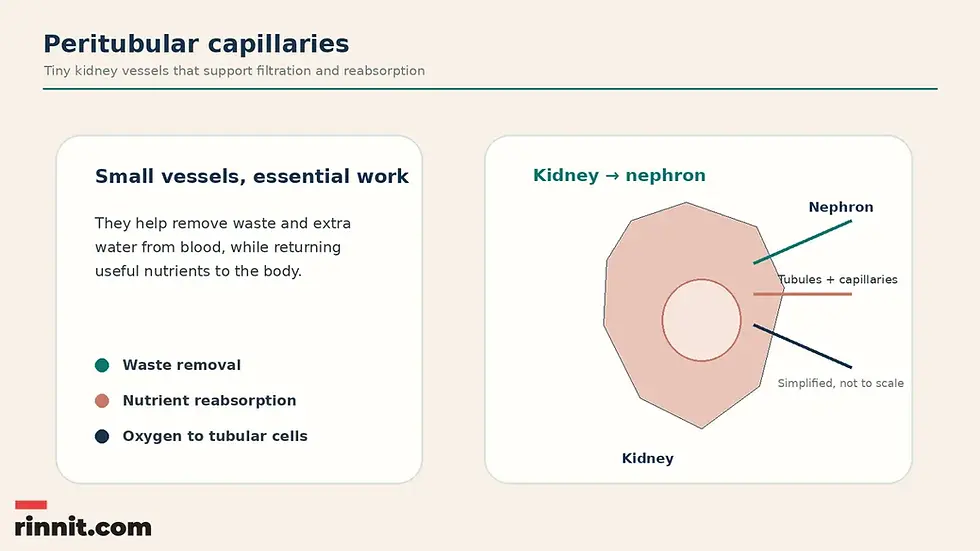
Peritubular capillaries are microscopic blood vessels around the kidney tubules inside the nephrons. They help the urinary system remove wastes and extra water from the blood, reabsorb nutrients the body needs and supply blood and oxygen to the cells of the kidney's tubular system. Damage to them can contribute to chronic kidney disease and high blood pressure. [1]
What the research says
Loss of peritubular capillaries is a common feature of chronic kidney disease. A review of the evidence describes peritubular capillary rarefaction as commonly detected in kidney diseases such as hypertensive nephrosclerosis and diabetic nephropathy. It correlates with impaired kidney function and predicts the later development of end-stage kidney disease. The author argues it is a central driver of CKD progression, though the underlying mechanisms are not yet fully understood (Kida, Int J Mol Sci, 2020). [2]
Injury to kidney tubules can damage the capillaries around them. A review in the Journal of the American Society of Nephrology explains that after acute kidney injury, tubules that fail to recover send signals that disturb the relationship between capillary endothelium and pericyte-like cells. This leads to fibrosis, capillary disintegration and rarefaction, and the resulting local low-oxygen conditions may prevent tubules from recovering (Venkatachalam et al., J Am Soc Nephrol, 2015). [3]
Chronic kidney disease is common worldwide. A meta-analysis of 100 studies including 6,908,440 people estimated a global CKD prevalence of 13.4% (95% CI 11.7–15.1%) across all five stages and 10.6% (95% CI 9.2–12.2%) for stages 3–5. These are population figures, not an individual risk estimate (Hill et al., PLoS One, 2016). [4]
What does “peritubular” mean?
“Peritubular” means around small tubes, or tubules. In the kidney, the term describes capillaries located around the tubes that make up part of a nephron. [1]
Where are peritubular capillaries located?
Each kidney contains about 1 million nephrons. A nephron is a single kidney filtering unit that includes a glomerulus, which filters blood, and a system of tubes. The tubes reabsorb nutrients and water filtered by the glomerulus. [1]
Peritubular capillaries are located around those tubular structures. Because each kidney has about 1 million nephrons, the body has millions of these capillaries inside its kidney filtering units. [1]
How do peritubular capillaries work?
Peritubular capillaries perform two closely related jobs: they help remove waste products and excess water, and they reabsorb useful substances that the body needs. [1]
Waste removal
The urinary system handles waste products including urea, creatinine and acids. Urea forms when the body breaks down proteins, and creatinine is a waste product from muscles. These wastes and extra water move through the kidney’s filtering units, into the urinary bladder and out of the body in urine. [1]
Nutrient reabsorption
The capillaries also reabsorb amino acids, minerals and glucose. Reabsorption means that useful substances filtered out earlier can move back into the body’s circulation rather than being lost in urine. [1]
Support for tubular cells
Peritubular capillaries supply blood and oxygen to cells in the kidney’s tubular system. [1]
Process | What happens |
Filtration pathway | Blood is filtered through the nephron’s glomerulus. |
Waste handling | Urea, creatinine, acids and excess water move toward urine. |
Reabsorption | Amino acids, minerals and glucose return to the body. |
Tubular support | Blood and oxygen reach cells in the kidney’s tubular system. |
What substances are secreted from peritubular capillaries?
Peritubular capillaries pass some waste products from the blood into the tubules, a process called secretion, and take most of the filtered water back into the blood. They also reabsorb helpful nutrients and supply blood and oxygen to tubular cells. [1]
This balance allows the kidney’s filtering units to separate substances the body needs from waste products that eventually leave in urine.
What do peritubular capillaries look like?
Peritubular capillaries are so small that they cannot be seen with the naked eye. A microscope is needed to see them. [1]
They are fenestrated blood vessels, meaning they have tiny openings, or pores. Thin membranes at the pores open and close. The pores make it easier for fluids and substances such as minerals and waste products to move between the capillaries and the surrounding tissues. [1]

Feature | Description |
Visibility | Microscopic; not visible to the naked eye. |
Vessel type | Fenestrated, with tiny pores. |
Exchange | Fluids, minerals and waste products move between capillaries and nearby tissues. |
Purpose of pores | Make movement between blood and surrounding tissues easier. |
How does blood travel through the kidney to these capillaries?
Blood enters each kidney through a renal artery. The renal artery branches into smaller blood vessels called afferent arterioles, which lead to the nephrons. [1]
Inside each nephron, the glomerulus filters blood. After filtration, blood passes through efferent arterioles and enters the peritubular capillaries. [1]
When blood leaves the peritubular capillaries, it travels through veins that gradually become larger until the blood exits the kidney through the renal vein. [1]
Step | Vessel or structure |
1 | Renal artery brings blood into the kidney. |
2 | Afferent arterioles carry blood toward the nephron. |
3 | Glomerulus filters the blood. |
4 | Efferent arterioles carry blood into peritubular capillaries. |
5 | Veins carry blood away and enlarge toward the renal vein. |
What conditions can affect peritubular capillaries?
Inflammation and scarring from health conditions can damage peritubular capillaries. Damage may reduce the density of these vessels, a condition called peritubular capillary rarefaction. [1]
Damaged peritubular capillaries do not repair themselves very well. When they cannot work as they should, rarefaction can contribute to chronic kidney disease and high blood pressure. Without treatment, kidney disease may lead to kidney failure. [1]
Kidney disease may result from or occur alongside glomerular diseases such as glomerulonephritis, kidney infection or an obstruction in the ureter. [1]
Concern | Connection |
Inflammation or scarring | Can damage peritubular capillaries. |
Rarefaction | Loss of peritubular capillary density. |
Chronic kidney disease | Rarefaction can contribute to CKD. |
High blood pressure | Rarefaction can contribute to hypertension. |
Kidney failure | Kidney disease may lead to kidney failure without treatment. |
In the United States, nearly half of adults have high blood pressure and about 15% have some type of chronic kidney disease. These figures are context, not an individual risk estimate. [1]
What symptoms may occur?
A person may have no symptoms even when there is a problem involving the peritubular capillaries. When symptoms occur, they may include flank pain, fever, nausea and vomiting, fatigue and changes in urination. [1]
Urinary changes can include frequent urination, trouble peeing, blood in the urine, pain when peeing or cloudy urine. Swelling, especially in the feet or ankles, and urinary tract infections that repeatedly return are also listed. [1]
These symptoms can have many causes and do not identify a diagnosis on their own. A healthcare professional can decide what evaluation is appropriate.
Symptom or sign | Plain-language description |
Flank pain | Pain in the side of the body near the kidneys. |
Fever | May occur with a kidney or urinary-system problem. |
Nausea and vomiting | Possible symptoms. |
Fatigue | Feeling very tired. |
Urinary changes | Frequent urination, trouble peeing, blood, pain or cloudy urine. |
Swelling | Edema, especially in the feet or ankles. |
Recurrent UTIs | Urinary tract infections that go away and come back. |
What tests check kidney function?
When a healthcare professional suspects a problem involving the kidney’s filtering system, they may recommend kidney-function tests. These include urinalysis and blood tests such as blood urea nitrogen (BUN), creatinine clearance and estimated glomerular filtration rate (eGFR). [1]
Imaging tests may include a CT scan, MRI or kidney, also called renal, ultrasound. These tests can help evaluate the kidneys and urinary system, but interpretation depends on the individual result and clinical context. [1]

Test category | Examples |
Urine testing | Urinalysis. |
Blood testing | BUN, creatinine clearance and eGFR. |
Imaging | CT, MRI and renal ultrasound. |
How can you support kidney and peritubular-capillary health?
Peritubular-capillary damage cannot always be prevented. Focusing on overall health can lower the risk of kidney problems and other conditions.
This includes eating healthy foods every day and drinking water when thirsty, managing diabetes and high blood pressure along with other chronic conditions, maintaining a healthy weight for you, and quitting smoking. Smoking and other tobacco products damage blood vessels and cause vascular disease, also called vasculopathy. [1]
These are general health measures, not a substitute for individualized advice. A healthcare professional can help adapt prevention and monitoring to a person’s medical history.
General care topic | Guidance |
Nutrition and hydration | Eat healthy foods daily and drink when thirsty. |
Chronic conditions | Manage diabetes, high blood pressure and other long-lasting conditions. |
Weight | Maintain a healthy weight for you. |
Tobacco | Quitting smoking can reduce exposure to tobacco-related blood-vessel damage. |
When should you contact a healthcare professional?
Contact a healthcare professional about flank pain, fever, nausea or vomiting, significant fatigue, new urinary changes, cloudy or bloody urine, painful urination, swelling or recurrent urinary tract infections. This is especially important because kidney-related problems may sometimes cause no symptoms.
Prompt medical assessment is appropriate for severe or rapidly worsening symptoms, or when you are worried about a serious kidney or urinary-system problem. Do not use an online explanation or a single test result to diagnose yourself.
Conclusion
Peritubular capillaries are microscopic blood vessels around the kidney tubules. They help remove waste and excess water, reabsorb amino acids, minerals and glucose, and provide blood and oxygen to the tubular system.
They are part of a larger nephron pathway that begins with filtration in the glomerulus and continues through efferent arterioles, peritubular capillaries and veins leading toward the renal vein. Damage or loss of capillary density can contribute to chronic kidney disease and high blood pressure.
Symptoms can be absent or may include flank pain, fever, urinary changes, fatigue, swelling and recurrent urinary tract infections. A healthcare professional can decide whether urine, blood or imaging tests are appropriate. Use this guide to prepare questions for a clinician.
Frequently Asked Questions
What are peritubular capillaries?
Peritubular capillaries are tiny blood vessels around the tubules of kidney nephrons. They help remove wastes and reabsorb useful nutrients.
What does “peritubular” mean?
The term “peritubular” means around small tubes, or tubules.
What do peritubular capillaries remove?
Peritubular capillaries help remove urea, creatinine, acids and excess water. These substances move through the kidney’s filtering units and leave the body in urine.
What do peritubular capillaries reabsorb?
Peritubular capillaries reabsorb amino acids, minerals and glucose, substances the body needs.
How many peritubular capillaries are in the kidneys?
Each kidney contains about 1 million nephrons, and the kidneys contain millions of peritubular capillaries inside their filtering units.
Can you see peritubular capillaries without a microscope?
No. They are too small to see with the naked eye and require a microscope.
What are fenestrated blood vessels?
Fenestrated blood vessels are blood vessels with tiny openings, or pores, that allow fluids and substances to move between the vessels and surrounding tissues.
How does blood reach peritubular capillaries?
Blood enters through a renal artery, passes through afferent arterioles and the glomerulus, then travels through efferent arterioles into the peritubular capillaries.
What happens after blood leaves these capillaries?
The blood flows through veins that become progressively larger until it exits the kidney through the renal vein.
What is peritubular capillary rarefaction?
Peritubular capillary rarefaction is a loss in the density of peritubular capillaries. Inflammation and scarring can contribute to this damage.
Can peritubular-capillary problems cause symptoms?
Sometimes there may be no symptoms. Possible signs include flank pain, fever, nausea and vomiting, fatigue, urinary changes, cloudy or bloody urine, swelling and recurrent urinary tract infections.
What conditions may be connected with kidney disease in this context?
Glomerular diseases such as glomerulonephritis, kidney infection and ureteral obstruction can be connected with kidney disease.
What tests may check kidney function?
Testing may include urinalysis, BUN, creatinine clearance, eGFR, CT, MRI and renal ultrasound.
Can peritubular-capillary damage be prevented?
Peritubular-capillary damage cannot always be prevented, but general health measures include healthy eating, drinking water when thirsty, managing chronic conditions, maintaining a healthy weight and quitting smoking.
When should I seek medical advice?
Contact a healthcare professional for flank pain, fever, urinary changes, blood or pain in the urine, swelling, recurrent urinary tract infections or other concerning symptoms. Prompt assessment is appropriate for severe or rapidly worsening symptoms.
Related Reading
Acute Tubular Necrosis: The Most Common Cause of Acute Kidney Injury — How It Develops, How It Is Diagnosed, and How Kidneys Recover explains damage to kidney tubules that can cause sudden kidney injury.
Bowman’s Capsule: The Kidney’s Vital Filtration Gateway describes the structure where kidney filtration begins.
eGFR (Estimated Glomerular Filtration Rate): Normal Values, CKD Stages and What Results Mean explains the blood test that estimates how well the kidneys filter.
Chronic Kidney Disease: What It Is, Its 5 Stages, Causes, and How It's Treated covers the stages, causes and treatment of long-term kidney damage.
References
Cleveland Clinic. Peritubular Capillaries: Location, Anatomy & Function. Cleveland Clinic. Updated October 22, 2024. https://my.clevelandclinic.org/health/body/21914-peritubular-capillaries
Kida Y. Peritubular Capillary Rarefaction: An Underappreciated Regulator of CKD Progression. Int J Mol Sci. 2020;21(21):8255. PMID 33158122. https://doi.org/10.3390/ijms21218255
Venkatachalam MA, Weinberg JM, Kriz W, et al. Failed Tubule Recovery, AKI-CKD Transition, and Kidney Disease Progression. J Am Soc Nephrol. 2015;26(8):1765-1776. PMID 25810494. https://doi.org/10.1681/ASN.2015010006
Hill NR, Fatoba ST, Oke JL, et al. Global Prevalence of Chronic Kidney Disease - A Systematic Review and Meta-Analysis. PLoS One. 2016;11(7):e0158765. PMID 27383068. https://doi.org/10.1371/journal.pone.0158765
Disclaimer
This article is for general educational purposes and is not a substitute for professional medical advice, diagnosis or treatment. Always seek the advice of a qualified healthcare professional with any questions about a medical condition or treatment.



Comments