Bowman’s Capsule: The Kidney’s Vital Filtration Gateway

Updated: 3 days ago
Medically reviewed by Dr. Baraa Alnahhal, MD · Last reviewed: October 2026
Quick Answer: What is Bowman’s capsule?
Bowman’s capsule is a pouch-like sac in the kidney's nephron that surrounds the glomerulus to filter blood. [1] It lets small molecules enter the urinary space while keeping large proteins and blood cells in circulation. [1] Located in the renal cortex, it protects podocytes. [1] Managing blood pressure and blood sugar helps protect it, as damage can lead to inflammation or kidney failure. [1]
What the research says
Chronic kidney disease is common worldwide, so protecting the kidney's filters matters. A systematic review and meta-analysis of 100 studies covering 6,908,440 people estimated a global CKD prevalence of 13.4% (95% CI 11.7% to 15.1%) across all five stages, and 10.6% (95% CI 9.2% to 12.2%) for stages 3 to 5, with stage 3 being the most common (PubMed: Hill et al., PLoS One, 2016) [2].
A low-salt diet was linked to fewer kidney events in people with CKD, but not to clear changes in protein leakage. In a meta-analysis of 33 studies (101,077 participants), a low-salt diet produced a 28% reduction in renal composite outcome events (relative risk 0.72; 95% CI 0.58 to 0.89). No significant effects were found for proteinuria, the rate of eGFR decline, all-cause mortality or cardiovascular events, and the authors called for more definitive studies (PubMed: Shi et al., BMJ Open, 2022) [3].
Glomeruli are lost gradually with age, while remaining nephrons enlarge to compensate. Reviewing a series of 319 autopsy kidneys and a Mayo Clinic analysis of 1,388 kidney donors, researchers found that hypertension up to middle age could not be explained by too few glomeruli, but that glomeruli are lost with later aging alongside adaptive nephron enlargement that can keep filtration near normal (PubMed: Hughson et al., Anat Rec, 2020) [4].
What role does Bowman's capsule play in kidney filtration?
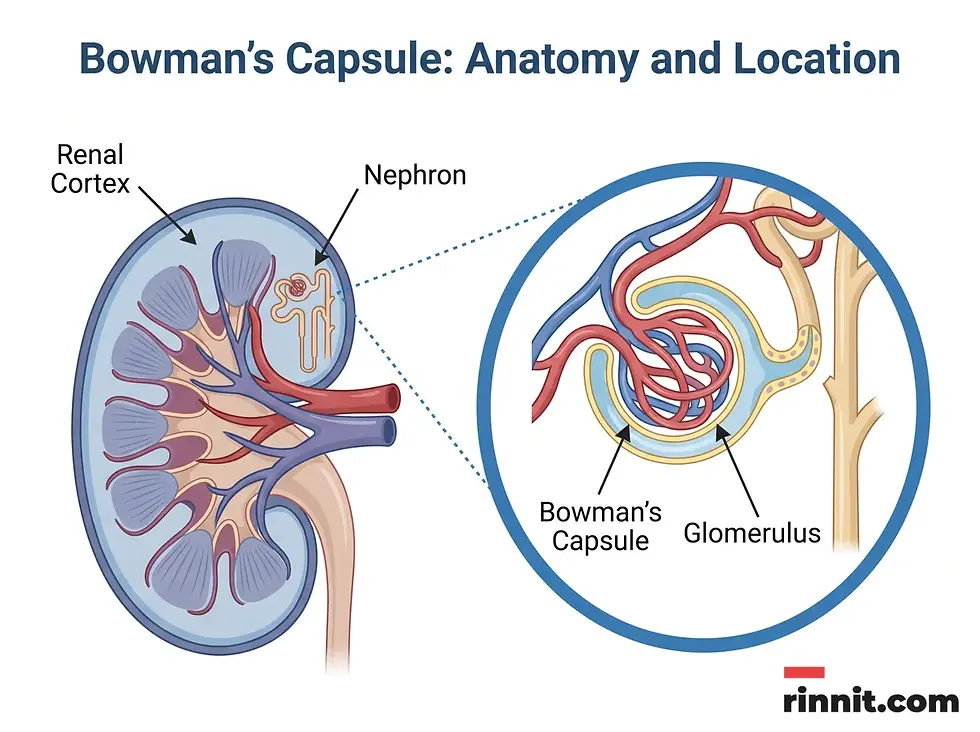
Bowman’s capsule is a fundamental part of the nephron, the functional filtering unit of the kidney. Each human kidney contains approximately one million nephrons, which collectively work to clean the blood and regulate the body's internal environment. [1] The capsule acts as a specialized pouch that encases a group of tiny blood vessels known as the glomerulus. [1] Together, Bowman’s capsule and the glomerulus form the renal corpuscle, the primary site for blood filtration. [1]
The primary function of the capsule is to assist the glomerulus in the selective filtration process. It allows small molecules, such as water, glucose, and metabolic waste, to pass freely into the filtration space, also known as Bowman’s space. [1] Conversely, it acts as a barrier to larger components, ensuring that essential blood cells and large proteins remain within the bloodstream. [1]
Feature | Description and Function |
Location | Situated in the renal cortex, the outer layer of the kidney. |
Structure | A two-walled pouch (sac) resembling a cup, visible only under a microscope. |
Renal corpuscle | The combined unit of Bowman’s capsule and the glomerulus. |
Filtration goal | Selective removal of waste while retaining nutrients and blood cells. |
What is the anatomy and cellular structure of Bowman's capsule?

Microscopically, Bowman’s capsule is composed of two distinct layers that facilitate its filtration role. The outer layer, known as the parietal layer, consists of simple squamous epithelium that provides structural integrity to the capsule. [1] The inner layer, or visceral layer, is composed of highly specialized cells called podocytes. [1]
These podocytes possess finger-like projections called pedicels that interdigitate to form narrow filtration slits. [1] This intricate arrangement ensures that only specific molecules can pass through into the urinary space. The capsule also serves a protective role by preventing white blood cells from entering and potentially damaging the delicate podocytes. [1]
What conditions affect Bowman's capsule, and how are they detected?
Because Bowman’s capsule is inextricably linked to the glomerulus, it is highly susceptible to glomerular diseases. These conditions can cause the filtration units to become inflamed, scarred, or hardened, significantly impairing kidney function. [1] If left untreated, damage to the capsule and surrounding vessels can progress to chronic kidney failure. [1]
Symptoms of potential kidney or capsule dysfunction include changes in urination frequency, extreme fatigue, high blood pressure, and swelling in the ankles or hands. [1] Clinical diagnosis often involves blood tests to measure filtration efficiency, urinalysis to check for protein leakage, and imaging tests like ultrasound to examine kidney structure. [1]
Diagnostic Test | Purpose in Assessing Kidney Health |
Blood tests | Measure how effectively the glomeruli are filtering the blood. |
Urinalysis | Detect abnormal substances like protein or blood in the pee. |
Imaging (ultrasound) | Evaluate the physical size and shape of the kidneys. |
Kidney biopsy | Microscopic examination of a small tissue sample for damage. |
How can you keep Bowman's capsule and kidney filters healthy?

Preserving the health of Bowman’s capsules involves proactive lifestyle choices aimed at supporting overall kidney function. Since these units are sensitive to systemic pressure and metabolic changes, managing chronic conditions like diabetes and hypertension is critical. [1]
Recommended health tips include maintaining a healthy weight, increasing physical activity, and avoiding tobacco products. [1] Dietary adjustments, such as reducing salt intake and limiting the use of nonsteroidal anti-inflammatory drugs (NSAIDs), also play a vital role in protecting these delicate filters from unnecessary strain. [1] [3]
Conclusion
Bowman’s capsule is a microscopic yet mighty component of the human filtration system, serving as the essential gateway for blood purification. By surrounding and supporting the glomerulus, it ensures that the body retains what it needs while efficiently discarding what it does not. Understanding its structure and function underscores the importance of kidney health and the need for regular clinical monitoring to prevent long-term renal complications.
If you are experiencing symptoms like persistent swelling, fatigue, or changes in urination, consult a healthcare professional to evaluate your kidney function and ensure your filtration units are working correctly.
Frequently Asked Questions
1. What is another name for Bowman’s capsule?
Bowman’s capsule is also known as the glomerular capsule, Malpighian capsule, or renal corpuscular capsule.
2. Where exactly is Bowman’s capsule located?
Bowman’s capsule is located in the renal cortex of the kidney, which is found in the back below the rib cage.
3. What does Bowman’s capsule filter?
Bowman’s capsule helps filter small molecules like water and nutrients into the kidney tubules while keeping blood cells and proteins in the blood.
4. What are the two layers of the capsule?
The outer layer is the parietal layer (epithelium), and the inner layer is the visceral layer (podocytes).
5. What is the renal corpuscle?
The renal corpuscle is the combination of Bowman’s capsule and the glomerulus.
6. Can you see Bowman’s capsule without a microscope?
No, it is a microscopic structure that can only be seen using a microscope.
7. What happens if Bowman’s capsule is damaged?
Damage can lead to glomerular diseases, inflammation, and potentially kidney failure if not treated.
8. What are the signs of kidney filtration issues?
Signs include fatigue, high blood pressure, muscle cramps, nausea, and swelling in the ankles or hands.
9. How can I keep my kidneys healthy?
Manage blood pressure and sugar, reduce salt, stay active, and avoid tobacco and excessive NSAID use.
10. What is Bowman’s space?
Bowman’s space is the filtration space between the two walls of the capsule where the filtered fluid collects.
Related Reading
The Kidney: Anatomy, Function, and Vital Health Roles explains how the kidneys filter blood and balance fluids.
eGFR (Estimated Glomerular Filtration Rate): Normal Values, CKD Stages and What Results Mean describes the blood test that estimates how well kidneys filter.
Glomerulonephritis: Why Your Kidney Filters Inflame, the 6 Warning Signs, and How Treatment Protects Your Kidneys covers inflammation of the kidney filters and its warning signs.
Urinalysis: What It Tests, How to Prepare, Normal Values and What Results Mean explains the urine test that can spot kidney filter problems.
References
Cleveland Clinic. Bowman’s Capsule: Anatomy, Function & Conditions. Cleveland Clinic. Nov. 5, 2025. https://my.clevelandclinic.org/health/body/22964-bowmans-capsule
Hill NR, Fatoba ST, Oke JL, et al. Global prevalence of chronic kidney disease: a systematic review and meta-analysis. PLoS One. 2016;11(7):e0158765. PMID 27383068. https://doi.org/10.1371/journal.pone.0158765
Shi H, Su X, Li C, et al. Effect of a low-salt diet on chronic kidney disease outcomes: a systematic review and meta-analysis. BMJ Open. 2022;12(1):e050843. PMID 35017237. https://doi.org/10.1136/bmjopen-2021-050843
Hughson MD, Hoy WE, Bertram JF. Progressive nephron loss in aging kidneys: clinical-structural associations investigated by two anatomical methods. Anat Rec (Hoboken). 2020;303(10):2526-2536. PMID 31599090. https://doi.org/10.1002/ar.24249
Medical Disclaimer
This article is for informational purposes only and does not constitute medical advice. Always seek the advice of your physician or other qualified health provider with any questions you may have regarding a medical condition. Never disregard professional medical advice or delay in seeking it because of something you have read here.



Comments