Pectineus Muscle: Location, Function, Strain Symptoms and Care

Updated: 2 days ago
Medically reviewed by *Dr. Baraa Alnahhal, MD* · Last reviewed: October 2026
Quick Answer
The pectineus is a small, flat muscle at the front of the thigh near the pelvis. It works with other hip flexors to move and rotate the hip. Its two main actions are hip adduction, moving the hip inward toward the center of the body, and hip flexion, lifting the knee toward the chest. [1]
Core idea | Plain-language meaning |
Location | Front of the thigh, next to the pelvis. |
Number | One pectineus muscle on each side of the pelvis. |
Muscle group | Part of the hip-flexor group. |
Main movements | Hip adduction and hip flexion. |
Most common problem | Muscle strain. |
What the research says
Adductor-strengthening exercises have lowered groin-pain injuries in young athletes. In a cluster-randomized trial of 202 high school soccer players over 16 weeks, the Copenhagen adduction exercise alone reduced groin-pain injury risk (relative risk 0.42, 95% CI 0.19–0.90) and combined with the Nordic hamstring exercise reduced it further (relative risk 0.19, 95% CI 0.07–0.54) compared with usual training (Fujisaki et al., Int J Sports Phys Ther, 2022). [2]
Strength gains depend on how often the exercise is done. In a randomized trial of 30 high-level youth hockey players, adductor squeeze strength rose 34% more than in controls after eight weeks of a higher-volume (twice-weekly) adduction exercise protocol, and about 27% more was still present three weeks after stopping. These studies looked at the adductor and groin muscles as a group, not the pectineus alone (Quintana-Cepedal et al., J Sports Sci, 2024). [3]
Where is the pectineus muscle?
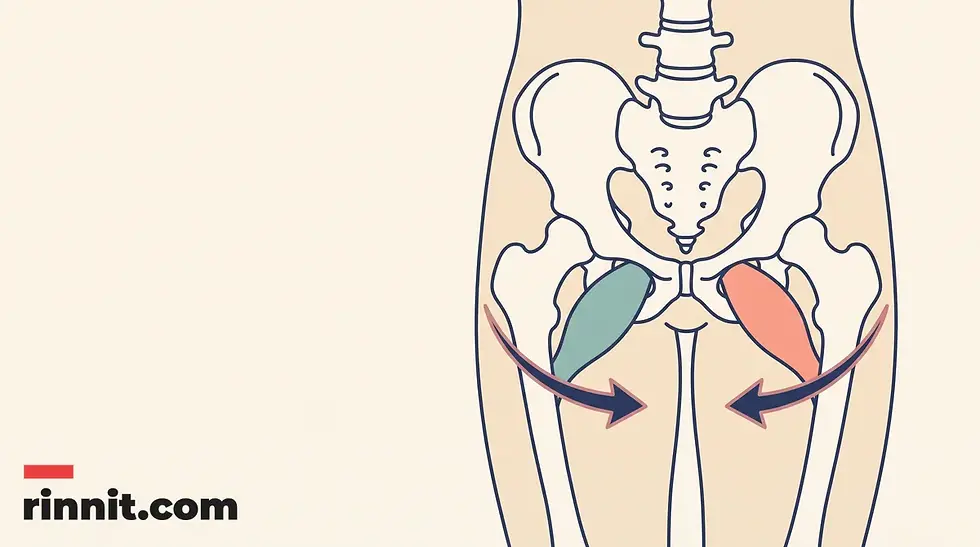
The pectineus is at the front of the thigh, right beside the pelvis. Its upper end connects to the pelvis near the pubic bone. From there, it runs at an angle away from the body’s center toward the top of the femur, wraps behind the femur and connects on the back side. [1]
The pectineus is flat, has four sides and is shaped somewhat like a rectangle with rounded corners. It is smaller than larger thigh muscles such as the hamstrings or quadriceps, but it still contributes to everyday leg movement. [1]
Because it sits at the border of two muscle compartments, healthcare professionals may group it with the medial, or inner, thigh compartment or with the anterior, or front, thigh compartment. This classification is mainly relevant when discussing anatomy or an injury with a healthcare professional. [1]

What does the pectineus muscle do?
The pectineus works with other hip flexors to move and rotate the hips. It supports two main actions. [1]
Hip adduction means moving the hip inward, toward the center of the body. Hip flexion is the movement that helps lift the knee toward the chest. [1]
Other muscles, such as the adductor longus and adductor brevis, can also help with both movements, but the pectineus is one of the main muscles that combines hip adduction and hip flexion.
Movement | What it means |
Hip adduction | Moving the hip inward toward the center of the body. |
Hip flexion | Lifting the knee toward the chest. |
Hip rotation | The pectineus works with other hip flexors to help move and rotate the hips. |
You may use these movements while running, adjusting posture, moving around at a desk or changing leg position during daily activities.
What is a pectineus strain?
A pectineus strain happens when a sudden force stretches the muscle farther than its limit. The tiny fibers that make up the muscle can be stretched apart or torn. Strains are by far the most common problem affecting the pectineus. For a broader overview, see our guide to muscle strains. [1]
Hip-flexor strains are common sports injuries. A sudden kick, twist or jerk of the leg can overstretch the pectineus. Injury is more likely when muscles are tight or when physical activity increases suddenly. [1]
A strain is not something to diagnose from a webpage alone. Hip, thigh and groin pain can have more than one cause, so persistent symptoms should be assessed. Our article on groin strain explains one related cause of groin pain.
What are the symptoms of a pectineus strain?
Pain in the hip, thigh or groin is the most common sign of a strained pectineus. Other symptoms may include stiffness, tenderness, swelling and bruising. [1]
Possible symptom | What to know |
Hip pain | A common sign of a strained pectineus. |
Thigh pain | A common sign of a strained pectineus. |
Groin pain | A common sign of a strained pectineus. |
Stiffness | May occur with a strain. |
Tenderness | May occur with a strain. |
Swelling | May occur with a strain. |
Bruising | May occur with a strain. |
Do not push through pain or other symptoms. Continuing through symptoms can turn a minor strain into a more serious issue.
What can increase the risk of a pectineus injury?
Injuries are more common when the muscles are tight or when someone suddenly does much more physical activity than usual. Sudden movements that kick, twist or jerk the leg can also overstretch the pectineus. [1]
Risk context | Why it matters |
Tight muscles | Injuries are more common when muscles are tight. |
Sudden increase in activity | A rapid change in physical activity can increase injury risk. |
Sudden kick | May overstretch the pectineus. |
Sudden twist | May overstretch the pectineus. |
Sudden jerk | May overstretch the pectineus. |
How can you reduce the risk of a pectineus strain?
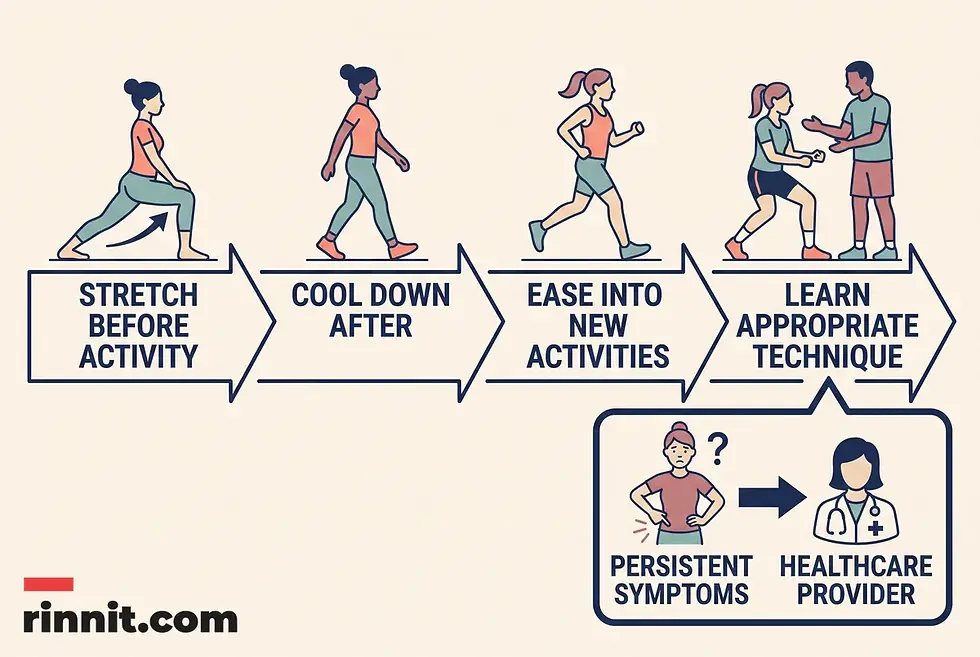
Helpful steps include stretching before physical activity or workouts, cooling down after activity, easing into new sports or activities and learning appropriate techniques. These steps are intended to avoid placing a sudden, excessive force on a muscle. [1]
Stretch before activity. Pre-activity stretching gives the muscles time to “wake up” before a person puts substantial force on them.
Cool down afterward. Stretching after a workout, physical work or sports may help the muscles return toward their resting state.
Increase activity gradually. Ease into new sports or activities rather than suddenly increasing how active you are. Learning appropriate technique for a new workout or sport is also part of the guidance.
When should you see a healthcare professional?
Visit a healthcare professional if hip, thigh or groin pain or other symptoms last more than a few days. Seek care sooner if symptoms make it hard to move or use the hips. [1]
A professional assessment can help determine whether symptoms are related to a pectineus strain or another problem. It is a good idea to have muscle injuries evaluated before they become bigger problems.
Seek urgent medical assessment for severe or rapidly worsening pain, inability to use the leg, significant swelling, numbness, a cold or discolored limb or symptoms that feel life-threatening. Use local emergency guidance when needed.
What does recovery involve?
Recovery depends on the nature of the injury and the person’s symptoms. This article does not provide a rehabilitation schedule, exercise prescription, imaging protocol or medication plan.
Do not start, stop or change treatment based only on this article. A qualified healthcare professional can explain an appropriate plan.
Conclusion: a small muscle with an important role
The pectineus is a small, flat muscle at the front of the thigh near the pelvis. It is part of the hip-flexor group and helps move the hip inward and lift the knee toward the chest.
Strains are the most common pectineus problem. Sudden kicks, twists, jerks, tight muscles and rapid increases in activity can contribute to injury. Hip, thigh or groin pain, stiffness, tenderness, swelling and bruising are symptoms to take seriously—especially when they last more than a few days or interfere with movement.
Use this guide to prepare questions for a qualified healthcare professional. Clear information is a starting point for better care—not a diagnosis.
Frequently Asked Questions
Where is the pectineus muscle located?
The pectineus muscle is at the front of the thigh, next to the pelvis. Its upper end connects near the pubic bone, and it runs toward the top of the femur.
What movements does the pectineus muscle support?
The pectineus muscle supports hip adduction, moving the hip inward toward the body’s center, and hip flexion, lifting the knee toward the chest.
Is the pectineus a hip flexor?
Yes. The pectineus is part of the group of muscles called the hip flexors.
What is the most common pectineus problem?
Strains are by far the most common pectineus muscle issue.
What causes a pectineus strain?
A sudden force can stretch the muscle beyond its limit. Sudden kicking, twisting or jerking can overstretch it.
What does a pectineus strain feel like?
The most common symptom is pain in the hip, thigh or groin. Stiffness, tenderness, swelling and bruising can also occur.
Can tight muscles increase injury risk?
Yes. Injuries are more common when muscles are tight or when physical activity increases suddenly.
How can I reduce my risk of a pectineus injury?
Stretch before activity, cool down afterward, ease into new activities and learn appropriate techniques.
When should I see a healthcare professional for pectineus pain?
Seek care if pain or other symptoms last more than a few days, or if they make it hard to move or use your hips.
Should I push through hip or groin pain?
No. Pushing through pain or other symptoms can turn a minor strain into a more serious issue.
Related Reading
Groin Strain: What It Is, Why It Happens, and How to Heal explains pulled groin muscles and how they heal.
The Obturator Nerve: Anatomy, Function, and Injury Prevention covers a nerve that supplies the inner thigh and groin muscles.
Understanding Sports Hernia: Causes, Symptoms, and Recovery explains a groin injury in athletes that can mimic a muscle strain.
What Is a Muscle Strain? A Plain-Language Guide to Pulled Muscles, How They Happen, and the P.R.I.C.E. Method describes how pulled muscles are graded and treated at home.
References
Cleveland Clinic. Pectineus Muscle: What It Is, Anatomy & Function. Cleveland Clinic. Updated December 29, 2025. https://my.clevelandclinic.org/health/body/pectineus-muscle
Fujisaki K, Akasaka K, Otsudo T, et al. Effects of a Groin Pain Prevention Program in Male High School Soccer Players: A Cluster-Randomized Controlled Trial. Int J Sports Phys Ther. 2022;17(5):841-850. PMID 35949380. https://doi.org/10.26603/001c.36631
Quintana-Cepedal M, de la Calle O, Medina-Sánchez M, et al. The dose-response of the Copenhagen adduction exercise on adductor strength in high-level youth hockey players: A three-arm randomised controlled trial. J Sports Sci. 2024;42(24):2326-2332. PMID 39551738. https://doi.org/10.1080/02640414.2024.2430875
Disclaimer
This article is for general educational purposes and is not a substitute for professional medical advice, diagnosis or treatment. Always seek the advice of a qualified healthcare professional with any questions about a medical condition or treatment.



Comments