What Is a Muscle Strain? A Plain-Language Guide to Pulled Muscles, How They Happen, and the P.R.I.C.E. Method

Updated: 3 days ago
Medically reviewed by Dr. Baraa Alnahhal, MD · Last reviewed: October 2026
Quick Answer
A muscle strain is an injury to a muscle or tendon, ranging from overstretched fibers to partial or complete tears, most often in the lower back and hamstrings. [1] It causes pain, swelling, limited movement and spasms. [1] First aid follows the P.R.I.C.E. method: protect, rest, ice, compress and elevate. [2] See a doctor for worsening pain, numbness or a suspected complete tear.
What the research says
Strength-based prevention programs can cut hamstring injuries by about half in soccer players. A meta-analysis of five studies found that programs including the Nordic hamstring exercise lowered hamstring injury risk by up to 51% (injury rate ratio 0.49, 95% CI 0.29–0.83) compared with teams using no injury prevention. (Al Attar et al., Sports Medicine, 2017 [4])
Hamstring strengthening also lowers other leg injuries. Across 23 randomized trials (15 of them, with 14,721 participants, in the overall lower-limb analysis), hamstring eccentric training programs reduced lower-limb injuries by 28%, hamstring injuries by 46%, and knee injuries by 34%. (Hu et al., International Journal of Environmental Research and Public Health, 2023 [5])
Evidence for stretching and warm-ups alone is still thin. A Cochrane review of seven randomized trials (1,919 participants) found insufficient evidence to draw firm conclusions about preventing hamstring injuries, and a warm-up/cool-down and stretching protocol showed no statistically significant effect on hamstring injuries in the one trial that tested it. (Goldman & Jones, Cochrane Database of Systematic Reviews, 2010 [6])
What Is a Muscle Strain?
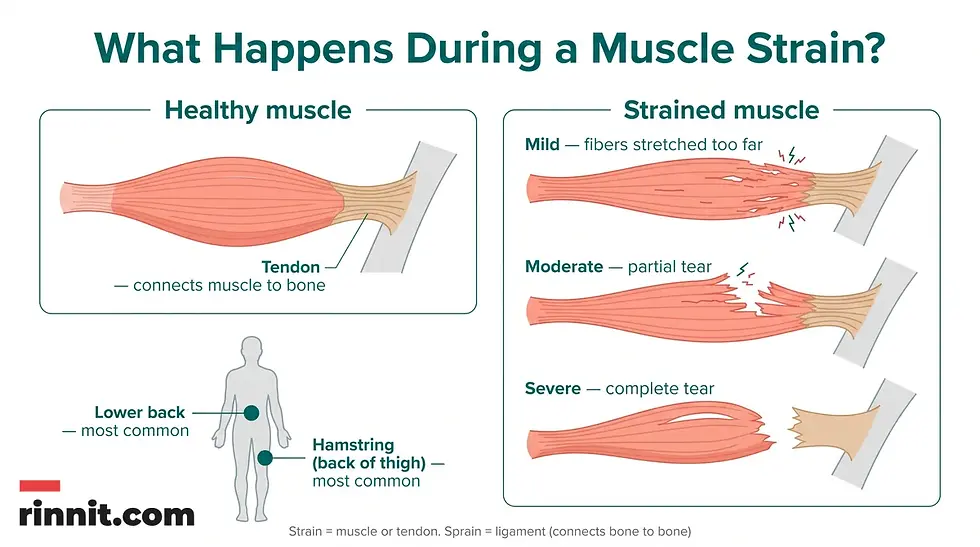
A muscle strain is an injury to a muscle or a tendon. Tendons are fibrous tissues that connect muscles to bones. [1] [3] Strains can range from mild to serious. [1]
A mild strain happens when muscles or tendon fibers are simply stretched too far. With a serious strain, the tissue is partially or completely torn. [1]
Muscle strains often are called pulled muscles. They most commonly affect the lower back and the hamstring muscles at the back of the thigh. [1]
It helps to know the difference between a strain and a sprain, because people often mix the two up. A strain involves an injury to a muscle or tendon, while a sprain injures a ligament — a band of tissue that connects two bones together. [1]
Strain vs. sprain, in one line: strain = muscle or tendon; sprain = ligament.
What Are the Symptoms of a Muscle Strain?
Symptoms of a muscle strain depend on how bad the injury is. They may include:
Pain or tenderness
Changes in skin color over the injury — this may look red, purple or grey depending on the color of your skin
Limited movement
Muscle spasms
Swelling
Muscle weakness [1]
What Causes a Muscle Strain?
Strains come in two basic patterns.
Acute strains happen suddenly, often from a single event. For example, a strain may come from lifting something heavy with poor form or from sprinting while running. [1]
Chronic strains develop over time from repeating the same movement. This puts ongoing stress on a muscle, which can cause a strain. [1]
Who Is at Higher Risk?
You are more likely to get a strain if you play contact sports, such as soccer, hockey, boxing or wrestling. [1] You are also more likely to get a strain if you run fast or use certain body parts repeatedly in sports or activities. [1]
Body Part | Activities That Raise the Risk | Typical Strain |
Legs and ankles | Running sports that require speed, such as sprints; sports with quick starts and jumps, such as basketball or hurdling | Hamstring muscle strains; Achilles tendon strains [1] |
Hands | Sports that require strong gripping, such as gymnastics or golf | Hand strains |
Elbows | Throwing sports, such as baseball; racquet sports, such as pickleball or tennis | Elbow strains [1] |
How Is a Muscle Strain Treated?
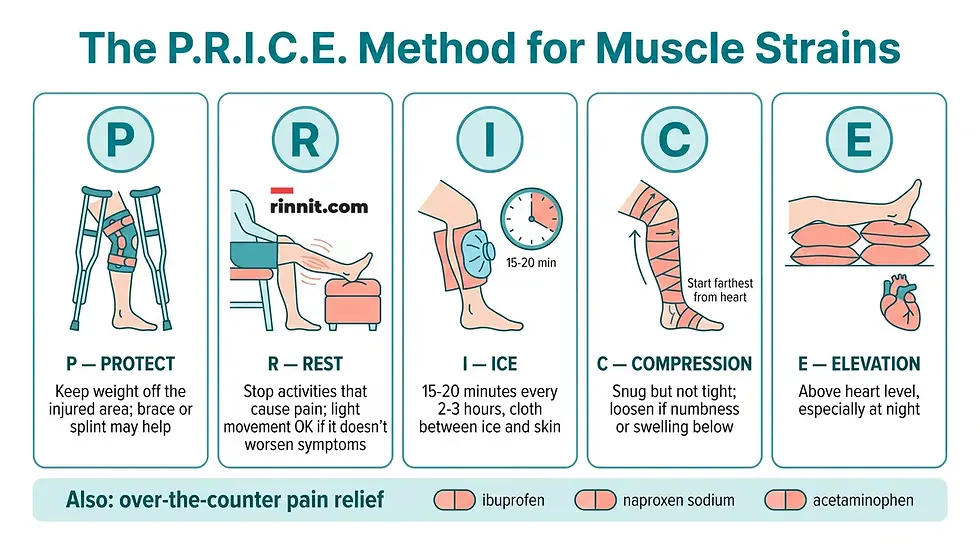
Initial treatment for strains includes protection of the injury, rest, ice, compression and elevation. [2] This is often called the P.R.I.C.E. method. Mild strains typically can be successfully treated at home. Serious strains may need medical treatment, including surgery. [2] [3]
Here is what each letter means in practice:
Step | What It Means | How to Do It |
P — Protect | Protect the injured area | |
R — Rest | Stop activities that cause pain, swelling or discomfort | Light movement is OK if it doesn't make symptoms worse. [2] |
I — Ice | Apply ice right away | |
C — Compression | Wrap the area to reduce swelling | |
E — Elevation | Raise the injured area | Raise it above the level of your heart, especially at night, to help reduce swelling. [2] |
You also can manage pain by taking pain medicines you can buy without a prescription, such as ibuprofen (Advil, Motrin IB, others), naproxen sodium (Aleve) or acetaminophen (Tylenol, others). [2]
How Are Serious Strains Treated?
For rehabilitation and further treatment, a physical therapist can help you rebuild strength and stability. [2] Your healthcare professional may recommend a brace or splint to keep the area still while it heals. [2]
For serious injuries, such as when a tendon completely tears from the bone, surgery may be needed. [2]
How Is a Muscle Strain Diagnosed?
During the physical exam, your healthcare professional will check for swelling and tender spots. [2] The location and intensity of your pain can help your healthcare professional figure out how serious the injury is. [2]
If the muscle or tendon is completely torn, your healthcare professional may be able to see or feel an issue in the injured area. [2] An ultrasound may help show the difference between types of soft tissue injuries. [2]
When Should I See a Doctor?
Mild strains can be treated at home. See a healthcare professional if:
Can Muscle Strains Be Prevented?
Yes. You can lower your risk of muscle strains with three habits:
Stretching regularly. This improves flexibility so your muscles and tendons move more easily. And it increases the range of motion in your joints. [1]
Strengthening exercises. These build muscle support and stability, which protects tendons and joints. [1]
Conditioning for your sport or activity. This means slowly preparing your body for the specific demands of your sport or activity. For example, runners can build up mileage slowly and add core and leg strengthening. Tennis and pickleball players can practice agility drills and shoulder-strengthening exercises. And people with physically demanding jobs can train with lifting, carrying or endurance exercises that mimic their work tasks. [1]

Preparing for Your Appointment
You may first see your primary healthcare professional. Depending on your injury, you may be referred to a sports medicine specialist or a doctor who specializes in bones, joints and muscles, typically an orthopedic surgeon. Or you may be referred to a physical medicine rehabilitation program. [2]
What you can do. Bring a list that includes:
A detailed description of your symptoms, including what they feel like, when they started and what makes them better or worse
Information about past medical issues
Information about health issues of your parents or siblings
All medicines, vitamins and dietary supplements you take
Questions you want to ask [2]
What to expect from your doctor. Your healthcare professional may ask questions such as:
Question Your Doctor May Ask | Why It Matters |
What were you doing when the injury occurred? | Helps identify the mechanism — a single event suggests an acute strain; repetition suggests a chronic one |
Did you hear or feel a pop or snap? | A pop can suggest a more significant tear |
When did the injury happen? | Helps place the injury on a timeline and gauge severity |
What home treatments have you tried? | Shows whether the P.R.I.C.E. method has been started |
Have you ever injured this part of your body before? If so, how? [2] | Prior injuries can change the treatment plan |
The Bottom Line
A muscle strain — the "pulled muscle" most people know — is an injury to a muscle or the tendon that attaches it to bone. Mild strains stretch fibers too far; serious strains tear tissue partially or completely. The lower back and hamstrings take the most hits, and the pattern matters: acute strains strike from a single event like lifting with poor form or sprinting, while chronic strains build up from repeating the same movement. Start with the P.R.I.C.E. method — protect, rest, ice, compress, elevate — plus over-the-counter pain relief, and most mild strains heal at home. But pain that is serious or not improving, numbness or tingling, trouble using the muscle, or a pop at the moment of injury all point to a provider's exam, because a tendon torn completely from the bone may need surgery, and an ultrasound can show what kind of soft-tissue injury you're dealing with.
Take the Next Step
If you felt a pull while lifting, sprinting, or swinging — or the same spot keeps hurting week after week — don't just stretch it off and hope. Begin P.R.I.C.E. right away, even if you plan to see a professional: protect the area, stop activities that cause pain, ice for 15 to 20 minutes every 2 to 3 hours with a cloth over your skin, wrap it snugly starting farthest from your heart, and elevate above heart level at night. Then call your provider if the pain is serious, not improving, or coming with numbness or tingling, and bring your symptom list — what it feels like, when it started, what makes it better or worse — plus your medicine list and your questions. A physical therapist can rebuild your strength and stability once healing begins, and preventing the next strain starts with regular stretching, strengthening, and sport-specific conditioning. Explore more of Rinnit.com's plain-language guides to understand your symptoms, prepare for your appointment, and know exactly what to ask.
Light movement is OK during recovery — as long as it doesn't make symptoms worse. Complete immobilization isn't the goal for most mild strains; protect and rest, then rebuild.
Frequently Asked Questions
What is a muscle strain?
A muscle strain is an injury to a muscle or a tendon — the fibrous tissue that connects muscle to bone. Mild strains stretch fibers too far; serious strains partially or completely tear the tissue.
What is the difference between a strain and a sprain?
A strain injures a muscle or tendon. A sprain injures a ligament — a band of tissue that connects two bones together.
Where do muscle strains most often happen?
Most commonly in the lower back and the hamstring muscles at the back of the thigh.
What does a muscle strain feel like?
Depending on severity, it may cause pain or tenderness, swelling, limited movement, muscle spasms, weakness, and skin color changes over the injury — which may look red, purple or grey depending on your skin color.
What is the P.R.I.C.E. method?
The P.R.I.C.E. method is the standard first treatment: Protect the injured area, Rest from activities that cause pain, Ice for 15–20 minutes every 2–3 hours for the first few days, Compress with a snug (not tight) elastic bandage starting farthest from the heart, and Elevate the injury above your heart, especially at night.
Can I treat a muscle strain at home?
Yes — mild strains typically can be successfully treated at home with the P.R.I.C.E. method plus over-the-counter pain medicine such as ibuprofen, naproxen sodium or acetaminophen.
When should I see a doctor for a strain?
See a healthcare professional if your symptoms get worse, pain is serious or not improving, you have numbness or tingling, or you have trouble using the injured muscle. A complete tear — sometimes with a pop or snap — may need surgery.
How can I prevent muscle strains?
Stretch regularly to improve flexibility, do strengthening exercises to build support and stability, and condition for your sport or activity by preparing your body gradually — like runners building mileage slowly or workers training with exercises that mimic their job tasks.
How long does a pulled muscle take to heal?
Mild strains often feel better within a few weeks with home care. Severe strains or tears can take several months to heal and may need surgery.
Should I use ice or heat on a muscle strain?
Use ice for the first few days to ease pain and swelling. After the swelling goes down, gentle heat may help relax stiff muscles.
Related Reading
If you found this guide helpful, explore these related Rinnit.com articles:
References
Mayo Clinic Staff. Muscle strains - Symptoms and causes. Mayo Clinic. May 30, 2026. https://www.mayoclinic.org/diseases-conditions/muscle-strains/symptoms-causes/syc-20450507
Mayo Clinic Staff. Muscle strains - Diagnosis and treatment. Mayo Clinic. May 30, 2026. https://www.mayoclinic.org/diseases-conditions/muscle-strains/diagnosis-treatment/drc-20450520
Wittstein JR. Sprains, Strains, and Other Soft-Tissue Injuries. OrthoInfo. Accessed October 15, 2026. https://www.orthoinfo.org/diseases--conditions/sprains-strains-and-other-soft-tissue-injuries/
Al Attar WSA, et al. Effect of Injury Prevention Programs that Include the Nordic Hamstring Exercise on Hamstring Injury Rates in Soccer Players: A Systematic Review and Meta-Analysis. Sports Med. 2017;47(5):907-916. PMID 27752982. https://doi.org/10.1007/s40279-016-0638-2
Hu C, et al. Effects of Different Hamstring Eccentric Exercise Programs on Preventing Lower Extremity Injuries: A Systematic Review and Meta-Analysis. Int J Environ Res Public Health. 2023;20(3):2057. PMID 36767424. https://doi.org/10.3390/ijerph20032057
Goldman EF, et al. Interventions for preventing hamstring injuries. Cochrane Database Syst Rev. 2010;2010(1):CD006782. PMID 20091605. https://doi.org/10.1002/14651858.CD006782.pub2
Medical disclaimer
This article is for general informational purposes only and does not constitute medical advice. Always consult a qualified healthcare professional for diagnosis and treatment decisions.



Comments