Understanding Sports Hernia: Causes, Symptoms, and Recovery

Updated: 2 days ago
Medically reviewed by Dr. Baraa Alnahhal, MD · Last reviewed: October 17, 2026
Quick Answer: What is a sports hernia?
A sports hernia is a tear or injury to the muscles and tendons of the lower abdomen or groin, often from repetitive, forceful twisting. Unlike a traditional hernia, there is no visible bulge. [1] The main symptom is chronic groin or lower abdominal pain that worsens with exertion. [1] Treatment begins with rest and physical therapy, and persistent cases may need surgery. [1]
When to get urgent care
A sports hernia is not an emergency. But groin pain can also come from a true hernia that becomes trapped. Seek urgent care for sudden severe groin pain, a bulge that you cannot gently push back in, or groin pain with nausea, vomiting, or fever.

What the research says
Surgery may speed return to sport, but conservative care comes first. A systematic review of 10 studies covering 468 athletes (about 59% soccer players) found that people who had surgery for pubalgia may return to sport earlier than those treated without surgery. The authors still advise trying conservative management before surgery, and noted that studies of conservative care were of higher quality (Serafim et al., Journal of Orthopaedic Surgery and Research, 2022) [2].
Exercise-based therapy is a reasonable first step. A JAMA Surgery review concluded that exercise-based therapy can be an effective first-line treatment for this groin pain syndrome and that surgery is generally reserved for people who do not improve. It also noted that the evidence is of relatively low quality and that experts still disagree about the diagnosis (Zuckerbraun et al., JAMA Surgery, 2020) [3].
Diagnosis relies on exam findings and ruling out the hip. Symptoms can often be reproduced with a resisted sit-up or a forced cough or sneeze, MRI can show tears of the rectus abdominis or adductor tendons, and any underlying hip impingement should be identified because it affects whether an athlete returns to sport successfully (Drager et al., Arthroscopy, 2020) [4].
What Is a Sports Hernia?
A sports hernia, or athletic pubalgia, is a soft tissue injury in the lower abdomen and groin. [1] Despite the name, it is not a true hernia because there is no opening in the abdominal wall through which organs or tissue protrude. [1] Instead, the deep layers of the abdominal wall or the tendons that attach muscles to the pubic bone weaken or tear. [4] [5] Other names include core muscle injury, sportsman's hernia, and Gilmore's groin. [1] [4]
The injury is most common in athletes whose sports involve sudden changes of direction, sprinting, kicking, and twisting, such as soccer, ice hockey, and football. It can also affect people who do not play sports. [1]
What are the symptoms of a sports hernia?
The main symptom is persistent pain in the lower abdomen or groin. It may begin suddenly during a specific movement, then settle into a dull, burning ache that is hard to pinpoint. The pain can spread toward the inner thigh and, in men, the scrotum [1], and it is usually worst with high-intensity movements such as sprinting, jumping, kicking, and twisting. Coughing or sneezing can also bring it on. [1] [4]
How is a sports hernia different from a traditional hernia?
The two conditions can feel similar, but they are different problems. A sports hernia can occasionally weaken the abdominal wall enough that a traditional hernia develops, but the two are considered separate injuries. For more on true hernias and how they are fixed, see our guide to hernia repair surgery and our article on robotic hernia surgery.
Feature | Sports hernia (athletic pubalgia) | Traditional hernia |
|---|---|---|
Nature of injury | Soft tissue tear or weakness (muscle or tendon) | Gap or weak spot in the abdominal wall |
Physical sign | No visible bulge | Often a visible bulge under the skin |
Main cause | Repetitive twisting or forceful motion | Tissue or intestine pushing through the wall |
Who it affects | Mostly athletes in cutting and pivoting sports | Anyone, including people who do not play sports |

What causes a sports hernia and who is at risk?
Sports hernias are usually caused by repetitive, forceful hip and trunk movements. An imbalance between the strength of the hip muscles and the abdominal muscles can contribute, as can poor sports conditioning or unsafe abdominal exercises. [1] Athletes who lack core strength or hip mobility are at higher risk.
Higher-risk sports | Movements involved |
|---|---|
Soccer and football | Forceful kicking and sudden cutting |
Ice hockey | Repetitive pelvic twisting and sprinting |
Wrestling and rugby | Intense abdominal strain and grappling |
Skiing and tennis | Rapid lateral movements and pivoting |
How is a sports hernia diagnosed and treated?
Diagnosing a sports hernia can be difficult because many conditions cause groin pain. [1] Your provider will take a history, examine you (often including painful movements such as a resisted sit-up), and may order an MRI, X-ray, or ultrasound to rule out other causes such as a pelvic stress fracture or hip problems. A related condition that can mimic it is osteitis pubis, and hip impingement can occur alongside it.
Initial management is usually non-surgical:
Rest and ice: most helpful during the first 7 to 10 days after the injury.
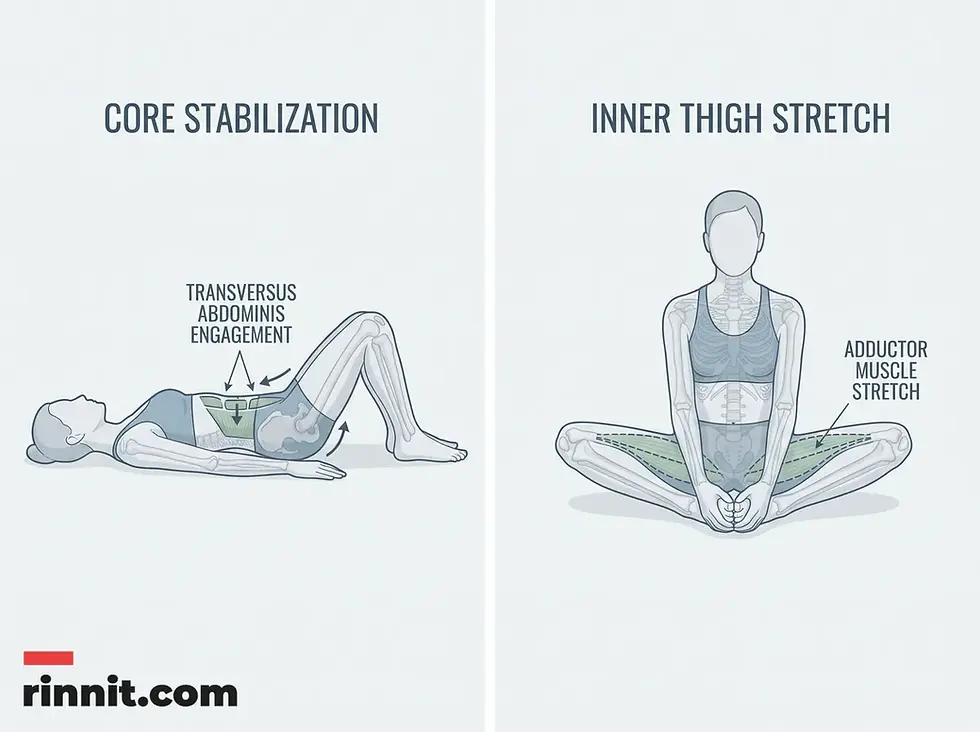
Physical therapy: usually begins within the first couple of weeks to restore flexibility and strengthen the core and hip muscles. See our overview of physical therapy.
Medication: anti-inflammatory drugs can help with swelling and pain [1] if they are safe for you.
Injections: a corticosteroid injection may be considered if medicines are not enough. [1]
If pain continues two to six months after non-surgical treatment, surgical repair is usually considered. [1] Surgery can be done with minimally invasive (laparoscopic) or open techniques [1] [4], depending on the damage.
What is recovery and the outlook after a sports hernia?
Recovery time depends on the treatment. Non-surgical recovery usually involves several weeks of rest followed by a progressive physical therapy program. After surgery, rehabilitation can take several months. A clinical review reports that most athletes who have surgery improve and return to high-level competition (Elattar et al., Sports Health, 2016) [5]. Continuing to play through the pain usually makes it worse, so most athletes need to reduce activity until the tissue heals.
To lower your risk, build core and hip strength, keep your hips mobile, warm up before training, and avoid unsafe abdominal exercises.
Conclusion
A sports hernia is a real injury that can limit performance and cause long-lasting discomfort, even though it is not a true hernia. With early evaluation, a structured recovery plan that starts with rest and targeted physical therapy, and surgery when needed, most people can return to their previous level of activity.
What are the next steps if you think you have a sports hernia?
If you have persistent groin or lower abdominal pain that gets worse with activity, see a healthcare professional for a thorough evaluation. Early diagnosis and a structured rehabilitation plan help prevent further injury and support a safe return to sport.
Trusted resources: Cleveland Clinic: Sports Hernia (Athletic Pubalgia)
Frequently Asked Questions
Is a sports hernia a real hernia?
No. There is no hole in the abdominal wall and no tissue pushing through the muscle. It is a soft tissue injury involving a tear or weakness in muscles or tendons.
What is the medical term for a sports hernia?
Healthcare professionals prefer "athletic pubalgia." Other names include core muscle injury, sportsman's hernia, and Gilmore's groin.
Can women get sports hernias?
Yes. It is reported more often in men, but anyone who does sports involving repetitive twisting and kicking can be affected.
Does a sports hernia cause a visible bulge?
No. The lack of a visible bulge is one of the main ways it differs from a traditional hernia.
How long does it take to recover from a sports hernia?
Non-surgical recovery typically takes several weeks of rest followed by physical therapy. If surgery is needed, rehabilitation can take several months.
What sports are most likely to cause this injury?
Soccer, ice hockey, football, wrestling, and rugby, because they involve frequent pelvic twisting, sprinting, and sudden changes of direction.
Can I keep playing with a sports hernia?
Playing through the pain often makes the injury worse. Most athletes need to reduce their activity until the tissue heals.
Does a sports hernia go away with rest alone?
Rest helps, but it usually needs formal treatment such as physical therapy to correct the muscle weakness or imbalance behind the injury.
How is a sports hernia diagnosed?
Through a history and physical exam, often with painful movements such as a resisted sit-up, plus imaging such as MRI to rule out other conditions and show soft tissue damage.
What is the first step in treatment?
A period of rest and icing, usually 7 to 10 days, followed by a move into physical therapy.
When is surgery necessary?
Surgery is usually considered if pain persists two to six months despite consistent non-surgical treatment.
Can a sports hernia lead to a traditional hernia?
A sports hernia can. A sports hernia may weaken the abdominal wall enough that a traditional hernia develops, but they are considered separate injuries.
What type of surgery is used?
Surgeons may use laparoscopic (minimally invasive) or open techniques to repair the torn or weakened muscles and tendons.
Are there ways to prevent a sports hernia?
Prevention focuses on good conditioning, strengthening the core and hip muscles, keeping the hips mobile, and avoiding unsafe abdominal exercises.
Does the pain from a sports hernia radiate?
Often. It can spread into the inner thigh and, in men, the scrotum.
Related Reading
Groin Strain: What It Is, Why It Happens, and How to Heal explains pulled groin muscles and how they heal.
Osteitis Pubis: Symptoms, Causes, Diagnosis, Treatment, and Recovery — What You Need to Know describes inflammation of the pubic bone joint in athletes.
Hip Labral Tear: Symptoms, Causes, and How It Is Diagnosed and Treated covers a hip cartilage injury that can also cause groin pain.
Inguinal Hernia: Symptoms, Causes, and When Surgery Is Needed explains the true groin hernia and when surgery is needed.
References
Cleveland Clinic. Sports Hernia (Athletic Pubalgia). Cleveland Clinic. September 24, 2021. https://my.clevelandclinic.org/health/diseases/21873-sports-hernia
Serafim TT, Oliveira ES, Migliorini F, et al. Return to sport after conservative versus surgical treatment for pubalgia in athletes: a systematic review. J Orthop Surg Res. 2022;17(1):484. PMID 36369155. https://doi.org/10.1186/s13018-022-03376-y
Zuckerbraun BS, Cyr AR, Mauro CS. Groin pain syndrome known as sports hernia: a review. JAMA Surg. 2020;155(4):340-348. PMID 32022837. https://doi.org/10.1001/jamasurg.2019.5863
Drager J, Rasio J, Newhouse A. Athletic pubalgia (sports hernia): presentation and treatment. Arthroscopy. 2020;36(12):2952-2953. PMID 33276883. https://doi.org/10.1016/j.arthro.2020.09.022
Elattar O, Choi HR, Dills VD, et al. Groin injuries (athletic pubalgia) and return to play. Sports Health. 2016;8(4):313-323. PMID 27302153. https://doi.org/10.1177/1941738116653711
Medical Disclaimer
This article is for informational purposes only and does not constitute medical advice. Always seek the advice of a qualified healthcare professional with any questions you may have regarding a medical condition.



Comments