The Obturator Nerve: Anatomy, Function, and Injury Prevention

Updated: 3 days ago
Medically reviewed by Dr. Baraa Alnahhal, MD · Last reviewed: October 2026
The obturator nerve is a nerve of the peripheral nervous system that starts in the lumbar plexus of the lower back and travels through the pelvis to the inner thigh. [1] It helps move the leg toward the middle of the body, extend the hip and rotate the leg outward, and it carries sensation from the inner thigh and parts of the hip and knee joints. [1] Injuries from accidents, sports, childbirth or pelvic procedures can cause groin pain, numbness and weakness. [1]
Quick Answer: What is the obturator nerve?
The obturator nerve is a peripheral nerve formed from the L2, L3 and L4 nerve roots that runs from the lower back through the pelvis to the inner thigh. [1] It controls the adductor muscles and provides feeling to the skin, hip and knee. [1] Damage can cause groin or thigh pain, numbness and weakness. [1]
What the research says
Blocking the obturator nerve reduces a known surgical hazard. In a meta-analysis of 4 randomized trials and 3 cohort studies (448 patients) of bladder tumor resection, adding an obturator nerve block to spinal anesthesia was associated with a significantly lower risk of obturator reflex (the involuntary leg jerk) and of bladder perforation, with no local anesthetic toxicity among 159 patients assessed (Krishan et al., J Endourol, 2021) [2].
How the block is given matters. A pooled analysis of 5 randomized trials (312 patients) found that the inguinal approach had a higher success rate than the classic approach (risk ratio 1.15, 95% CI 1.04 to 1.27), with fewer puncture attempts (Chou et al., Asian J Anesthesiol, 2022) [3].
What is the anatomy and path of the obturator nerve?
The obturator nerve begins in the lumbar plexus in the lower back, with roots from the L2, L3 and L4 levels, and follows a long path through the pelvis. [1] Its nerve roots come from the L2, L3 and L4 levels of the lumbar spine. From there it follows a long path:
Once it passes through the groin, the nerve splits into three main branches that serve different roles.
Nerve Branch | Location | Key Role |
Anterior branch | Front of the upper thigh | Helps the muscles that adduct the hip (bring it toward the middle of the body). [1] |
Cutaneous branch | Skin of the upper inner thigh | Gives feeling to the skin on the upper part of the inner thigh. [1] |
Posterior branch | Back of the upper thigh | Rotates the hip outward and adducts the thigh. [1] |
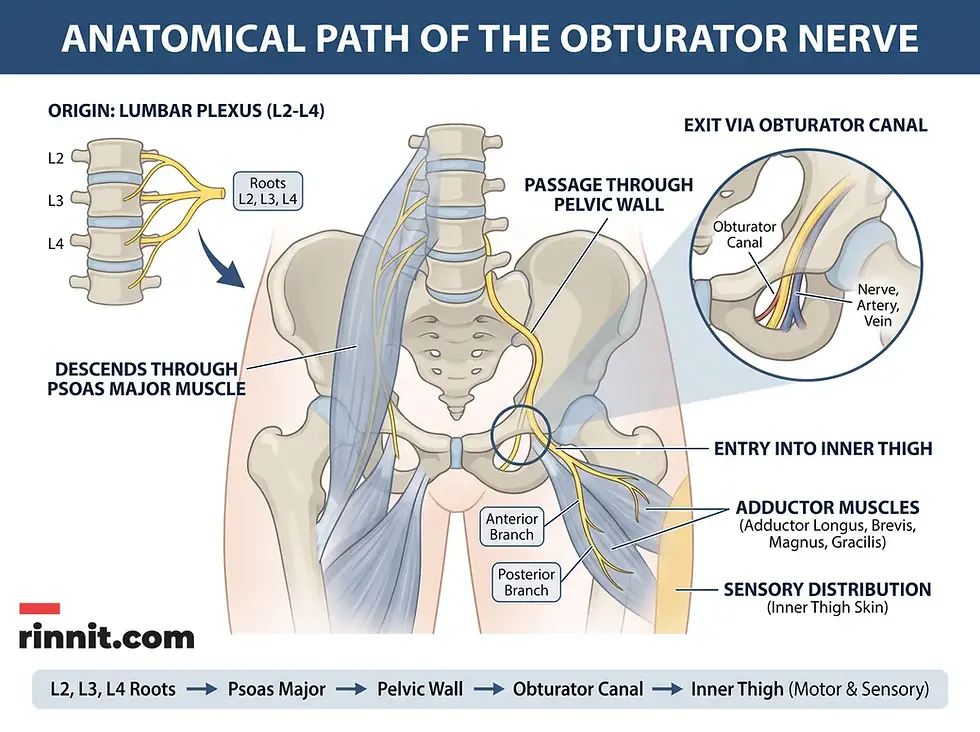
In some people the anterior branch also helps move the pectineus, a muscle in the upper inner thigh that the femoral nerve usually controls. This is a normal variation. [1]
What are the motor and sensory functions of the obturator nerve?
The obturator nerve provides movement (motor function) and feeling (sensory function) to the inner thigh. Muscles along the nerve help you move your leg in toward the middle of your body (adduction), extend your leg at the hip and rotate your leg away from your body. [1]
On the sensory side, the nerve provides feeling to the skin covering the inside of the thigh and to portions of the hip and knee joints. [1]
Muscle | Location in the Thigh |
Adductor longus [1] | Inner thigh |
Adductor brevis [1] | Behind the adductor longus in the inner thigh |
Adductor magnus [1] | Deepest in the inner thigh |
Gracilis [1] | Inside of the inner thigh |
Obturator externus [1] | Upper inner thigh, close to the hip joint |
Pectineus [1] | Upper inner thigh, close to the groin (in some people) |

Which conditions affect the obturator nerve?
Obturator nerve injury can cause groin or thigh pain, numbness or tingling and weakness, with causes including obturator neuropathy, obturator hernia and nerve entrapment. It can cause pain, numbness or tingling in the groin or thigh, and weakness when you bring your thigh toward the middle. [1] Causes include:
Obturator neuropathy: Nerve damage from normal wear and tear over time or from a sudden injury, such as one that stretches the nerve. [1]
Obturator hernia: Abdominal tissue pushes through the obturator canal and presses on the nerve. [1]
Nerve entrapment: Too much pressure on nearby tissues, for example when ligaments swell, which may happen with endometriosis or pregnancy. [1]
Pelvic trauma: This can happen during childbirth or after an injury such as a car crash, when bleeding inside the body puts pressure on the nerve. [1]
Pelvic tumors or cancer: Growths on organs such as the bladder, cervix or rectum. [1]
Sports injuries: Sports with a lot of kicking, such as football, or with long periods of sitting, such as cycling or horseback riding. [1]
Because the pelvis packs many important structures into a small space, the nerve can occasionally be at risk during procedures. In rare cases, pressure or stretching can injure it, and your provider will talk through these risks with you beforehand. [1] Childbirth can also affect the nerve, because moving the legs away from the body during delivery can put extra pressure or stretch on it. [1]
Obturator Nerve Block
A nerve block is an injection of medication that numbs the nerve so you do not feel sensations from it. A provider may use an obturator nerve block to:
When to Contact a Healthcare Provider
Contact a provider if you notice:
Constant aches near the pubic bone. [1]
Discomfort that extends along the thigh. [1]
A feeling of pins and needles in the groin. [1]
Leg cramps or muscle weakness in the thigh. [1]
Muscle pain during activity that stops when you rest. [1]
Numbness in the thigh. [1]
Pain that gets worse with side-to-side leg movements. [1]

What can you do to keep your obturator nerve healthy?
Keeping your obturator nerve healthy means using proper technique in sports, not ignoring persistent groin pain or thigh numbness and following your treatment plan if injured.
Use proper technique. Use correct form in sports such as football or cycling to avoid unnecessary stretching or compression of the nerve.
Listen to your body. Do not ignore persistent groin pain or thigh numbness.
Talk to your provider. If you are planning pelvic surgery or have recently given birth, ask about the health of the nerve.
Follow your treatment plan. If you are diagnosed with a nerve injury, follow the treatments your provider offers.
Conclusion
The obturator nerve is an often overlooked part of the anatomy that makes the movements of the inner thigh possible. Knowing its path and function helps you recognize early signs of a problem and seek timely care. Most people never think about this nerve until something feels off, but problems with it are not uncommon, and a healthcare provider can diagnose what is wrong and offer treatments to help you feel better.
Next step: If you have constant aches near the pubic bone, pins and needles in the groin, or sudden weakness in the thigh that affects how you walk, consult a healthcare provider for an evaluation.
Frequently Asked Questions
What is the obturator nerve?
The obturator nerve is a nerve of the peripheral nervous system that carries signals for movement and feeling in the inner thigh.
Where does the obturator nerve originate?
The obturator nerve starts in the lumbar plexus in the lower back, from the L2, L3 and L4 nerve roots.
What is the main function of the obturator nerve?
The obturator nerve helps you move your leg toward the middle of your body (adduction), extend the leg at the hip and rotate it outward, and it provides feeling to the inner thigh.
What muscles does the obturator nerve control?
The obturator nerve supplies the adductor longus, adductor brevis, adductor magnus, gracilis and obturator externus. In some people it also helps supply the pectineus.
What are the symptoms of an obturator nerve injury?
Symptoms can include pain, numbness or tingling in the groin or thigh, and weakness when bringing the thigh toward the middle of the body.
What is an obturator hernia?
An obturator hernia is a condition in which abdominal tissue pushes through the small opening in the pelvis called the obturator canal and presses on the nerve.
Can childbirth affect the obturator nerve?
Yes. Moving the legs away from the body during delivery can put extra pressure on or stretch the nerve.
What is an obturator nerve block?
An obturator nerve block is an injection of medication that numbs the nerve. It may be used before hip or knee procedures, to prevent involuntary leg jerks during pelvic surgery, to relieve groin or thigh pain that does not respond to standard therapies, or to treat inner thigh spasticity.
How are obturator nerve problems diagnosed?
A healthcare provider can diagnose the cause and recommend treatment. Tell them about your symptoms and about any recent injury, surgery or childbirth.
When should I see a doctor about inner thigh pain?
Contact a provider for constant aches near the pubic bone, pins and needles in the groin, thigh numbness or weakness, or pain that gets worse with side-to-side leg movements.
Related Reading
Understanding the Femoral Nerve: Anatomy, Function, and Clinical Importance explains the neighboring thigh nerve and signs of femoral nerve damage.
Obturator Hernia Comprehensive Guide: Symptoms, Risk Factors, and Surgical Repair covers the rare pelvic hernia that can press on the obturator nerve.
Groin Strain: What It Is, Why It Happens, and How to Heal explains inner thigh muscle strains and how they heal.
Peripheral Nerve Injuries: Symptoms, Causes & Treatment — Why Numbness Needs Early Care covers how nerve injuries happen, how they are found and treated.
References
Cleveland Clinic. Obturator Nerve. Cleveland Clinic. Last updated August 27, 2025. https://my.clevelandclinic.org/health/body/22348-obturator-nerve
Krishan A, Bruce A, Khashaba S, et al. Safety and Efficacy of Transurethral Resection of Bladder Tumor Comparing Spinal Anesthesia with Spinal Anesthesia with an Obturator Nerve Block: A Systematic Review and Meta-analysis. J Endourol. 2021;35(3):249-258. PMID 33218270. https://doi.org/10.1089/end.2020.1054
Chou CT, Yu SW, Lin TC. Systematic Review and Meta-Analysis of Inguinal Versus Classic Obturator Nerve Block. Asian J Anesthesiol. 2022;60(1):1-10. PMID 35483676. https://doi.org/10.6859/aja.202203_60(1).0001
Medical disclaimer
The information provided in this article is for educational purposes only and should not be used as a substitute for professional medical advice, diagnosis, or treatment. Always seek the advice of your physician or other qualified health provider with any questions you may have regarding a medical condition.



Comments