Parotid Gland Tumors: Understanding Rare Salivary Gland Growths

Updated: 2 days ago
Medically reviewed by Dr. Baraa Alnahhal, MD · Last reviewed: September 2026
TL;DR: Parotid gland tumors are rare abnormal growths on the largest salivary glands, located just in front of each ear. While most (80%) are benign (noncancerous), about 20% are malignant (cancerous). The primary symptom is a slow-growing lump near the ear. Treatment typically involves surgery (parotidectomy) to remove the mass, with radiation therapy added for cancerous cases. Early detection is key, as surgery often cures benign tumors and provides the best outlook for malignant ones.
Quick answer: A parotid gland tumor is an abnormal mass that develops on the parotid gland, the largest of the three major salivary glands. These tumors are rare, affecting between 1 and 6 in 100,000 people worldwide. Most are noncancerous, but they can be malignant, representing the most common form of salivary gland cancer. Diagnosis involves physical exams, imaging like CT or MRI scans, and fine-needle aspiration to determine if the growth is cancerous and to identify its specific subtype.
Understanding the Parotid Gland
The parotid glands are located in front of each ear and are responsible for producing saliva. Tumors in this area are categorized based on whether they are cancerous (malignant) or noncancerous (benign). They belong to the wider family of salivary gland tumors, and malignant cases are treated as head and neck cancers.
Benign (noncancerous), about 80% of cases: slow-growing, typically painless, with 11 known subtypes.
Malignant (cancerous), about 20% of cases: more likely to cause pain, numbness, or facial asymmetry, with over 20 subtypes.
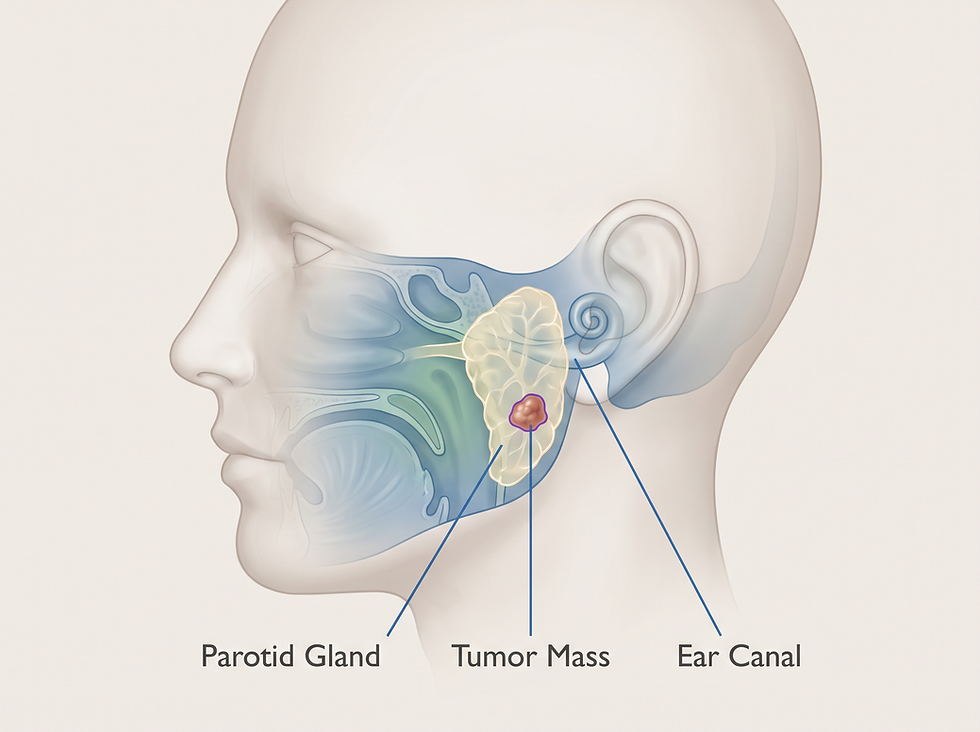
Symptoms and Warning Signs
Most parotid tumors grow very slowly and may be present for months or even years before symptoms appear.
Common Symptoms
Localized lump: a firm, slow-growing mass in front of or just below the ear.
Pain: more common in cancerous tumors than benign ones.
Facial changes: facial numbness or one side of the face appearing larger or smaller.
Trismus: difficulty opening the mouth fully.
Skin changes: a sore or lesion developing over the lump.
Diagnosis and Subtyping
Healthcare providers use a combination of physical exams and advanced testing to evaluate a parotid mass.
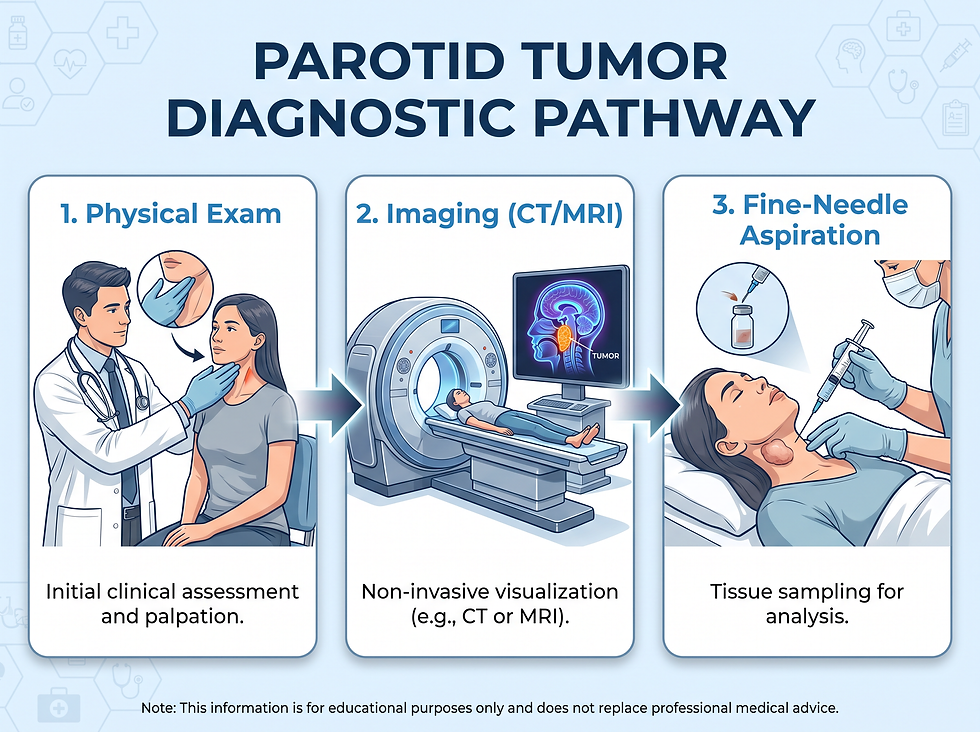
Physical examination: a focused head and neck exam to assess the size and firmness of the lump.
Blood tests: used to rule out infections that might cause glandular swelling (leukocytosis).
Imaging (CT/MRI): provides detailed views of the tumor's size and its relationship to nearby structures like the facial nerve.
Fine needle aspiration (FNA): a biopsy to confirm if the tumor is cancerous and identify the specific subtype (for example, mucoepidermoid carcinoma).
Treatment and Long-Term Management
Surgery is the primary treatment for both benign and malignant parotid tumors.
Surgical Intervention
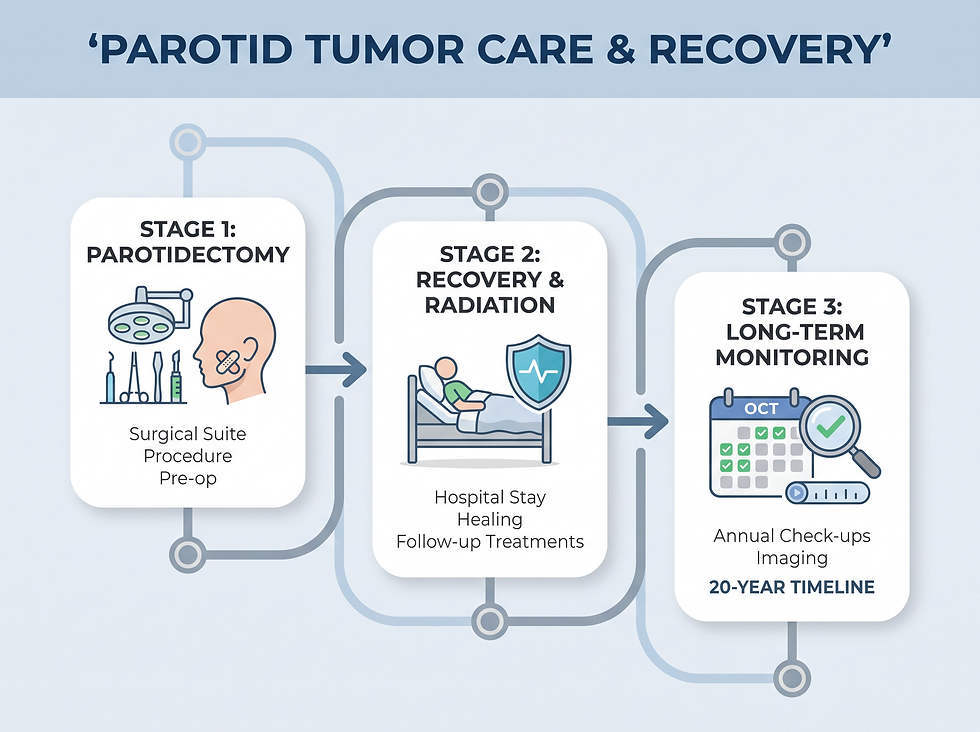
The most common procedure is a parotidectomy, which involves removing part or all of the parotid gland. For benign tumors, surgery is typically curative.
Cancer Management
If the tumor is malignant, providers may follow surgery with radiation therapy to target any remaining cancerous cells. Because these tumors can recur years later, long-term monitoring is essential. A typical follow-up schedule looks like this:
Year 1: every 1 to 3 months.
Year 2: every 2 to 6 months.
Years 3 to 5: every 4 to 8 months.
Year 5 and beyond: every 12 months (for up to 20 years).
Recovery and Outlook
The outlook depends heavily on the tumor's grade and stage at the time of diagnosis.
Benign tumors: surgery usually provides a complete cure with low risk of recurrence.
Malignant tumors: survival rates vary by subtype. For mucoepidermoid carcinoma (MEC), the most common subtype, five-year survival ranges from 86% for low-grade tumors to 22% for high-grade tumors.
Recurrence: cancerous tumors can return decades after initial treatment, making lifelong follow-up appointments critical.
Frequently Asked Questions (FAQ)
Are all parotid tumors cancerous?
No. Approximately 80% of parotid gland tumors are benign (noncancerous).
What is the most common symptom?
The most common sign is a painless lump in front of or just below the ear.
How rare are these tumors?
Cancerous parotid tumors affect about 1 in 100,000 people annually, while benign ones affect an estimated 1 to 6 in 100,000.
Can I prevent a parotid tumor?
There is no guaranteed way to prevent them, but avoiding tobacco use may lower your risk.
What is a parotidectomy?
It is a surgical procedure to remove part or all of the parotid gland to treat a tumor.
Does a parotid tumor cause pain?
While many are painless, cancerous tumors are more likely to cause pain or facial numbness.
What is "trismus"?
Trismus is a condition where you have difficulty opening your mouth, which can be a symptom of a parotid tumor.
How long can a tumor be present before symptoms?
Most grow very slowly and can be present for months, years, or even decades before being noticed.
Why are follow-up appointments so long?
Malignant parotid tumors can recur up to 20 years after treatment, so long-term monitoring is necessary.
What is fine-needle aspiration?
It is a diagnostic test that uses a thin needle to take a small sample of cells from the tumor for analysis.
Can radiation therapy be used alone?
Radiation is typically used as a follow-up to surgery for cancerous tumors rather than as a standalone treatment.
What is the most common type of parotid cancer?
Mucoepidermoid carcinoma (MEC) is the most frequently diagnosed subtype of cancerous parotid tumor.
Does a high white blood cell count mean I have cancer?
Not necessarily. A high count (leukocytosis) often indicates an infection, which can also cause the parotid gland to swell.
What determines the survival rate for parotid cancer?
The outlook depends on the tumor's subtype, its stage (size and spread), and its grade (how aggressive the cells appear).
When should I see a doctor?
You should consult a healthcare provider if you notice any new swelling or a lump near your ear or jawline.
Medical disclaimer: This content is for informational purposes only and does not constitute medical advice. Always seek the advice of your physician or other qualified health provider with any questions you may have regarding a medical condition.
Source date: March 11, 2024.
Comments