Salivary Gland Cancer: Types, Symptoms, and Advanced Treatment Options

Updated: 2 days ago
Medically reviewed by Dr. Baraa Alnahhal, MD · Last reviewed: October 2026
Quick Answer: What is salivary gland cancer?
Salivary gland cancer is a rare malignant tumor that starts in the glands that make saliva in the mouth and throat. The most frequent sign is a painless lump in the jaw, cheek, mouth or neck, though facial weakness or trouble swallowing can occur. Imaging and a biopsy confirm it. Surgery is the main treatment, sometimes with radiation or chemotherapy. [2]
What the research says
Long-term survival is good for most patients. In a 50-year series of 1,637 patients treated for salivary gland carcinoma, overall survival was 93.1% at 5 years, 87.2% at 10 years, and 79.3% at 15 years. Adenoid cystic carcinoma (34.3%) and mucoepidermoid carcinoma (29%) were the most common types, 14.1% of patients developed distant metastases, and survival improved over the past three decades as more patients were diagnosed early and received radiotherapy (Jia et al., J Oral Maxillofac Surg, 2022). [3]
Surgery plus targeted radiation is the standard approach. A review of salivary gland tumors estimated 7,800 new diagnoses in Europe in 2013 and noted more than 20 malignant subtypes in the 2017 WHO classification. Surgery is the mainstay, radiation is added for high-grade and high-risk features, and intensity-modulated radiotherapy (IMRT) is preferred over older conformal techniques (Gatta et al., Crit Rev Oncol Hematol, 2020). [4]
Immunotherapy shows modest activity in advanced disease. In a phase 1b trial of 26 patients with PD-L1-positive advanced salivary gland carcinoma, pembrolizumab produced a confirmed response rate of 12% (95% CI 2 to 30%), all partial responses, with a median response duration of 4 months. Treatment-related side effects occurred in 85% of patients (Cohen et al., Am J Clin Oncol, 2018). [5]
What are the types of salivary gland cancer?
Salivary gland tumors can be benign or malignant, and both can occur in any salivary gland. Most start in the parotid glands. Tumors are rare in the tiny minor salivary glands, but most of those that do form are malignant (Cleveland Clinic, 2022). [2]
Doctors classify cancers by their cell of origin and by grade. Low-grade tumors look like healthy tissue and grow slowly, while high-grade tumors are aggressive and spread faster. Mucoepidermoid carcinoma and adenoid cystic carcinoma are the two most common types, and together they account for about half of malignant salivary gland tumors. [2]
Common Cancer Type | Growth and Characteristics |
|---|---|
Mucoepidermoid carcinoma | The most common type. Growth ranges from slow to fast, so the cells must be studied to determine grade. |
Adenoid cystic carcinoma | Usually slow-growing but prone to spreading and to coming back years after treatment. |
Acinic cell carcinoma | Low to intermediate grade. Tends to grow slowly and is less aggressive. |
Salivary duct carcinoma | High grade. An aggressive, fast-growing type that needs intensive treatment. |
What are the symptoms and warning signs of salivary gland cancer?
Salivary gland cancer most often causes a painless lump on a salivary gland, though a small number of people have no symptoms at all. In most cases salivary gland cancer causes a painless lump on a salivary gland. If the tumor is malignant, other symptoms are more likely: [2]
When to see a doctor: make an appointment if you notice a lump in the mouth, jaw, or neck that does not go away within a few weeks, or if symptoms last more than two weeks. Lumps are not always cancer, but only a provider can tell. [2]
Risk Factors
The exact cause of most salivary gland cancers is unknown. Men are more likely to have malignant tumors, and the risk is higher if you are 55 or older, smoke or drink alcohol frequently, have had radiation to the head or neck, or work in certain jobs such as plumbing, rubber manufacturing, asbestos mining, or leatherwork. There is no proven way to prevent salivary gland cancer, but avoiding tobacco and limiting alcohol lowers your overall cancer risk. [2]
How is salivary gland cancer diagnosed?
Salivary gland cancer is diagnosed with an exam, imaging such as CT, MRI or PET scans, and a biopsy, which is the only way to confirm the tumor is cancer. Tests may include: [2]
CT scan: Shows tumor size and whether cancer has spread, for example to the lungs or bone. [2]
MRI: Especially good at showing spread into soft tissue such as muscles, blood vessels, and nerves. [2]
PET scan: Looks for spread to lymph nodes or elsewhere, often combined with CT. [2]
Biopsy: A fine-needle aspiration or core needle biopsy collects a sample for a pathologist to examine. A biopsy is the only way to confirm that a salivary gland tumor is cancer. [2]
How is salivary gland cancer staged, and what are the survival rates?
Staging describes how far the cancer has spread and guides treatment. Tumors of the parotid, submandibular, and sublingual glands are staged by tumor size and location (T), spread to lymph nodes (N), and spread to distant organs (M), and a different system is used for minor salivary glands. In general, stage I tumors are small and contained, while stage IV cancers have grown into nearby structures or spread to distant organs such as the lungs, bone, or liver. [2]
The American Cancer Society reports survival using SEER stages (localized, regional, distant) rather than numbered stages. These figures are for people diagnosed between 2015 and 2021: [1]
SEER Stage | What It Means and 5-Year Relative Survival |
|---|---|
Localized | Cancer is limited to the salivary gland. 5-year relative survival: 96%. |
Regional | Cancer is very large or has spread to nearby structures or lymph nodes. 5-year relative survival: 70%. |
Distant | Cancer has spread to distant parts of the body, such as the lungs. 5-year relative survival: 42%. |
All stages combined | 5-year relative survival: 78%. |
These numbers cannot predict what will happen to any one person. Tumor type, grade, size, location, nerve involvement, whether surgery can remove the tumor completely, age, sex, and smoking history all affect the outlook (American Cancer Society, 2026). [1]

What are the treatment options for salivary gland cancer?
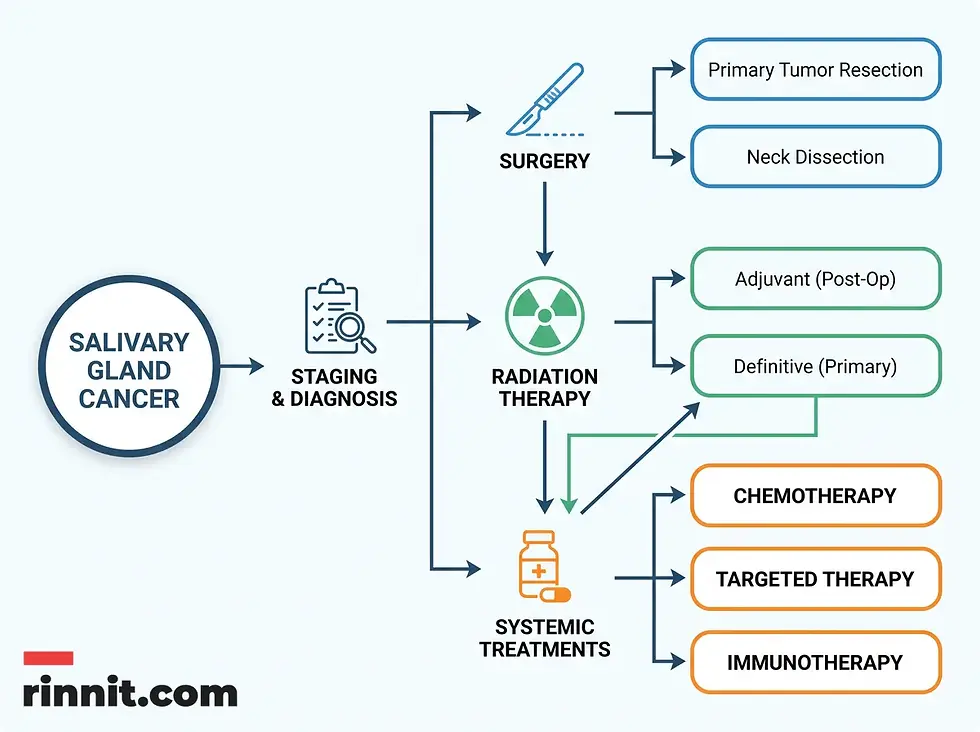
Treatment depends on the tumor’s grade and stage, the gland involved, and your overall health. Many people need a combination of treatments.
Surgery: The primary treatment. The surgeon removes the tumor, sometimes with nearby lymph nodes, and takes care to protect the facial nerve whenever possible. [2] [4]
Radiation therapy: Usually given after surgery to destroy remaining cancer cells and reduce recurrence, and used as the main treatment when surgery is not possible. IMRT is preferred, and particle therapy such as protons or carbon ions may help in advanced or unresectable disease (Gatta et al., 2020). [2] [4]
Chemotherapy: May be used if the cancer has spread beyond the head and neck. [2] [4]
Clinical trials: Immunotherapy (checkpoint inhibitors), targeted therapy based on the tumor’s genetic changes, and radiosensitizers are being studied, especially for metastatic or adenoid cystic carcinoma. [2] [4]
What is the outlook and follow-up for salivary gland cancer?
Most people recover fully if the cancer is diagnosed and treated early. Long-term follow-up is still important: in the 50-year series, survival gradually declined from 93.1% at 5 years to 79.3% at 15 years (Jia et al., J Oral Maxillofac Surg, 2022), and some types, particularly adenoid cystic carcinoma, can come back years after treatment. Ask your care team how often you need checkups and imaging. [2] [3]
Conclusion
Salivary gland cancer is rare and complex, and care needs to be personalized. The outlook is good for many people, especially when the cancer is found while it is still localized. If you notice a persistent lump or unusual weakness in your facial muscles, a prompt evaluation by an ear, nose, and throat (ENT) specialist is the most important next step.
What are the next steps after a salivary gland cancer diagnosis?
If you have found a new lump in your jaw or mouth, or you have unexplained facial numbness or weakness, schedule an appointment with an otolaryngologist soon. Early diagnosis is the biggest factor in a good outcome and in keeping all treatment options open. To learn how salivary gland cancer fits among related cancers, read our complete guide to head and neck cancers.
Trusted resources: American Cancer Society, National Cancer Institute, professional head and neck surgery societies.
Frequently Asked Questions
What is salivary gland cancer?
Salivary gland cancer is a rare cancer that starts in the glands that make saliva (spit) in the mouth and throat. Salivary gland tumors can be benign (noncancerous) or malignant (cancerous), and both can affect any salivary gland. [2]
Where are the salivary glands located?
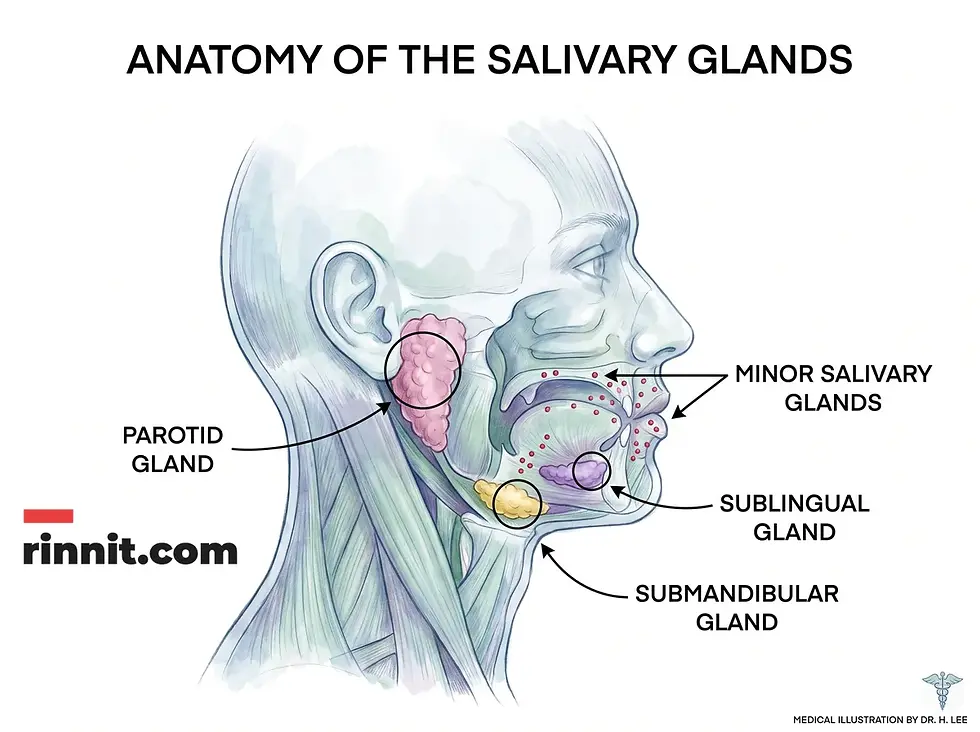
The major glands are the parotid glands (inside each cheek, in front of the ears), the submandibular glands (below the jawbone), and the sublingual glands (along the floor of the mouth). Hundreds of tiny minor salivary glands are also found in the lining of the mouth, lips, cheeks, sinuses, nose, and voice box. [2]
What is the most common symptom?
A painless lump on a salivary gland, in the mouth, jaw, cheek, or neck. [2]
Are all salivary lumps cancerous?
No. A lump may be a cyst or a benign tumor. Only a biopsy can confirm whether a salivary gland tumor is cancer. [2]
Who is most at risk?
Anyone can develop it, but men are more likely to have malignant salivary tumors. Other risk factors include being 55 or older, smoking or frequent alcohol use, past radiation therapy to the head or neck, and certain occupations such as plumbing, rubber manufacturing, asbestos mining, and leatherwork. [2]
What is the difference between low-grade and high-grade tumors?
Grade describes how abnormal the cells look. Low-grade tumors look more like normal cells and tend to grow slowly. High-grade tumors look very abnormal and are more likely to grow and spread quickly. [2]
What is adenoid cystic carcinoma?
Adenoid cystic carcinoma is one of the two most common salivary gland cancers, along with mucoepidermoid carcinoma, which together make up about half of malignant salivary gland tumors. It tends to grow slowly but can spread, so long-term follow-up is important. [2]
How do doctors diagnose salivary gland cancer?
With a physical exam and history, imaging tests such as CT, MRI, or PET, and a biopsy (fine-needle aspiration or core needle) to confirm cancer cells. [2]
What are targeted therapy and immunotherapy?
Targeted therapy uses drugs that attack specific weaknesses in cancer cells’ genetic code, and immunotherapy helps the immune system find cancer cells. Both are mostly used in clinical trials for advanced salivary gland cancer. [2]
What are the 5-year survival rates?
In US data for people diagnosed between 2015 and 2021, the 5-year relative survival rate was 96% for localized disease, 70% for regional disease, 42% for distant spread, and 78% for all stages combined. These numbers cannot predict any one person’s outcome. [1]
Can salivary gland cancer come back?
Yes. Recurrence is possible, and some types can return years after treatment, so regular long-term follow-up with your care team is important. [2]
Can a benign salivary tumor become cancer?
Sometimes. Benign salivary gland tumors may become malignant over time, so have any lump that grows quickly or causes numbness, weakness, or pain checked.
Which specialist should I see?
An otolaryngologist (ear, nose, and throat or ENT doctor) or a head and neck cancer specialist.
References
American Cancer Society. Survival Rates for Salivary Gland Cancer. American Cancer Society. Last revised March 11, 2026. https://www.cancer.org/cancer/types/salivary-gland-cancer/detection-diagnosis-staging/survival-rates.html
Cleveland Clinic. Salivary Gland Cancer. Cleveland Clinic. July 7, 2026. https://my.clevelandclinic.org/health/diseases/17965-salivary-gland-cancer
Jia MQ, Gao M, Ye P, et al. Survival outcome of salivary gland carcinoma: a 50-year retrospective study with long-term follow-up. J Oral Maxillofac Surg. 2022;80(12):2003-2014. PMID 36100114. https://doi.org/10.1016/j.joms.2022.08.007
Gatta G, Guzzo M, Locati LD, et al. Major and minor salivary gland tumours. Crit Rev Oncol Hematol. 2020;152:102959. PMID 32485526. https://doi.org/10.1016/j.critrevonc.2020.102959
Cohen RB, Delord JP, Doi T, et al. Pembrolizumab for the treatment of advanced salivary gland carcinoma: findings of the phase 1b KEYNOTE-028 study. Am J Clin Oncol. 2018;41(11):1083-1088. PMID 29462123. https://doi.org/10.1097/COC.0000000000000429
Medical Disclaimer
This content is for informational purposes only and does not constitute medical advice. Always seek the guidance of a qualified healthcare provider regarding any persistent lumps, facial pain, or swallowing difficulties. Never disregard professional medical advice or delay in seeking it because of something you have read in this article.



Comments