Parotid Gland: Anatomy, Function, Location and Common Problems

Updated: 2 days ago
Medically reviewed by Dr. Baraa Alnahhal, MD · Last reviewed: October 2026
Quick Answer: What is the parotid gland?
The parotid gland is one of the major salivary glands, with one on each side of the face just below and in front of the ears. It makes saliva that supports chewing, digestion and protection from cavities. Swelling can come from duct stones, infection or tumors. Get advice for persistent swelling, a new lump, facial pain or fever. [1]

What the research says
Stones are a leading cause of salivary duct blockage, but the parotid duct is a less common site. A pilot study of eight patients with Stensen’s duct stones notes that lithiasis accounts for more than 60% of salivary gland obstruction but only 20% occurs in Stensen’s duct; in the pilot, all eight patients were treated satisfactorily and one developed duct stenosis needing reintervention (Saga-Gutierrez et al., Eur Arch Otorhinolaryngol, 2021). [2]
Malignant parotid tumors are rare, and some tumors that look neck-negative still have hidden spread. Major salivary gland malignancies make up 1% to 3% of head and neck tumors; in a retrospective study of 119 surgically treated malignant parotid tumors, 19 of 58 patients (32.7%) with a clinically negative neck who had an elective neck dissection had occult metastases (Dell’Aversana Orabona et al., Br J Oral Maxillofac Surg, 2021). Both studies are small or single-center, so they illustrate rather than define typical outcomes. [3]
What does the parotid gland do?
The parotid glands make a specific type of saliva that is thin and watery. They also release amylase, a protein that helps jumpstart starch digestion. [1]
Saliva from the parotid glands keeps the mouth lubricated, helps with digestion, reduces harmful bacteria and helps protect the teeth from cavities. The glands produce about 10% of the saliva in the mouth and approximately 25% when a person is eating. If your mouth often feels dry, see our guide to dry mouth. [1]
Function | Role |
Lubrication | Helps keep the mouth moist and comfortable. |
Chewing | Saliva helps support chewing. |
Digestion | Helps with digestion; amylase helps begin starch digestion. |
Bacteria control | Helps reduce harmful bacteria in the mouth. |
Tooth protection | Helps protect teeth from cavities. |
During eating | Contributes approximately 25% of saliva when eating, compared with about 10% overall. |

Where is the parotid gland located?
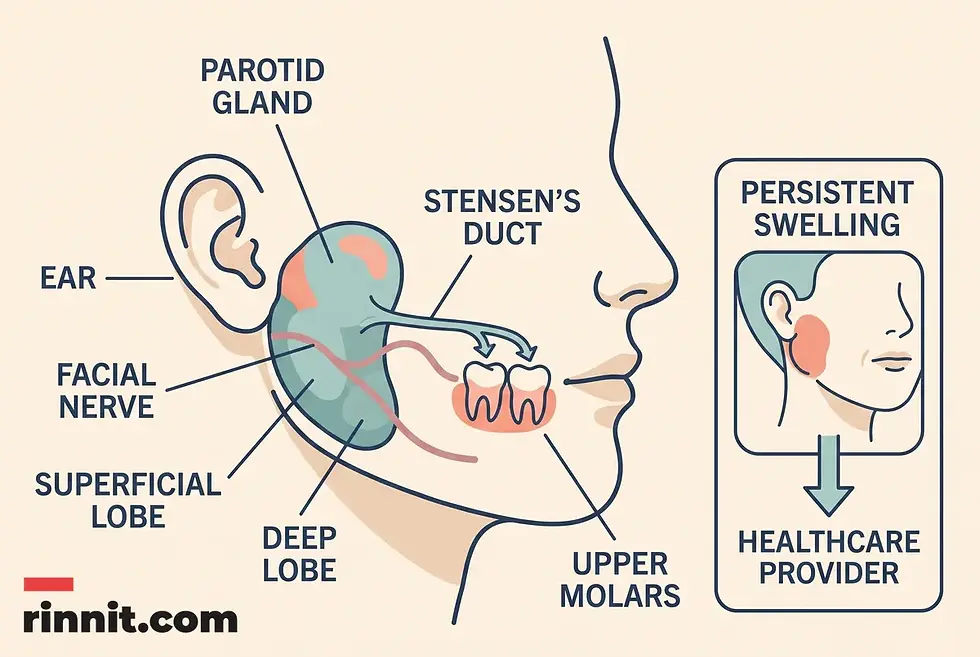
Each parotid gland is just below and in front of an ear. The other two pairs of major salivary glands are the sublingual glands under the tongue and the submandibular glands under the jaw. [1]
A tube called Stensen’s duct carries parotid saliva to the mouth and releases it near the upper molar teeth. The submandibular glands use a different tube, called Wharton’s duct, and the sublingual glands drain through several small ducts; both release saliva into the floor of the mouth. [1]
What does the parotid gland look like?
The parotid gland resembles an upside-down pyramid. It is wider near the top and tapers near the jawline. Lymph nodes cover the outer part, while the inner grooved surface rests against the jaw and masseter muscle. [1]
The facial nerve, also called cranial nerve VII, divides the gland into two lobes: the superficial lobe and the deep lobe. The gland is yellowish and covered with pink connective tissue. [1]
The parotid gland is the largest salivary gland, measuring about 5.8 centimeters long and 3.4 centimeters across. The average weight is about 14.28 grams. [1]
Anatomy feature | Description |
Shape | Upside-down pyramid, wider at the top and narrower near the jawline. |
Lobes | Superficial and deep lobes, separated by the facial nerve. |
Duct | Stensen’s duct carries saliva to the mouth near the upper molar teeth. |
Nearby structures | Lymph nodes, the jaw and the masseter muscle. |
Size | About 5.8 cm long and 3.4 cm across. |
Average weight | About 14.28 grams. |
What causes a swollen parotid gland?
A swollen parotid gland can be caused by salivary stones (sialolithiasis), infection (sialadenitis), parotid gland tumors or parotid gland cancer. They include sialolithiasis, sialadenitis, parotid gland tumors and parotid gland cancer. For a closer look at swelling, see our guide to parotitis. [1]
Sialolithiasis means calcified stones have developed and blocked a parotid duct. The resulting painful swelling can worsen when eating. [1]
See also our guide to salivary gland stones.
Sialadenitis is an infection of the parotid gland caused by a blockage, bacteria or viruses. Staph infections and the mumps virus are examples. [1]
Our plain-language guide to mumps explains that virus.
Parotid gland tumors can develop in either lobe and cause swelling of the jaw and face. Most parotid tumors are noncancerous, but cancerous tumors can occur. [1]
Salivary gland cancers, including mucoepidermoid carcinoma and adenoid cystic carcinoma, are uncommon. They make up about 6% to 8% of all head and neck cancers. If parotid gland cancer develops, prompt treatment is necessary to help prevent cancer cells from spreading to lymph nodes. See our guide to mucoepidermoid carcinoma. [1]
Possible cause | What to know |
Sialolithiasis | Calcified stones block a duct; pain and swelling may worsen when eating. |
Sialadenitis | Infection related to blockages, bacteria or viruses. |
Parotid gland tumor | May cause jaw or facial swelling; most tumors are noncancerous, but cancerous tumors can occur. |
Parotid gland cancer | Uncommon salivary-gland cancer requiring prompt treatment if it develops. |
What are the symptoms of a parotid gland problem?
Many parotid conditions cause similar symptoms. They include swelling of the face or jaw, pain and fever. Pain or discomfort may be worse after eating. [1]
Symptom | Context |
Facial swelling | May occur with parotid conditions. |
Jaw swelling | A common symptom of parotid problems. |
Pain | May be worse after eating. |
Fever | May occur with parotid conditions. |
Symptoms alone cannot identify the cause. Persistent swelling, a new lump or worsening pain should be evaluated by a qualified healthcare professional.
How is a parotid gland problem diagnosed?
Evaluation usually begins with a physical examination. A healthcare provider may feel around the parotid glands to check for pain or swelling. [1]
If an issue is suspected, additional tests may be requested. A needle biopsy uses a thin needle to collect fluid from the gland, which is sent to a laboratory for testing. Imaging may include a salivary gland scan, MRI, ultrasound or CT scan. [1]
Test | Purpose |
Physical examination | Checks the parotid area for pain or swelling. |
Needle biopsy | Collects fluid with a thin needle for laboratory testing. |
Salivary gland scan | An imaging assessment of the salivary glands. |
MRI, ultrasound or CT | Imaging options that may be requested to assess a suspected problem. |
How are parotid gland conditions treated?
Treatment depends on the underlying cause. A bacterial infection may be treated with antibiotics. [1]
When stones block a parotid duct, a healthcare provider may recommend facial massage or sucking on lemon candy to encourage saliva flow. If that does not work, different medications may be used to induce salivary flow. Surgery may be recommended to remove stones when nonsurgical treatment does not help. [1]
Parotid gland tumors usually require parotidectomy, which is surgery to remove part or all of the gland. Parotid gland cancer may require surgery and/or a combination of chemotherapy and radiation therapy. [1]
Cause or condition | Treatment approach |
Bacterial infection | Antibiotics may be prescribed. |
Duct stones | Saliva-flow measures, possible medication and surgery if nonsurgical treatment does not help. |
Parotid tumor | Often requires parotidectomy. |
Parotid gland cancer | May require surgery and/or chemotherapy with radiation therapy. |
Do not start, stop or change a treatment based only on this article. The appropriate plan depends on the examination, test results and underlying cause.
What can you do for a swollen parotid gland?
Sucking on sour candy may encourage saliva flow and may clear a blockage. If swelling continues, schedule an appointment with a healthcare provider so they can identify the cause. [1]
How can you care for your parotid glands?
Keeping the mouth supplied with saliva supports lubrication and oral health. Helpful habits include drinking plenty of water, chewing sugarless gum, sucking on sugarless candy, avoiding smoking, reducing caffeine and alcohol intake and asking a healthcare provider about saliva substitutes. [1]
These measures cannot always prevent parotid gland problems, but they may help reduce risk.
Care area | Suggestion |
Hydration | Drink plenty of water. |
Saliva flow | Chew sugarless gum or suck on sugarless candy. |
Smoking | Avoid smoking. |
Caffeine and alcohol | Reduce intake. |
Dry mouth | Ask a healthcare provider about saliva substitutes. |
When should you contact a healthcare professional?
Contact a healthcare professional about persistent parotid swelling, a new lump, facial or jaw pain, pain that worsens during eating or fever. These symptoms can have several causes and cannot be interpreted reliably without an evaluation.
Prompt evaluation is particularly important if a parotid lump or swelling does not improve, because tumors can occur in either lobe and cancerous tumors, although uncommon, can develop. A lump that grows quickly, feels hard or fixed, or comes with weakness or drooping on one side of the face needs prompt medical review.
Seek urgent medical assessment for severe or rapidly worsening swelling, difficulty breathing or swallowing, confusion or other symptoms that feel life-threatening. Use local emergency guidance when needed.
Conclusion
The paired parotid glands sit near the ears and produce saliva that supports mouth lubrication, chewing, digestion, bacteria control and tooth protection. Their ducts carry saliva to the mouth near the upper molar teeth, and the facial nerve divides each gland into superficial and deep lobes.
Swelling, pain and fever may result from a blocked duct, infection, tumor or another condition. Evaluation may include an examination, biopsy or imaging, and care depends on the cause. Use this guide to prepare questions for a qualified healthcare professional. For more clear, compassionate health explainers, explore Rinnit.com’s health library.
Frequently Asked Questions
How many parotid glands do people have?
People have two parotid glands, one just in front of and below each ear.
What does the parotid gland produce?
The parotid gland produces thin, watery saliva and releases amylase, a protein that helps begin starch digestion.
Where does parotid saliva enter the mouth?
Stensen’s duct carries saliva to the mouth and releases it near the upper molar teeth.
Why might a parotid gland swell after eating?
A calcified stone can block a parotid duct and cause painful swelling that worsens when eating.
What is parotitis?
Parotitis is swelling or infection of a parotid gland, often related to blockages, bacteria or viruses.
Are parotid gland tumors cancerous?
Most parotid gland tumors are noncancerous, but cancerous tumors can occur.
What are common symptoms of a parotid problem?
Swelling of the face or jaw, pain and fever are common. Pain may be worse after eating.
What tests can check the parotid gland?
Evaluation may include a physical examination, needle biopsy, salivary gland scan, MRI, ultrasound or CT scan.
How are parotid stones treated?
A healthcare provider may recommend measures to encourage saliva flow, medication or surgery if nonsurgical treatment does not help.
What is a parotidectomy?
A parotidectomy is surgery to remove part or all of a parotid gland. It is usually used for parotid gland tumors.
Can I prevent parotid gland problems?
Not always. Hydration, sugarless gum or candy, avoiding smoking, reducing caffeine and alcohol and asking about saliva substitutes may help reduce risk.
Related Reading
Parotitis: Understanding Parotid Gland Swelling explains why the parotid gland swells and how it is treated.
Parotid Gland Tumors: Understanding Rare Salivary Gland Growths covers growths in the parotid gland and how they are diagnosed.
Salivary Gland Stones: Causes, Symptoms, and Removal Options explains stones that block saliva flow and how they are removed.
Parotidectomy: Understanding Salivary Gland Tumor Surgery describes surgery to remove part or all of the parotid gland.
References
Cleveland Clinic. Parotid Gland: Anatomy, Function, Location & Definition. Cleveland Clinic. Updated June 8, 2022. https://my.clevelandclinic.org/health/body/23232-parotid-gland
Saga-Gutierrez C, Chiesa-Estomba CM, Larruscain E, et al. Sialendoscopy-assisted transoral approach for parotid gland lithiasis. Eur Arch Otorhinolaryngol. 2021;278(2):567-571. PMID 32588168. https://doi.org/10.1007/s00405-020-06136-y
Dell'Aversana Orabona G, Salzano G, Abbate V, et al. Malignant tumours of the parotid gland: management of the neck (including the clinically negative neck) and a literature review. Br J Oral Maxillofac Surg. 2021;59(6):665-671. PMID 33952405. https://doi.org/10.1016/j.bjoms.2020.08.026
Disclaimer
This article is for general educational purposes and is not a substitute for professional medical advice, diagnosis or treatment. Always seek the advice of a qualified healthcare professional with any questions about a medical condition or treatment.



Comments