Mucoepidermoid Carcinoma: Symptoms, Diagnosis, Treatment and Outlook

Updated: 2 days ago
Medically reviewed by Dr. Baraa Alnahhal, MD · Last reviewed: October 2026
Quick Answer: What is mucoepidermoid carcinoma?
Mucoepidermoid carcinoma is a rare cancer that most often starts in the salivary glands and less commonly in the ear, esophagus, breast or lungs. The most common sign is a lump or swelling near a salivary gland. It is caused by genetic mutations, is not hereditary and has no known behavioral cause. Only a biopsy can confirm it. [1]

What the research says
Parotid MEC generally has favorable short- and medium-term outcomes, but tumor grade matters. A systematic review and meta-analysis of 21 studies (7,192 patients with primary parotid MEC) reported pooled overall survival of 90% at 5 years and 70% at 10 years, and disease-specific survival of 100% at 5 years and 90% at 10 years. Tumor grade was low in 32.2%, intermediate in 41.8% and high in 26.1%, and high-grade histology, advanced T/N stage and positive surgical margins were associated with poorer outcomes (Salzano et al., Cancers, 2026). [2]
In children, salivary gland cancer is most often low-grade MEC, and survival is high. A meta-analysis of 19 studies (749 children with salivary gland cancer) found that low-grade, low-stage mucoepidermoid carcinoma was the most common cancer. Five-year overall survival was 94% and disease-free survival was 83%, with recurrence in 20% of children at a median of 1.1 years after diagnosis (Zamani et al., Pediatr Blood Cancer, 2019). [3]
Where does mucoepidermoid carcinoma occur?
MEC most often affects the salivary glands, which are located in and around the mouth and produce saliva. It can rarely start in other sites, including inside the ear, the esophagus, the breast and the lungs. [1]
Because the tumor can occur in different locations, symptoms may depend on where it begins. This article focuses mainly on MEC of the salivary glands.
Location | Context |
Salivary glands | The most common site; these glands make saliva in and around the mouth. |
Inside the ear | A rare site for MEC. |
Esophagus | A rare site for MEC. |
Breast | A rare site for MEC. |
Lung | A rare site for MEC. |
MEC is the most common form of salivary gland cancer, but it is uncommon overall. Because it is uncommon, healthcare teams continue to study which treatments work best. [1]
What are the symptoms of mucoepidermoid carcinoma?
MEC usually grows slowly, but sometimes it has a sudden period of rapid growth. Possible symptoms include a lump or swelling in front of the ear, inside the mouth or in the jaw; pressure or pain at the lump; drainage from the ear; difficulty opening the mouth all the way; and trouble swallowing. [1]
Possible symptom | What it looks like |
Lump or swelling | In front of the ear, inside the mouth or in the jaw. |
Pressure or pain | Felt at the site of the lump. |
Ear drainage | Fluid draining from the ear. |
Limited mouth opening | Not being able to open the mouth fully. |
Trouble swallowing | Difficulty swallowing. |
These symptoms can have causes other than cancer. The important point is not to diagnose MEC from a symptom list, but to have a new, firm, immovable or enlarging lump examined.
What causes mucoepidermoid carcinoma?
MEC happens when genetic mutations, or changes, cause tumors to form. It is not a hereditary cancer that a person is born with, and there are no known behaviors that cause it. [1]
This means a person should not assume that a past behavior caused the tumor. A healthcare provider can explain what is known about the diagnosis and which factors matter for treatment.
Who develops mucoepidermoid carcinoma?
Both children and adults can develop MEC, although most people are diagnosed in their 50s. Females may be slightly more at risk than males. [1]
Age and sex are population-level patterns, not a way to determine whether an individual lump is cancerous. Evaluation depends on the lump, symptoms, examination and, when needed, diagnostic testing.
How is mucoepidermoid carcinoma diagnosed?
A healthcare provider begins by reviewing medical history and performing a physical exam. The provider may feel for lumps around the salivary glands and check the lymph nodes for swelling, which may be a sign that the cancer has spread there. [1]
Imaging may be used to show the tumor inside the body. MRI, CT and PET scans are possible imaging tests. [1]
A biopsy is the only way to confirm MEC. During a biopsy, a provider removes tissue or fluid from the lump and tests it for cancer cells. [1]
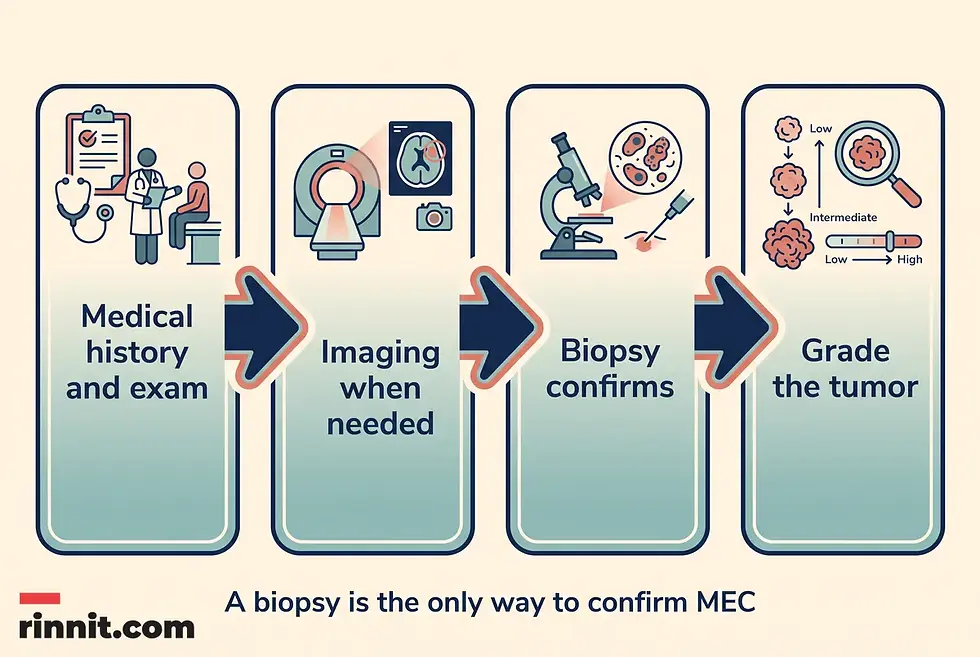
Diagnostic step | Purpose |
Medical history | Helps the provider understand the person's health context. |
Physical examination | Checks the salivary gland area and lymph nodes for lumps or swelling. |
MRI, CT or PET scan | Shows the tumor inside the body. |
Biopsy | Tests tissue or fluid for cancer cells and confirms MEC. |
Grading | Describes how abnormal the cells look under a microscope. |
What does MEC grade mean?
Grading is an important part of diagnosis. MEC grades are low, intermediate and high. The higher the grade, the more abnormal the cells look under a microscope. [1]
High-grade MEC is more aggressive than low- or intermediate-grade MEC. It may return after surgery and may require more intensive treatment. Grade is one part of the overall picture, alongside whether the cancer has spread and other features of the diagnosis. [1]
Grade | What it means |
Low grade | Cells look less abnormal under a microscope; early-stage low-grade tumors may be curable. |
Intermediate grade | A middle category in the grading system. |
High grade | Cells look more abnormal, the cancer is more aggressive, and it may require more intensive treatment. |
A grade is not the same as a personal prediction. Ask the treating team how grade, tumor location, spread and other findings affect the care plan.
How is mucoepidermoid carcinoma treated?
Treatment is designed around the person's unique diagnosis. Options include surgery, radiation therapy, chemotherapy and clinical trials. [1]
Surgery
If possible, a healthcare provider removes the tumor completely. Nearby lymph nodes may also be removed if the cancer has spread there. [1]
Radiation therapy
Radiation therapy may be given after surgery, particularly for high-grade tumors. It can destroy cancer cells that surgery may have missed. [1]
Chemotherapy
Chemotherapy treats advanced MEC by destroying cancer cells throughout the body. It may also make cancer cells more sensitive to radiation. [1]
Clinical trials
A provider may recommend a clinical trial. Clinical trials are studies that test the safety and effectiveness of new treatments. [1]
Treatment approach | When it is used |
Surgery | When possible, to remove the tumor completely; lymph nodes may also be removed if cancer has spread there. |
Radiation therapy | May follow surgery, especially for high-grade tumors. |
Chemotherapy | For advanced MEC; may also increase sensitivity to radiation. |
Clinical trial | May be recommended to study the safety and effectiveness of new treatments. |
The appropriate treatment depends on the tumor's grade, location, stage and the person's overall diagnosis. Only the treating team can explain which options apply to an individual.

What is the outlook and prognosis for mucoepidermoid carcinoma?
MEC is a serious cancer diagnosis that requires treatment and follow-up care. However, the experience differs from person to person. Early-stage low-grade tumors may be curable, while high-grade tumors are harder to treat but may still be curable. [1]
Factors associated with better outcomes include a younger age at diagnosis (children have better outcomes than adults), no spread beyond the primary tumor site, and low-grade MEC. These factors do not determine one person's outcome on their own. [1]
Survival statistics: how to interpret them
According to a recent study, about half of people with high-grade MEC were alive five years after diagnosis, and in a large U.S. study about 99% of people with low-grade MEC did not die of the cancer within five years. These numbers are a snapshot of the past. They do not account for individual age, health, treatment response or other details. Other studies report higher survival for specific groups, such as parotid gland MEC (see the research box above), because figures depend on which patients are included.
Prognosis factor | Why it matters |
Tumor grade | Low-grade tumors generally have a more favorable outlook than high-grade tumors. |
Spread beyond the primary site | Not having spread is associated with better outcomes. |
Age at diagnosis | Younger age, including childhood, is associated with better outcomes. |
Treatment response | Individual response affects the outlook but is not captured by a population statistic. |
A treating provider is the best resource for explaining what a diagnosis means for a particular person. Population statistics should support, not replace, an individualized discussion.
When should you see a healthcare provider?
See a healthcare provider if you are unsure what is causing a new lump. Most lumps and bumps are not serious, but a new lump that is firm, immovable or growing bigger should be evaluated. [1]
A healthcare visit does not mean that a lump is cancer. It is the appropriate way to identify what is causing the change and to decide whether examination, imaging or a biopsy is needed.
Consider bringing a short record of when the lump appeared, whether it has changed in size, whether it is painful, and whether you have ear drainage, difficulty opening your mouth or trouble swallowing. This helps organize the conversation but does not replace medical evaluation.
What questions should you ask after a mucoepidermoid carcinoma diagnosis?
A new cancer diagnosis can make it difficult to know what to ask. These questions may help:
Question | Why it may help |
What grade is the tumor? | Grade describes how abnormal the cells look and helps frame treatment discussions. |
Has it spread beyond the primary tumor site? | Spread is one factor associated with outcome and treatment planning. |
Is surgery possible? | Surgery is the primary treatment approach when complete removal is possible. |
Could radiation or chemotherapy be part of the plan? | These are treatment options in particular situations. |
Would a clinical trial be appropriate? | Trials study the safety and effectiveness of new treatments. |
What follow-up care will I need? | MEC requires treatment and follow-up, and the schedule depends on the diagnosis. |
Conclusion
Mucoepidermoid carcinoma is an uncommon cancer that most often begins in the salivary glands. It may grow slowly, but a new firm, immovable or enlarging lump deserves professional evaluation. A biopsy confirms the diagnosis, and grading helps describe how abnormal the cells look.
Treatment may involve surgery, radiation therapy, chemotherapy or a clinical trial, depending on the individual diagnosis. Outlook is shaped by grade, spread, age, health and treatment response, not by a single statistic alone. Bring personal cancer-care questions to a qualified oncology team.
Frequently Asked Questions
Is mucoepidermoid carcinoma common?
MEC is the most common form of salivary gland cancer, but it is uncommon overall. [1]
Where does mucoepidermoid carcinoma usually start?
Mucoepidermoid carcinoma most often starts in the salivary glands. Rarely, it can begin inside the ear, esophagus, breast or lung. [1]
What is the most common symptom?
A lump or swelling near the salivary glands, such as in front of the ear, inside the mouth or in the jaw. Pressure or pain, ear drainage, limited mouth opening and trouble swallowing can also occur. [1]
Is mucoepidermoid carcinoma hereditary?
No. MEC is not a hereditary cancer that a person is born with. It occurs when genetic mutations cause tumors to form, and there are no known behaviors that cause it. [1]
Can a lump alone confirm MEC?
No. A lump can have many causes. A biopsy is the only way to confirm mucoepidermoid carcinoma. [1]
What tests may be used?
A provider may review medical history, perform a physical exam, check lymph nodes, and use MRI, CT or PET imaging. A biopsy tests tissue or fluid for cancer cells. [1]
What does high-grade MEC mean?
High-grade MEC has cells that look more abnormal under a microscope and is more aggressive than low- or intermediate-grade MEC. It may return after surgery and may need more intensive treatment. [1]
What is the primary treatment?
Surgery is the primary treatment when the tumor can be removed completely. Radiation therapy, chemotherapy and clinical trials may also be part of care, depending on the diagnosis. [1]
Can mucoepidermoid carcinoma be cured?
Early-stage low-grade tumors may be curable, and high-grade tumors are harder to treat but may still be curable. An individual outlook depends on grade, spread, age, health and treatment response. [1]
When should I have a new lump checked?
See a healthcare provider for a new lump that is firm, immovable or growing bigger, or when you are unsure what is causing it. [1]
Related reading
References
Cleveland Clinic. Mucoepidermoid Carcinoma: Symptoms, Causes & Treatment. Cleveland Clinic. Last updated August 27, 2025. https://my.clevelandclinic.org/health/diseases/mucoepidermoid-carcinoma
Salzano G, Scocca V, Vaira LA, et al. Prognostic factors and survival outcomes in parotid gland mucoepidermoid carcinoma: a systematic review with meta-analysis and workflow proposal. Cancers (Basel). 2026;18(7):1146. PMID 41976368. https://doi.org/10.3390/cancers18071146
Zamani M, Grønhøj C, Schmidt Jensen J, et al. Survival and characteristics of pediatric salivary gland cancer: a systematic review and meta-analysis. Pediatr Blood Cancer. 2019;66(3):e27543. PMID 30378272. https://doi.org/10.1002/pbc.27543
Disclaimer
This article is for general educational purposes and is not a substitute for professional medical advice, diagnosis or treatment. Always seek the advice of a qualified healthcare professional with any questions about a medical condition or treatment.



Comments