Paraovarian Cyst: Symptoms, Causes, and Treatment Options

Updated: 2 days ago
Medically reviewed by Dr. Baraa Alnahhal, MD · Last reviewed: October 17, 2026
A paraovarian cyst is a fluid-filled sac that develops in the tissue near the ovaries or fallopian tubes [1]. Unlike ovarian cysts, it does not grow on the ovary itself, and it often causes no symptoms. Most are harmless and need no treatment, but a large cyst can cause pain or complications such as torsion, which is a medical emergency. Management ranges from simple observation to surgical removal.
Quick Answer: What is a paraovarian cyst?
A paraovarian cyst is a fluid-filled sac that forms in the tissue beside the ovaries or fallopian tubes, not on the ovary itself. Most are harmless, cause no symptoms and are found incidentally, often between ages 20 and 40. Treatment is usually unnecessary, but a twisted cyst causes sudden, sharp abdominal pain and needs emergency care. [1]
What the research says
In surgical series, torsion and enlargement are the main complications, and laparoscopy is the usual approach. A retrospective analysis of 51 patients who had surgery for a paraovarian cyst found a mean cyst size of 7.51 cm. About 62.74% had abdominal pain and the rest were incidental findings. Complications included cyst enlargement (79.62%), adnexal torsion (18.51%), hemorrhage (7.4%), and rupture (1.85%). Laparoscopy was used in 84.31% of cysts and fertility-sparing surgery in 57.39%. Because all patients had surgery, these figures reflect cysts that caused problems, not the many small cysts that never do (Durairaj & Gandhiraman, J Obstet Gynaecol India, 2019).
Recurrence after removal is uncommon but possible, and cancer was not found in a large pediatric series. In a review of 627 children and adolescents with a surgically removed paratubal or paraovarian cyst, 11.3% (70 patients) had a recurrence. Recurrence was not linked to age, BMI, cyst size, or number of cysts, and 70.1% of recurrences were on the same side. There were no cases of paratubal cyst malignancy in the cohort (Magistrado et al., J Pediatr Adolesc Gynecol, 2020).
Research summaries are based on article abstracts retrieved from PubMed.
What Is a Paraovarian Cyst?
Paraovarian cysts are sacs, most often filled with fluid, that develop in the tissue next to the ovaries or fallopian tubes. A critical distinction from common ovarian cysts is their location: paraovarian cysts form in nearby tissue rather than on or inside the ovaries themselves [1]. When they occur close to the fallopian tubes, they are sometimes called paratubal cysts.
Because they often do not cause symptoms, it is hard to know exactly how common they are, though providers consider them a common finding. Most remain small and harmless throughout a person's life [1].
What are the symptoms and possible complications of a paraovarian cyst?
In most cases, paraovarian cysts cause no symptoms. When a cyst enlarges, it may press on nearby organs and cause noticeable discomfort [1].
Symptom or complication | Description and impact |
|---|---|
Pelvic pain | A dull ache or sharp pain if the cyst grows large [1]. |
Pressure symptoms | Large cysts can cause a feeling of fullness, constipation, or needing to pee more often. |
Torsion | A medical emergency in which the cyst twists, potentially cutting off blood flow. |
Rupture | The cyst may break open, causing bleeding and sudden pain. |
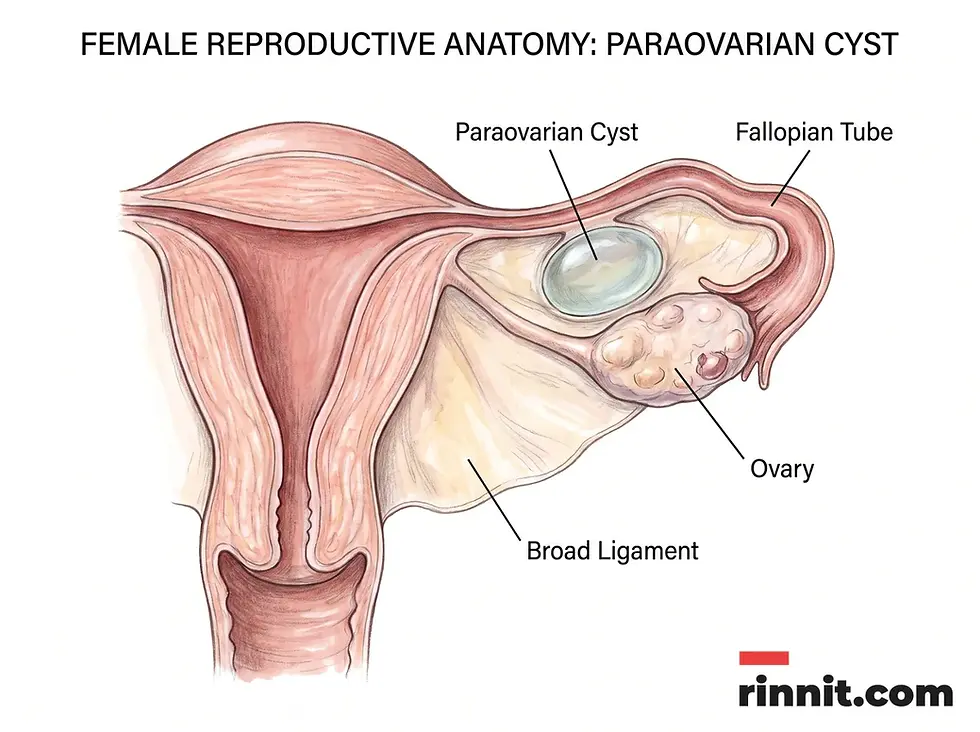
Anatomical illustration showing the location of a paraovarian cyst in the broad ligament beside the ovary and fallopian tube.
What causes a paraovarian cyst, and how does it develop?
Paraovarian cysts form within the broad ligament, a layer of tissue that supports the ovaries and fallopian tubes. A cyst can develop when fluid collects in this tissue, and many form from remnants of the Müllerian ducts [1]. These ducts are structures present during fetal development that help form the uterus, cervix, fallopian tubes, and upper vagina.
Leftover tissue from these ducts can persist and later form a cyst. Because this tissue is present from before birth, there is no known way to prevent these cysts. They are most often found in people between the ages of 20 and 40 [1].
How is a paraovarian cyst diagnosed?
Many people learn they have a paraovarian cyst when a provider feels it during a pelvic exam, or when an ultrasound done for another reason shows it [1].
If you have symptoms, your provider may perform a transvaginal ultrasound, which shows the cyst's size and location. Providers can diagnose most paraovarian cysts this way. In some cases, your provider may recommend removing the cyst so they can examine what is inside [1].
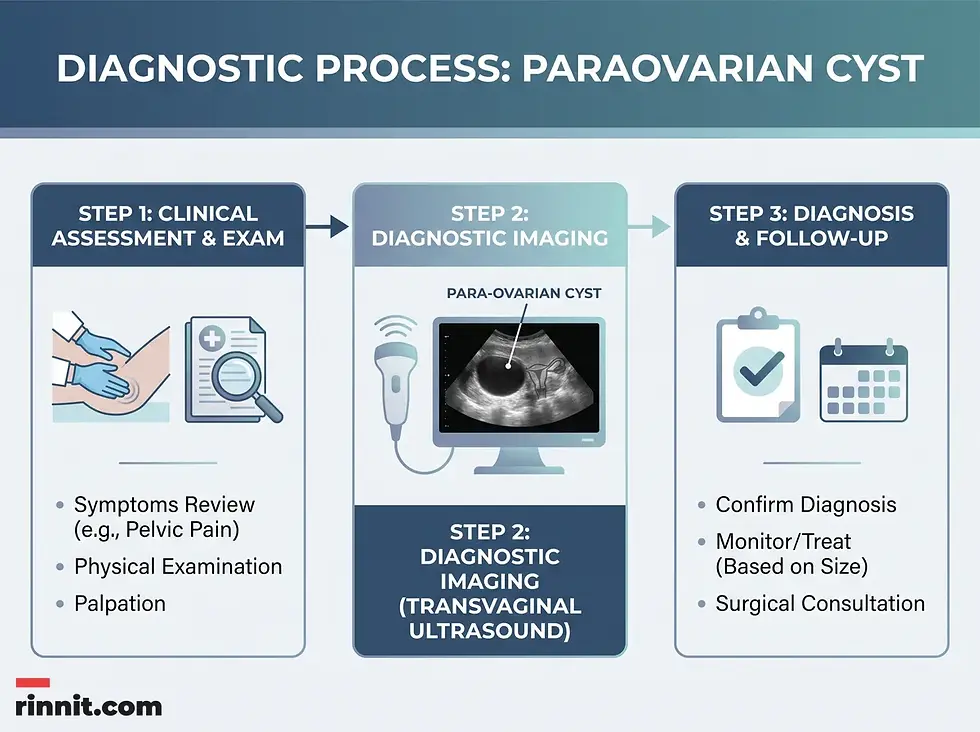
Visual guide to the diagnostic process for a paraovarian cyst, featuring clinical assessment, transvaginal ultrasound, and follow-up.
How is a paraovarian cyst managed and treated?
Most paraovarian cysts are harmless and do not need treatment. Management depends on the cyst's size, whether it causes symptoms, and the risk of complications. Your provider may recommend removing a cyst if it is growing large or could be cancerous [1].
Treatment options
Expectant management: no follow-up care is needed because the cyst is harmless, has no symptoms, and is unlikely to cause problems. This is the most common approach.
Surveillance: the cyst is likely harmless but could grow or cause problems, so you may need more imaging or blood tests to check for changes.
Surgery: removal is an option if the cyst is causing symptoms or puts you at risk of complications. A surgeon removes the cyst through tiny cuts in the abdomen (laparoscopy).
Emergency warning signs
A twisted cyst (torsion) is a medical emergency, and you should get help right away. Signs include sudden, sharp pain in the abdomen, pain radiating from the lower back, and intense pain that makes you feel sick to your stomach or causes vomiting [1].

Infographic detailing management options for paraovarian cysts, from expectant management to laparoscopic surgical removal.
How does a paraovarian cyst affect fertility and pregnancy?
Paraovarian cysts usually do not disrupt ovulation or your ability to get pregnant. However, a very large cyst may press on a fallopian tube. If you are trying to conceive and know you have a large cyst, talk with your provider about a management plan [1].
What is the bottom line on paraovarian cysts?
Finding a paraovarian cyst can be concerning, but these fluid-filled sacs are usually harmless leftovers from reproductive development. Most people never need treatment or have symptoms. Regular gynecological checkups are the best way to make sure any changes are monitored and addressed if necessary.
Your next step: If you have sudden, sharp pelvic pain or a persistent feeling of abdominal fullness, see your healthcare provider for an evaluation. Seek emergency care right away if pain is severe and sudden.
Frequently Asked Questions
Are paraovarian cysts cancerous?
Although it is extremely rare, these cysts can become cancerous. Very few cases have been reported [1].
Can a paraovarian cyst go away on its own?
Yes. Some cysts may resolve without any medical intervention [1].
What is the difference between an ovarian and a paraovarian cyst?
Ovarian cysts grow on or inside the ovary, while paraovarian cysts form in the tissue beside the ovary or fallopian tube [1].
How large can these cysts grow?
Most are between 1 and 8 centimeters in diameter, but in rare cases they can grow up to 20 centimeters [1].
Does a paraovarian cyst affect my period?
Paraovarian cysts usually do not disrupt ovulation or your ability to get pregnant [1].
Is surgery always necessary for large cysts?
Surgery is an option if the cyst is causing symptoms or puts you at risk of complications such as torsion or rupture [1].
What causes a cyst to twist?
Large cysts are at higher risk of twisting (torsion), which can cut off blood flow and damage tissue. It needs emergency treatment [1].
Can I prevent paraovarian cysts?
No. Because many develop from tissue present before birth, there is no known way to prevent them [1].
Is an ultrasound enough to diagnose them?
A transvaginal ultrasound can show the cyst's size and location, and providers can diagnose most paraovarian cysts this way [1].
Should I be worried if my doctor finds one?
In most cases, no. The cyst is probably harmless, and your provider will let you know if you need follow-up care or more tests [1].
Related Resources
External resource for deeper reading:
Related Reading
Ovarian Cysts: Symptoms, Causes, and Treatment Options Explained explains cysts that form on the ovary and how they are treated.
Ovarian Torsion: Symptoms, Causes, Diagnosis, and Emergency Treatment explains the emergency twisting that a large cyst can cause.
Transvaginal Ultrasound: Why It's Done, How to Prepare and What to Expect describes the pelvic scan used to find and measure cysts.
Adnexal Tumors and Masses: Complete Guide to Symptoms, Causes & Treatment covers growths near the uterus, ovaries and fallopian tubes.
References
Cleveland Clinic. Paraovarian Cyst. Cleveland Clinic Health Library. Last updated July 2, 2026. Accessed October 10, 2026. https://my.clevelandclinic.org/health/diseases/paraovarian-cyst
Durairaj A, Gandhiraman K. Complications and management of paraovarian cyst: a retrospective analysis. J Obstet Gynaecol India. 2019;69(2):180-184. PMID: 30956474. DOI: https://doi.org/10.1007/s13224-018-1152-2
Magistrado L, Dorland J, Sangi-Haghpeykar H, et al. Paratubal cyst recurrence in children and adolescents. J Pediatr Adolesc Gynecol. 2020;33(6):649-651. PMID: 32712189. DOI: https://doi.org/10.1016/j.jpag.2020.07.008
Medical disclaimer
This article is for informational purposes only and is not a substitute for professional medical advice, diagnosis, or treatment. Always seek the advice of your physician or other qualified health provider with any questions you may have about a medical condition.



Comments