Adnexal Tumors and Masses: Complete Guide to Symptoms, Causes & Treatment

Updated: 2 days ago
Medically reviewed by Dr. Baraa Alnahhal, MD · Last reviewed: September 2026
Quick Answer
Adnexal tumors and masses are growths of cells that form on the organs and connective tissue around the uterus — the ovaries, fallopian tubes, and the connective tissue supporting them. Most are not cancer, but some can be. Many cause no symptoms at all, while others trigger pelvic or belly pain, pressure, unusual vaginal bleeding, or urinary changes. Diagnosis combines a pelvic exam, imaging tests (ultrasound, CT, MRI), and blood tests, and treatment depends on the size and cause — small cysts sometimes need no treatment, while large, symptomatic, or possibly cancerous masses may require surgery.
TL;DR
What they are: Cell growths on or near the ovaries, fallopian tubes, and surrounding connective tissue.
Cancer status: Most often are NOT cancer — but they can be.
Symptoms: Often none; when present — pelvic/belly pain, worse period cramps, pressure, unusual bleeding, urinary changes, fever.
Top causes: Cysts (fluid buildup), endometriosis, and ectopic pregnancy.
Cancer risk factors: Menopause, hormone infertility medicines, family history of breast/ovarian/fallopian tube cancer, inherited DNA changes, smoking; hormonal birth control lowers risk.
Treatment: Small cysts may need nothing; surgery is considered for large, symptomatic, or possibly cancerous masses.
Adnexal Tumors at a Glance
What they are: Growths of cells on the organs and connective tissue around the uterus.
Where they form: Ovaries, fallopian tubes, and the connective tissue supporting them.
Cancer status: Most often are not cancer, but they can be.
Typical symptoms: Often none; otherwise pelvic/belly pain, pressure, unusual bleeding, urinary changes, fever.
Most common causes: Cysts, endometriosis, ectopic pregnancy; plus fibrosis, hydrosalpinx, abscess, torsion, or cancer.
Diagnosis: Pelvic exam, imaging (ultrasound, CT, MRI), blood tests (including CA 125 tumor marker).
Treatment: Depends on size and cause; small cysts may need no treatment; surgery for large, symptomatic, or possibly cancerous masses.
When cancer risk rises: After menopause, with hormone infertility medicines, family history of related cancers, inherited DNA changes, or smoking.
Note: This article is for general information only and is not a substitute for professional medical advice. Always consult a qualified healthcare professional for diagnosis and treatment.
What Are Adnexal Tumors and Masses?
Adnexal tumors and masses are growths of cells that form on the organs and connective tissue around the uterus. The crucial fact to understand from the start: they most often aren't cancer, but they can be cancer.
These growths appear in three places:
Ovaries: The reproductive system has two ovaries, one on each side of the uterus. They make eggs (ova) and the hormones estrogen and progesterone.
Fallopian tubes: The tubes that connect the ovaries to the uterus.
Connective tissue: The tissue that surrounds and supports the ovaries and fallopian tubes.
Diagnosis involves a careful physical exam, imaging tests, and blood tests. Treatment depends on the size of the tumor or mass and its cause.
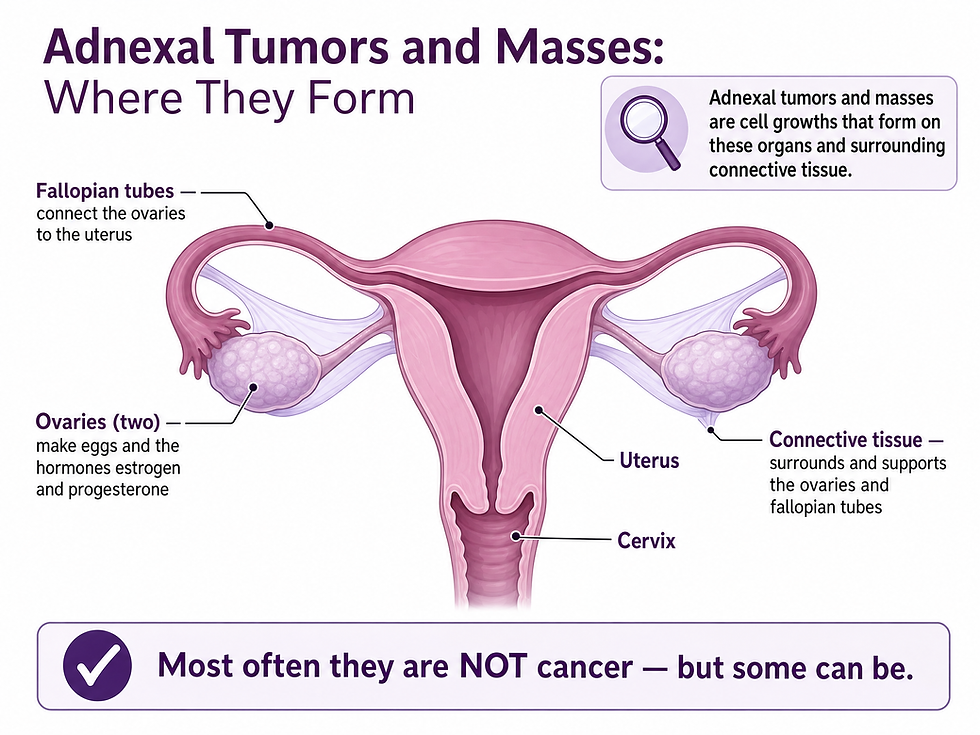
Where adnexal tumors and masses form: the ovaries, fallopian tubes, and surrounding connective tissue. Source: rinnit.com
Adnexal Mass Symptoms: What to Watch For
Here's the important nuance: many adnexal tumors and masses don't cause symptoms at all. They're often found during a medical exam done for another reason.
When symptoms do occur, they may include:
Pain, including pain in the pelvis or belly, period cramps that are worse than usual, and painful sex
A feeling of fullness or pressure in the pelvis or belly, or feeling full quickly when eating
Nausea and vomiting
Constipation or bloating
Urinating a lot or having trouble urinating
Vaginal bleeding that is out of the ordinary
Fever
When to See a Doctor — and When It's an Emergency
Make an appointment with a healthcare professional if you have any symptoms that worry you.
Get emergency medical care right away if you have any of these:
Terrible pelvic or belly pain
Pelvic or belly pain that starts quickly
Vaginal bleeding during the first three months of pregnancy
Adnexal Mass Causes: From Cysts to Cancer
There are many possible causes. The most common ones:
Cysts: When fluid builds up in an area of the body, the mass that forms is called a cyst. Cysts can happen within the ovaries and fallopian tubes as well as in the connective tissue around them.
Endometriosis: Tissue similar to the inner lining of the uterus grows outside the uterus, often affecting the ovaries, fallopian tubes, and the tissue lining the pelvis.
Ectopic pregnancy: A fertilized egg implants and grows outside the main cavity of the uterus, most often in a fallopian tube.
Other health conditions that can lead to adnexal tumors and masses include:
Fibrosis: Connective tissue becomes thick and scarred.
Hydrosalpinx: Fluid blocks a fallopian tube.
Infection: Pus builds up and forms a mass, called an abscess.
Ovarian torsion: An ovary moves out of its typical position and becomes twisted.
Cancer: Most adnexal tumors and masses are not cancer, but some may be cancer affecting the ovaries, fallopian tubes, or the tissue around them.
Risk Factors: What Raises Cancer Risk?
Because so many conditions can cause adnexal tumors and masses, many things can raise the risk of developing them. But the most important factors are those that affect the risk of an adnexal tumor or mass being cancer:
Menopause: People who have gone through menopause are more likely to have a cancerous adnexal tumor or mass.
Hormone medicines: Those who used infertility medicines with hormones are at higher risk; those who used hormonal birth control are at a much lower risk.
Family medical history: Family members who had breast cancer, ovarian cancer, or fallopian tube cancer raise the risk.
Inherited DNA changes: DNA changes that raise cancer risk can pass from parents to children and greatly raise the risk of some cancers — though not everyone with these changes gets cancer.
Smoking cigarettes: Raises the risk of a cancerous adnexal tumor or mass.
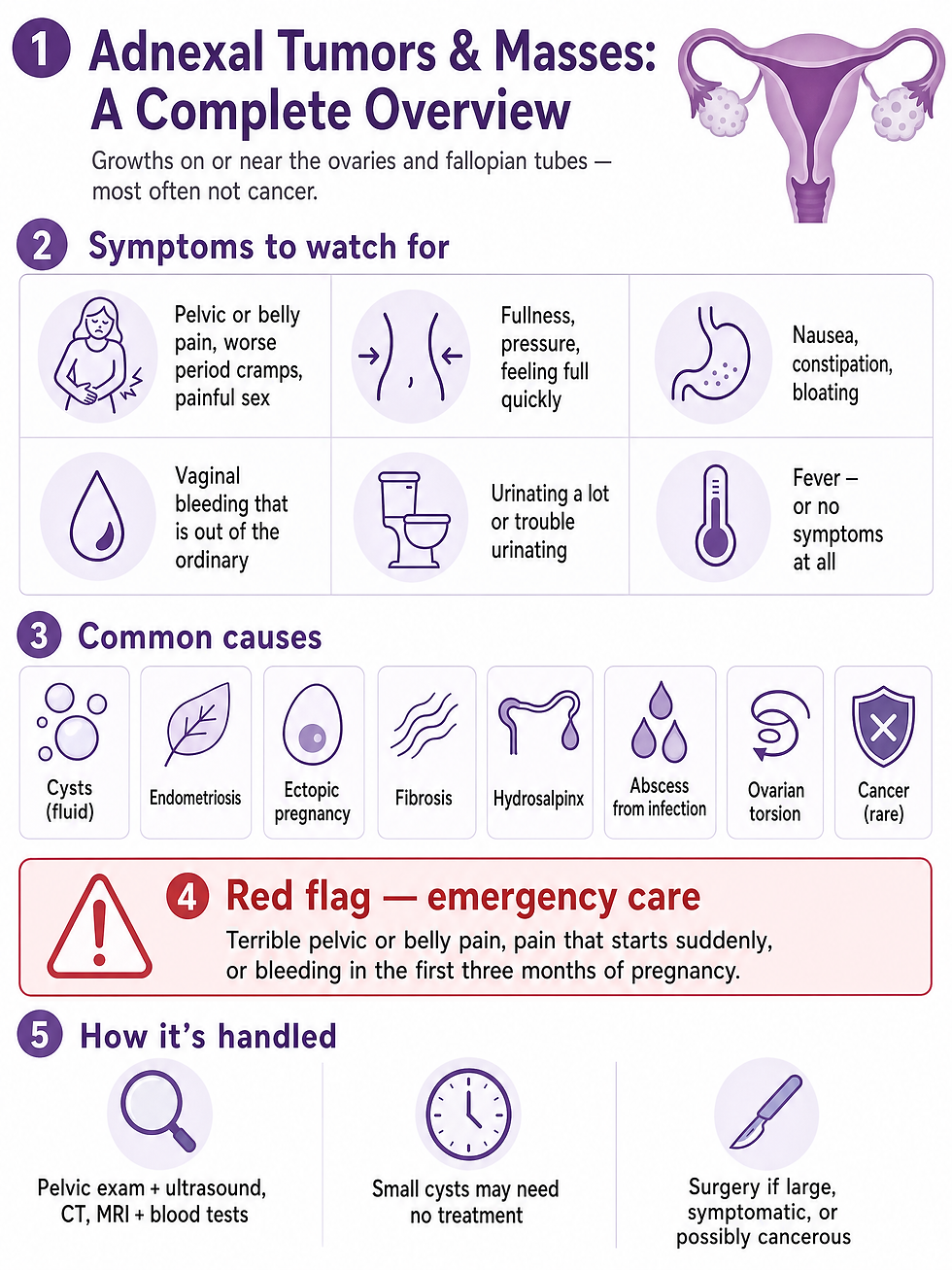
A quick reference: symptoms, common causes, emergency warning signs, and how adnexal tumors and masses are diagnosed and treated. Source: rinnit.com
How Adnexal Tumors Are Diagnosed
Diagnosis starts with a pelvic exam, then may move to imaging and blood tests.
Pelvic exam: The healthcare professional puts gloved fingers into the vagina and presses a hand on the belly at the same time to feel the pelvic organs. It also involves looking at the external genitals, vagina, and cervix.
Imaging tests: Imaging makes pictures of the body and can show the location and size of an adnexal tumor or mass. Tests include ultrasound, CT scan (computerized tomography), and MRI (magnetic resonance imaging).
Blood tests: Three kinds may be used: a pregnancy test; tests to find an infection; and a tumor marker test. The CA 125 test finds a protein that's often found on the surface of ovarian cancer cells.
Adnexal Tumor Treatment: What to Expect
Treatment depends on the type of growth and what's causing it.
Small cyst: In some situations, such as with a small cyst, no treatment may be needed at all.
Surgery to remove an adnexal tumor or mass may be advised if the tumor or mass is large, if it's causing symptoms, or if it could be cancer.
Preparing for Your Appointment
If you have symptoms that worry you, start by making an appointment with a doctor or healthcare professional. If an adnexal tumor or mass could be cancer, you may be referred to a gynecologic oncologist — a doctor who specializes in cancer of the reproductive organs.
Because appointments can be brief, it's a good idea to be prepared.
What You Can Do
Write down any symptoms, including any that seem unrelated to the reason for your appointment
Write down key personal information, including major stresses or recent life changes
Make a list of all medicines, vitamins, or supplements you take
Consider taking along a family member or friend — it can be hard to remember everything from an appointment, and someone with you may catch what you miss
Write down questions to ask
Questions to Ask Your Doctor
What's likely causing my symptoms?
What tests might I need?
Could my adnexal tumor or mass go away on its own, or will I need treatment?
Do you have printed materials or brochures I can have? What websites do you recommend?
What to Expect From the Doctor
Be ready to answer questions such as:
How often do you have symptoms, and how bad are they?
Do you have regular menstrual cycles? What was the date of your last menstrual period?
Do your symptoms seem related to your menstrual cycle?
Have you used hormonal birth control or infertility medicines? How long?
What makes your symptoms better? What makes them worse?
Frequently Asked Questions (FAQ)
What is an adnexal tumor or mass?
An adnexal tumor or mass is a growth of cells that forms on the organs and connective tissue around the uterus — the ovaries, fallopian tubes, and the connective tissue supporting them. Most often they are not cancer, but some can be.
Do adnexal masses always cause symptoms?
No. Many adnexal tumors and masses cause no symptoms at all and are often found during a medical exam done for another reason. When symptoms do appear, they can include pelvic or belly pain, pressure, unusual vaginal bleeding, nausea, urinary changes, or fever.
What causes adnexal masses?
The most common causes are cysts (fluid buildup), endometriosis, and ectopic pregnancy. Other causes include fibrosis, a blocked fallopian tube (hydrosalpinx), an abscess from infection, ovarian torsion, and, less commonly, cancer of the ovaries, fallopian tubes, or surrounding tissue.
Are adnexal tumors usually cancer?
Most adnexal tumors and masses are not cancer. However, the risk of a mass being cancerous rises after menopause, with hormone-based infertility medicines, a family history of breast, ovarian, or fallopian tube cancer, certain inherited DNA changes, and cigarette smoking.
How is an adnexal mass diagnosed?
Diagnosis begins with a pelvic exam, followed by imaging tests such as ultrasound, CT, or MRI to show the location and size of the mass, and blood tests — including a pregnancy test, infection screening, and the CA 125 tumor marker test, which looks for a protein often found on ovarian cancer cells.
How are adnexal tumors treated?
Treatment depends on the type of growth and its cause. A small cyst may need no treatment at all. Surgery to remove the mass may be advised if it is large, causing symptoms, or could be cancer.
Conclusion
Three lessons anchor this guide: the word sounds scary, but most adnexal masses are not cancer — which is why the right response to a finding is careful evaluation, not panic; silence is common — many masses cause no symptoms and are discovered by accident, so paying attention to the warning signs (pelvic pain, pressure, unusual bleeding) and seeking emergency care for sudden severe pain matters; and treatment is proportional — small cysts often need nothing at all, while surgery is reserved for masses that are large, symptomatic, or possibly cancerous.
This guide walked you through where these growths form, the full symptom list, every major cause from cysts to cancer, the factors that raise cancer risk, the three-step diagnostic path, and what to ask at your appointment. If you've been diagnosed with an adnexal mass or you're experiencing symptoms that worry you, the most valuable next step is a pelvic exam and follow-up testing with your healthcare professional — because knowing what you're dealing with is the first step to handling it well.
What to do next: If you found this guide useful, explore more in-depth health guides on rinnit.com — including our guide to adenomyosis, another uterine health condition where understanding what's happening makes all the difference.
References
This content is provided for general informational purposes only and is not a substitute for professional medical advice, diagnosis, or treatment. Always seek the advice of a qualified healthcare provider with any questions about a medical condition.
Comments