Pancreas Transplant: Who It's For, Surgery and Recovery

Updated: 2 days ago
Written and medically reviewed by Dr. Baraa Alnahhal, MD · Last reviewed: November 2026 · How we review
Quick Answer
A pancreas transplant is surgery to replace a pancreas that no longer works with a healthy donated pancreas. It treats severe, long-term type 1 diabetes that doesn't respond to other treatments. Many people no longer need insulin shots afterward. You'll take anti-rejection medicine for life. About 9 in 10 recipients are alive 5 years later.
What the research says
Combined transplants worked well in type 2 diabetes: pooling 9 studies, people with type 2 diabetes and kidney failure who got a combined pancreas-kidney transplant had 98%, 95% and 91% survival at 1, 3 and 5 years, similar to type 1 diabetes and better than a kidney transplant alone (Cao Y et al., Langenbeck's Archives of Surgery, 2022) [2]
Combined grafts lasted better than pancreas alone: a meta-analysis found pancreas grafts placed with a kidney survived better at 1 year than pancreas-alone grafts (87.2% vs. 76.6% from brain-death donors), with no difference between donor types (van Loo ES et al., Pancreatology, 2017) [3]
Key takeaways
A pancreas transplant replaces a failing pancreas with a donor organ.
It mainly treats severe type 1 diabetes.
Many people also get a kidney at the same time.
The new pancreas usually makes insulin right away.
You'll need anti-rejection medicine for life.
What is a pancreas transplant?
Your pancreas makes insulin, which controls blood sugar. In a transplant, a donor pancreas is connected to blood vessels and your small intestine. Your own pancreas stays in place to keep making digestive juices. About 1,000 pancreas transplants are done each year. Sources: [1]
Why it's done
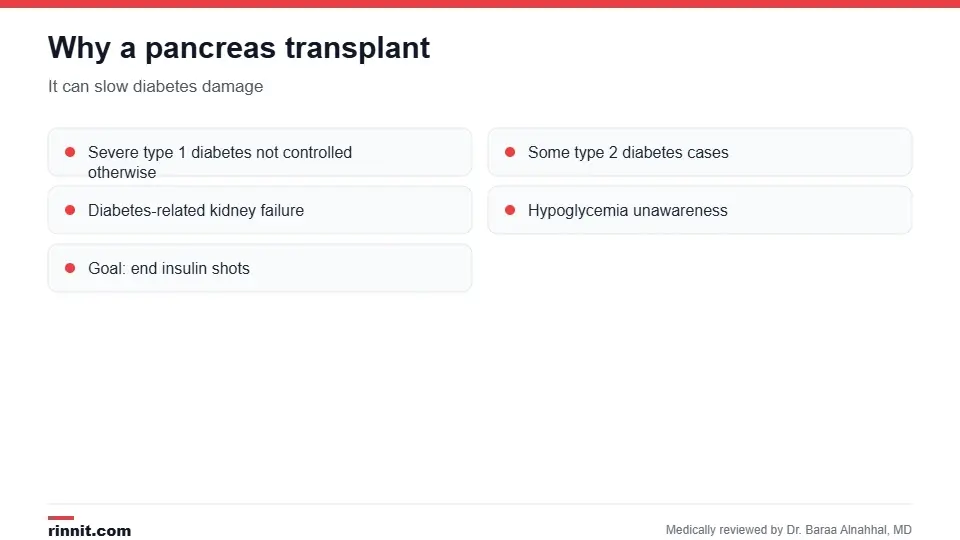
It won't cure diabetes, but it can slow its damage.
Severe, long-term type 1 diabetes that doesn't respond to other treatments.
Some cases of type 2 diabetes that meet certain criteria.
Hypoglycemia unawareness, when you can't feel low blood sugar coming on.
Ending daily blood sugar checks, insulin shots and food limits. Sources: [1]
A transplant can slow damage to your kidneys, blood vessels, eyes and nerves. Many people report more energy. Sources: [1]
Types of pancreas transplant
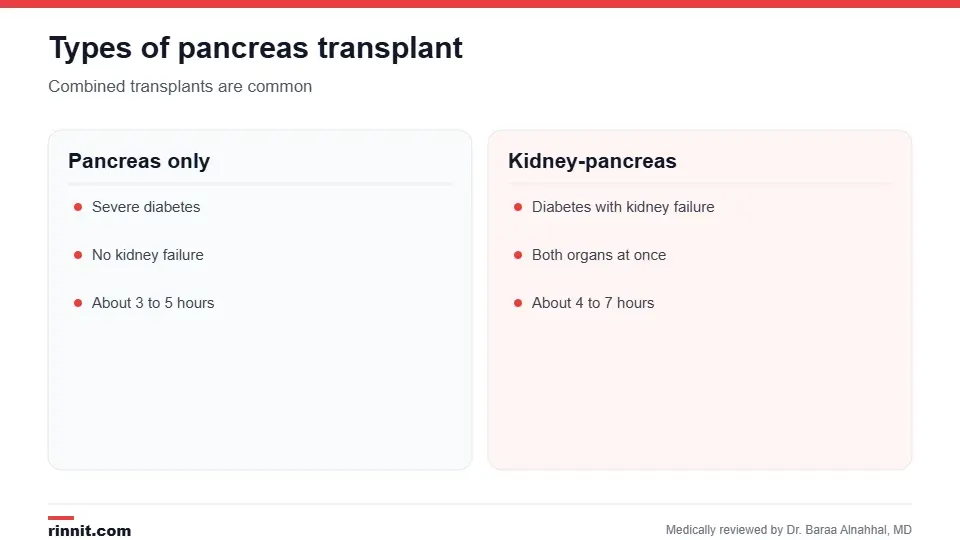
A combined transplant is common because diabetes often damages the kidneys.
Type | Who it's for | Surgery time |
Pancreas only | Severe diabetes without kidney failure | About 3 to 5 hours |
Diabetes with kidney failure | About 4 to 7 hours |
Sources: [1, 2, 3]
Who is eligible
Usually ages 18 to 60.
A life expectancy of at least 5 years.
Hypoglycemia unawareness or large amounts of protein in the urine.
Family or friends who can help during recovery. Sources: [1]
The evaluation includes blood and urine tests, heart tests, cancer screenings, immune tests for donor matching, imaging and a mental health evaluation. The waiting list can last months or even years. Sources: [1]
What happens during surgery
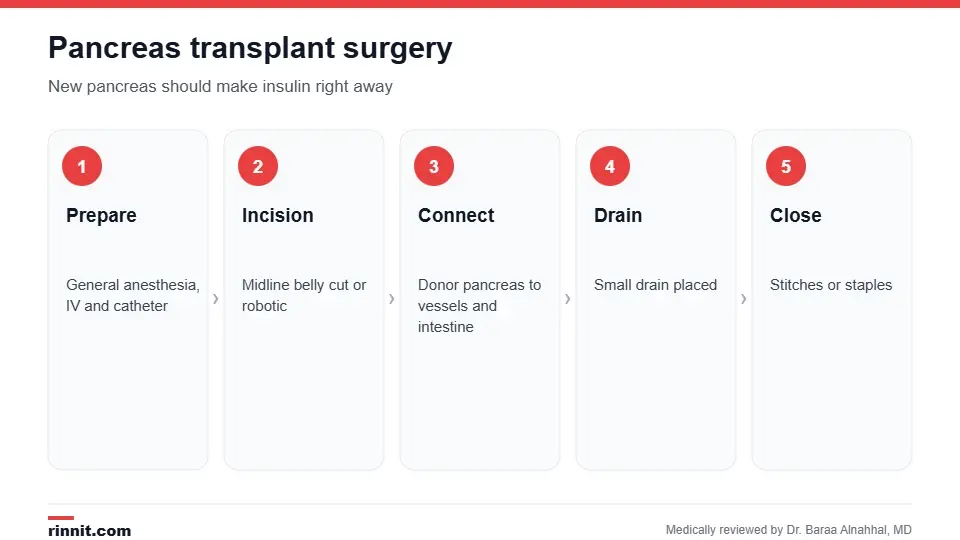
The new pancreas should start making insulin right away.
You get general anesthesia, an IV and a urinary catheter.
The surgeon makes a cut down the middle of your belly, or uses robotic surgery through small cuts.
The donor pancreas is connected to blood vessels and your small intestine.
A small drain is placed, and the cut is closed. Sources: [1]
Risks
Risk | Notes |
Rejection | Prevented with lifelong anti-rejection medicine |
Blood clots and bleeding | Possible |
Leakage | Where the pancreas joins the small intestine |
Infection | Anti-rejection medicines raise the risk |
Pancreatitis or organ failure | Possible |
Anti-rejection medicines, or immunosuppressants, have their own risks. Most people can have children but should wait at least a year. Sources: [1]
Recovery
When | What to expect |
1 to 2 weeks | Hospital stay with close monitoring |
About 3 weeks | Stitches or staples removed |
After about 6 weeks | Increase activity |
A few months | Time off work or school |
About 6 months | Full recovery |
Sources: [1]
Outlook
Pancreas transplant success is very good. About 9 out of 10 recipients are alive 5 years later, and many people live for years or decades. If the new pancreas stops working, it can sometimes be replaced. Sources: [1, 2]
When to call your care team
A fever above 100.4°F (38°C), chills or aches.
Dizziness, nausea or vomiting.
Urinating less than usual.
Pain or tenderness near the new pancreas.
Swelling or sudden weight gain. Sources: [1]
Conclusion
A pancreas transplant can free people with severe diabetes from insulin shots and slow diabetes damage. Taking anti-rejection medicine every day and reporting warning signs early protect your new organ.
Keep learning: read about kidney-pancreas transplants and organ donation.
Frequently asked questions
What is a pancreas transplant?
Surgery that replaces a failing pancreas with a donor pancreas.
Who needs a pancreas transplant?
People with severe type 1 diabetes that other treatments can't control.
Will I still need insulin?
The new pancreas usually starts making insulin right away.
Does a pancreas transplant cure diabetes?
No, but it can slow diabetes damage.
Why get a kidney at the same time?
Many candidates also have diabetes-related kidney failure.
How long does surgery take?
About 3 to 5 hours, or 4 to 7 hours with a kidney.
How long is the hospital stay?
Usually 1 to 2 weeks.
Is my old pancreas removed?
No. It stays to keep making digestive juices.
What is the survival rate?
About 9 in 10 recipients are alive 5 years later.
How long is the waiting list?
It can last months or even years.
Related Reading
Kidney-Pancreas Transplant: Who Qualifies, Surgery, Recovery and Outcomes a combined transplant for diabetes and kidney failure.
Diabetes: Symptoms, Types, Causes, Diagnosis & Treatment — Complete Guide an overview of diabetes.
Immunosuppressants: A Guide to Managing Your Immune System anti-rejection medicines.
Organ Donation and Transplantation: How It Works, Who Can Donate, and What Recovery Looks Like how organ donation works.
Kidney Transplant: Understanding the Procedure, Benefits, and Recovery kidney transplant surgery.
References
Cleveland Clinic. Pancreas Transplant: Benefits, Risks & Considerations. Cleveland Clinic. Last updated September 14, 2026. https://my.clevelandclinic.org/health/treatments/24384-pancreas-transplant
Cao Y, Liu X, Lan X, et al. Simultaneous pancreas and kidney transplantation for end-stage kidney disease patients with type 2 diabetes mellitus: a systematic review and meta-analysis. Langenbecks Arch Surg. 2022;407(3):909-925. PMID 34279713. https://doi.org/10.1007/s00423-021-02249-y
van Loo ES, Krikke C, Hofker HS, et al. Outcome of pancreas transplantation from donation after circulatory death compared to donation after brain death. Pancreatology. 2017;17(1):13-18. PMID 27838258. https://doi.org/10.1016/j.pan.2016.11.002
Medical disclaimer
This article is for general education only and does not replace advice from a qualified healthcare professional. Talk to your doctor about your own diagnosis and treatment, and seek emergency care right away for severe or sudden symptoms.



Comments