Pacemaker and ICD Replacement: Why It's Needed, What Happens, and How You Recover

Updated: 6 days ago
Written and medically reviewed by Dr. Baraa Alnahhal, MD · Last reviewed: October 31, 2026 · How we review
Quick Answer: What is cardiac device replacement?
Cardiac implantable electronic device (CIED) replacement is a procedure to swap out a pacemaker or implantable cardioverter-defibrillator (ICD), most often because its battery is running low after about 6 to 10 years. It is usually a same-day outpatient procedure under IV sedation that replaces only the generator. Call your doctor for chest pain, fever, or fainting afterward. [1]
What the research says
A simple generator swap carries a small but real risk. In a study of 1,744 patients at 72 U.S. centers, major complications occurred in 4.0% of simple pacemaker or ICD generator replacements, compared with 15.3% when a new lead was added at the same time. No deaths occurred during the procedures, and infection rates at 6 months were 1.4% and 1.1% (Poole et al., Circulation, 2010).
Replacement nearly doubles the odds of device infection. A review of 60 studies found that device infections affected about 1–1.3% of patients on average, and replacement or revision procedures raised the odds of infection about twofold (odds ratio 1.98). Diabetes (OR 2.08) and end-stage kidney disease (OR 8.73) also raised the risk (Polyzos et al., Europace, 2015).
An antibiotic envelope cut infections by 69%. Across 5 studies of 4,490 patients having new implants or generator replacements, placing the device in an antibiotic-coated envelope was linked to a 69% lower relative risk of device infection (Koerber et al., J Cardiovasc Electrophysiol, 2018).
Key takeaways
Pacemaker and ICD batteries usually last 6 to 10 years, so many people need more than one replacement in their lifetime.
In most cases, only the battery-powered generator is replaced. The leads (wires) stay in place.
Most people go home the same day, a few hours after the procedure.
Mild swelling or soreness for a few days is normal. Chest pain, fever, shortness of breath, or pus at the incision is not.
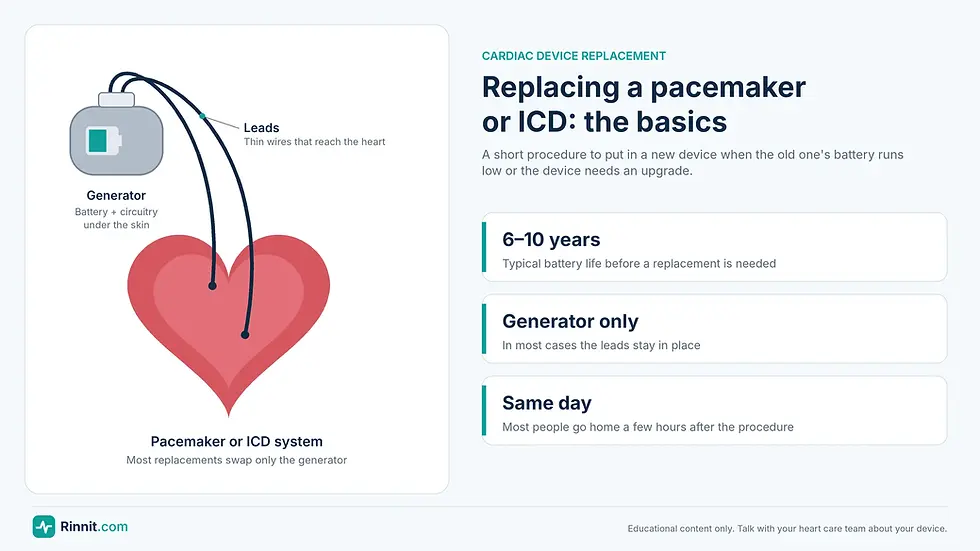
Pacemaker and ICD replacement at a glance
Question | Short answer |
What gets replaced? | Usually the generator (battery + circuitry) only |
Why? | Low battery, malfunction, an upgrade, or (rarely) infection |
How often? | About every 6 to 10 years |
Who does it? | A heart surgeon, cardiologist, or electrophysiologist |
Anesthesia | IV sedation through a vein in your arm |
Hospital stay | Several hours; most people go home the same day |
Recovery | Rest on day one; no heavy lifting or strenuous exercise for several days |
What is cardiac implantable electronic device replacement?
Cardiac implantable electronic device (CIED) replacement is surgery to replace a device that helps control your heart rhythm. The device being replaced is either a pacemaker or an implantable cardioverter-defibrillator (ICD).
Both devices treat abnormal heart rhythms, called arrhythmias. A pacemaker helps when the heart beats too slowly, as in bradycardia, heart block, or sick sinus syndrome. An ICD watches for dangerous fast rhythms, such as those in ventricular arrhythmia.
In most cases, replacement is a simple outpatient procedure. It does not require an overnight stay in the hospital.
Who needs a pacemaker or ICD replacement?
People need a pacemaker or ICD replacement most often because the device's battery is reaching the end of its life, has a low charge, or can no longer hold a charge.
Batteries typically last 6 to 10 years. That means you may have several replacements during your lifetime. Your healthcare provider checks the generator at your follow-up visits, so they will know when the battery is getting close to the end.
Other reasons for replacing the device include:
Reason | What it means |
Low battery | The most common reason; battery nears the end of its lifespan |
Upgrade | Your provider recommends a newer device or one with extra features |
Malfunction | The device stops working properly or stops working entirely |
Infection (rare) | An infection that requires the device to be removed |
Who performs pacemaker and ICD replacement?
A pacemaker or ICD replacement is performed by a physician who specializes in the heart. This may be a heart surgeon, a cardiologist, or an electrophysiologist (a doctor who specializes in the heart's electrical system).
How do you prepare for pacemaker or ICD replacement?
Preparing for pacemaker or ICD replacement means following your care team's detailed instructions, which may include medicine changes and a few tests. Your provider may:
Ask you to stop certain medicines, such as aspirin or anti-inflammatory drugs.
Check your heart with an electrocardiogram (EKG) or an echocardiogram.
Order blood tests to make sure you are healthy enough for the procedure.
What happens during pacemaker or ICD replacement?
During a typical pacemaker or ICD replacement, only the battery-powered generator under your skin is replaced. The leads attached to your heart usually stay where they are, so major surgery to remove them is not needed.

During a generator replacement, your healthcare provider:
Gives you IV sedation through a vein in your arm.
Makes an incision (cut) in the skin over the implanted device.
Detaches the old generator from the leads and removes it.
Implants the new generator and connects it to the leads.
Closes the incision with stitches or glue.
What are the types of pacemaker or ICD replacement?
Type | What happens | Complexity |
Generator only | Battery unit swapped; existing leads reconnected | Most common, simplest |
Full system (with leads) | Generator and leads removed or replaced | More complex procedure |
Leadless pacemaker | Old device switched off and left in place with a new one added, or removed through a vein with a catheter | Possible because leadless devices are much smaller |
What happens after pacemaker or ICD replacement?
After pacemaker or ICD replacement, you stay in the hospital or outpatient surgery center for several hours while your care team monitors you as the sedation wears off. Most people go home the same day.
What are the benefits of replacing a pacemaker or ICD?
The main benefit of replacing a pacemaker or ICD is keeping the device working at its best. A well-functioning device is essential for your heart health and can prevent dangerous abnormal heart rhythms, and even death, such as sudden cardiac arrest.
What are the risks of pacemaker or ICD replacement?
Pacemaker or ICD replacement is typically a safe, low-risk procedure, but complications can happen. Possible risks include:
An allergic reaction to the sedation.
Excessive bleeding or blood clots.
Infection of the incision, or around the leads if they need to be replaced.
What is recovery like after pacemaker or ICD replacement?
Recovery after pacemaker or ICD replacement is usually quick: take it easy on the day of the procedure, and avoid strenuous exercise or heavy lifting for several days.

Time | What to expect |
Procedure day | Several hours of monitoring; most people go home; rest |
First few days | Some swelling or soreness around the incision |
Several days | Avoid strenuous exercise and heavy lifting |
Ongoing | Follow your provider's instructions for device checks |
Your healthcare provider can give you medicine for mild to moderate pain. They will also explain how to:
Clean and care for your incision as it heals.
Monitor your new device.
Get back to your regular activities.
When should you call your doctor after pacemaker or ICD replacement?
Call your healthcare provider after pacemaker or ICD replacement if you have chest pain, a fever, shortness of breath, or signs of infection at the incision, or if your device may not be working correctly.
Possible complication | Possible device problem |
Chest pain | Dizziness |
Fever or other flu-like symptoms | Fainting |
Shortness of breath | Fast or slow heartbeat |
Pus or foul-smelling drainage from the incision | Hiccups |
If symptoms are severe or sudden, such as fainting with chest pain, seek emergency care right away.
Conclusion
Pacemaker and ICD replacement is a routine part of living with a heart rhythm device. Because batteries last about 6 to 10 years, most replacements are planned well ahead at regular device checks. In most cases, only the generator is swapped, the procedure takes place under sedation, and you go home the same day.
Knowing what is normal during recovery, and which warning signs need a call to your doctor, helps you get through it safely and with confidence.
Have a device replacement coming up? Save or print this guide and bring it to your next appointment, and keep exploring our heart health guide for clear, doctor-reviewed answers about your heart.
Frequently asked questions
How long does a pacemaker or ICD battery last?
A pacemaker or ICD battery typically lasts about 6 to 10 years. Your provider checks the battery at follow-up visits, so they will know when a replacement is getting close.
Do the leads need to be replaced too?
The leads usually do not need to be replaced. Most replacements swap only the generator and reconnect it to the existing leads. Replacing the full system, including the leads, is a more complex procedure.
Will I be awake during the replacement?
You receive IV sedation through a vein in your arm, which helps you stay relaxed during the procedure.
Do I need to stay overnight in the hospital?
Most people do not need to stay overnight. You are monitored for several hours after the procedure, and most people go home the same day.
How soon can I return to normal activities?
Take it easy on the day of the procedure and avoid strenuous exercise or heavy lifting for several days. Your provider will tell you when to resume regular activities.
What happens if I have a leadless pacemaker?
A leadless pacemaker can be turned off and left in place while a new device is implanted, or it can be removed through a vein using a thin, flexible tube called a catheter.
What are the warning signs after a pacemaker or ICD replacement?
Call your doctor for chest pain, fever, shortness of breath, or pus or foul-smelling drainage from the incision. Dizziness, fainting, a fast or slow heartbeat, or hiccups can signal that the device is not working correctly.
Is pacemaker or ICD replacement painful?
You get numbing medicine and usually sedation, so you should feel little during the procedure. Mild soreness or swelling for a few days afterward is normal.
How will I know when my device battery is running low?
Your regular device checks, in the clinic or by remote monitoring, track the battery. Replacement is usually planned well before the battery runs out.
Will I get a new incision for the replacement?
Usually the surgeon opens the same area where your current device sits. Your care team will explain the plan for your procedure.
Related reading
References
Cleveland Clinic. Cardiac Implantable Electronic Device Replacement. Cleveland Clinic. Last updated August 29, 2022. https://my.clevelandclinic.org/health/treatments/16837-cardiac-implantable-electronic-device-replacement
National Library of Medicine. Pacemakers and Implantable Defibrillators. MedlinePlus. Last updated August 12, 2025. https://medlineplus.gov/pacemakersandimplantabledefibrillators.html
American Heart Association. Living With Your Pacemaker. Heart.org. Last reviewed October 29, 2024. https://www.heart.org/en/health-topics/arrhythmia/prevention--treatment-of-arrhythmia/living-with-your-pacemaker
National Health Service. Pacemakers. NHS. Page last reviewed March 30, 2026. https://www.nhs.uk/tests-and-treatments/pacemaker-implantation/
Beurskens NE, Tjong FV, Knops RE. End-of-life Management of Leadless Cardiac Pacemaker Therapy. Arrhythm Electrophysiol Rev. 2017;6(3):129-133. PMID 29018521. https://doi.org/10.15420/aer.2017:16:1
Poole JE, Gleva MJ, Mela T, et al. Complication rates associated with pacemaker or implantable cardioverter-defibrillator generator replacements and upgrade procedures: results from the REPLACE registry. Circulation. 2010;122(16):1553-1561. PMID 20921437. https://doi.org/10.1161/CIRCULATIONAHA.110.976076
Polyzos KA, Konstantelias AA, Falagas ME. Risk factors for cardiac implantable electronic device infection: a systematic review and meta-analysis. Europace. 2015;17(5):767-777. PMID 25926473. https://doi.org/10.1093/europace/euv053
Koerber SM, Turagam MK, Winterfield J, et al. Use of antibiotic envelopes to prevent cardiac implantable electronic device infections: A meta-analysis. J Cardiovasc Electrophysiol. 2018;29(4):609-615. PMID 29364546. https://doi.org/10.1111/jce.13436
Medical disclaimer
This article is for educational purposes only and does not replace advice from your doctor. Always follow the instructions of your heart care team.



Comments