Onchocerciasis Guide: Understanding and Preventing River Blindness

Updated: 2 days ago
Medically reviewed by Dr. Baraa Alnahhal, MD · Last reviewed: October 2026
Quick Answer: Onchocerciasis at a Glance
Onchocerciasis, or river blindness, is an infection with the parasitic worm Onchocerca volvulus spread by repeated bites of infected blackflies, mostly in sub-Saharan Africa and Yemen. [1] [2] It causes intense itching, skin nodules, eye lesions and permanent blindness. [1] [2] It does not spread person to person. [1] Treatment is ivermectin by mouth at least once a year for 10 to 15 years. [1] [2]
Feature | Details |
Common name | |
Cause | |
Transmission | |
Main symptoms | |
Where it occurs | Mostly sub-Saharan Africa and Yemen, with smaller foci on the Brazil-Venezuela border. [2] |
Main treatment | |
Prevention | Avoid affected areas when possible. Otherwise, cover up, use DEET repellent, and wear permethrin-treated clothing. [1] |
What the research says
Long-running ivermectin programs can stop transmission, but it takes time, high coverage, and sometimes more frequent dosing. A systematic review and meta-analysis covered 238 foci in 19 sub-Saharan African countries (282 records). Elimination of transmission was reported in 9% of records, being close to elimination in 30%, and ongoing transmission in 61%. Programs with 10 or more years of continuous ivermectin treatment at 80% or higher coverage had significantly higher odds of reaching or approaching elimination, and 15 to 19 years of treatment and twice-yearly dosing were also associated with progress. (Mutono et al., Lancet Glob Health, 2024) [4]
A newer drug, moxidectin, cleared more skin larvae than ivermectin in a large trial. In a randomized, double-blind phase 3 trial in Ghana, Liberia, and the Democratic Republic of the Congo, 998 people aged 12 or older were assigned a single dose of moxidectin and 501 were assigned ivermectin. Twelve months later, skin larvae density was 0.6 per mg of skin with moxidectin versus 4.5 with ivermectin (an 86% treatment difference). Nearly everyone in both groups had expected treatment reactions, and no serious adverse events were judged to be related to treatment. (Opoku et al., Lancet, 2018) [5]
What Is Onchocerciasis?
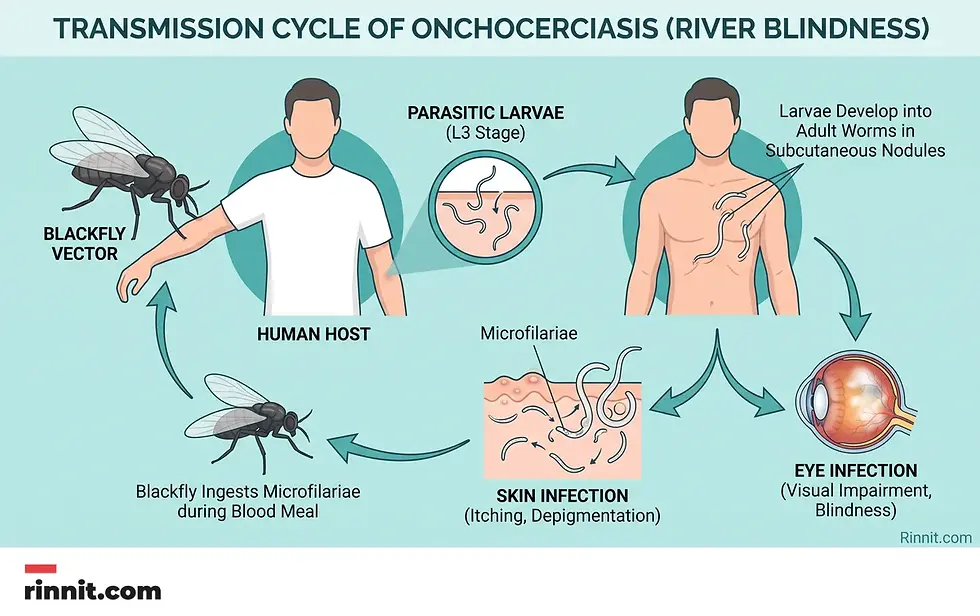
Onchocerciasis is an infection caused by the parasitic worm Onchocerca volvulus. [1] [2] It is called river blindness because the blackflies that spread it breed in fast-flowing rivers and streams, usually near remote, rural, agricultural villages. [1] [2] When an infected fly bites, it passes larvae into the skin. [1] The larvae grow into adult worms that form nodules under the skin. [2] The adult female worms live for roughly 10 to 15 years and produce millions of microscopic larvae (microfilariae) that spread through the skin and to the eyes. [1]
The disease can cause severe skin problems and vision loss, including permanent blindness. [1] [2] Cleveland Clinic describes it as the second-leading infectious cause of blindness in the world. [1]
How Common Is It?
More than 99% of infected people live in Africa and Yemen, according to the World Health Organization (WHO). [2] The remaining 1% live on the border between Brazil and Venezuela. [2] The Global Burden of Disease Study estimated in 2017 that 14.6 million infected people already had skin disease and 1.15 million had vision loss. [2] Some countries have eliminated the disease through insecticide spraying and mass treatment [1]: WHO has verified Colombia, Ecuador, Mexico, and Guatemala as free of onchocerciasis, along with Niger in 2025. [2] [3]
How Do You Get River Blindness?
The disease does not spread directly between people. [1] A blackfly picks up microfilariae when it bites an infected person. [1] The larvae develop inside the fly and are passed to a new person during a later bite. [1] Several bites are generally needed for infection, so the people most at risk live in affected areas or stay there for a long time, such as field researchers, missionaries, and Peace Corps volunteers. [1]
What are the symptoms of onchocerciasis (river blindness)?
A person with onchocerciasis usually feels fine until the larvae reproduce in large numbers, which may take 12 to 18 months. [1] Then the body mounts an inflammatory response, and symptoms appear, mainly in the skin and eyes. [1]

How Is Onchocerciasis Diagnosed?
Onchocerciasis is diagnosed with skin biopsies, a slit-lamp eye exam and blood tests, and early care matters because vision loss from river blindness is permanent. [1] Providers use several tests:
Skin biopsies: small skin samples from different parts of the body are examined under a microscope for larvae. [1]
Slit-lamp eye exam: a microscope with a bright light lets the provider look for lesions on the eye. [1]
Blood tests: these can detect antibodies the body makes to fight the infection. [1]
How Is It Treated?
Treatment is ivermectin, an oral antiparasitic medicine. [1] It kills the larvae but not the adult worms. [1] Because each adult female worm can live about 10 to 15 years, ivermectin must be taken at least once a year for 10 to 15 years. [1] [2] WHO recommends the same schedule, and in affected communities ivermectin is given to whole populations (mass drug administration), with a minimum target of 80% treatment coverage. [2]
Newer options also exist: moxidectin was approved by the U.S. FDA in 2018 for river blindness in people aged 12 and older. In one large trial, a single dose of moxidectin lowered skin larvae counts more than ivermectin at 12 months [5] (see the research box above), but WHO recommends treating onchocerciasis with ivermectin. [2] In areas where onchocerciasis overlaps with Loa loa, another parasitic worm, treatment strategies may need to be adjusted because of the risk of severe side effects, so follow your country's program guidance. [2]
How Can You Prevent It?
Onchocerciasis is best prevented by avoiding places where infection still occurs, or by preventing blackfly bites with covering clothes, DEET repellent and permethrin-treated clothing. [1] If you must go, take these steps to avoid blackfly bites:
Wear long sleeves and long pants. [1]
Tuck your pants into your socks so your ankles are not exposed. [1]
Spray your skin and clothes with an insect repellent that contains DEET. [1]
Choose clothing treated with permethrin, an insecticide, for an added layer of protection. [1]
Stay away from fast-flowing rivers and streams in affected areas, where the flies breed.

What is the outlook for onchocerciasis (river blindness)?
River blindness can be controlled, and in some places it has been eliminated. [1] [2] Without treatment, the infection can cause disfiguring skin disease and permanent blindness. [1] [2] Getting medical treatment as soon as possible after infection helps prevent severe disease. [1] If you have been bitten by blackflies in an affected region, or you have itchy skin, skin lumps, or vision changes after travel there, see a healthcare provider. [1]
What is the bottom line on onchocerciasis?
Onchocerciasis is a serious parasitic disease, but it is preventable and treatable. Protecting yourself from blackfly bites in affected areas and starting ivermectin treatment early are the best ways to protect your skin and your vision. Vision that has already been lost cannot be restored [1], which makes early diagnosis and long-term treatment so important.
Want more global health and infection prevention guides? Explore more plain-language health information at Rinnit.com.
Frequently Asked Questions
Is river blindness contagious?
No. It cannot spread directly from one person to another. It spreads only when blackflies bite an infected person, pick up the larvae, and then bite someone else. [1]
Can river blindness be cured?
Ivermectin kills the larvae but not the adult worms, so treatment is needed at least once a year for 10 to 15 years, about the lifespan of the adult female worms. [1] Vision that has already been lost cannot be restored. [1]
How soon do symptoms start after infection?
A person usually feels fine until the larvae reproduce in large numbers, which may take 12 to 18 months. [1]
Is the blindness from onchocerciasis reversible?
No. If onchocerciasis leads to blindness, the vision loss is permanent. [1]
Where is onchocerciasis most common?
More than 99% of infected people live in Africa and Yemen. [2] The rest live on the border between Brazil and Venezuela. [2]
What does a skin biopsy for onchocerciasis involve?
A healthcare provider takes small skin samples from different parts of the body and examines them under a microscope for larvae. [1]
Does ivermectin kill the adult worms?
No. Ivermectin kills the larvae only. That is why treatment must continue for 10 to 15 years, until the adult worms die. [1]
What is a slit-lamp exam?
A slit-lamp exam is an eye exam that uses a microscope attached to a bright light, which lets a provider look for lesions on the eye. [1]
Can I get river blindness from a single fly bite?
Infection generally takes several bites from infected blackflies, so a single bite is unlikely to cause it. [1] The risk is highest for people who live in affected areas or stay there for a long time. [1]
What should I do if I think I was exposed?
See a healthcare provider, especially if you have been bitten by blackflies in an affected region or you have itchy skin, skin lumps, or vision changes. A provider can test your skin and blood for infection. [1]
Can permethrin help prevent infection?
Clothing treated with the insecticide permethrin is one of the protective steps advised for people who must travel to affected areas, along with DEET repellent, long sleeves and pants, and tucking pants into socks. [1]
Is there a vaccine for onchocerciasis?
No vaccine is currently in routine use. Prevention relies on avoiding blackfly bites in affected areas and on community-wide ivermectin treatment programs.
Can children get onchocerciasis?
Yes. Anyone who lives in or stays in an affected area can be infected if they are bitten repeatedly by infected blackflies.
How many people are affected?
The Global Burden of Disease Study estimated in 2017 that 14.6 million infected people had skin disease and 1.15 million had vision loss. [2] WHO reports that at least 252.3 million people needed preventive treatment in 2024. [2]
Why is it called river blindness?
River blindness is named for the fast-flowing rivers and streams where the blackfly carriers breed, and for the permanent blindness the disease can cause. [3]
Related Reading
Loiasis (African Eye Worm): Causes, Symptoms, and Treatment covers a related filarial worm infection that affects ivermectin safety.
Uveitis: Symptoms, Causes, and Treatment — What Eye Inflammation Means for Your Vision explains eye inflammation, which onchocerciasis can cause.
Blindness: The Complete Loss of Vision That Affects About 1 Million Americans — and What Medicine Can and Cannot Fix explains the main causes of blindness and vision loss.
Parasitic Infection: Types, Symptoms, and Prevention Strategies covers common parasitic infections and how to prevent them.
References
Cleveland Clinic. Onchocerciasis (River Blindness). Cleveland Clinic. Updated March 29, 2023. https://my.clevelandclinic.org/health/diseases/24868-onchocerciasis-river-blindness
World Health Organization. Onchocerciasis. WHO. Published December 4, 2025. https://www.who.int/news-room/fact-sheets/detail/onchocerciasis
Pan American Health Organization. Onchocerciasis - "River Blindness". PAHO. Accessed October 15, 2026. https://www.paho.org/en/topics/onchocerciasis-river-blindness
Mutono N, et al. Elimination of transmission of onchocerciasis (river blindness) with long-term ivermectin mass drug administration with or without vector control in sub-Saharan Africa: a systematic review and meta-analysis. Lancet Glob Health. 2024;12(5):e771-e782. PMID 38484745. https://doi.org/10.1016/S2214-109X(24)00043-3
Opoku NO, et al. Single dose moxidectin versus ivermectin for Onchocerca volvulus infection in Ghana, Liberia, and the Democratic Republic of the Congo: a randomised, controlled, double-blind phase 3 trial. Lancet. 2018;392(10154):1207-1216. PMID 29361335. https://doi.org/10.1016/S0140-6736(17)32844-1
Medical disclaimer
This article is for general informational purposes only and does not constitute medical advice. Always consult a qualified healthcare professional for diagnosis and treatment decisions. If you have been in an area where river blindness occurs and notice itchy skin, skin lumps, or changes in your vision, see a healthcare provider.



Comments