Oligodendroglioma: Symptoms, Causes, Grades and Treatment Options

Updated: 3 days ago
Medically reviewed by Dr. Baraa Alnahhal, MD · Last reviewed: October 2026
Oligodendroglioma is a rare, usually slow-growing tumor that starts in oligodendrocytes, the cells that protect nerve cells in the brain and, more rarely, the spinal cord. Seizures are often the first symptom [1].
Quick Answer: What is oligodendroglioma?
Oligodendroglioma is a brain tumor that begins in cells called oligodendrocytes and usually grows slowly, with seizures typically the first symptom. Diagnosis combines MRI, a tissue sample and genetic testing. Tumors are graded 2 or 3. Treatment is usually surgery, often followed by radiation and chemotherapy, and the relative five-year survival rate is 79.5%. [1] [2]
What the research says
A targeted drug delayed progression in grade 2 IDH-mutant glioma. In a double-blind trial of 331 patients with residual or recurrent grade 2 IDH-mutant glioma after surgery, median progression-free survival was 27.7 months with vorasidenib versus 11.1 months with placebo (hazard ratio 0.39). Grade 3 or higher adverse events occurred in 22.8% versus 13.5%, and a grade 3 or higher rise in the liver enzyme ALT occurred in 9.6% versus none (Mellinghoff et al., N Engl J Med, 2023).
Adding chemotherapy to radiotherapy lengthened survival in 1p/19q-codeleted anaplastic tumors. In very long-term follow-up (median 18–19 years) of two phase 3 trials, median survival with versus without PCV chemotherapy was 14.2 versus 9.3 years in EORTC 26951 (80 patients with codeletion) and 13.2 versus 7.3 years in RTOG 9402 (125 patients). The EORTC difference did not reach statistical significance (Lassman et al., J Clin Oncol, 2022).
What Is Oligodendroglioma?
Oligodendroglioma is a growth of cells that starts in the brain or spinal cord. It begins in oligodendrocytes, cells that make a substance that protects nerve cells and helps electrical signals flow. The tumor comes from cells that support nerve cells, not the nerve cells themselves [1].
It usually forms in the brain and more rarely in the spinal cord. As it grows it can press on nearby tissue, and the symptoms depend on which part is affected. Oligodendrogliomas are rare, most common in adults, and can happen at any age; most grow slowly [1].
Key fact | Detail |
Cell of origin | Oligodendrocytes (cells that protect nerve cells and support electrical signals) |
Usual location | Brain; more rarely, spinal cord |
How common | Rare; most common in adults but possible at any age |
Growth pattern | Usually slow-growing |
Typical first symptom | Seizures |
Medical description | Oligodendroglioma, IDH-mutant, 1p/19q-codeleted |
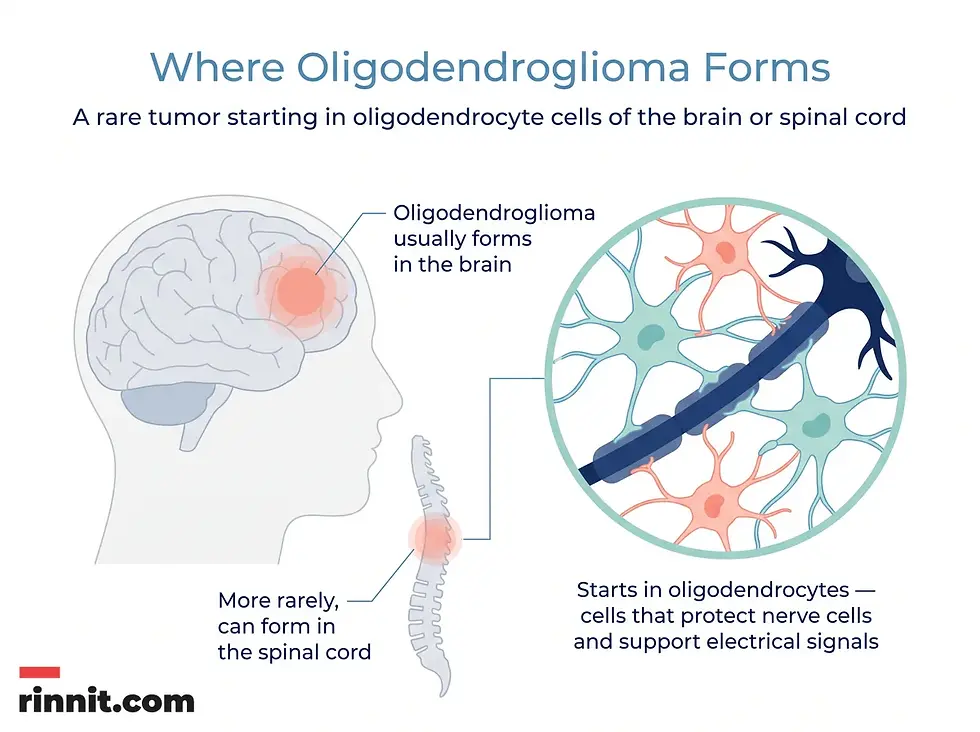
Oligodendroglioma usually forms in the brain, and more rarely in the spinal cord.
What are the symptoms of oligodendroglioma?
Because these tumors grow slowly, symptoms may not appear for many years. Sometimes the tumor is found when brain images are taken for another reason, such as severe headaches or a suspected concussion [1].
Seizures are usually the first symptom. These tumors often occur in brain areas that support motor control, and the tumor can disrupt the brain's electrical signals [1]. Other symptoms depend on tumor size and location:
Changes in behavior
Headaches
Memory problems
Numbness on one side of the body
Problems speaking
Problems thinking clearly
When to See a Doctor
If you notice ongoing symptoms that concern you, reach out to a healthcare professional, clinic, or trusted community health resource for advice [1]. This matters especially for a new seizure, ongoing headaches, or gradual changes in memory, speech, or movement.
What Causes Oligodendroglioma?
The cause often is not known. The tumor happens when oligodendrocytes develop changes in their DNA. In healthy cells, DNA instructs cells to grow and multiply at a set rate and to die at a set time. In tumor cells, the DNA changes tell the cells to grow and multiply quickly and keep living when healthy cells would die, producing too many cells [1].
Doctors look for DNA changes called IDH mutations and specific chromosome changes (1p/19q codeletion). As the growth enlarges it may press on nearby brain or spinal cord tissue, and sometimes the DNA changes turn the tumor cells into cancer cells that can invade and destroy healthy tissue [1].
What are the risk factors for oligodendroglioma?
The cause of oligodendroglioma is often unknown and there is no way to prevent it, although some risk factors are known.
Risk factor | How it relates to risk |
History of radiation exposure | Radiation to the head and neck can increase risk |
Adult age | Possible at any age, but more often found in adults in their 40s and 50s |
White race | Happens most often in white people without Hispanic ancestry |
There is no way to prevent oligodendroglioma [1].

Known risk factors for oligodendroglioma. The cause is often unknown, and the tumor cannot be prevented.
How is oligodendroglioma diagnosed?
Oligodendroglioma diagnosis is made precise with genetic testing, which helps the care team understand how the tumor might change and which treatments might help.
Diagnostic step | What it involves |
Neurological exam | Questions about symptoms and checks of vision, hearing, balance, coordination, strength, and reflexes; problems can hint at the affected brain area |
MRI | Detailed cross-sectional images that show where the tumor is and how large it is |
Functional MRI | Shows blood flow to areas handling critical functions, language, and movement, which helps guide brain surgery decisions |
Tissue sample | Taken during tumor-removal surgery when possible; otherwise collected with a needle biopsy |
Microscope and genetic tests | Show cell types, check for DNA changes specific to oligodendroglioma, and rule out similar gliomas such as astrocytoma and glioblastoma |
Genetic testing makes the diagnosis precise and helps the team understand how the tumor might change and which treatments might help [2].
What are the grades and prognosis of oligodendroglioma?
Oligodendrogliomas are graded 2 or 3, reflecting how aggressive they are. Grade 2 tumors grow slowly and are usually treated with surgery, sometimes followed by radiation or chemotherapy. Grade 3 (anaplastic) tumors are more aggressive and treatment usually includes surgery, radiation, and chemotherapy [2].
Survival Rates
Long-term survival is possible for many people, but these tumors generally shorten lifespan because they can keep growing and can be hard to treat [2].
Measure | Figure |
Relative 5-year survival (overall) | 79.5% |
Grade 2 | Often more than 10 years after treatment, especially if healthy, younger, and the tumor is entirely removed; some research shows a median survival of 18 to 20 years |
Grade 3 (anaplastic) | Median survival of 14 years in long-term trials; about 20% of people live five years or less |
A relative survival rate compares people with the tumor to people without it: 79.5% means those diagnosed are 79.5% as likely to live at least five years. Survival varies with tumor grade and age at diagnosis.
Factors That Affect Outlook
Your team considers the tumor's grade, how quickly it is growing, where it is, whether surgery can remove it completely, how well other treatments work, and your overall health. Younger, generally healthy people have a better chance of living longer. Factors that usually predict a worse outcome include [2]:
Older age at diagnosis, especially over 60
Being assigned male at birth
Trouble with movement, speech, or other brain-related activities
Poorer overall health
A tumor in a hard-to-reach area of the brain
A tumor larger than about 2 inches (4 to 5 centimeters)
No seizures when the tumor was first found
What You Can Do
Follow up with your team for monitoring and regular scans, maintain your health as advised, report new symptoms quickly, and take part in supportive care programs if offered [2].
What are the treatment options for oligodendroglioma?
Treatment depends on the tumor's size and location, your symptoms, age, and general health [2].
Surgery
Surgery is used when possible, and the goal is to remove as much of the tumor as possible without harming healthy brain tissue. In awake brain surgery, you are woken from a sleeplike state and the surgeon may ask questions and monitor brain activity as you reply, which helps identify important areas to avoid. Surgery cannot always be done if the tumor is hard to reach [2].
Radiation Therapy
Radiation therapy uses powerful energy beams, such as X-rays or protons, aimed at exact points in the brain to kill tumor cells. It is sometimes used after surgery, may be combined with chemotherapy, and is recommended for grade 3 oligodendroglioma [2].
Chemotherapy
Chemotherapy uses strong medicines to kill tumor cells. It is often used after surgery to kill any remaining cells, and can be given at the same time as radiation or after it is finished. After surgery, radiation plus chemotherapy is generally best for managing oligodendroglioma, with the regimen and timing adjusted for how much tumor was removed, age, health, genetic markers, and symptoms [2].
Watchful Waiting
Your team may recommend watchful waiting, with regular imaging scans to watch for changes in the tumor [2].
Other Options
Option | When it may be used |
Medicines | After surgery for grade 2 IDH-mutant oligodendroglioma, vorasidenib (Voranigo) is FDA-approved for people 12 and older to help slow regrowth. It can harm the liver, so regular liver blood tests are needed |
Clinical trials | Studies of new treatments; the risk of side effects may not be known, so ask your team about participating |
Supportive (palliative) care | Relieves pain and other symptoms and can be used at the same time as surgery, chemotherapy, or radiation |

Treatment options for oligodendroglioma: surgery, radiation, chemotherapy, watchful waiting, medicines, and supportive care.
Recurrent Oligodendroglioma
If treatment shrinks the tumor but it comes back later, it is called recurrent oligodendroglioma and more treatment may be needed. Your team will likely keep monitoring the tumor even after treatment [1][2].
How should you prepare for an oligodendroglioma appointment?
To prepare for an oligodendroglioma appointment, which may be with your primary care provider, an oncologist or a neurosurgeon, list your symptoms, medications and questions. Make a list of your symptoms (including ones that seem unrelated), key personal information and family medical history, all medications and supplements with doses, and your questions, and bring a family member or friend if possible [2]. Useful questions include:
Do I have cancer? If the tumor is not cancerous, do I still need to have it removed?
Do I need more tests?
What are my treatment options and their potential complications? Do any cure my cancer?
Can I have a copy of my pathology report?
How much time can I take to consider my options?
What would happen if I chose not to have treatment?
What is the bottom line on oligodendroglioma?
Oligodendroglioma is a rare, usually slow-growing tumor of the cells that protect nerve cells. Seizures are often the first sign, diagnosis relies on MRI plus genetic testing, and treatment usually combines surgery with radiation and chemotherapy. Discuss your grade, genetic markers, treatment options, clinical trials, and supportive care with your healthcare team [1][2].
Frequently Asked Questions
What is an oligodendroglioma?
An oligodendroglioma is a rare growth of cells that starts in the brain or, more rarely, the spinal cord, beginning in oligodendrocytes, the cells that protect nerve cells and help electrical signals flow. It usually grows slowly, seizures are often the first symptom, and treatment is usually surgery, sometimes followed by radiation and chemotherapy.
What causes oligodendroglioma?
The cause is often not known. The tumor starts when oligodendrocytes develop DNA changes that tell the cells to grow and multiply quickly and to keep living when healthy cells would die, forming a tumor that can press on brain or spinal cord tissue.
What are the first symptoms of oligodendroglioma?
Seizures are usually the first symptom because these tumors often occur in brain areas that support motor control. Other symptoms include headaches, memory problems, numbness on one side of the body, problems speaking or thinking clearly, and changes in behavior.
Is oligodendroglioma a type of cancer?
Oligodendroglioma is a tumor, and sometimes the DNA changes turn the tumor cells into cancer cells that can invade and destroy healthy tissue. Genetic testing for IDH mutations and 1p/19q codeletion confirms the tumor type.
What is the difference between grade 2 and grade 3 oligodendroglioma?
Grade 2 tumors grow slowly and are usually treated with surgery, sometimes followed by radiation or chemotherapy. Grade 3 tumors, also called anaplastic oligodendroglioma, are more aggressive, and treatment usually includes surgery, radiation, and chemotherapy.
What is the survival rate for oligodendroglioma?
The relative five-year survival rate is 79.5%. Many people with grade 2 tumors live more than 10 years after treatment, with some research showing a median survival of 18 to 20 years. For grade 3 tumors, long-term trials show a median survival of 14 years, and about 20% of people live five years or less.
How is oligodendroglioma diagnosed?
Diagnosis involves a neurological exam, MRI (sometimes functional MRI), and a tissue sample taken during surgery or with a needle biopsy. Lab and genetic tests look for the IDH mutation and 1p/19q codeletion and rule out similar gliomas such as astrocytoma and glioblastoma.
What treatments are used for oligodendroglioma?
Treatment usually starts with surgery to remove as much of the tumor as possible, sometimes with awake brain surgery. Radiation therapy and chemotherapy are often combined afterward. Watchful waiting, newer medicines such as vorasidenib, clinical trials, and palliative care are other options depending on the situation.
Can oligodendroglioma come back after treatment?
Yes. If treatment shrinks the tumor but it returns later, it is called recurrent oligodendroglioma and more treatment may be needed. Regular MRI monitoring helps catch recurrences early.
What increases the risk of oligodendroglioma?
Risk factors include a history of radiation to the head and neck, adult age (most often the 40s and 50s), and being a white person without Hispanic ancestry. There is no way to prevent oligodendroglioma.
What should I ask my doctor about oligodendroglioma?
Ask whether you have cancer, whether the tumor needs removal if it is not cancerous, what other tests you need, what your treatment options and their complications are, whether you can get a copy of your pathology report, how long you have to decide, and what would happen without treatment.
Related Resources
Related reading on Rinnit:
External resources for deeper reading:
References
Mayo Clinic Staff. Oligodendroglioma: symptoms and causes. Mayo Clinic. October 8, 2025. https://www.mayoclinic.org/diseases-conditions/oligodendroglioma/symptoms-causes/syc-20576736
Mayo Clinic Staff. Oligodendroglioma: diagnosis and treatment. Mayo Clinic. October 8, 2025. https://www.mayoclinic.org/diseases-conditions/oligodendroglioma/diagnosis-treatment/drc-20576750
Mellinghoff IK, van den Bent MJ, Blumenthal DT, et al. Vorasidenib in IDH1- or IDH2-mutant low-grade glioma. N Engl J Med. 2023;389(7):589-601. PMID: 37272516. DOI: 10.1056/NEJMoa2304194
Lassman AB, Hoang-Xuan K, Polley MC, et al. Joint final report of EORTC 26951 and RTOG 9402: phase III trials with procarbazine, lomustine, and vincristine chemotherapy for anaplastic oligodendroglial tumors. J Clin Oncol. 2022;40(23):2539-2545. PMID: 35731991. DOI: 10.1200/JCO.21.02543
Medical disclaimer
This article is for informational purposes only and is not a substitute for professional medical advice, diagnosis, or treatment. Always seek the advice of your physician or other qualified health provider with any questions you may have about a medical condition.



Comments