Glioblastoma: Understanding the Most Aggressive Brain Cancer — Symptoms, Causes, and Treatment Options

Updated: 3 days ago
Medically reviewed by Dr. Baraa Alnahhal, MD · Last reviewed: October 30, 2026
Quick Answer
Glioblastoma (GBM) is the most common malignant brain tumor in adults, a grade 4 glioma that starts in astrocytes and spreads quickly into nearby brain tissue. Symptoms include headaches, new seizures, memory loss, personality changes and one-sided weakness. There is no cure, but surgery, radiation, chemotherapy, tumor treating fields and targeted therapy can slow it and extend life.
What the research says
Adding temozolomide chemotherapy to radiation helps people with glioblastoma live longer. In a trial of 573 patients, median survival was 14.6 months with radiation plus temozolomide versus 12.1 months with radiation alone, and two-year survival was 26.5% versus 10.4% (Stupp et al., N Engl J Med, 2005) [4].
Tumor treating fields add a further survival benefit. In a trial of 695 patients, median overall survival was 20.9 months with tumor treating fields plus temozolomide versus 16.0 months with temozolomide alone (Stupp et al., JAMA, 2017) [5].
What Is Glioblastoma?
Glioblastoma is a type of cancer that starts in cells called astrocytes that support nerve cells [2]. It can form in the brain or spinal cord.
Because it begins in these glial cells, glioblastoma belongs to a wider group of tumors called gliomas. Glioblastoma is the most common malignant form of glioma — it's the most common malignant brain tumor in adults and makes up about half of all malignant brain tumors in adults.
Within this group, glioblastoma is classified as a grade 4 glioma, the most serious type of glioma. Grade 4 means the tumor grows and spreads quickly into nearby brain tissue, which makes it hard to remove completely [2]. As a result, these tumors can invade and destroy healthy tissue.
Glioblastoma is sometimes called GBM. The older term "glioblastoma multiforme" refers to the same disease.

Glioblastoma can occur at any age, but it happens most often in older adults [2]. There is no cure for glioblastoma. Treatments such as surgery, radiation, and chemotherapy may slow tumor growth, ease symptoms, and help people live longer.
Symptoms: What Glioblastoma Feels Like
Signs and symptoms of glioblastoma can vary based on where the tumor forms in the brain.
Symptom Category | What to Notice |
Headache and related | Frequent or worsening headaches; headaches worse in the morning; headaches worse when lying down; nausea or vomiting |
Thinking and memory | Confusion or trouble understanding information; difficulty making decisions; memory loss or difficulty concentrating |
Personality and behavior | Irritability; reduced ability to control emotions; noticeable shifts in behavior or mood; restlessness and agitation |
Sensory | Blurred or double vision or loss of side vision; hearing changes or ringing in the ears; numbness or reduced sense of touch; changes in smell or taste |
Speech and language | Difficulty finding words; difficulty understanding language; slurred or unclear speech |
Movement and coordination | Difficulty with balance or coordination; weakness in the face, arms, or legs; weakness affecting one side of the body; difficulty swallowing |
Seizures and alertness | New seizures in someone without a prior seizure history; increased tiredness or sleepiness; brief periods of being less alert or harder to wake |
Two patterns stand out in this list. Headaches that worsen in the morning or when lying down, often with nausea or vomiting, reflect rising pressure inside the skull. And a first-ever seizure in an adult with no seizure history is a signal that should always be evaluated promptly.

Causes: DNA Changes in Support Cells
The cause of most glioblastomas is not known [2].
Glioblastoma happens when cells in the brain develop changes in their DNA. Healthcare professionals sometimes call these changes mutations or variations. DNA gives cells instructions for how to grow, divide, and die. When DNA changes occur, the instructions change. The cells may grow too fast, make too many copies, or keep living when healthy cells would die. These changed cells become cancer cells.
The cancer cells can build up and form a tumor. As the tumor grows, it can press on nearby nerves and parts of the brain. It also can invade and destroy healthy brain tissue, leading to symptoms and complications.
Most glioblastomas do not run in families, and inherited causes are rare.
Risk Factors
Researchers do not know why most glioblastomas develop, but a few factors have been linked to a higher risk.
Risk Factor | Details |
Getting older | Glioblastoma is most common in older adults, but it can happen at any age |
Ionizing radiation exposure | Exposure to ionizing radiation, such as radiation therapy used to treat cancer, increases risk [2] |
Inherited syndromes | DNA changes passed from parents to children may raise risk; examples include Lynch syndrome and Li-Fraumeni syndrome [2]; genetic testing can find these syndromes |
Sex assigned at birth | Glioblastoma is about 1.5 times more common in people assigned male at birth |
Researchers haven't found anything you can do to prevent glioblastoma.
Complications: What Happens as the Tumor Grows
Glioblastoma can cause complications as it grows and affects nearby brain tissue. Which complications happen depends on the tumor's size and location.
Complication | What Happens |
Seizures | May cause new seizures or make existing seizures worse |
Brain swelling | Tumor growth leads to swelling in the brain, which may cause headache, nausea, or changes in alertness |
Changes in thinking or personality | Can affect memory, planning, attention, or behavior |
Weakness or movement changes | Tumors in certain areas can cause weakness on one side of the body or make coordination difficult |
Vision or speech trouble | May affect how someone sees or speaks, depending on where it forms |
Hydrocephalus | The tumor blocks the flow of fluid around the brain, causing a buildup of pressure |
Recurrence | Even with treatment, glioblastoma often returns; symptoms may become more noticeable and additional treatment may be needed |
When to See a Doctor
Make an appointment with a doctor or other healthcare professional if you have any signs or symptoms that worry you.
Diagnosis: Confirming Glioblastoma
To diagnose glioblastoma, you may have a physical exam and a review of your personal and medical history. You also may have tests to check how your brain is working and to take pictures of your brain.
Test or Procedure | What It Involves |
Neurological exam | Checks vision, hearing, balance, coordination, strength, and reflexes; changes give clues about the part of the brain the glioblastoma affects |
Brain MRI | The imaging test used most often to diagnose glioblastoma; an IV injection of contrast material is sometimes given to create better pictures |
Brain CT | Another imaging test that can help find the tumor's location and size |
PET scan (positron emission tomography) | An additional imaging test that may be used |
Biopsy | A tissue sample is removed with a needle before surgery or during surgery; the sample is tested in a lab to confirm whether the cells are cancerous and whether they're glioblastoma; special tests give the team more information about the tumor and prognosis for the treatment plan |
Treatment: The Options, and When Each Is Used
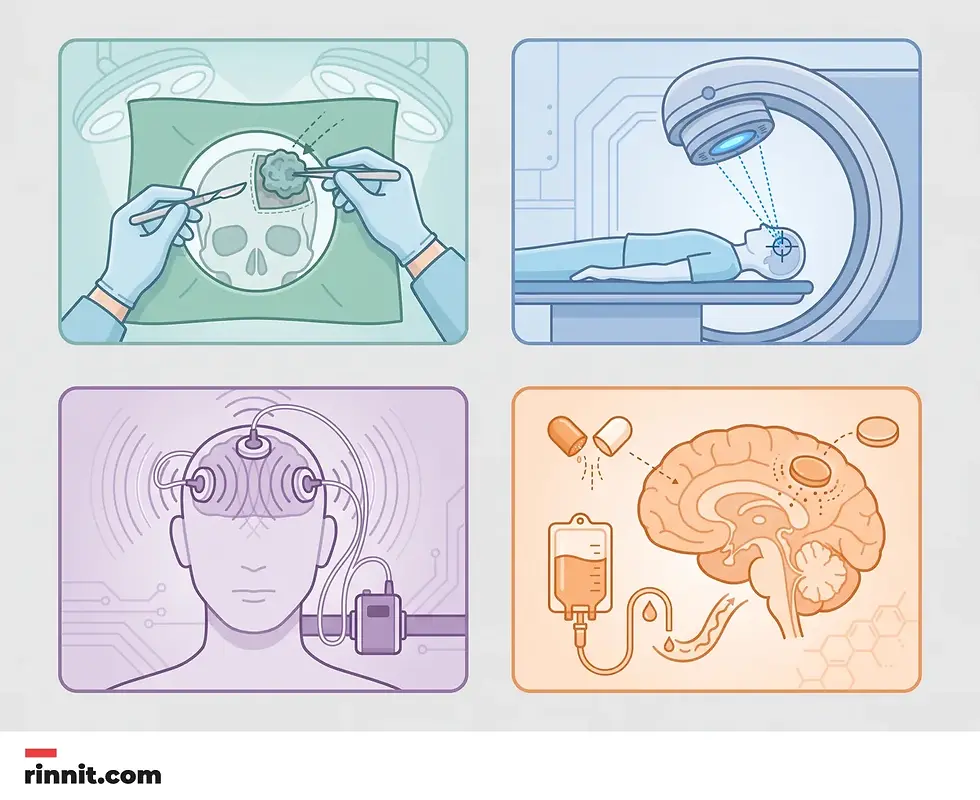
There are several kinds of cancer therapy that may be used to treat glioblastoma. Treatment may begin with surgery if the tumor can be safely accessed. But surgery isn't always an option — if the glioblastoma grows deeper into the brain, it might be too risky to remove much of the cancer, and only a biopsy may be considered. Radiation therapy and chemotherapy might be recommended as the first treatment instead.
The treatments that are right for you depend on your particular situation. Your healthcare team considers the size of the glioblastoma, where it's located in the brain, your health, and your preferences.
Treatment | How It Works | When It's Used |
Surgery | A neurosurgeon removes as much of the glioblastoma as can be done safely; complete removal isn't expected because the tumor grows into nearby tissue [2] | May begin treatment if the tumor can be safely accessed; other treatments follow to kill remaining cells |
Radiation therapy | Powerful energy beams (X-rays or protons) aimed at specific brain areas by a machine moving around you | Usually after surgery to kill remaining cells; combined with chemotherapy; main treatment for people who can't have surgery |
Chemotherapy | Strong medicines; a pill is often used after surgery and during and after radiation; IV chemotherapy for tumors that return; dissolving wafers containing chemotherapy may be placed in the brain during surgery | After surgery; during and after radiation; at recurrence |
Tumor treating fields (TTF) | Electrical energy damages glioblastoma cells and makes them hard to multiply [2]; sticky pads on the scalp connect by wires to a portable device generating an electrical field | Works with chemotherapy; may be suggested after radiation therapy |
Targeted therapy | Medicines attack unique biomarkers in cancer cells to make them die; bevacizumab may shrink the tumor or reduce swelling and symptoms; does not cure glioblastoma | After surgery if the tumor can't be removed completely; at recurrence; cancer cells may be tested first |
Clinical trials | Studies of new medicines, combinations, or delivery methods, including immunotherapy, vaccines, and cell-based therapies such as CAR T-cell therapy | Options for some people; not yet part of standard care |
Medicines to Control Symptoms
If your glioblastoma is causing symptoms, you might need medicine to help you feel more comfortable. Which medicines you need depends on your situation. Options include medicine to control seizures, steroid medicines to reduce brain swelling, and medicine to help with headaches.
Palliative Care: Comfort Alongside Treatment
Palliative care is a special type of healthcare that helps someone with a serious illness feel better. If you have cancer, palliative care can help relieve pain and other symptoms. Palliative care does not try to cure the cancer.
A healthcare team that may include doctors, nurses, and other specially trained health professionals provides palliative care. The care team's goal is to improve quality of life for you and your family. Palliative care specialists work with you, your family, and your care team, providing an extra layer of support while you have cancer treatment. You can have palliative care at the same time you're getting strong cancer treatments, such as surgery, chemotherapy, or radiation therapy. The use of palliative care with other medical treatments can help people with cancer feel better and live longer.
Integrative Medicine: Coping Without Curing
Alternative medicine therapies can't cure glioblastoma. But some integrative treatments can be combined with your healthcare team's care to help you cope with cancer treatment and side effects, such as distress.
People with cancer often feel distress. If you're distressed, you may have difficulty sleeping and find that you are thinking about your cancer all the time. Discuss your feelings with your healthcare team — specialists can help you come up with strategies for coping, and for some people, medicines may help.
Integrative medicine treatments that may help you feel better include art therapy, exercise, massage therapy, meditation, music therapy, relaxation exercises, and spirituality. Talk with your healthcare team if you're interested in these treatment options.
Prevention: The Honest Answer
There is no known way to prevent glioblastoma. Most glioblastomas happen without a clear cause, and researchers have not found any lifestyle changes that lower the risk.
Avoiding unnecessary exposure to ionizing radiation may reduce risk, but this type of radiation is not common in daily life.
Preparing for Your Appointment
Make an appointment with a doctor or other healthcare professional if you have any symptoms that worry you. If your healthcare professional thinks you might have a brain tumor, such as glioblastoma, you may be referred to a specialist. Specialists who care for people with glioblastoma include neurologists (brain and nervous system diseases), medical oncologists (medicine to treat cancer), radiation oncologists (radiation to treat cancer), neuro-oncologists (brain and nervous system cancers), and neurosurgeons (surgery on the brain and nervous system).
Before your appointment, note anything you need to do in advance (such as diet restrictions), write down your symptoms — including any that may not seem related — along with important personal information like major stresses or recent life changes. Make a list of all medicines, vitamins, and supplements with doses, and take a family member or friend along to help remember the information you get. Write your questions down, ordered from most important to least important.
Questions to ask your healthcare team: In what part of the brain is my cancer located? Has my cancer spread to other parts of my body? Will I need more tests? What are the treatment options? How much does each treatment increase my chances of living longer? What are the possible side effects, and how will each treatment affect my daily life? Is there one treatment option you believe is the best? What would you recommend to a friend or family member in my situation? Should I see a specialist? What will determine whether I should plan for a follow-up visit?
Questions your doctor may ask you: When did you first begin having symptoms? Do you always have symptoms, or do they come and go? How bad are your symptoms? What seems to make them better or worse?
Coping and Support
With time, you'll find what helps you cope with the uncertainty and worry of a cancer diagnosis. Three strategies help: learn enough about glioblastoma to make decisions about your care by asking your healthcare team about test results, treatment options, and, if you like, your prognosis; keep friends and family close, since they provide practical support — such as helping care for your home if you're in the hospital — and emotional support when you feel overwhelmed; and find someone to talk with, whether a friend, family member, counselor, medical social worker, clergy member, or cancer support group. Some support groups and online communities focus specifically on brain tumors or glioblastoma.
Conclusion: An Aggressive Diagnosis, With Real Treatment Options
Glioblastoma is the most serious grade of glioma — a tumor that grows fast, spreads into healthy brain tissue, and in most cases cannot be fully removed by surgery. Its symptoms are as varied as the locations where it can form, ranging from pressure-driven morning headaches and new seizures to memory loss, personality shifts, and one-sided weakness.
The honest facts matter: the cause is usually unknown, inherited causes are rare, and there is no cure or known prevention. But treatment has moved well beyond "surgery and hope." Surgery to remove as much tumor as is safely possible, followed by radiation and chemotherapy, forms the standard path. Tumor treating fields add electrical disruption of cell division, and targeted therapy offers another option — especially when the tumor returns. Symptom-control medicines, palliative care alongside treatment, and integrative approaches for distress all work to protect quality of life.
Next steps: If you or someone you love has new, unexplained neurological symptoms — morning headaches, a first seizure, or one-sided weakness — make an appointment with a healthcare professional promptly. If a diagnosis has already been given, write down your questions before each appointment, bring someone who can help remember the discussion, and ask your care team about the full range of options, including clinical trials. Explore our related guides on brain tumors, seizure disorders, and radiation therapy for more context.
Frequently Asked Questions
What is glioblastoma?
Glioblastoma (GBM) is the most aggressive type of brain cancer and the most common malignant brain tumor in adults, making up about half of all malignant brain tumors. It starts in astrocytes — cells that support nerve cells — and can form in the brain or spinal cord.
What grade is glioblastoma?
Glioblastoma is classified as a grade 4 glioma — the most serious type of glioma. Grade 4 means the tumor grows and spreads quickly into nearby brain tissue, making complete removal very difficult.
What are the most common symptoms of glioblastoma?
Symptoms depend on where the tumor forms and can include frequent or worsening headaches (especially worse in the morning or when lying down), nausea, memory loss, personality changes, new seizures, vision or speech problems, and weakness on one side of the body.
What causes glioblastoma?
In most cases the cause is not known. It develops when brain cells develop DNA changes that make cells grow too fast, multiply uncontrollably, or keep living when they should die. Most cases are not inherited.
What are the risk factors for glioblastoma?
Risk is higher with older age, prior exposure to ionizing radiation (such as radiation therapy for cancer), certain inherited cancer syndromes (like Lynch syndrome and Li-Fraumeni syndrome), and being assigned male at birth — glioblastoma is about 1.5 times more common in people assigned male at birth.
Can glioblastoma be cured?
There is no cure for glioblastoma. Treatments such as surgery, radiation, chemotherapy, tumor treating fields, and targeted therapy may slow tumor growth, ease symptoms, and help people live longer.
How is glioblastoma treated?
Treatment may begin with surgery to remove as much tumor as is safely possible, followed by radiation therapy and chemotherapy. Tumor treating fields use electrical energy to disrupt cancer cell division, and targeted therapy such as bevacizumab may shrink the tumor or reduce swelling, especially at recurrence.
What are tumor treating fields (TTF)?
TTF is a treatment that uses electrical energy to damage glioblastoma cells and make it hard for them to multiply. Sticky pads on the scalp connect to a portable device that generates an electrical field interrupting the signals cancer cells need to divide. It works alongside chemotherapy.
What role does palliative care play in glioblastoma treatment?
Palliative care helps relieve pain and other symptoms and does not try to cure the cancer. It can be provided at the same time as surgery, chemotherapy, or radiation therapy, with the goal of improving quality of life for the patient and family.
Can lifestyle changes prevent glioblastoma?
Researchers have not found any lifestyle changes that lower the risk of glioblastoma. Avoiding unnecessary exposure to ionizing radiation may reduce risk, but this type of radiation is not common in daily life.
Further Reading and Credible Sources
National Cancer Institute. Brain Tumors—Patient Version. National Cancer Institute. Accessed October 30, 2026. https://www.cancer.gov/types/brain
American Brain Tumor Association. Glioblastoma (GBM). American Brain Tumor Association. June 2024. https://www.abta.org/tumor_types/glioblastoma-gbm/
American Brain Tumor Association. Home. American Brain Tumor Association. Accessed October 30, 2026. https://www.abta.org/
Stupp R, Mason WP, van den Bent MJ, et al. Radiotherapy plus concomitant and adjuvant temozolomide for glioblastoma. N Engl J Med. 2005;352(10):987-996. PMID 15758009. https://doi.org/10.1056/NEJMoa043330
Stupp R, Taillibert S, Kanner A, et al. Effect of Tumor-Treating Fields Plus Maintenance Temozolomide vs Maintenance Temozolomide Alone on Survival in Patients With Glioblastoma: A Randomized Clinical Trial. JAMA. 2017;318(23):2306-2316. PMID 29260225. https://doi.org/10.1001/jama.2017.18718



Comments