Navigating Rare and Orphan Diseases: Definitions, Causes, and Care

Updated: 2 days ago
Medically reviewed by Dr. Baraa Alnahhal, MD · Last reviewed: October 2026
A rare disease is any condition that affects fewer than 200,000 people in the United States, yet together more than 7,000 rare diseases affect over 25 million Americans and more than 300 million people worldwide [1].
Quick Answer: What are rare and orphan diseases?
A rare disease is a medical condition affecting fewer than 200,000 people in the U.S., while an orphan disease is one researchers study little or not at all, often because of cost. Over 7,000 rare diseases are known, many genetic. They can take years to diagnose, most lack effective treatments, and care focuses on managing symptoms. [1]
What the research says
Rare diseases are individually rare but collectively common. An analysis of the Orphanet database found 6,172 unique rare diseases, 71.9% of them genetic. Together they are estimated to affect 3.5–5.9% of the population, or 263–446 million people worldwide at any one time (Nguengang Wakap et al., Eur J Hum Genet, 2020).
Getting a diagnosis takes years. In a survey of 6,507 people living with 1,675 rare diseases across 41 European countries, the average time to diagnosis was 4.7 years, and 56% were diagnosed more than 6 months after their first medical contact. Misdiagnosis and seeing many healthcare professionals were linked to longer delays (Faye et al., Eur J Hum Genet, 2024).
What are rare and orphan diseases?
A rare disease is any medical condition that affects fewer than 200,000 people in the United States. Globally, the exact definition varies by country. In the United Kingdom, rare diseases are those that affect fewer than 1 in 2,000 people, and the World Health Organization (WHO) defines them as those that affect fewer than 65 in 100,000 people [1].
Organization / Region | Rare disease definition |
United States | Fewer than 200,000 people |
United Kingdom | Fewer than 1 in 2,000 people |
World Health Organization | Fewer than 65 in 100,000 people |
Global impact | More than 300 million people worldwide, often children |
Many people use “orphan disease” and “rare disease” interchangeably, but there is a slight difference. Orphan diseases are diseases, including rare ones, that researchers are not investigating much or at all, often because of cost. This is improving as governments and organizations ramp up funding for orphan drugs, the medications that treat rare and orphan diseases [1].
Examples of Rare Diseases
Well-known and lesser-known examples include [1]:
Acromegaly
Amyotrophic lateral sclerosis (ALS)
Cystic fibrosis
Duchenne muscular dystrophy
Ehlers-Danlos syndrome
Huntington's disease
Mesothelioma
Sickle cell disease
What Causes Rare Diseases?
There are many causes, and three main groups stand out [1]:
Genetics: Gene mutations are a common cause. You might inherit a mutation from a parent (germline mutation), or it might arise for the first time in you, without any family history (a new, or de novo, mutation).
Germs (microbes): Infections can sometimes be quite rare. Some are rare in the U.S. but common elsewhere, such as tuberculosis.
Toxins: Certain substances can harm the body. For example, asbestos exposure can lead to mesothelioma, a rare cancer of the lining around the lungs.
Other possible causes include a nutritional deficiency, injuries, and unintended effects of treatment. Sometimes a rare disease has no known cause.
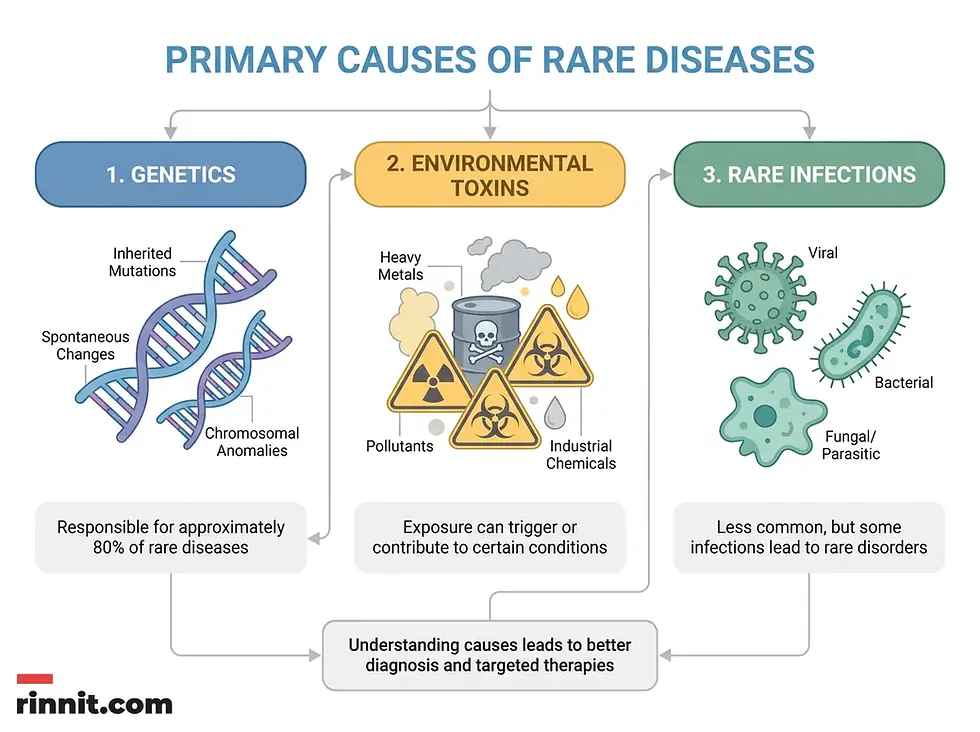
The main causes of rare diseases: genetics, environmental toxins, and rare infections. Understanding the cause helps guide diagnosis and treatment.
What are the symptoms of rare diseases?
Symptoms vary widely by disease. They can mimic those of more common conditions, and some people have no symptoms early on [1]. See a healthcare provider if you have symptoms such as pain or constant fatigue and do not know why.
Why are rare diseases hard to diagnose and live with?
Diagnosis is often difficult because symptoms resemble those of other conditions and many diseases are so rare that providers seldom diagnose or treat them. It may take several years to learn what is happening. Providers ask about your symptoms and run tests such as imaging and blood tests, and may refer you to a medical center that specializes in rare diseases [1].
Rare diseases are also defined by their impact on life. Symptoms may make it hard to keep a job, manage household tasks, or get through the day, rare diseases often lead to financial hardship for families, and living with one can be physically and mentally exhausting for individuals and caregivers [1].

The rare disease journey brings three common challenges: diagnostic delay, limits on daily living, and strain on caregivers.
Diagnosis in Babies
In the U.S., routine newborn screening helps identify conditions that are not immediately visible, such as sickle cell disease or cystic fibrosis. Early diagnosis lets treatment begin right away [1].
How are rare and orphan diseases managed and treated?
Possible treatments include medications, nutritional supplements or diet changes, occupational therapy, physical therapy, procedures or surgeries, and medical devices [1]. Goals differ by disease and may include:
Curing the disease (rarely possible)
Preventing the disease from getting worse
Managing symptoms
Many rare diseases do not yet have effective treatments, and researchers continue to investigate options.
The Role of Clinical Trials
Clinical trials are carefully designed research studies that show how well tests and treatments work. Joining one can give access to the latest, most promising treatments for your condition. Ask your healthcare provider about available trials [1].
If you come across a “remedy” or “cure” online, proceed with caution. Show it to a healthcare provider first, because some products do nothing and some can be harmful [1].

A typical care pathway: newborn screening, referral to a specialist, then ongoing care, therapies, and research participation.
What is the outlook for rare diseases, and can they be prevented?
Your outlook depends on your specific diagnosis, how early you are diagnosed, available treatments, and other medical conditions. Many people with rare diseases live long, happy lives, although some rare diseases can shorten life [1].
There is little you can do to prevent rare diseases, especially because many are genetic. If you or your partner have a rare disease and are considering pregnancy, genetic counseling can explain the chances of your baby developing it [1].
When should you see a healthcare provider about a possible rare disease?
See a healthcare provider about a possible rare disease if you have new symptoms, or changes in symptoms, that have no clear cause. If several providers cannot find one, ask for a referral to a medical center that specializes in diagnosing, treating, and researching rare diseases [1]. After a diagnosis, useful questions include:
What caused my condition?
What treatments are available, and what do they involve?
What is my outlook?
Do you recommend a clinical trial?
Do you recommend genetic testing for my family?
Can you connect me with patient support groups?
What is the bottom line on rare and orphan diseases?
Each rare disease is uncommon, but together they affect hundreds of millions of people, and the road to diagnosis can be long. Specialist referrals, clinical trials, genetic counseling, and patient support groups can help patients and families find information, care, and community [1].
Frequently Asked Questions
What is the definition of a rare disease in the U.S.?
In the United States, a rare disease is any medical condition that affects fewer than 200,000 people. While each disease is uncommon on its own, researchers have identified more than 7,000 of them.
How many people are affected by rare diseases?
Combined, rare diseases affect more than 25 million people in the U.S. and over 300 million people around the world, many of them children.
What is an orphan disease?
An orphan disease is a disease, often also a rare one, that researchers are not investigating much or at all, usually because of cost. Funding for orphan drugs is growing to address this gap.
Why does it take so long to diagnose a rare disease?
Symptoms often mimic those of more common conditions, and many diseases are so rare that healthcare providers seldom see them. It can take several years to learn what is happening.
Are rare diseases always genetic?
No, but gene mutations are a common cause. Rare diseases can also be caused by rare infections, toxins such as asbestos, nutritional deficiencies, injuries, or unintended effects of treatment, and sometimes the cause is unknown.
Can rare diseases be cured?
A cure is rarely possible. Treatment usually aims to prevent the disease from getting worse and to manage symptoms, and many rare diseases do not yet have effective treatments.
What are orphan drugs?
Orphan drugs are medications that treat rare and orphan diseases. Governments and organizations around the world are ramping up efforts to fund research into them.
How are rare diseases diagnosed in babies?
In the U.S., routine newborn screening can identify conditions that are not immediately visible, such as sickle cell disease or cystic fibrosis, so treatment can begin right away.
What should I do if I think I have a rare disease?
See a healthcare provider if you have symptoms, such as pain or constant fatigue, and do not know why. If several providers cannot find a cause, ask for a referral to a medical center that specializes in diagnosing and treating rare diseases.
Can genetic testing help diagnose a rare disease?
Yes. Genetic tests can find the cause of many rare diseases, especially those that start in childhood. A genetic counselor can explain what the results mean for you and your family.
Related Resources
Related reading on Rinnit:
External resources for deeper reading:
References
Cleveland Clinic. Rare and orphan diseases. Cleveland Clinic Health Library. Medically reviewed; last updated September 13, 2024. https://my.clevelandclinic.org/health/diseases/rare-and-orphan-diseases
Nguengang Wakap S, Lambert DM, Olry A, et al. Estimating cumulative point prevalence of rare diseases: analysis of the Orphanet database. Eur J Hum Genet. 2020;28(2):165-173. PMID: 31527858. DOI: 10.1038/s41431-019-0508-0
Faye F, Crocione C, Anido de Peña R, et al. Time to diagnosis and determinants of diagnostic delays of people living with a rare disease: results of a Rare Barometer retrospective patient survey. Eur J Hum Genet. 2024;32(9):1116-1126. PMID: 38755315. DOI: 10.1038/s41431-024-01604-z
Medical disclaimer
This article is for informational purposes only and is not a substitute for professional medical advice, diagnosis, or treatment. Always seek the advice of your physician or other qualified health provider with any questions you may have about a medical condition.



Comments