Fanconi Anemia: Understanding the Genetic Risks and Treatment Options

Updated: 2 days ago
Medically reviewed by Dr. Baraa Alnahhal, MD · Last reviewed: October 2026
Source currency note: This guide reflects medical information reviewed in March 2026. Always confirm current guidance with your healthcare professional.
Quick Answer: What is Fanconi anemia?
Fanconi anemia is a rare inherited condition caused by mutations in FA genes that normally repair damaged DNA, leading to bone marrow failure and a higher cancer risk. Signs include thumb abnormalities, hearing loss, café-au-lait spots, fatigue and bleeding. It is lifelong with shorter life expectancy, but stem cell transplantation and early diagnosis improve outcomes. [4]
What the research says
Inherited marrow failure is common in children, and the right test matters. A review of how pediatric bone marrow failure syndromes are investigated notes that inherited (constitutional) syndromes account for up to 50% of pediatric cases, can mimic immune aplastic anemia because signs outside the blood may be subtle or absent, and that chromosomal breakage testing remains the gold-standard assay for Fanconi anemia (Catto et al., Pediatric Hematology and Oncology, 2026 [1]).
Head and neck cancer risk is very high. A systematic review of 119 people with Fanconi anemia-associated head and neck or esophageal squamous cell carcinoma (131 primary tumors) reported a greater than 500-fold incidence of head and neck squamous cell carcinoma compared with the general population, and concluded that surgical resection with curative intent should remain the primary treatment when possible (Lee et al., Clinical Cancer Research, 2021 [2]).
Transplant has extended life expectancy. A systematized review found that steadily improved approaches to hematopoietic cell transplantation, the only proven curative therapy for the blood-related features of Fanconi anemia, have significantly increased life expectancy, which makes long-term, multi-organ follow-up increasingly important (Hoover et al., Blood Reviews, 2024 [3]).
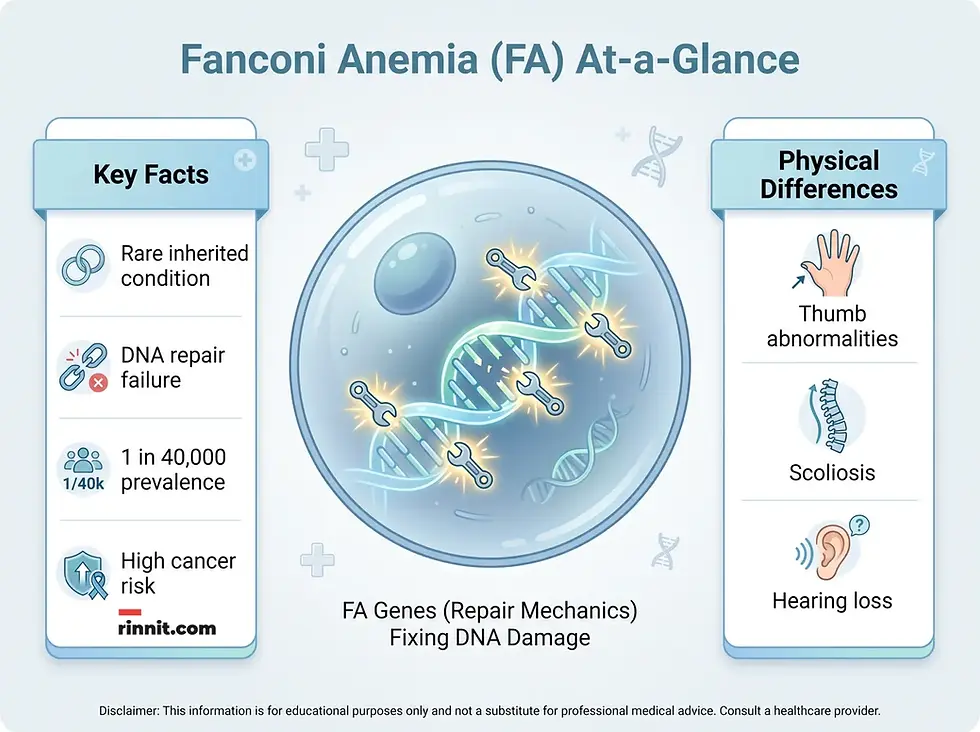
Overview of Fanconi anemia
Fanconi anemia is primarily defined by its impact on the bone marrow's ability to produce essential blood cells and platelets. It is a rare condition that requires specialized, long-term medical care to manage evolving symptoms and monitor for secondary health challenges, particularly cancerous tumors that often appear earlier than in the general population [4].
Key fact | Description |
Primary cause | Inherited mutations in FA genes (DNA repair failure) |
Core impact | Bone marrow failure, physical differences, high cancer risk |
Prevalence | Rare (classic FA affects about 1 in 40,000 males) |
Life expectancy | Generally shorter than the general population; improved by early care |
Contagion | Not contagious; strictly genetic |
How common is Fanconi anemia?
Fanconi anemia is classified as a rare disease. While classic Fanconi anemia is estimated to affect roughly 1 in 40,000 males, the carrier rate in the general population is much higher. Individuals who carry only one mutated gene do not develop the symptoms of the disorder but can pass the gene to their children [4].
Symptoms and physical differences
The symptoms of Fanconi anemia are highly variable and can show up at different stages of life. Physical differences are often present at birth, while bone marrow failure and cancer risks typically emerge as the child grows [4].
Category | Common symptoms and signs |
Physical features | Differently shaped thumbs, scoliosis (spinal curvature), hearing loss |
Skin signs | Café-au-lait spots (light brown skin patches) |
Head size | Hydrocephaly (unusually large head) or microcephaly (unusually small head) |
Marrow failure | Fatigue, shortness of breath, frequent fevers, headaches, pale skin |
Bleeding issues | Excessive bruising, nosebleeds, or bleeding gums |
Identifying bone marrow failure
Bone marrow failure occurs when the body cannot produce enough red blood cells, white blood cells, or platelets. This leads to a specific set of symptoms that need prompt medical attention to prevent severe complications such as infections or internal bleeding [4].
A helpful way to picture it: FA genes work like on-call mechanics for your DNA, repairing damage as it happens. When those genes stop working, abnormal blood cells can grow and spread quickly or die earlier than they should [4].
Causes and genetic inheritance
Fanconi anemia is an autosomal recessive disorder, meaning a child must inherit two copies of the mutated gene, one from each biological parent, to develop the condition. A child who inherits only one mutated gene becomes a carrier but does not show symptoms of the disease [4].
Inheritance scenario | Result for the child |
Both parents pass the mutated gene | Child develops Fanconi anemia (FA) |
One parent passes the mutated gene | Child is a carrier (no symptoms) |
Neither parent passes the mutated gene | Child does not have FA and is not a carrier |
The underlying biological cause is a failure in the DNA repair mechanism. Normal FA genes act as mechanics for the body's genetic code; when they are mutated, damaged DNA accumulates, leading to the premature death of blood-producing cells or the development of cancerous growths [4].

Complications and cancer risks
The most significant risk associated with Fanconi anemia is the development of bone marrow failure and various forms of cancer. Because the body's DNA repair system is compromised, cells are more likely to become malignant at a younger age, often in the 20s and 30s [4].
Type of risk | Specific conditions |
Blood disorders | Aplastic anemia, myelodysplastic syndrome (MDS) |
Blood cancers | Acute myeloid leukemia (AML) |
Solid tumors | Head and neck squamous cell carcinoma, skin cancer (squamous cell carcinoma) |
Genital cancers | Squamous cell carcinoma of the cervix, vagina, or penis |
Other cancers | Brain, esophageal, and liver cancer (less common) |
Monitoring for secondary tumors
People with Fanconi anemia need regular screenings for solid tumors. Warning signs that call for prompt medical evaluation include lumps that do not go away, localized pain, and unexplained weight loss [4].
Diagnosis and diagnostic testing
Healthcare providers use a combination of physical exams, family history, and specialized laboratory tests to confirm a diagnosis of Fanconi anemia. Early detection is critical for planning long-term monitoring and treatment [4].
Test | Purpose |
Chromosome breakage analysis | The gold standard test for detecting FA-specific DNA sensitivity |
Complete blood count (CBC) | Monitors levels of red cells, white cells, and platelets |
Bone marrow biopsy | Evaluates the health of blood-producing tissue and checks for cancer |
Genetic testing | Identifies specific mutations in the FA gene family |
Prenatal testing | Amniocentesis or chorionic villus sampling to check a fetus |
Treatment options for Fanconi anemia
Treatment is tailored to the specific symptoms and complications present in each person. While the genetic cause cannot be cured, the effects on the blood and physical health can often be managed effectively [4].
Treatment | How it is used |
Stem cell transplant | The primary treatment for bone marrow failure and blood cancers |
Growth factors (G-CSF) | Medicines that stimulate the marrow to produce blood cells |
Surgery | Corrects physical differences such as thumb or skeletal issues |
Cancer therapies | Specialized surgery, radiation, or medication for solid tumors |
Managing long-term care
Ongoing medical surveillance is the cornerstone of living with Fanconi anemia. This includes regular blood work, cancer screenings, and support from specialists such as hematologists, geneticists, and child life specialists to help with the emotional and physical challenges of the condition [4].

Outlook and living with Fanconi anemia
While Fanconi anemia is a serious, life-limiting condition, advances in medical care, particularly in stem cell transplantation, have improved the outlook for many people. Early diagnosis remains the most effective way to build a proactive care plan that supports quality of life and longevity [4].
Strategy for longevity | Description |
Regular check-ups | Essential for catching bone marrow changes or early-stage tumors |
Infection prevention | Treating fevers promptly and keeping vaccinations up to date |
Skin protection | Watching for sores that do not heal or scaly patches |
Family support | Joining support groups to share resources and reduce stress |
When to seek emergency care
Contact a healthcare provider immediately for unusual bleeding, excessive bruising, extreme fatigue, or new lumps and bumps that persist. These can be signs of advancing bone marrow failure or a secondary cancer [4].
Conclusion and next steps
Fanconi anemia is a complex genetic disorder that requires a multidisciplinary approach to care. By understanding the genetic risks, keeping up a rigorous screening schedule, and using modern treatments like stem cell transplants, families can better manage the challenges of this condition.
If you or a family member has been diagnosed with Fanconi anemia, consider these next steps:
Genetic counseling. Discuss inheritance risks and family planning with a specialist.
Specialized care centers. Seek out hematology centers with experience in rare bone marrow failure syndromes.
Patient advocacy. Connect with organizations such as the Fanconi Anemia Research Fund for the latest research and community support.
Frequently Asked Questions
Is Fanconi anemia the same as regular anemia?
No. While "anemia" refers to a low red blood cell count, Fanconi anemia is a complex genetic disorder that affects all types of blood cells and causes physical differences and high cancer risks. Regular anemia is often caused by iron deficiency or other non-genetic factors.
Can you grow out of Fanconi anemia?
No, Fanconi anemia is a lifelong genetic condition. It is caused by mutations present in the DNA at birth. While symptoms can be managed and blood production can be restored through transplants, the underlying genetic mutation remains.
How is Fanconi anemia inherited?
Fanconi anemia is inherited in an autosomal recessive pattern. This means a child must receive one mutated FA gene from each biological parent. If both parents are carriers, there is a 25% chance with each pregnancy that the child will have the condition.
What is the most common age for diagnosis?
Physical differences are often noticed at birth or in early infancy. However, the blood-related symptoms of bone marrow failure typically emerge between the ages of 5 and 10, leading to a diagnosis during childhood.
Does Fanconi anemia cause cancer?
Fanconi anemia significantly increases the risk. Because the body cannot repair DNA damage effectively, cells are more likely to turn cancerous. People with Fanconi anemia have a much higher risk of leukemia and solid tumors, particularly of the head, neck, and skin.
What is a chromosome breakage test?
A chromosome breakage test is a specialized blood test used to diagnose Fanconi anemia. It exposes the patient's cells to chemicals that damage DNA; cells with FA show significantly more chromosome breakage than healthy cells.
Can women with Fanconi anemia have children?
Yes, but it requires careful coordination with a medical team. Women with FA may have early menopause or other reproductive challenges, and there are risks associated with passing the gene to the next generation.
Is there a cure for Fanconi anemia?
There is no cure for the underlying genetic mutation. However, bone marrow failure, the most life-threatening aspect, can often be cured through a successful allogeneic stem cell transplant.
What are café-au-lait spots?
Café-au-lait spots are light brown, flat spots on the skin that are often present in people with Fanconi anemia. They are harmless on their own, but they can serve as a physical marker that helps doctors identify the condition early.
What is the life expectancy for someone with Fanconi anemia?
Life expectancy is generally shorter than average because of cancer and marrow failure risks. However, with early diagnosis and modern treatments like stem cell transplants, many people are living well into adulthood.
References
Catto MB, Young DJ, Catto LFB. How we investigate bone marrow failure syndromes in pediatric patients. Pediatric Hematology and Oncology. 2026;43(5):268-290. PMID 42223416. https://doi.org/10.1080/08880018.2026.2676558
Lee RH, Kang H, Yom SS, et al. Treatment of Fanconi anemia-associated head and neck cancer: opportunities to improve outcomes. Clinical Cancer Research. 2021;27(19):5168-5187. PMID 34045293. https://doi.org/10.1158/1078-0432.CCR-21-1259
Hoover A, Turcotte LM, Phelan R, et al. Longitudinal clinical manifestations of Fanconi anemia: a systematized review. Blood Reviews. 2024;68:101225. PMID 39107201. https://doi.org/10.1016/j.blre.2024.101225
Cleveland Clinic. Fanconi anemia (FA). Cleveland Clinic. Medically reviewed March 19, 2026. https://my.clevelandclinic.org/health/diseases/14473-fanconi-anemia-fa
Medical disclaimer
This article was prepared for general information only and is not a substitute for professional medical advice.



Comments