Lissencephaly: Understanding the Rare "Smooth Brain" Condition

Updated: 2 days ago
Medically reviewed by Dr. Baraa Alnahhal, MD · Last reviewed: October 2026
Lissencephaly is a rare congenital brain disorder in which the surface of the brain lacks the normal folds and bumps and looks smooth. It happens during fetal development, when nerve cells fail to migrate to their proper locations, and it can cause developmental delays, seizures, and physical challenges. There is no cure, but supportive treatments such as therapy, seizure medication, and specialized feeding can improve quality of life for affected children [1].
Quick Answer: What is lissencephaly?
Lissencephaly, often called smooth brain, is a rare brain malformation in which the brain lacks the typical grooves and folds of the cerebral cortex. It develops during pregnancy, mainly when developing nerve cells fail to migrate properly, often due to genetic mutations. Symptoms range from mild learning differences to severe delays and seizures. There is no cure; care manages symptoms. [1]
What the research says
Most cases have an identifiable genetic cause. In a cohort of 811 patients with lissencephaly or subcortical band heterotopia, genetic testing (earlier single-gene tests plus a 17-gene panel or exome sequencing) found a mutation in 81% overall: LIS1 in 40%, DCX in 23%, TUBA1A in 5%, and DYNC1H1 in 3%, while 19% remained unsolved, suggesting more genes are yet to be found (Di Donato et al., Genet Med, 2018 [2]).
Seizures are often hard to control. In a study of 20 patients with epilepsy and lissencephaly spectrum malformations, most had therapy-resistant epilepsy, epileptic spasms were the most prominent seizure type, and the best seizure control came from the ketogenic diet, vigabatrin, clobazam, phenobarbital, and valproate; 55% had a PAFAH1B1 (LIS1) mutation or deletion (Kolbjer et al., Eur J Paediatr Neurol, 2021 [3]).
Neuronal migration defects share a common clinical picture and have several causes. A review explains that these disorders, including lissencephaly, can result from single-gene disorders or from damaging factors during pregnancy such as infections, and are typically marked by severe developmental delay, severe intellectual disability, and intractable epilepsy, although understanding of the underlying mechanisms is still limited (Schiller et al., J Inherit Metab Dis, 2020 [4]).
What is Lissencephaly?
Lissencephaly is a spectrum of rare brain malformations that result in a smooth brain surface [1]. In a typically developing brain, the surface is covered with bumps called gyri and grooves called sulci. These folds matter because they separate brain regions and increase the brain's surface area and cognitive ability.
In lissencephaly the brain does not develop these folds. It can occur on its own (isolated lissencephaly) or as part of syndromes such as Miller-Dieker syndrome and Walker-Warburg syndrome. There are more than 20 recognized types, mostly divided into two main groups: classic lissencephaly (Type 1) and cobblestone lissencephaly (Type 2), which share similar symptoms but involve different genetic mutations [1].
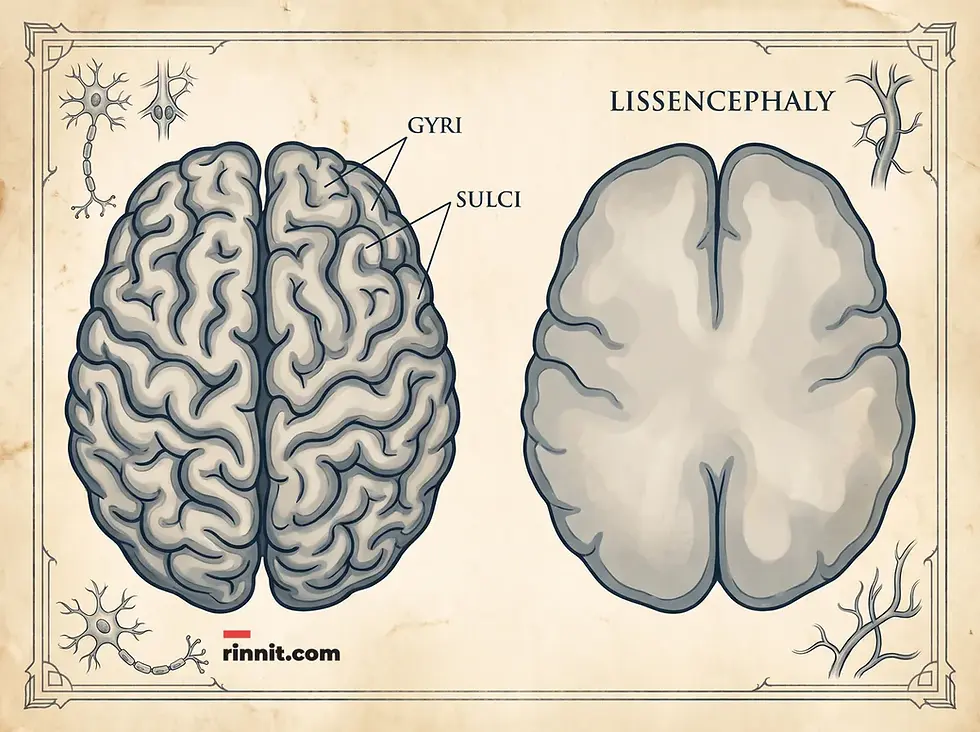
A typical brain with gyri and sulci (left) compared with the smooth surface of lissencephaly (right).
What are the symptoms and challenges of lissencephaly?
Lissencephaly symptoms vary widely depending on how severe the brain malformation is and whether it is part of a syndrome. Some children develop as expected with only mild learning differences, while others have many severe symptoms [1]. The table summarizes the signs often seen:
Symptom Category | Common Indicators |
Neurological | Seizures (epilepsy develops in the first year of life in 9 out of 10 cases), muscle spasms, and mental disability. |
Physical | Smaller-than-normal head size (microcephaly), congenital limb differences in the hands, fingers, or toes, and failure to thrive. |
Functional | Difficulty swallowing (dysphagia), eating challenges, and poor hand-eye coordination. |
Developmental | Significant delays in reaching milestones and impaired psychomotor functions. |
What causes the brain malformation in lissencephaly?
Lissencephaly develops during a critical window of fetal growth, between the 12th and 24th weeks of pregnancy [1]. The underlying problem is impaired "neuronal migration." Normally, cells that will become specialized nerve cells travel to the surface of the developing brain and form several cell layers that fold into gyri. In lissencephaly these cells do not reach their destinations, leaving the cortex with too few layers and a smooth surface.

Neurons migrate to form folded cortical layers in healthy development (top) but fail to do so in lissencephaly (bottom).
Genetic and Non-Genetic Factors
Several factors can disrupt brain development in this way [1]:
Genetic mutations: Changes in genes such as LIS1 (PAFAH1B1), DCX, ARX, and RELN are known causes. Some are inherited, while others occur randomly. Because DCX and ARX are on the X chromosome, males are generally more severely affected.
Viral infections: Infections of the pregnant mother or the fetus, especially in the first trimester, can interfere with fetal brain development.
Oxygen deprivation: A lack of oxygenated blood flow (ischemia) to the fetal brain during pregnancy can lead to the condition.
How is lissencephaly diagnosed?
Lissencephaly can sometimes be diagnosed before birth if a family history or a prenatal ultrasound raises suspicion; otherwise it is usually diagnosed at birth through a physical evaluation and head imaging. On imaging, providers look for a lack or reduction of sulci and gyri and a thickened cerebral cortex [1].
Test Type | Description and Purpose |
Prenatal ultrasound | Uses sound waves to monitor fetal development and look for visible brain structure issues. |
Fetal MRI | Provides detailed images of the fetal brain to look for the absence of folds. |
Genetic testing | Cell-free fetal DNA screening, amniocentesis, or chorionic villus sampling (CVS) can check for chromosomal conditions and specific gene mutations. |
Postnatal imaging | Head ultrasound, CT, or MRI after birth look for a thickened cortex and lack of sulci; an EEG may also be done. |
To confirm the diagnosis, providers use DNA studies, such as chromosomal analysis and specific gene mutation analysis, to find the mutation responsible [1].
How is lissencephaly managed with supportive care?
There is no cure or main treatment for lissencephaly, so care is aimed at the specific symptoms each child has, often through a team of specialists such as pediatricians, neurologists, gastroenterologists, nutritionists, respiratory therapists, and occupational and physical therapists [1].
Common treatments include anti-seizure medications to prevent, reduce, or control seizures; a gastrostomy tube (G-tube) and/or speech and swallowing therapy for children with feeding difficulties; physical and occupational therapy for motor development and muscle stiffness; and a ventriculoperitoneal (VP) shunt to treat hydrocephalus when it occurs. Genetic counseling is also likely to be recommended [1].

Physical, occupational, and speech therapies support a child's movement, communication, and daily activities.
What is the prognosis and long-term outlook for lissencephaly?
The outlook depends on the severity of the malformation and on whether it is part of a syndrome. Many children remain at an early developmental level, while others develop with only mild learning differences. Early and consistent physical, occupational, speech, and vision therapy can be very helpful for some children, and most need daily medication to prevent seizures [1].
Life expectancy is generally short, and many children with the condition die before they reach 10 years of age. The most common cause of death is aspiration (breathing in food or another object) and respiratory disease, so these risks need careful monitoring. No two children are affected in exactly the same way, so it is best to talk with providers who specialize in treating lissencephaly about what to expect [1].
Conclusion and Next Steps
Lissencephaly is a complex and challenging condition that calls for lifelong medical support and specialized care. Early diagnosis and a strong support network are vital for families. If you plan to have a biological child, talk with your healthcare provider about genetic testing to understand your risk. If you have concerns about your child's development or a family history of brain malformations, consult a pediatric neurologist or genetic counselor [1].
Frequently Asked Questions
What does the term lissencephaly mean?
The term comes from Greek words meaning 'smooth brain,' referring to the lack of normal folds on the brain's surface.
How common is lissencephaly in infants?
Lissencephaly is a rare condition, estimated to affect approximately 1 out of every 100,000 babies born.
When does lissencephaly develop?
The condition develops during pregnancy, typically between the 12th and 24th weeks of fetal development.
Can lissencephaly be detected before birth?
Yes, it can sometimes be diagnosed through prenatal ultrasound, fetal MRI, or genetic testing like amniocentesis.
Are seizures common in children with lissencephaly?
Yes, approximately 9 out of 10 children with this condition develop epilepsy within their first year of life.
Is lissencephaly always a genetic condition?
While often caused by genetic mutations, it can also result from viral infections or oxygen deprivation during pregnancy.
What is the difference between Type 1 and Type 2 lissencephaly?
Type 1 is classic lissencephaly, while Type 2 is known as cobblestone lissencephaly; they involve different genetic mutations and brain appearances.
Can children with lissencephaly learn to walk or talk?
Development varies from child to child. Many children remain at an early developmental level, while others develop with only mild learning differences.
What are the main health risks for these children?
Common risks include severe seizures, respiratory infections, and complications from difficulty swallowing, such as choking.
Is there a cure for smooth brain?
There is no cure for lissencephaly, but supportive treatments can help manage symptoms and improve comfort.
Related Reading
Miller-Dieker Syndrome: Symptoms, Causes, and Management covers the genetic syndrome that causes a severe form of lissencephaly.
Epilepsy: Seizures, Symptoms, Causes, and Treatment explains seizure types and treatments, a common concern in lissencephaly.
Understanding Microcephaly: Causes, Diagnosis, and Lifelong Care explains a smaller than expected head size and lifelong care.
Cerebral Palsy: Symptoms, Causes, Diagnosis, and Treatment Explained covers movement and muscle tone problems and supportive therapies.
References
Cleveland Clinic. Lissencephaly. Cleveland Clinic. April 11, 2022. https://my.clevelandclinic.org/health/diseases/6033-lissencephaly
Di Donato N, Timms AE, Aldinger KA, et al. Analysis of 17 genes detects mutations in 81% of 811 patients with lissencephaly. Genetics in Medicine. 2018;20(11):1354-1364. PMID 29671837. https://doi.org/10.1038/gim.2018.8
Kolbjer S, Martin DA, Pettersson M, et al. Lissencephaly in an epilepsy cohort: molecular, radiological and clinical aspects. European Journal of Paediatric Neurology. 2021;30:71-81. PMID 33453472. https://doi.org/10.1016/j.ejpn.2020.12.011
Schiller S, Rosewich H, Grünewald S, Gärtner J. Inborn errors of metabolism leading to neuronal migration defects. Journal of Inherited Metabolic Disease. 2020;43(1):145-155. PMID 31747049. https://doi.org/10.1002/jimd.12194
Medical disclaimer
This article is for informational purposes only and is not a substitute for professional medical advice, diagnosis, or treatment. The clinical information in this guide reflects source material last reviewed in April 2022.



Comments