Miller-Dieker Syndrome: Symptoms, Causes, and Management

Updated: 3 days ago
Medically reviewed by Dr. Baraa Alnahhal, MD · Last reviewed: October 2026
Editorial note: This article is provided for educational purposes only. It is not medical advice. Always consult a qualified healthcare professional about your individual health situation.
Quick Answer: What Is Miller-Dieker Syndrome?
Miller-Dieker syndrome is a rare genetic disorder caused by a deletion on chromosome 17, characterized by lissencephaly, a smooth brain surface. [1] It causes severe developmental delays, seizures and features such as a small head. [1] There is no cure, and the syndrome is fatal, with most children dying by age two. [1] Management focuses on comfort through seizure control and nutrition. [1]
What the research says
Miller-Dieker is the most severe form of 17p13.3 deletion. A literature review explains that deletions of chromosome 17p13.3 vary in severity with their size and location, and that Miller-Dieker syndrome is the most severe, marked by lissencephaly, dysmorphic facial features, growth failure, developmental disability and often early death. Loss of one gene, PAFAH1B1, is responsible for the characteristic lissencephaly (Baker et al., Am J Med Genet A, 2023) [2].
Two genes help explain the two halves of the syndrome. A genetics study notes that point mutations or deletions of PAFAH1B1 cause lissencephaly, whereas larger deletions involving both PAFAH1B1 and YWHAE result in Miller-Dieker syndrome, with facial dysmorphisms and a more severe grade of lissencephaly. In 5 patients whose deletions involved YWHAE but not PAFAH1B1, the authors found significant growth restriction, cognitive impairment and shared craniofacial features (Nagamani et al., J Med Genet, 2009) [3].
Much of the affected genetic region is still poorly understood. A review notes that, besides PAFAH1B1, CRK and YWHAE, there are 23 other genes in the Miller-Dieker critical region on chromosome 17p13.3, and little is known about their roles in brain development (Liu et al., Brain Sci, 2022) [4].
What is Miller-Dieker syndrome?
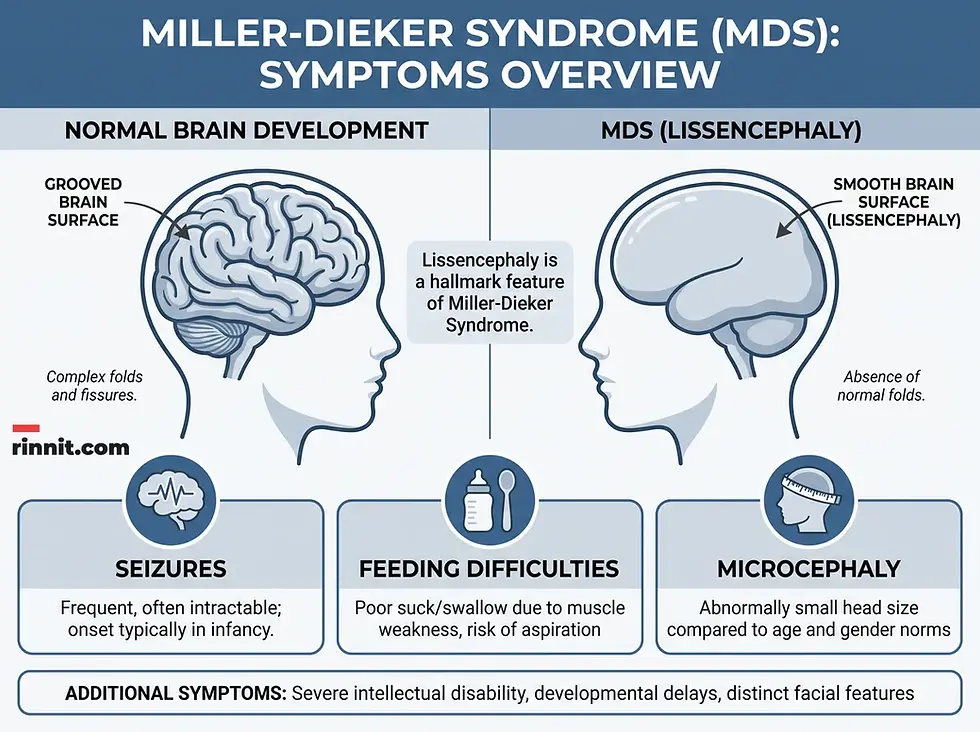
Miller-Dieker syndrome (MDS) is a rare neurological disorder that fundamentally alters the structure of the cerebral cortex. In a typically developing brain, the outer surface is marked by complex folds, wrinkles, and grooves. In children with MDS, these features fail to develop, resulting in a condition known as lissencephaly, or "smooth brain." [1]
The condition is rare, affecting approximately 1 in every 100,000 births. [1] It was first described in the 1960s by physicians James Q. Miller and H. Dieker, whose names the syndrome now bears. [1] MDS is also sometimes referred to as classic lissencephaly syndrome. [1]
What causes Miller-Dieker syndrome, and what genetic factors are involved?
The primary cause of Miller-Dieker syndrome is the deletion of genetic material on chromosome 17. [1] This missing section of DNA is critical for normal brain formation during fetal development. [1]
Genetic Mechanism | Description |
Spontaneous Deletion | Most cases occur randomly with no family history; the deletion can happen in the sperm, egg, or after conception. [1] |
Balanced Translocation | In about 10% of cases, a parent carries a rearranged chromosome 17 that does not affect their health but increases the risk for offspring. [1] |
Risk of Recurrence | If a parent carries a balanced translocation, there is a 1 in 3 chance of future children having the syndrome. [1] |

What are the symptoms and physical features of Miller-Dieker syndrome?
Miller-Dieker syndrome affects both the physical appearance and the neurological development of the child. Symptoms are often apparent at birth or become severely evident within the first six months of life. [1]
Neurological and Developmental Symptoms
The severity of symptoms is directly linked to how smooth the brain surface is. [1] Common challenges include:
Developmental Delays: Most infants do not reach milestones like sitting up or rolling over. [1]
Seizures: Recurring electrical disturbances in the brain.
Feeding Difficulties: Trouble swallowing (dysphagia) and poor growth. [1]
Muscle Tone Issues: Both low muscle tone (hypotonia) and muscle stiffness (spasticity) can occur. [1]
Distinct Physical Features
Children with MDS often exhibit recognizable physical characteristics:
How is Miller-Dieker syndrome diagnosed and managed?
Healthcare providers use a combination of prenatal testing and postnatal observations to diagnose Miller-Dieker syndrome.
Diagnostic Procedures
Prenatal Screening: Abnormal brain development may be detected via ultrasound during pregnancy. [1]
Genetic Testing: Amniocentesis or chorionic villus sampling (CVS) can identify chromosomal changes in utero. [1]
Postnatal Evaluation: Physical examination and monitoring of developmental milestones or seizure activity.
Management and Support
There is currently no cure for MDS, and the condition is fatal. [1] Medical care focuses on alleviating symptoms and ensuring the child's comfort. [1] This often involves seizure management and nutritional support through tube feeding (enteral nutrition). [1] Parents are encouraged to seek mental health support and connect with specialized resources to navigate the challenges of raising a child with a life-limiting illness.

Conclusion
Miller-Dieker syndrome is a profound genetic condition that presents significant challenges for affected children and their families. While the prognosis remains difficult, early diagnosis and specialized medical care can help manage symptoms and improve comfort. Ongoing genetic counseling is essential for families to understand the risks and options for future pregnancies.
When should you seek help for possible Miller-Dieker syndrome?
If you have concerns about your child's developmental milestones or physical growth, consult a pediatrician or a pediatric neurologist immediately. For families already affected by Miller-Dieker syndrome, seeking support from genetic counselors and specialized healthcare teams is a vital step in providing the best possible care and support.
Related reading: Lissencephaly: Understanding the Rare "Smooth Brain" Condition
Sources: Cleveland Clinic — Miller-Dieker Syndrome | Baker et al., 2023 | Nagamani et al., 2009 | Liu et al., 2022
Frequently Asked Questions
1. What is lissencephaly?
Lissencephaly is a medical term meaning "smooth brain," where the cerebral cortex lacks the normal grooves and folds.
2. Is Miller-Dieker syndrome inherited?
Most cases are spontaneous, but about 1 in 10 children inherit it from a parent with a balanced translocation on chromosome 17.
3. How rare is MDS?
MDS is a rare condition, affecting approximately 1 in 100,000 babies.
4. What is the life expectancy for a child with MDS?
Most children pass away by age two, though some may live to age ten; survival into the teens is rare.
5. Can MDS be detected during pregnancy?
Yes, prenatal ultrasounds and genetic tests like amniocentesis can often detect signs of the syndrome.
6. What are the main symptoms?
Common symptoms include severe developmental delays, seizures, feeding problems, and distinct facial features.
7. Is there a cure for Miller-Dieker syndrome?
No, there is currently no cure for the condition, and it is fatal.
8. What is a balanced translocation?
A balanced translocation is a genetic rearrangement where a parent has an intact chromosome 17 but in the wrong order, posing a risk to future children.
9. What is aspiration pneumonia?
Aspiration pneumonia is a common complication where weakened throat muscles allow food or drink to enter the lungs instead of the stomach.
10. What kind of support is available for parents?
Parents can benefit from support groups, home healthcare services, and mental health counseling to cope with the challenges.
References
Cleveland Clinic. Miller-Dieker Syndrome. Cleveland Clinic. April 11, 2022. https://my.clevelandclinic.org/health/diseases/22746-miller-dieker-syndrome
Baker EK, Brewer CJ, Ferreira L, et al. Further expansion and confirmation of phenotype in rare loss of YWHAE gene distinct from Miller-Dieker syndrome. Am J Med Genet A. 2023;191(2):526-539. PMID 36433683. https://doi.org/10.1002/ajmg.a.63057
Nagamani SCS, Zhang F, Shchelochkov OA, et al. Microdeletions including YWHAE in the Miller-Dieker syndrome region on chromosome 17p13.3 result in facial dysmorphisms, growth restriction, and cognitive impairment. J Med Genet. 2009;46(12):825-833. PMID 19584063. https://doi.org/10.1136/jmg.2009.067637
Liu X, Bennison SA, Robinson L, Toyo-Oka K. Responsible genes for neuronal migration in the chromosome 17p13.3: beyond PAFAH1B1 (LIS1), CRK and YWHAE (14-3-3ε). Brain Sci. 2022;12(1):56. PMID 35053800. https://doi.org/10.3390/brainsci12010056
Medical disclaimer
The information provided in this article is for educational purposes only and should not be used as a substitute for professional medical advice, diagnosis, or treatment. Always seek the advice of your physician or other qualified health provider with any questions you may have regarding a medical condition. Never disregard professional medical advice or delay in seeking it because of something you have read here.



Comments