Understanding Meningoencephalitis: Symptoms, Causes, and Emergency Care

Updated: 3 days ago
Medically reviewed by Dr. Baraa Alnahhal, MD · Last reviewed: October 2026
Meningoencephalitis is a rare and life-threatening condition in which meningitis and encephalitis happen at the same time, meaning both the protective membranes around the brain and spinal cord (the meninges) and the brain tissue itself are inflamed or infected. Symptoms such as fever, a stiff neck, severe headache and neurological changes usually develop and progress quickly, so anyone with these signs needs immediate medical help [1].
Quick Answer: What is meningoencephalitis?
Meningoencephalitis is inflammation and/or infection of the meninges and the brain at the same time, most often caused by bacteria, viruses, fungi or amoebas. Symptoms include fever, stiff neck, headache, confusion and seizures. It is a medical emergency in which early treatment is essential. Diagnosis relies on a spinal tap and brain imaging, and most cases need hospital care. [1]
What the research says
In bacterial meningitis, one infectious cause of meningoencephalitis, adjunctive corticosteroids lowered hearing loss but did not clearly lower deaths. A Cochrane review of 24 trials with 4,041 participants found similar mortality with corticosteroids and placebo (18.0% vs 20.0%; risk ratio 0.92, 95% CI 0.82 to 1.04), while severe hearing loss (RR 0.67, 95% CI 0.51 to 0.88) and any hearing loss (RR 0.76, 95% CI 0.64 to 0.89) were lower with corticosteroids. The benefit appeared in high-income countries but not in low-income countries (Brouwer et al., Cochrane Database Syst Rev, 2010 [2]).
A pooled analysis of individual patient data found no significant drop in death with dexamethasone. Across 2,029 patients from five randomized trials, 26.5% died on dexamethasone versus 27.2% on placebo (OR 0.97, 95% CI 0.79 to 1.19). Hearing loss among survivors was lower with dexamethasone (24.1% vs 29.5%; OR 0.77, 95% CI 0.60 to 0.99), and no prespecified subgroup showed a clear treatment effect (van de Beek et al., Lancet Neurol, 2010 [3]).
In adults, adding corticosteroids to antibiotics reduced the risk of hearing loss. A network meta-analysis of nine randomized trials with 1,002 adults found that corticosteroids plus antibiotics lowered the risk of any hearing loss compared with antibiotics alone (RR 0.64, 95% CI 0.45 to 0.91; moderate certainty). The risk of death was numerically lower but not statistically significant (RR 0.65, 95% CI 0.42 to 1.02) (Rayanakorn et al., PLoS One, 2020 [4]).
What is meningoencephalitis, exactly?
Meningitis is an infection or inflammation of the area surrounding your brain and spinal cord (the meninges), which protect them from injury and provide support and structure. Encephalitis is inflammation in the brain tissue. Both conditions usually develop because of an infection, such as a viral or bacterial infection, but they can have other causes as well. When they happen together, the result is meningoencephalitis, which can affect anyone at any age, including infants [1].
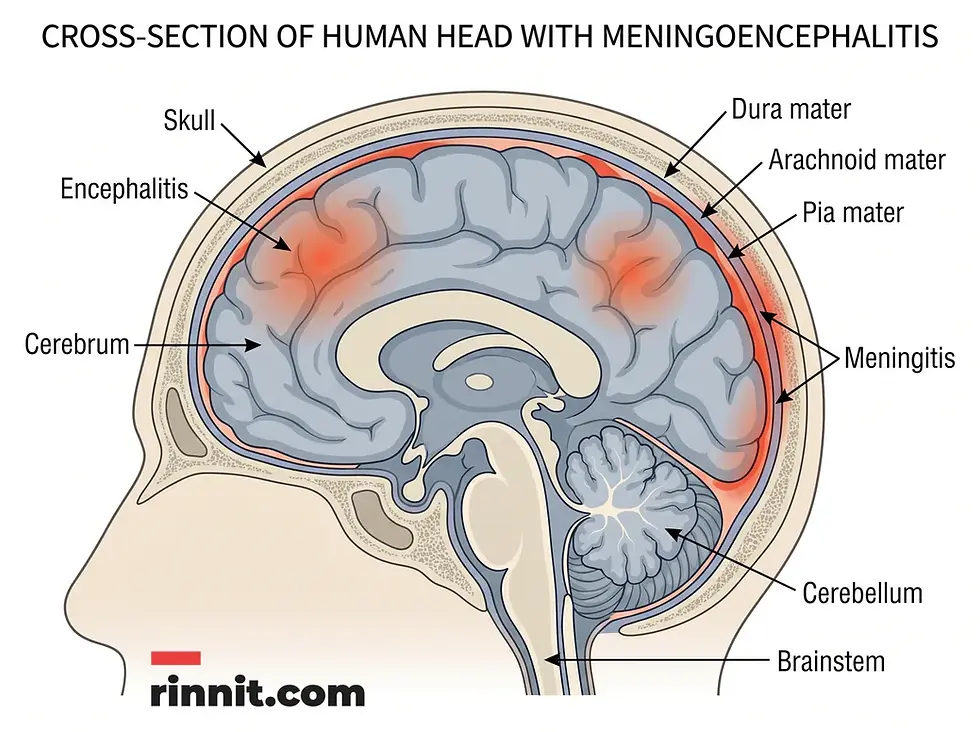
Meningoencephalitis involves inflammation of both the meninges and the brain tissue.
What are the types and causes of meningoencephalitis?
Meningoencephalitis is grouped into types by the underlying cause of the inflammation in the brain and meninges. It is most often related to an infection, and these infections can spread through air, water, food or close contact with someone who has them. Not everyone who gets these infections develops meningoencephalitis [1]. The main types are:
Type | Common causes |
Bacterial | Neisseria meningitidis (meningococcal disease), Streptococcus pneumoniae and Haemophilus influenzae type b are the most common causes. |
Herpetic (viral) | Herpes simplex virus type 1 (HSV1) causes most cases, and HSV2 can also be responsible. It can occur during the first infection but most often happens when the virus reactivates from an earlier infection. |
Cryptococcal (fungal) | Cryptococcus fungi affect the brain and/or lungs. |
Primary amebic | The amoeba Naegleria fowleri, which lives in warm, shallow fresh water such as lakes, rivers and hot springs and is commonly called the "brain-eating amoeba." |
Non-infectious | Autoimmune diseases such as autoimmune encephalitis, or medication side effects such as those from immune checkpoint inhibitor therapy. |
Meningoencephalitis itself, meaning the inflammation in your brain and meninges, is not contagious. But most bacterial and viral causes can spread from person to person, as the herpes simplex virus does [1].
What are the warning signs of meningoencephalitis?
Meningoencephalitis symptoms develop quickly and commonly include headache, stiff neck, fever, light sensitivity, confusion and seizures, so these signs need immediate medical help. Common symptoms include [1]:
Headache, and stiff neck or neck pain
Fever and fatigue
Nausea and vomiting
Sensitivity to light (photophobia)
Difficulty thinking clearly, and personality and behavior changes
Muscle weakness and speech issues
Hallucinations, usually visual and/or auditory
Seizures and loss of consciousness
In infants, symptoms can also include a bulging forehead, feeding issues, and difficulty waking or excessive sleepiness [1].
When to get help right away: if you or your child have these symptoms, seek immediate medical help. Meningoencephalitis is life-threatening, and early treatment is essential [1].

Fever, stiff neck, headache, light sensitivity, seizures and confusion are key warning signs.
Who is at risk of meningoencephalitis?
Anyone can develop meningoencephalitis, but people with a weakened immune system, such as young children, older adults and people with HIV or cancer, face a higher risk of the infectious types. Factors that weaken the immune system include [1]:
Age: children under 5 and people over 65 typically have weaker immune systems, and infants are especially at risk.
HIV: cryptococcal meningoencephalitis, for example, frequently affects people with advanced HIV disease.
Immunosuppressant medicines, such as those taken after an organ or stem cell transplant or for certain autoimmune conditions.
Cancer and cancer treatments, such as chemotherapy and radiation therapy.
Primary immunodeficiency disorders.
Certain autoimmune conditions, such as psoriasis, Crohn's disease and lupus.
Alcohol use disorder.
In the rare autoimmune forms, the cause may not be entirely clear, but risk factors include a personal or family history of autoimmunity, younger age and being female [1].
How is meningoencephalitis diagnosed?
Meningoencephalitis is diagnosed quickly through physical and neurological exams, a spinal tap and brain imaging, followed by immediate hospital care. They will do physical and neurological exams and ask when and how your symptoms developed [1]. Tests used to confirm the diagnosis include:
Test | What it shows |
Body fluid tests (blood, urine, saliva) | Signs of infection, such as white blood cell counts, and the specific type of infection. |
Spinal tap (lumbar puncture) | A needle in the lower back collects cerebrospinal fluid (CSF), which a lab checks for bacteria, fungi or abnormal cells, protein types and levels, and white blood cell types and levels. Providers most often use CSF tests to distinguish meningoencephalitis from conditions such as sepsis. |
EEG (electroencephalogram) | Records the brain's electrical signals to look for problems with how the brain is functioning. |
CT scan | Can show clots, swelling, infection or inflammation in the brain or meninges. |
MRI | Shows similar problems in the brain or meninges and is preferred for infants and children because it does not use radiation. |
Source: Cleveland Clinic [1].

Diagnosis combines a clinical exam, a spinal tap and brain imaging, followed by immediate hospital care.
How is meningoencephalitis treated in an emergency?
Meningoencephalitis treatment depends on the cause and severity, and most cases need hospital care with medicines for the infection, seizure control and drugs that reduce swelling. Treatments may include [1]:
Medication for the underlying infection, such as antibiotics for bacterial causes, antifungal medication for cryptococcal meningoencephalitis, and antiviral medication such as acyclovir for herpetic meningoencephalitis.
Antiseizure medications to prevent or treat seizures.
Corticosteroids and diuretics, which can help reduce swelling from inflammation, and corticosteroids may also help prevent hearing loss.
CSF drainage, which can also help reduce intracranial pressure.
Pain relievers and/or sedatives in cases of severe inflammation.
Your healthcare team will closely monitor you during your hospital stay and address any issues or complications that arise [1].
What is the outlook for meningoencephalitis, and can it be prevented?
The outlook depends on the cause, its severity and how quickly treatment begins. About 69% of survivors of cryptococcal meningoencephalitis have cognitive and/or physical impairments 12 months after diagnosis, and about 50% to 70% of people with herpetic meningoencephalitis experience permanent brain damage, neurological disorders or coma. People with mild cases who receive timely treatment are more likely to have fewer complications [1].
Not all cases can be prevented, but the best strategy is to stay healthy and avoid the bacteria, viruses and fungi that cause infections. Helpful steps include [1]:
Washing your hands frequently with soap and water.
Covering your mouth and nose when you cough or sneeze.
Disinfecting frequently touched surfaces.
Avoiding contact with others when either of you is sick with a contagious disease.
Not swimming in or drinking water that could be contaminated, and using distilled or treated water for nasal irrigation.
Reducing your risk of sexually transmitted infections with condoms and regular testing.
Reducing your risk of fungal infections by wearing a mask in dusty areas such as construction sites and staying inside during dust storms.
Seeing a healthcare provider regularly, especially if you are at increased risk of infections. Staying up to date on recommended vaccines, including those that protect against meningococcal, pneumococcal and Hib bacteria.
What is the bottom line on meningoencephalitis?
Meningoencephalitis is rare, but it is life-threatening and can progress quickly. A combination of fever, stiff neck, headache and changes in thinking, behavior or consciousness is a reason to seek emergency care immediately, because early treatment is essential for a better outcome [1]. If you are at increased risk of serious infections, talk to your healthcare provider about how to lower your risk and stay healthy.
Frequently Asked Questions
What is meningoencephalitis?
Meningoencephalitis is a rare and life-threatening condition in which the brain tissue and the meninges, the protective membranes around the brain and spinal cord, are inflamed or infected at the same time [1].
Is meningoencephalitis the same as meningitis?
No. Meningitis is an infection or inflammation of the meninges, while meningoencephalitis involves both the meninges and the brain tissue at the same time [1].
What causes meningoencephalitis?
Infections are the main cause, including bacteria, viruses such as herpes simplex, fungi and the amoeba Naegleria fowleri. Autoimmune diseases and medication side effects, such as those from immune checkpoint inhibitor therapy, can also cause it [1].
Is meningoencephalitis contagious?
The inflammation itself is not contagious, but most bacterial and viral causes can spread from person to person through air, water, food or close contact. Not everyone who gets these infections develops meningoencephalitis [1].
What are the main symptoms of meningoencephalitis?
Symptoms include fever, stiff neck, headache, nausea and vomiting, sensitivity to light, difficulty thinking clearly, behavior changes, hallucinations, seizures and loss of consciousness [1].
What are the signs of meningoencephalitis in babies?
Infants can have a bulging forehead, feeding issues, and difficulty waking or excessive sleepiness, in addition to the other symptoms. Seek immediate medical help if your child has these signs [1].
How do doctors diagnose meningoencephalitis?
Providers do physical and neurological exams and may order body fluid tests, a spinal tap (lumbar puncture) to test cerebrospinal fluid, an EEG, and CT or MRI scans [1].
Is meningoencephalitis a medical emergency?
Yes. It is life-threatening, symptoms typically progress quickly, and early treatment is essential. Most cases require treatment in a hospital [1].
How is meningoencephalitis treated?
Treatment depends on the cause and severity. It may include medication for the underlying infection, antiseizure medications, corticosteroids and diuretics, CSF drainage, and pain relievers or sedatives [1].
Can you fully recover from meningoencephalitis?
It depends on the cause, the severity and how quickly treatment starts. People with mild cases who receive timely treatment are more likely to have fewer complications, but serious cases can leave lasting impairments. For example, about 69% of survivors of cryptococcal meningoencephalitis have cognitive and/or physical impairments 12 months after diagnosis [1].
Related Reading
Understanding Meningitis: Symptoms, Causes, and Emergency Care explains inflammation of the brain lining and its emergency warning signs.
HSV Encephalitis: What It Is, Why It Happens, and How It's Treated covers herpes virus brain infection and why fast treatment matters.
Autoimmune Encephalitis: Complete Guide to Symptoms, Causes & Treatment explains brain inflammation caused by the immune system and its treatment.
Lumbar Puncture (Spinal Tap): Purpose, Procedure, Recovery and Results explains how a spinal tap collects fluid and what recovery involves.
References
Cleveland Clinic. Meningoencephalitis. Cleveland Clinic. July 25, 2023. https://my.clevelandclinic.org/health/diseases/25157-meningoencephalitis
Brouwer MC, McIntyre P, de Gans J, Prasad K, van de Beek D. Corticosteroids for acute bacterial meningitis. Cochrane Database Syst Rev. 2010;(9):CD004405. PMID 20824838. https://doi.org/10.1002/14651858.CD004405.pub3
van de Beek D, Farrar JJ, de Gans J, et al. Adjunctive dexamethasone in bacterial meningitis: a meta-analysis of individual patient data. Lancet Neurol. 2010;9(3):254-263. PMID 20138011. https://doi.org/10.1016/S1474-4422(10)70023-5
Rayanakorn A, Ser HL, Pusparajah P, et al. Comparative efficacy of antibiotic(s) alone or in combination of corticosteroids in adults with acute bacterial meningitis: a systematic review and network meta-analysis. PLoS One. 2020;15(5):e0232947. PMID 32469959. https://doi.org/10.1371/journal.pone.0232947
Medical disclaimer
This article is for informational purposes only and is not a substitute for professional medical advice, diagnosis, or treatment. The clinical information in this guide reflects source material last reviewed in July 2023.



Comments