HSV Encephalitis: What It Is, Why It Happens, and How It's Treated

Updated: 3 days ago
Medically reviewed by Dr. Baraa Alnahhal, MD · Last reviewed: October 2026
Quick Answer
HSV encephalitis is a serious condition in which the herpes simplex virus causes the brain to swell. Most cases are caused by HSV-1, and some by HSV-2. Warning signs include confusion, seizures, personality changes and an altered mental state. Standard treatment is IV acyclovir in a hospital, and many survivors need ongoing therapy for memory, movement or speech problems. [1]
What the research says
Acyclovir cut deaths compared with the older drug vidarabine. In a randomized trial of 208 patients who had a brain biopsy for suspected HSV encephalitis (69 with proven disease), six-month mortality was 28% with acyclovir versus 54% with vidarabine (P = 0.008). Patients younger than 30 and with a Glasgow coma score above 10 did best, and 38% of acyclovir recipients were functioning normally at six months versus 14%. (Whitley et al., N Engl J Med, 1986)
Adding dexamethasone did not improve memory outcomes in the UK trial. In DexEnceph, 94 adults were enrolled across 53 hospitals (81 analyzed). Verbal memory scores at 26 weeks were similar with and without dexamethasone (71 vs 69; adjusted difference 1.77, 95% CI −9.57 to 13.12), and there were no treatment-related deaths. (Solomon et al., Lancet Neurol, 2026)
Routine steroid use is not supported by pooled data. A 2026 meta-analysis of four comparative studies (209 patients) found no difference in unfavorable outcome (RR 1.00, 95% CI 0.68–1.47) or mortality (RR 0.92, 95% CI 0.35–2.40) across the randomized trials, and concluded the evidence does not support routine adjunctive corticosteroids in unselected patients. (Zhang et al., J Neurol, 2026)
What Is Herpes Simplex Virus (HSV) Encephalitis?
Herpes simplex virus (HSV) encephalitis is brain swelling caused by a viral infection. It happens when a new or reactivated herpes simplex virus infection moves to the brain. The virus involved is the same one that causes cold sores and genital herpes. In the brain, the infection can lead to permanent brain damage or death. [1]
This is a neurological emergency. The brain sits inside the hard bone of the skull, so swelling raises pressure inside the head and can quickly cause permanent damage or death if not treated immediately. Unlike common HSV skin infections, encephalitis affects the central nervous system and needs specialized hospital care. [1]
How Does the Herpes Virus Reach the Brain?

Once you are infected with herpes simplex virus, it never really leaves your body. It can stay inactive for long periods and then reactivate. HSV encephalitis can happen when you first get infected (a primary infection) or from a reactivation. [1]
The virus spreads through kissing, skin-to-skin contact with sores, oral, anal or vaginal sex, sharing utensils or personal items such as razors, and from a pregnant person to the fetus or baby. The virus is contagious, but encephalitis is not: the infection does not usually spread to the brain, and most people with HSV never develop brain swelling. [1]
What Are the Early Warning Signs of HSV Encephalitis?
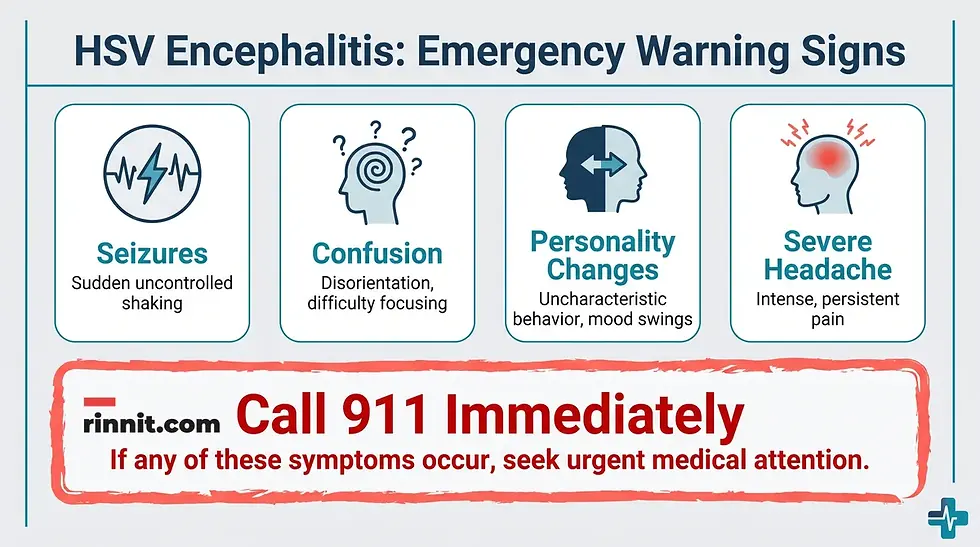
People with HSV encephalitis usually do not have herpes sores when brain symptoms begin, which can make it hard to recognize the herpes virus as the cause. Common symptoms include headache, fever, extreme lack of energy, confusion, personality or behavior changes, seizures, difficulty remembering or understanding words (aphasia), and nausea and vomiting. [1]
Symptom category | Common signs |
Physical | Severe headache, fever, nausea and vomiting |
Neurological | Seizures, difficulty remembering or understanding words (aphasia) |
Mental and behavioral | Confusion, personality or behavior changes, altered mental state |
Consciousness | Extreme lack of energy (lethargy), decreased consciousness |
When Is HSV Encephalitis a Medical Emergency?
HSV encephalitis is always a medical emergency. If you or someone you know has seizures, confusion or a sudden personality change, call 911 (or your local emergency number) or go to the nearest emergency room right away. Quick treatment gives the best chance of recovery. [1]
Complications include fluid in the brain (cerebral edema), increased pressure inside the head, seizures that last a long time or do not stop (status epilepticus), and brain herniation, in which part of the brain is pushed into areas it should not be. Long-term or permanent neurological problems are also possible. [1]
How Do Doctors Diagnose Brain Swelling From HSV?
Providers diagnose HSV encephalitis by testing spinal fluid collected with a lumbar puncture (spinal tap). They also use a CT scan or MRI to look at the brain. A PCR (polymerase chain reaction) test on the spinal fluid detects the virus's genetic material. Other tests, such as blood tests, a nasal swab and an EEG (to check brain activity), may help find the cause or evaluate brain function. [1]
What Are the Current Treatment Options?

HSV encephalitis is treated with intravenous (IV) acyclovir, an antiviral medicine given directly into a vein in the hospital. Doctors usually start it as soon as HSV encephalitis is suspected, without waiting for test results, because delays worsen outcomes. Treatment lasts a few weeks. [1] Early recognition and treatment are key to improving outcomes. [5]
Corticosteroids may also be used to reduce swelling. [1] However, a randomized trial (DexEnceph) and a 2026 meta-analysis did not show a clear benefit of adding steroids for unselected patients, so their use is a decision for the treating team. [3][4] Hospital teams also provide supportive care, such as managing seizures and monitoring for complications of brain swelling. [1][5]
What Can Be Expected During Recovery?
Yes, you can recover from herpes encephalitis, but recovery is often long and many people have lasting problems, including memory loss, seizure disorders such as epilepsy, movement problems, speech or language problems, trouble thinking clearly, and personality or behavior changes. These may improve over time but might not go away completely. [1][5]
Sometimes people get better and then relapse, usually within two months. This is more likely in children. If neurological problems continue, you may need physical, occupational or speech therapy. [1]
Can HSV Encephalitis Be Prevented?
If you already carry herpes, there is no specific way to prevent the virus from spreading to your brain. You can lower your risk of getting and spreading the virus by avoiding contact with herpes sores, getting tested for sexually transmitted infections (and asking partners to be tested), using condoms or dental dams during sex, and not sharing utensils or personal items. If you have had herpes before, ask your healthcare provider what to do if it reactivates and which symptoms of encephalitis to watch for. [1]
Conclusion
HSV encephalitis is a rare but serious complication of a very common virus. Recognizing the signs, especially confusion, seizures and personality changes, and getting emergency care can save a life. Recovery can be long and may involve long-term therapy, but antiviral treatment has greatly improved survival. [1][2]
Take charge of your health. If you have questions about neurological health or viral infections, visit Rinnit.com for more expert guides.
Frequently Asked Questions
Is HSV encephalitis the same as a cold sore?
No. They are caused by the same virus, but a cold sore is a minor skin infection, while HSV encephalitis is a life-threatening brain infection. [1]
Can you catch encephalitis from someone else?
You can catch the herpes virus from someone else, but the brain swelling itself is not contagious. Most people who get the virus never develop encephalitis. [1]
How common is HSV encephalitis?
HSV encephalitis is rare, affecting only a small number of the many people who carry the herpes virus. [5]
Can a person have HSV encephalitis without a fever?
Fever is a very common symptom, but other neurological symptoms such as confusion or seizures may be the main signs. Anyone with these symptoms needs emergency care. [1]
Does having genital herpes increase the risk of brain swelling?
Both HSV-1 and HSV-2 can cause encephalitis, but most cases are caused by HSV-1. [1]
How long does the hospital stay usually last?
Antiviral treatment takes a few weeks. In the UK DexEnceph trial, IV aciclovir was given for at least 14 days. Your care team will tell you how long you need to stay. [1][3]
What is the survival rate for HSV encephalitis?
Survival has improved with acyclovir. In a randomized trial of biopsy-proven cases, six-month mortality was 28% with acyclovir compared with 54% with the older drug vidarabine. It remains a very serious condition. [2]
Can children get HSV encephalitis?
Yes. Children can develop it, and relapse after treatment is more likely in children. [1]
Are there vaccines for HSV encephalitis?
There is currently no vaccine available to prevent herpes simplex virus infection or encephalitis.
Will memory loss from the infection ever go away?
Memory problems may improve over time, especially with therapy, but some problems might never go away completely. [1]
Can stress cause the virus to move to the brain?
Herpes simplex virus can reactivate after a period of dormancy, but why it reaches the brain in some people and not others is not well understood. [1][5]
Is acyclovir the only treatment?
IV acyclovir is the main antiviral treatment. Corticosteroids to reduce swelling are sometimes used, but recent research does not support their routine use. [1][3][4]
Can HSV encephalitis come back?
Sometimes people improve and then relapse, usually within two months. This is more likely in children. [1]
What kind of therapy is needed after the hospital?
If neurological problems continue, you may need physical, occupational or speech therapy to manage your symptoms. [1]
Should I get tested for herpes if I'm worried?
If you have concerns about herpes or neurological symptoms, talk to a healthcare provider about appropriate testing. Getting tested for STIs and asking sex partners to get tested is one way to lower risk. [1]
Related Reading
Autoimmune Encephalitis: Complete Guide to Symptoms, Causes & Treatment explains brain inflammation caused by the immune system, sometimes after HSV.
Lumbar Puncture (Spinal Tap): Purpose, Procedure, Recovery and Results describes the spinal fluid test used to diagnose brain infections.
Managing Herpes Simplex: A Comprehensive Guide to Outbreaks and Care covers the herpes simplex virus and how outbreaks are treated.
Understanding Meningoencephalitis: Symptoms, Causes, and Emergency Care explains infection of the brain and its lining and emergency care.
References
Cleveland Clinic. Herpes Simplex Virus (HSV) Encephalitis. Cleveland Clinic. Last updated December 11, 2024. https://my.clevelandclinic.org/health/diseases/hsv-encephalitis
Whitley RJ, Alford CA, Hirsch MS, et al. Vidarabine versus acyclovir therapy in herpes simplex encephalitis. N Engl J Med. 1986;314(3):144-9. PMID 3001520. https://doi.org/10.1056/NEJM198601163140303
Solomon T, Hooper C, Easton A, et al. Safety and efficacy of adjunct dexamethasone in adults with herpes simplex virus encephalitis in the UK (DexEnceph): a multicentre, observer-blind, randomised, phase 3, controlled trial. Lancet Neurol. 2026;25(2):136-146. PMID 41579900. https://doi.org/10.1016/S1474-4422(25)00454-5
Zhang D, Yang M, Huang Y, et al. Adjunctive corticosteroids in herpes simplex virus encephalitis: a meta-analysis of randomized and observational studies. J Neurol. 2026;273(10). PMID 42704513. https://doi.org/10.1007/s00415-026-14128-x
Bradshaw MJ, Venkatesan A. Herpes Simplex Virus-1 Encephalitis in Adults: Pathophysiology, Diagnosis, and Management. Neurotherapeutics. 2016;13(3):493-508. PMID 27106239. https://doi.org/10.1007/s13311-016-0433-7
This article is for general educational purposes only and is not a substitute for professional medical advice, diagnosis, or treatment. Always seek the advice of your physician or other qualified healthcare provider with any questions you may have about a medical condition. Never disregard professional medical advice or delay seeking care because of something you have read here. If you think you may have a medical emergency, call your doctor or emergency services immediately.
Medical disclaimer
The information provided in this article is for educational purposes only and should not be used as a substitute for professional medical advice, diagnosis, or treatment. Always seek the advice of your physician or other qualified health provider with any questions you may have regarding a medical condition.



Comments