McRoberts Maneuver: How It Frees a Stuck Shoulder During Birth, Steps, Success Rates, and Risks

Updated: 6 days ago
Written and medically reviewed by Dr. Baraa Alnahhal, MD · Last reviewed: October 2026 · How we review
Quick Answer: What is the McRoberts maneuver?
The McRoberts maneuver is a delivery technique used when a baby's shoulder gets stuck behind the pelvic bone after the head is born (shoulder dystocia). The team presses the birthing parent's thighs tightly toward the abdomen, rotating the pelvis to make room. It works about 42% of the time alone and up to 95% with added maneuvers. [1][2]
What the research says
The McRoberts position alone freed the shoulder in 42% of cases. In a review of 250 shoulder dystocia cases among 44,072 vaginal births (0.57%), 236 cases met study criteria, and the position by itself resolved 98 of them (42%). Researchers recommended it as the first technique to try. (Gherman et al., Am J Obstet Gynecol, 1997) [2]
Delivering the posterior shoulder had the highest success of any single maneuver. Among 132,098 term vaginal births, 2,018 had shoulder dystocia (1.5%). Posterior shoulder delivery succeeded in 84.4% of attempts, compared with 24.3%–72.0% for other maneuvers, and needing more maneuvers was linked to more newborn injuries. The authors advise trying it after McRoberts and suprapubic pressure. (Hoffman et al., Obstet Gynecol, 2011) [3]
X-rays confirm the position really reshapes the pelvis. In 34 analyzable x-rays of women at 37+ weeks, the angle between the pubic bone and the base of the spine rose from about 38° to about 52°, showing the pubic bone rotating upward and the sacrum flattening. (Gherman et al., Obstet Gynecol, 2000) [4]
Key takeaways
The McRoberts maneuver is usually the first step for shoulder dystocia. [1]
It involves flexing the thighs tightly toward the abdomen in a V position. [1]
It lifts the pubic bone by about 2 centimeters and widens the pelvic outlet. [1]
It works best during a contraction or with suprapubic pressure. [1]
Success is about 42% alone and up to 95% with added maneuvers. [1][2]
Rare risks include pelvic separation and nerve symptoms in the legs. [1]
What is shoulder dystocia?
Shoulder dystocia is a birth complication in which the baby's head is delivered, but one or both shoulders get stuck inside the birthing parent's pelvis. [1]
When this happens, the baby can't move fully down the birth canal. Normal gentle pulling on the head does not deliver the shoulders. [5]
Doctors diagnose shoulder dystocia when: [1]
The baby's head has been delivered, but the rest of the body is still inside the birth canal
At least one minute has passed since the head came out without the body following
Shoulder dystocia is an emergency. It can cause nerve injury to the baby's arm, low oxygen, and injuries or heavy bleeding for the birthing parent. [5]
Large baby size, a previous shoulder dystocia, and diabetes before or during pregnancy raise the risk. Still, most cases happen without warning, so delivery teams are trained to act fast. [5]
What is the McRoberts maneuver used for?
The McRoberts maneuver is used to free a baby's stuck shoulder during a vaginal delivery so the birth can continue. [1]
It is often the first technique the delivery team tries. It creates more space in the pelvis without touching the baby. [1]
It usually takes two providers, plus support from the rest of the delivery team, to do it. [1]
How does the McRoberts maneuver work?
The McRoberts maneuver works by changing the shape of the pelvis. Flexing the thighs tightly toward the abdomen rotates the pelvis and widens the space at the tailbone (sacrum). [1]

The McRoberts position rotates the pelvis to give the baby's shoulder more room.
What changes | What it does |
Thighs flexed toward the abdomen | Rotates the pelvis |
Hips turned outward (V position) | Opens the pelvic outlet |
Pubic bone moves up about 2 cm | Releases the trapped front shoulder |
Sacrum (tailbone area) widens | Creates more room at the back of the pelvis |
Source: [1]
This new position lets the baby's shoulder rotate from back to front and slip out from under the pubic bone. [1]
What happens during the McRoberts maneuver?
During the McRoberts maneuver, two team members hold the birthing parent's legs and press the thighs firmly toward the abdomen. [1]
The steps usually go like this:
Confirm shoulder dystocia. The team checks the pelvis and the baby's position. [1]
Flex the thighs. Each leg is pushed back tightly toward the abdomen. [1]
Turn the hips outward. The legs form a V shape, which lifts the pubic bone by about 2 cm. [1]
Time it with a contraction. The maneuver works best during a contraction. [1]
Add suprapubic pressure. A provider presses gently just above the pubic bone to help dislodge the shoulder. [1]
It may feel uncomfortable for a moment. But it is quick, and it is a simple change in position. [1]
How effective is the McRoberts maneuver?
The McRoberts maneuver frees the stuck shoulder about 42% of the time on its own. Success rises to about 95% when it is combined with suprapubic pressure or with delivering the baby's back (posterior) arm first. [1]

Combining maneuvers greatly raises the chance of a successful vaginal birth.
If these steps work, the baby can still be born vaginally. [1]
What are the benefits of the McRoberts maneuver?
The main benefit of a successful McRoberts maneuver is that vaginal delivery can continue safely. [1]
Benefits include: [1]
The birth can go on vaginally
It helps avoid shoulder dystocia complications, such as neck or spine injuries, broken bones, and lack of oxygen
It lowers the chance of needing a C-section or an episiotomy
What are the risks of the McRoberts maneuver?
The McRoberts maneuver is considered safe and effective, but it carries a small risk of pelvic and nerve problems for the birthing parent. [1]
Possible risk | What it means |
Separation of the pelvis | The joint at the front of the pelvis can be strained or separated |
Neuropathy in the legs | Nerve symptoms, such as numbness or weakness, in the lower limbs |
Source: [1]
If you notice new pelvic pain, leg numbness, or leg weakness after delivery, tell your care team.
What happens if the McRoberts maneuver doesn't work?
If the McRoberts maneuver doesn't free the shoulder, the delivery team moves on to other proven techniques. [1]
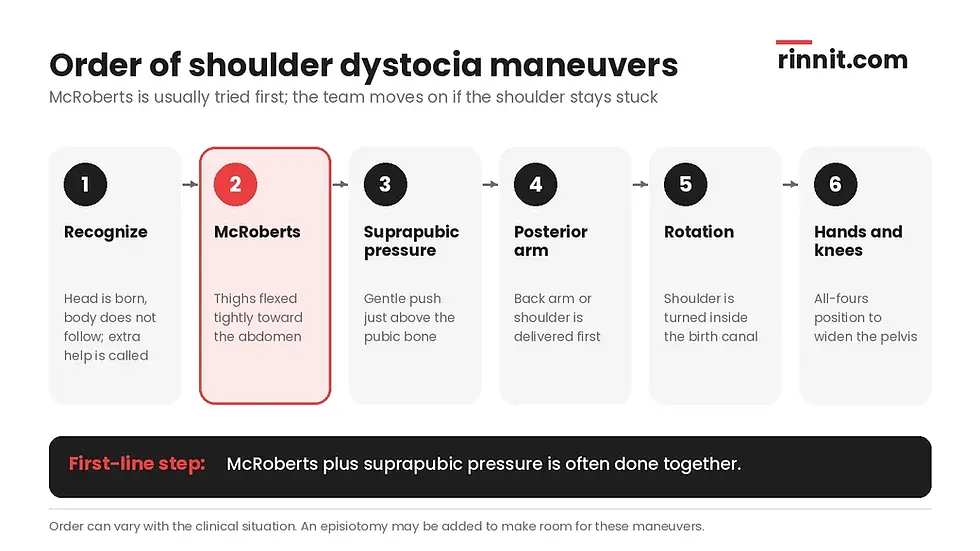
The team usually starts with McRoberts and moves through other steps if needed.
Maneuver | How it helps |
Suprapubic pressure | Gentle pressure above the pubic bone pushes the front shoulder free |
Posterior arm delivery | The arm closest to the vagina is delivered first |
Front-of-shoulder rotation | Pressure on the front of the back shoulder turns the baby |
Corkscrew rotation | Pressure behind the front (top) shoulder turns the baby like a corkscrew |
Hands and knees (Gaskin maneuver) | Moving onto all fours widens the pelvis |
Source: [1]
An episiotomy may be done to make room for these maneuvers. [1]
Calm, step-by-step use of these release maneuvers almost always leads to a successful delivery. [5]
What does this mean for you?
Most people never need the McRoberts maneuver. But knowing about it can make a stressful moment feel less frightening.
Related reading: The three stages of labor · Brachial plexus injury · Vaginal tears during childbirth
Conclusion
The McRoberts maneuver is a simple, fast, and effective first response to shoulder dystocia. By flexing the thighs tightly toward the abdomen, the delivery team rotates the pelvis and gives the baby's shoulder room to slip free.
Used alone, it works in about 4 out of 10 cases. Combined with suprapubic pressure or posterior arm delivery, success climbs to about 95%. Serious risks to the birthing parent are uncommon.
Preparing for birth? Explore our childbirth and labor guides, and talk to your provider about your birth plan, especially if you have diabetes or are expecting a larger baby. Every guide is written and medically reviewed by a physician.
FAQ
What is the McRoberts maneuver?
The McRoberts maneuver is a technique used during vaginal birth to free a baby's shoulder that is stuck in the pelvis. The delivery team flexes the birthing parent's thighs tightly toward the abdomen to rotate the pelvis and create more space.
Why is the McRoberts maneuver done?
The McRoberts maneuver is done to treat shoulder dystocia, which happens when the baby's head is born but the shoulders get stuck. It is usually the first technique the delivery team tries.
How is shoulder dystocia diagnosed?
Shoulder dystocia is diagnosed when the baby's head has been delivered but the body stays inside the birth canal. Doctors also look for at least one minute passing after the head emerges without the body following.
How successful is the McRoberts maneuver?
The McRoberts maneuver works about 42% of the time on its own. Success rises to about 95% when it is combined with suprapubic pressure or delivery of the posterior arm.
Is the McRoberts maneuver safe?
The McRoberts maneuver is considered safe and effective. Possible risks include separation of the pelvis and neuropathy (nerve symptoms) in the legs.
Does the McRoberts maneuver hurt?
The McRoberts maneuver may feel uncomfortable for a moment. It is quick, and it involves only a change in position.
What happens if the McRoberts maneuver doesn't work?
If the McRoberts maneuver doesn't work, the team uses other techniques. These include suprapubic pressure, delivering the posterior arm, rotating the baby's shoulders, or moving to hands and knees (the Gaskin maneuver).
Can the McRoberts maneuver prevent a C-section?
A successful McRoberts maneuver lets vaginal delivery continue. It lowers the chance of needing a C-section or an episiotomy.
Who is at higher risk of shoulder dystocia?
Risk is higher with a large baby, a previous shoulder dystocia, or diabetes before or during pregnancy. Many cases still happen without any known risk factor.
Can shoulder dystocia injure the baby?
It can sometimes cause nerve injury to the baby's arm or low oxygen. Many babies with arm nerve injuries recover with time and care, and your baby's team will check for any problems after birth.
Related Reading
Gaskin Maneuver: A Safe Technique for Relieving Shoulder Dystocia explains the all-fours position used to free a stuck shoulder.
Fetal Macrosomia: What It Means When Your Baby Is Larger Than Average explains what a larger-than-average baby means for delivery.
Brachial Plexus Injury: Symptoms, Causes, and Treatment covers arm nerve injuries, including those that happen at birth.
Gestational Diabetes: Symptoms, Causes, Risks & Treatment — Complete Guide explains diabetes in pregnancy and how it affects birth planning.
References
Cleveland Clinic. McRoberts Maneuver: Purpose, Procedure & Results. Cleveland Clinic. Last updated January 27, 2026. https://my.clevelandclinic.org/health/treatments/23155-mcroberts-maneuver
Gherman RB, Goodwin TM, Souter I, et al. The McRoberts' maneuver for the alleviation of shoulder dystocia: how successful is it? Am J Obstet Gynecol. 1997;176(3):656-661. PMID 9077624. https://doi.org/10.1016/s0002-9378(97)70565-9
Hoffman MK, Bailit JL, Branch DW, et al. A comparison of obstetric maneuvers for the acute management of shoulder dystocia. Obstet Gynecol. 2011;117(6):1272-1278. PMID 21555962. https://doi.org/10.1097/AOG.0b013e31821a12c9
Gherman RB, Tramont J, Muffley P, et al. Analysis of McRoberts' maneuver by x-ray pelvimetry. Obstet Gynecol. 2000;95(1):43-47. PMID 10636500. https://doi.org/10.1016/s0029-7844(99)00445-7
Hill DA, Lense J, Roepcke F. Shoulder Dystocia: Managing an Obstetric Emergency. Am Fam Physician. 2020;102(2):84-90. PMID 32667171. https://pubmed.ncbi.nlm.nih.gov/32667171/
American College of Obstetricians and Gynecologists. Practice Bulletin No 178: Shoulder Dystocia. Obstet Gynecol. 2017;129(5):e123-e133. PMID 28426618. https://doi.org/10.1097/AOG.0000000000002043
Gesner T, Toncar A, Jenkins SM, et al. McRoberts Maneuver. In: StatPearls [Internet]. Treasure Island (FL): StatPearls Publishing. Last updated February 12, 2024. PMID 30725965. https://www.ncbi.nlm.nih.gov/books/NBK537280/
Disclaimer
This article is for general education only and is not a substitute for professional medical advice, diagnosis, or treatment. Shoulder dystocia is an obstetric emergency managed by a trained delivery team. Always talk with your doctor or midwife about your pregnancy and birth plan, and seek emergency care right away if you have urgent concerns.



Comments