Linea Nigra: Understanding the Pregnancy Line

Updated: 3 days ago
Medically reviewed by Dr. Baraa Alnahhal, MD · Last reviewed: October 2026
The linea nigra is a dark, vertical line that develops on the stomach during pregnancy. Higher pregnancy hormone levels boost melanin production, so the line usually becomes visible around week 20. It is a normal part of pregnancy and gradually fades after birth as hormone levels return to their usual range [1].
Quick Answer: What is the linea nigra?
The linea nigra is a vertical streak of dark pigmentation on the abdomen during pregnancy, usually running from the pubic bone to the belly button. Pregnancy hormones increase melanin and darken the linea alba, a faint line everyone has. It usually appears around week 20, is harmless and typically fades over several weeks or months after delivery. [1]
What the research says
Pigment changes, especially the linea nigra, are very common in normal pregnancy. In a prospective study of 60 women with normal pregnancies, 51 had pigmentary changes, and the most frequent was linea nigra, seen in 45 women; melasma was seen in only 3 (Estève et al., Ann Dermatol Venereol, 1994 [2]). This is a small, older study, but it matches what clinicians see.
The line is a benign, physiologic change, but other skin changes still deserve attention. A clinical review describes linea nigra, melasma, pigmentary demarcation lines, and the secondary areola as benign physiologic pigment changes of pregnancy, and advises that any changing mole that would raise concern in a non-pregnant patient should raise the same concern in a pregnant one (Bieber et al., Obstet Gynecol, 2017 [3]).
What Is the Linea Nigra?
The linea nigra is a very common skin change in pregnancy, often called the pregnancy line. It is not a new structure but a darkened version of one you already have [1].
From Linea Alba to Linea Nigra
Before pregnancy, the line is called the linea alba, or white line. It is the connective tissue that holds your abdominal muscles together and is almost invisible until your hormones rise. During pregnancy it darkens and is then called the linea nigra. Not everyone's skin darkens enough for the line to be visible, but everyone has a linea alba [1].
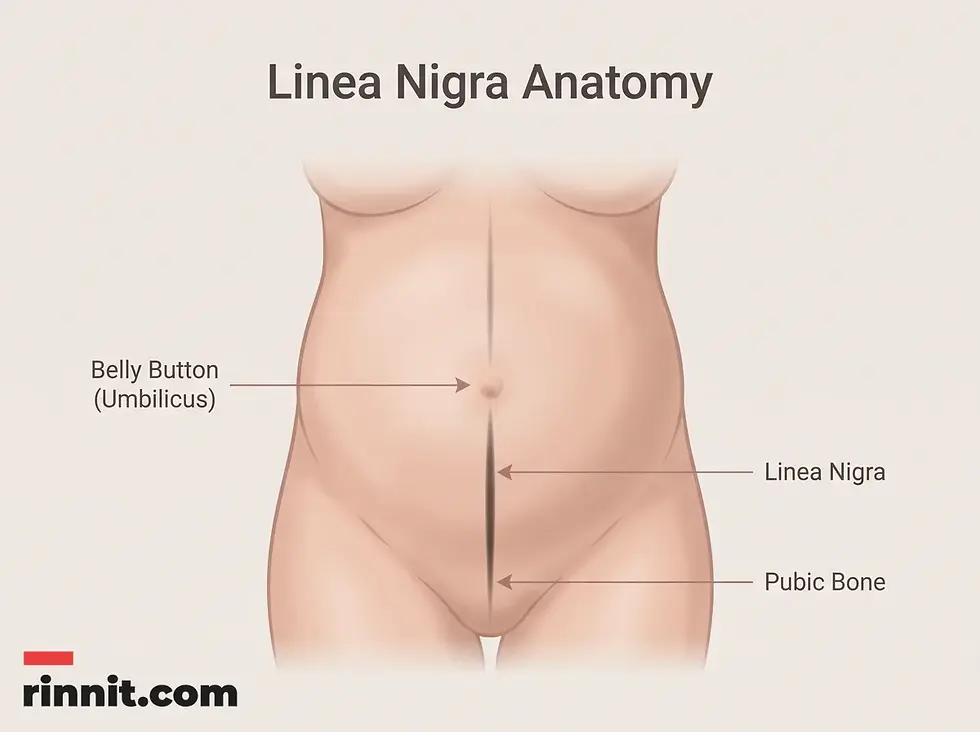
The linea nigra runs from the pubic bone through the belly button.
What does linea nigra look like?
Linea nigra, the pregnancy line, may get darker as pregnancy progresses and can look different with each pregnancy.
Feature | Description |
|---|---|
Width | About 1/4 inch to 1/2 inch wide, consistent from top to bottom. |
Color | Darker than your skin color; can look brown or light black. |
Location | From the pubic bone to the belly button, sometimes continuing toward the breasts. |
Timing | Usually visible around week 20 of pregnancy. |
Visibility | More pronounced in people with darker complexions. |
The line may get darker as pregnancy progresses. Each pregnancy can look different: it may be darker or lighter than before, or appear earlier or later [1].
Why Does the Linea Nigra Form?
The exact cause is not known, but most healthcare providers think that hormones made by the placenta cause melanin, your skin's natural pigment, to rise during pregnancy, darkening certain areas. This is a natural process and does not point to a problem for you or your baby [1].

Pregnancy hormones stimulate melanin production, which darkens the linea alba.
When does linea nigra appear, and when does it fade?
Linea nigra usually appears around 20 weeks of pregnancy, can keep darkening while hormone levels stay high and gradually fades over weeks or months after birth.
Appearance: you may first notice the line around 20 weeks, in the middle of the second trimester [1].
Development: it can keep darkening as pregnancy continues and hormone levels stay high [1].
Fading: after birth, as hormones return to regular levels, the line fades gradually over several weeks or months. In some cases it takes longer or does not disappear completely [1].
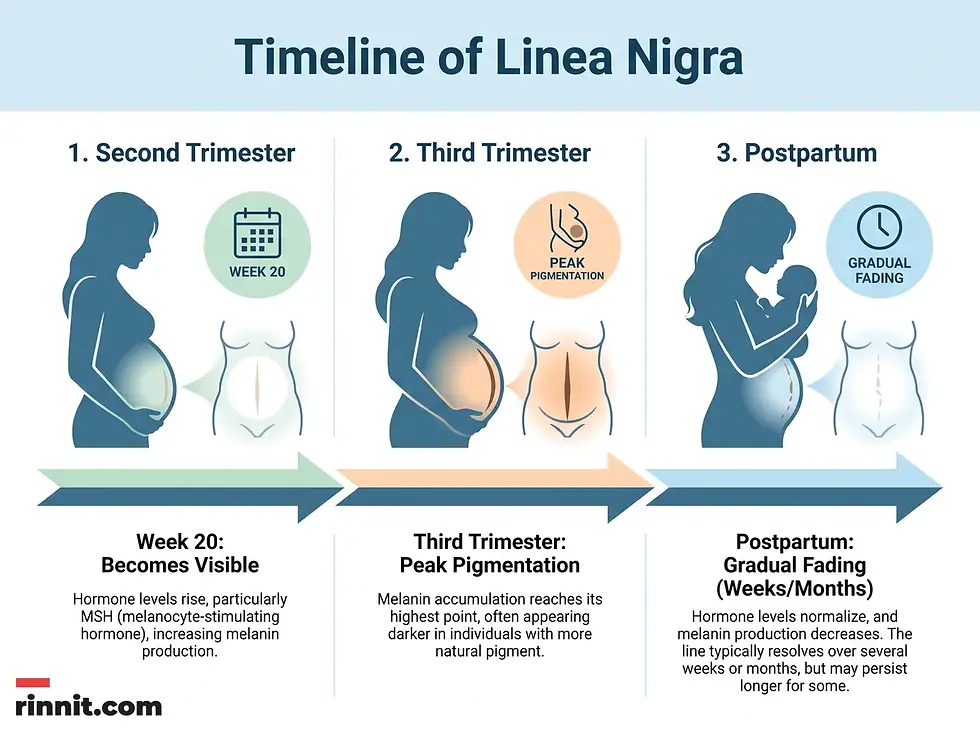
From first appearance around week 20 to gradual fading after delivery.
How should you care for your skin with linea nigra?
The linea nigra needs no treatment. Sun exposure is one factor that can darken the linea alba in people who are not pregnant [1]. A 2025 review of photoprotection in pregnancy notes that broad-spectrum sunscreens, wide-brimmed hats, and sun-safe clothing help limit pregnancy-associated pigment changes such as melasma and linea nigra [4]. Talk to your healthcare provider about which sunscreens are suitable during pregnancy.
Is It a Sign of a Health Problem?
No. The linea nigra is a normal part of pregnancy and is painless [1]. A similar line can also appear in children and in non-pregnant adults, probably through hormones; certain medications, underlying health conditions, or sun exposure may darken the linea alba [1]. If you notice other skin changes, especially a mole that is changing, mention it at your next prenatal visit rather than assuming it is hormonal [3].
What is the bottom line on linea nigra?
The linea nigra is a normal biological response to the hormonal changes of pregnancy. Whether it is faint or prominent, it is harmless and usually temporary, so no treatment is needed. If you have any concerns about skin changes during pregnancy, discuss them with your obstetrician or primary care provider.
Your next step: if you are noticing other skin changes during pregnancy, bring them up at your next prenatal visit to learn what is normal and how to care for your skin [1].
Frequently Asked Questions
What does "linea nigra" mean?
Linea nigra is Latin for "black line."
When does the pregnancy line usually appear?
The pregnancy line typically becomes visible around the 20th week of pregnancy.
Is the linea nigra a sign of a problem?
No. It is a normal and harmless part of pregnancy.
Where exactly is the line located?
The linea nigra runs vertically down the center of the stomach, usually from the pubic area to the belly button, and sometimes past the belly button toward the chest.
Why is the line darker on some people?
People with darker complexions have more natural pigmentation, which makes the line more visible.
How wide is the linea nigra?
The linea nigra is usually about 1/4 inch to 1/2 inch wide.
Does the line always go away?
The linea nigra usually fades gradually over weeks or months after delivery, though it may take longer or not disappear entirely for some people.
What is the line called before pregnancy?
The line before pregnancy is called the linea alba, or "white line."
Can sun exposure affect the line?
Sun exposure is one of the factors that can darken the line in people who are not pregnant, and sun protection is advised during pregnancy to help limit pigment changes.
Do hormones cause the linea nigra?
Yes. Most healthcare providers think hormones made by the placenta raise melanin levels during pregnancy, which darkens the skin along the line.
Related Reading
Understanding Melasma: Causes, Symptoms, and Management explains the dark facial patches that often appear in pregnancy.
Understanding Melanin: The Biology of Pigmentation and Protection describes the skin pigment that darkens to form the linea nigra.
Stretch Marks: Symptoms, Causes, Diagnosis, and Treatment Explained covers another common pregnancy skin change and treatment options.
Understanding the Linea Alba: Anatomy, Function, and Health explains the belly midline structure that the linea nigra follows.
References
Cleveland Clinic. Linea Nigra. Cleveland Clinic. May 22, 2026. https://my.clevelandclinic.org/health/body/23488-linea-nigra
Estève E, Saudeau L, Pierre F, et al. Physiological cutaneous signs in normal pregnancy: a study of 60 pregnant women. Ann Dermatol Venereol. 1994;121(3):227-231. PMID 7832550. https://pubmed.ncbi.nlm.nih.gov/7832550/
Bieber AK, Martires KJ, Stein JA, et al. Pigmentation and pregnancy: knowing what is normal. Obstet Gynecol. 2017;129(1):168-173. PMID 27926637. https://doi.org/10.1097/AOG.0000000000001806
Lim HW, Piquero-Casals J, Schalka S, et al. Photoprotection in pregnancy: addressing safety concerns and optimizing skin health. Front Med (Lausanne). 2025;12:1563369. PMID 40212279. https://doi.org/10.3389/fmed.2025.1563369
Medical disclaimer
This article is for informational purposes only and is not a substitute for professional medical advice, diagnosis, or treatment. The clinical information in this guide reflects source material last reviewed in May 2026.



Comments