Understanding the Linea Alba: Anatomy, Function, and Health

Updated: 2 days ago
Medically reviewed by Dr. Baraa Alnahhal, MD · Last reviewed: October 2026
Quick Answer
The linea alba is a vertical band of connective tissue, primarily composed of collagen and elastin, that extends from the sternum to the pubic bone [1]. It separates the left and right rectus abdominis muscles while serving as a central anchor for the obliques and transverse abdominis [1]. It stabilizes the torso and may darken or stretch during pregnancy [1].
What the research says
Structured exercise narrows the gap after pregnancy. Across 9 randomized trials (450 women), exercise reduced the inter-recti distance by a mean of 8.05 mm (95% CI −10.43 to −5.68), and programs started within 3 months of delivery did better (−10.2 mm), although function scores did not differ. (Capoccia Giovannini et al., Hernia, 2026) [2]
Programs that train deep and superficial abdominal muscles together work best. In a network meta-analysis of 27 trials (1,340 postpartum women), combined deep-and-superficial abdominal training reduced inter-recti distance more than single-muscle or passive approaches; kinesio-taping (mean difference −3.93) and abdominal binders (−10.32) were far less effective than the best exercise combinations (about −22.6 to −26.3). (Bigdeli et al., Sci Rep, 2025) [3]
Postpartum exercise helps the pelvic floor too. In 65 studies (21,334 participants), pelvic floor muscle training lowered the odds of urinary incontinence by 37% (OR 0.63, 95% CI 0.41–0.97), and abdominal muscle training reduced inter-rectus distance, though that evidence was low certainty. (Beamish et al., Br J Sports Med, 2025) [4]
The linea alba is a specialized band of fibrous connective tissue at the center of the abdomen. It plays a quiet but important role in core stability, and it is also the tissue most affected when the abdominal wall is stretched by pregnancy or excess abdominal pressure.
Anatomical Structure and Strategic Location
The linea alba, which translates from Latin as "white line," is a specialized band of fibrous connective tissue. It is situated along the midline of the anterior abdominal wall, running vertically from the lower end of the sternum (breastbone) to the pubic bone [1]. This tissue is primarily composed of collagen and elastin [1], providing it with a unique combination of strength and elasticity. While it is not a tendon [1], it serves a similar structural purpose by bringing the two sides of the abdominal wall together.
In most individuals, the linea alba is relatively inconspicuous as it blends into the surrounding skin. However, in people with highly developed abdominal muscles, it may appear as a colorless groove [1], creating the characteristic separation of a "six-pack." At its widest point, typically just above the belly button, it measures approximately 2.25 centimeters [1]. Its width and tension are vital for maintaining the internal pressure and external stability of the torso.
Feature | Anatomical detail |
|---|---|
Composition | Fibrous connective tissue made of collagen and elastin [1]. |
Length | Extends from the sternum (breastbone) to the pubic bone [1]. |
Width | Approximately 2.25 cm at its widest point above the navel [1]. |
Visibility | Colorless groove in muscular abdominals; darkens during pregnancy [1]. |

The Functional Role in Core Stability
The primary function of the linea alba is to act as a central anchor for the abdominal muscles. It separates the left and right sides of the rectus abdominis while providing an attachment point for other muscle groups, including the obliques and the transverse abdominis [1]. This central positioning allows the linea alba to stabilize the torso during movement and brace the core against external force or internal pressure.
Its high elasticity allows the abdomen to expand when necessary, such as during deep breathing or digestion. However, for functional movement, the linea alba must be able to stiffen and tighten [1]. This tension helps control the abdominal wall and ensures that force is distributed evenly across the core. Without a strong and functional linea alba, individuals may experience instability, poor posture, and difficulty performing everyday physical tasks.
Functional aspect | Description of impact |
|---|---|
Muscle separation | Keeps the left and right rectus abdominis muscles correctly positioned [1]. |
Anchor point | Provides a stable attachment for the obliques and transverse muscles [1]. |
Force absorption | Helps the core absorb and distribute pressure applied to the abdomen [1]. |
Torso stabilization | Braces the core to allow for stable and controlled body movements. |
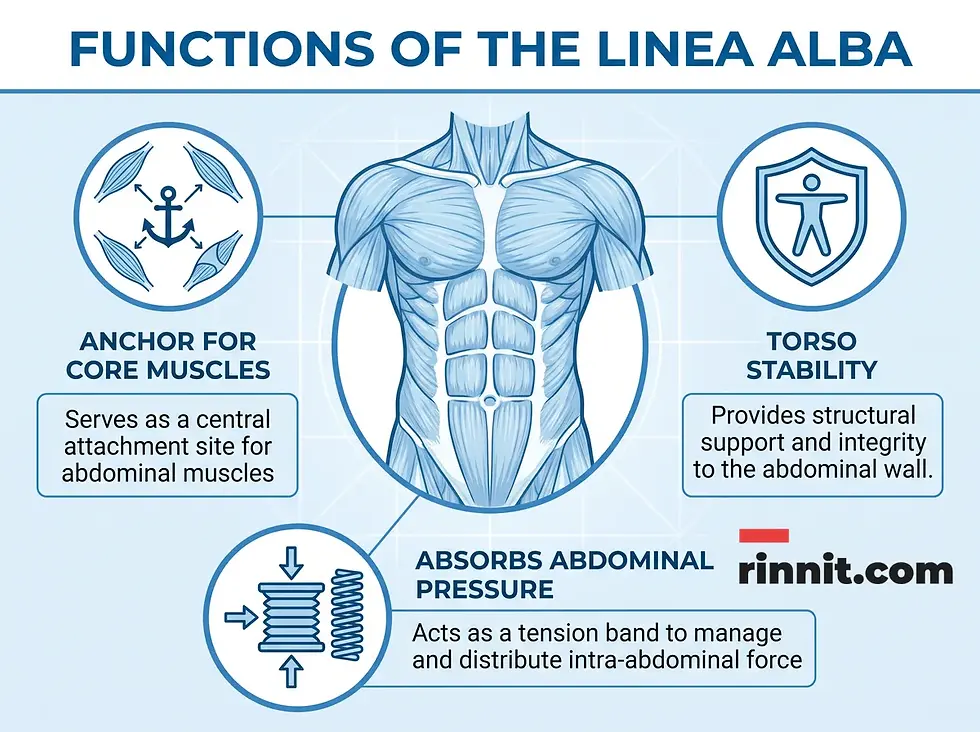
Conditions and Changes: Pregnancy and Stretching
The linea alba is subject to significant changes during certain life stages, most notably during pregnancy. Increased hormone levels and the expansion of the uterus cause the placenta to trigger higher melanin production. This results in the darkening of the tissue, transforming the colorless linea alba into a visible dark line known as the "linea nigra" or pregnancy line [1]. This line typically runs from the navel to the pubic area and usually fades after childbirth [1].
Beyond color changes, physical overstretching is a common concern. When the abdominal wall is pushed outward excessively, due to pregnancy or obesity, the linea alba can lose its elasticity and weaken [1]. If the tissue is stretched too far, the abdominal muscles may remain separated, a condition known as diastasis recti [1]. This can lead to a visible bulge in the stomach, low back pain, and pelvic instability. In some cases, a weak linea alba may even lead to the development of a hernia.

Proactive Care and Strengthening Strategies
Maintaining the integrity of the linea alba is essential for long-term core health. While the tissue can often repair itself [1], especially after pregnancy as muscles regain their natural strength, targeted strategies can accelerate recovery. Specific core-strengthening exercises and physical therapy are frequently recommended [1] [2] to close "ab gaps" and restore the tension required for stability.
Daily habits also play a significant role in protecting this tissue. Practicing good posture and using deep, rib-expanding breaths can reduce unnecessary strain [1]. It is also important to avoid straining while lifting and to avoid movements that put excessive, direct pressure on the midline, such as traditional sit-ups, when the tissue is already weak [1]. Always consult a healthcare professional before beginning a new exercise routine, as improper movements can inadvertently worsen abdominal separation [1].
Conclusion
The linea alba is a small but essential part of the core. It anchors the abdominal muscles, absorbs pressure, and keeps the torso stable. When pregnancy, obesity or repeated strain overstretch it, the tissue can weaken, but most people recover well with time, good habits and guided exercise.
Next Steps for Health
If you notice a bulge or doming along your midline, back or pelvic pain, leaking urine, or trouble lifting, talk to your healthcare provider. Strength exercises and physical therapy can usually help heal a damaged linea alba and conditions like diastasis recti.
Frequently Asked Questions
1. What exactly is the linea alba?
The linea alba is a vertical band of fibrous connective tissue that separates the left and right sides of the abdominal muscles.
2. Is the linea alba a tendon?
No. It is not a tendon; it is a band of fibrous connective tissue made of collagen and elastin.
3. Why does the linea alba turn dark during pregnancy?
Higher hormone levels increase melanin production, causing the line to darken into what is called the linea nigra.
4. What is diastasis recti?
Diastasis recti is a condition where the abdominal muscles remain separated because the linea alba has been overstretched and weakened.
5. Can a weak linea alba cause back pain?
Yes. Because it helps stabilize the core, a weak linea alba can lead to poor posture and lower back pain.
6. How wide is the linea alba?
The linea alba can be about 2.25 centimeters wide at its widest point, usually just above the belly button.
7. Does everyone have a linea alba?
Yes. Every person has a linea alba, although it is usually colorless and blends into the skin.
8. Can the linea alba repair itself?
Yes. It can often heal on its own as abdominal muscles regain strength, though physical therapy may help with significant separation.
9. What are the symptoms of a damaged linea alba?
Symptoms include coning or doming when contracting the abs, pelvic or hip pain, low back pain, poor posture, leaking urine and difficulty lifting objects.
10. What does "linea alba" mean?
"Linea alba" is Latin for "white line," referring to its appearance in muscular abdominal anatomy.
11. Are sit-ups good for a weak linea alba?
Traditional sit-ups should generally be avoided if the tissue is weak, as they can put too much pressure on the separation.
12. Does obesity affect the linea alba?
Yes. Excess pressure on the abdominal wall from obesity can stretch and weaken the tissue, similar to pregnancy.
13. What is coning or doming?
Coning or doming is a ridge or bulge along the midline of the stomach during abdominal exertion, which can indicate a weak linea alba.
14. How does deep breathing help?
Deep breaths that expand the ribs help manage abdominal pressure and can support the health of the core tissue.
15. Can a hernia occur in the linea alba?
Yes. If the tissue becomes significantly weak or damaged, a hernia can develop in the midline of the abdomen.
Related Reading
Diastasis Recti: What It Is, Why It Happens, and How to Fix It explains widening of the linea alba after pregnancy or strain.
Abdominal Muscles: Anatomy, Function, Common Problems and Care describes the belly muscles that meet at the linea alba.
Ventral Hernia: Types, Symptoms, and Treatment Options covers hernias through the front wall of the belly.
Umbilical Hernia in Babies and Adults: When It Closes on Its Own and When Surgery Is Needed explains belly button hernias and when repair is needed.
References
Cleveland Clinic. Linea Alba (Abdomen): Function, Anatomy & Conditions. Cleveland Clinic. Last updated July 18, 2022. https://my.clevelandclinic.org/health/body/23483-linea-alba
Capoccia Giovannini S, et al. Non operative management of postpartum Diastasis Recti: a systematic review and metanalysis of randomized controlled trials. Hernia. 2026;30(1). PMID 41995887. https://doi.org/10.1007/s10029-026-03671-1
Bigdeli N, et al. An evidence-based comparison of rehabilitation strategies for diastasis recti abdominis in postpartum women: a systematic review and network meta-analysis. Scientific Reports. 2025;15(1):39591. PMID 41224804. https://doi.org/10.1038/s41598-025-22574-2
Beamish NF, et al. Impact of postpartum exercise on pelvic floor disorders and diastasis recti abdominis: a systematic review and meta-analysis. British Journal of Sports Medicine. 2025;59(8):562-575. PMID 39694630. https://doi.org/10.1136/bjsports-2024-108619
Medical disclaimer
This article is for informational purposes only and does not constitute medical advice. Consult a healthcare professional for diagnosis and treatment.



Comments