Diastasis Recti: What It Is, Why It Happens, and How to Fix It

Updated: 3 days ago
Medically reviewed by Dr. Baraa Alnahhal, MD · Last reviewed: November 2026
Quick Answer
Diastasis recti is separation of the rectus abdominis (six-pack) muscles along the linea alba, caused by abdominal stretching during pregnancy [1]. Signs include a belly pooch, coning when contracting the abs and back pain [1]. Diagnosis is based on a gap wider than 2 centimeters [1]. Treatment focuses on gentle core exercises with a physical therapist, with surgery in select cases [1].
What the research says
Mild separation is very common during and after pregnancy, and it often improves over the first year. In a prospective cohort of 300 first-time pregnant women, diastasis recti abdominis (a palpated gap of two or more fingerbreadths) was present in 33.1% at gestation week 21, 60.0% at 6 weeks, 45.4% at 6 months, and 32.6% at 12 months after childbirth; women with and without it reported similar lumbopelvic pain at 12 months (PubMed: Sperstad et al., Br J Sports Med, 2016 [2]).
Evidence for any one exercise program is still weak. A systematic review of seven randomized trials (381 women) found that transversus abdominis (deep abdominal) training reduced the gap between the muscles (mean difference −0.63 cm; 95% CI −1.25 to −0.01; two trials), but the authors rated the evidence as very low quality and concluded there is not yet enough to recommend a specific exercise program (PubMed: Gluppe et al., Braz J Phys Ther, 2021 [3]).
Exercise may work better than a binder, especially below the belly button. A 2025 meta-analysis of 13 randomized trials found that abdominal exercise reduced the gap below the umbilicus more than abdominal binding or no intervention (mean difference −0.31; 95% CI −0.53 to −0.10), while the effect above the umbilicus was unclear (PubMed: Abdullah et al., Physiother Res Int, 2025 [4]).
What Is Diastasis Recti?
Diastasis recti (also called diastasis or rectus diastasis) is the separation of the rectus abdominis muscles [1] — the vertical muscles that run down the front of your stomach and are often called “six-pack abs.”
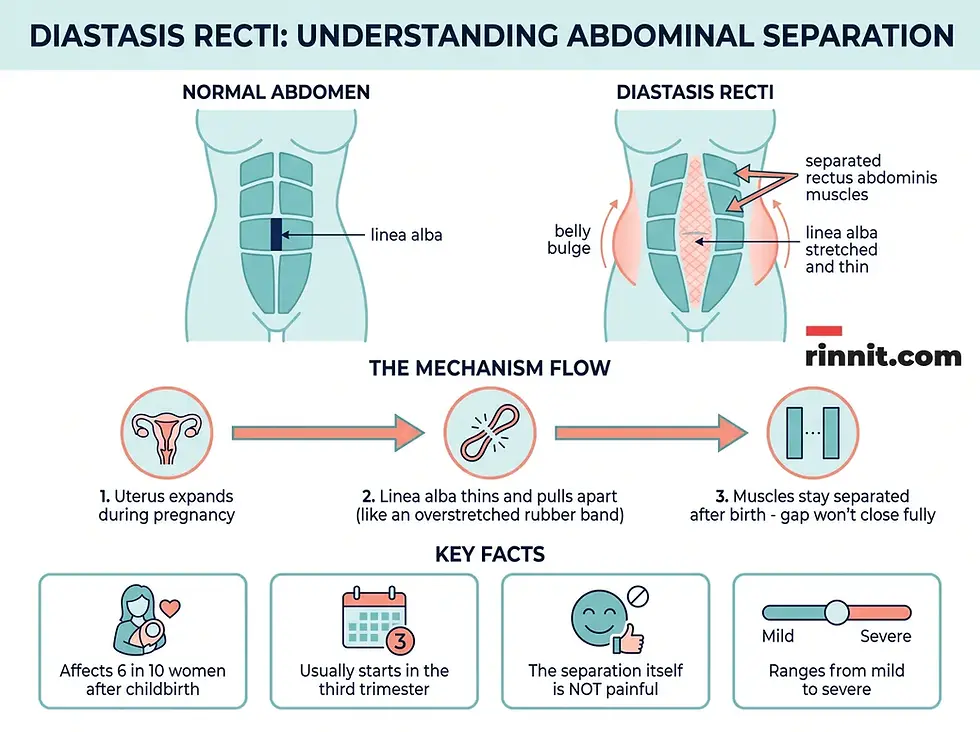
The rectus abdominis is a pair of muscles divided into left and right sides by a band of tissue called the linea alba. As your uterus expands during pregnancy, the linea alba thins and pulls apart [1].
After you deliver your baby, the linea alba can heal and come back together. It is elastic and retracts like a rubber band. But like a rubber band, it can lose its elasticity from stretching. When that happens, the gap won’t close as much as it should, the two sides of the abdominals stay separated, and the area appears pushed outward [1].
The condition is very common — it affects 6 in 10 women after childbirth [1] — and it can range from mild to severe [1].
Key fact | Detail |
What separates | The left and right rectus abdominis (“six-pack”) muscles |
The tissue involved | The linea alba, the midline band that divides the muscles |
Who it affects | About 6 in 10 women after childbirth |
When it starts | Usually the third trimester; often noticed weeks after birth |
How severe it can be | Ranges from mild to severe |
Is it painful | No — the separation itself does not hurt |
Symptoms and Causes
When Does Diastasis Recti Develop?
Diastasis usually develops in the third trimester [1]. However, you may not notice signs until several weeks after your baby is born [1].
The condition can occur above your belly button, below your belly button, or right at the belly button [1].
Symptoms of Diastasis Recti
The most recognizable sign is a visible bulge or “pooch” that sticks out just above or below the belly button — even after you have lost the weight you gained during pregnancy [1].
Common signs include:
A visible bulge or “pooch” just above or below the belly button (even after losing pregnancy weight) [1].
A soft or jelly-like feeling around the belly button [1].
Coning or doming when you contract your ab muscles or lean back in a chair [1].
Difficulty lifting objects, walking, or doing everyday tasks [1].
Low back pain [1].
Poor posture [1].
What does diastasis recti feel like? The separation itself isn’t painful [1]. You may feel pain from some of the side effects, but the ab separation doesn’t hurt. Some people feel weakness in their core during once-easy tasks like lifting a laundry basket, or a jelly-like texture in the space between the left and right abdominals when contracting the muscles.
Symptom | What you notice |
Belly bulge | A “pooch” above or below the belly button that won’t go away |
Jelly-like softness | A soft, jiggly area around the belly button |
Coning or doming | A ridge forms when you contract your abs or lean back |
Core weakness | Trouble lifting objects or doing everyday tasks |
Low back pain | Aching from weakened abdominal support |
Poor posture | Difficulty holding your body upright |

Risk Factors
Several factors can increase your risk of developing diastasis recti.
Risk factor | Why it matters |
Less than 12 months between pregnancies | The abdomen hasn’t fully recovered |
Over 35 years old | Tissue elasticity changes with age |
Carrying multiples (twins or triplets) | More abdominal stretching |
A heavy or big baby | Greater pressure on the abdominal wall |
Being extremely petite | A smaller frame accommodates less stretch |
Pushing during vaginal delivery | Straining increases abdominal pressure |
Complications
If diastasis recti is severe or goes untreated, complications can include:
Complication | Impact |
Umbilical hernia | Tissue bulges through the abdominal wall at the navel |
Constipation | Pressure and muscle changes affect bowel function |
Increased back pain | Weakened core leaves the back to compensate |
Leaking pee | Reduced support contributes to urinary incontinence |
Pain during sex | Pelvic floor strain (dyspareunia) |
Pelvic and hip pain | Poor core mechanics affect the pelvis |
Diagnosis and Tests
How Doctors Diagnose Diastasis Recti
Your healthcare provider will check whether you have diastasis, where it’s located, and how severe it is.
Providers use their hands and fingers to feel the abdominal area for gaps and muscle tone. Some may use ultrasound, a measuring tape, or a tool called a caliper for a more accurate measurement [1].
The measurement threshold matters: an abdominal gap wider than 2 centimeters is considered diastasis recti [1]. It is also measured in finger widths — for example, two or three fingers’ separation [1].
Based on the findings, your provider may recommend exercises or refer you to a physical therapist.
How Do I Test Myself?
You can check yourself for diastasis recti at home in four steps:
Lie on your back with your knees bent and feet flat on the floor.
Lift your shoulders slightly off the ground, keeping one hand behind your head for support — almost like you’re doing a sit-up — and look down at your belly.
Move your other hand above your belly button area, palms down and fingers pointing toward your toes.
Use your fingers to feel for a gap between the abs. Count how many fingers fit in the space between your right and left abdominals.
If you feel a gap of two or more finger widths, discuss your concerns with your healthcare provider [1]. They can confirm the diagnosis and recommend treatment.
Diagnostic detail | What it means |
Diagnosis threshold | Gap wider than 2 centimeters |
Finger-width method | Two or three fingers’ separation indicates diastasis |
Who confirms it | Healthcare provider or physical therapist |
Tools used | Hands and fingers, ultrasound, measuring tape, caliper |

Management and Treatment
How Do I Fix My Diastasis Recti?
Fixing diastasis recti requires gentle movements that tighten your abdominal muscles. Before starting any exercise program, make sure it is safe for diastasis recti.
Working with a physical therapist who has experience with diastasis recti is the best path [1]. They can create a treatment plan that makes sure you perform the movements correctly and progress to more challenging movements at the right time.
Early Postpartum Modifications
Certain movements make abdominal separation worse. In the first six weeks postpartum:
Do this | Avoid this |
Avoid lifting anything heavier than your baby | Heavy lifting |
Roll onto your side when getting out of bed | Sitting straight up from flat |
Use your arms to push yourself up | Crunches and sit-ups |
Belly Bands and Binders
You can wear an elastic belly band to hold your belly in and support your lower back. Keep in mind that binders can’t heal diastasis recti and won’t strengthen your core muscles [1] [4] — but they can be a helpful reminder to engage your core and use good posture.
Is It Too Late to Fix It?
No. It’s never too late to repair your diastasis recti. With the proper exercises, many people can improve their ab separation and core strength even years after delivering their last baby [1].
Can You Fix It Without Surgery?
Yes, it’s possible to fix diastasis recti without surgery. Providers recommend physical therapy or at-home exercises to help heal diastasis before considering surgery [1]. Surgery may be an option if you have an umbilical hernia or if you want diastasis recti surgery (a tummy tuck) [1].
Will It Heal on Its Own?
Possibly — it depends on the severity and whether you’re taking steps to help it. Mild cases with a little separation may improve with minimal effort [1].
The Best Exercises
The best exercises for diastasis recti are those that engage the deep abdominals [1] [5]. Most diastasis recti exercises involve deep breathing and slow, controlled movements [1].
Movements That Make It Worse
Any movement that bulges the abdominal wall forward can worsen your diastasis recti [1]. Everyday movements like getting out of bed or up off a chair can make it worse, so be mindful of how you use your abdominals throughout the day.
Exercises to avoid | Why |
Crunches or sit-ups of any kind | Push the abdominals outward |
Planks or push-ups (unless modified) | Strain the separated midline |
Downward dog, boat pose, other yoga poses | Bulge the abdominal wall |
Double leg lifts, scissors, other Pilates moves | Increase separation pressure |
Any exercise that causes coning or doming | A visible sign the gap is worsening |
When Should I See My Healthcare Provider?
Diastasis recti is a common and treatable condition. If you have more than a two-finger gap between your abdominals or are experiencing pain, contact your healthcare provider for a diagnosis. They may want you to see a physical therapist or pelvic floor specialist to help strengthen your abdominal muscles [1].
Outlook / Prognosis
How Long Will It Take to Heal?
One study found that 45% of women have diastasis at six months postpartum [1] [2]. The exact healing time depends on the amount of ab separation and how consistent you are with your strengthening exercises. After several weeks postpartum, the gap will start to close as your muscles regain strength [1].
Can I Get Diastasis Recti Again?
Yes. You can heal your diastasis recti and get it again. Your risk increases the more times you’re pregnant [1]. Think of the linea alba as a rubber band that’s continuously stretched — over time it loses its elasticity and may not regain its original shape after being stretched multiple times.
Outlook factor | Detail |
Prevalence at 6 months postpartum | 45% of women |
What drives healing | Severity of separation + exercise consistency |
When the gap starts to close | Several weeks postpartum |
Can it recur | Yes — risk rises with each pregnancy |
Is it ever too late to fix | No — repairable years after the last baby |
Prevention
Some abdominal separation is normal and expected with pregnancy [1]. But you can lower your risk with these steps:
Prevention step | How to do it |
Maintain healthy weight gain | Exercise and eat healthy foods; ask your provider about your target |
Practice good posture | Stand up straight with your shoulders back |
Deep breathing | Breathe so your ribs expand, not just your belly |
Safe core exercises | Avoid sit-ups and crunches after 12 weeks of pregnancy and postpartum |
Don’t strain while lifting | Be careful with grocery bags, children, and other loads |
Log roll out of bed | Roll to one side, then use your arms to push up |
Key Takeaways
Diastasis recti is a separation of the rectus abdominis (“six-pack”) muscles along the linea alba.
It affects about 6 in 10 women after childbirth and usually starts in the third trimester.
Signs include a belly “pooch,” jelly-like softness, coning when contracting the abs, back pain, and poor posture — but the separation itself isn’t painful.
A gap wider than 2 centimeters (about two finger widths) confirms the diagnosis.
Physical therapy and deep-abdominal exercises are the first-line treatment; surgery is reserved for hernias or cosmetic preference.
It’s never too late to fix — even years after your last baby.
Prevention starts in pregnancy with healthy weight gain, posture, safe core exercises, and log-rolling out of bed.
Take the Next Step
If you notice a belly bulge, coning when you move, or a gap of two or more finger widths, talk to a healthcare provider or physical therapist. Diastasis recti is common, treatable, and fixable at any stage — the right exercise plan can help you rebuild your core and feel confident in your body again.
Related reading: umbilical hernia, lower back pain, constipation
Frequently Asked Questions
1. What is diastasis recti?
Diastasis recti is the separation of the rectus abdominis muscles — the “six-pack” abs — that occurs when the midline tissue (linea alba) stretches and pulls apart during pregnancy. It affects about 6 in 10 women after childbirth.
2. What causes diastasis recti?
As the uterus expands during pregnancy, the linea alba thins and separates. After delivery, this tissue may lose elasticity like an overstretched rubber band, leaving the left and right abdominal muscles separated. Risk factors include multiples, a big baby, pregnancies less than 12 months apart, and being over 35.
3. What are the symptoms of diastasis recti?
Common signs are a visible bulge or “pooch” above or below the belly button, a soft jelly-like feeling near the navel, coning or doming when contracting the abs, core weakness, low back pain, and poor posture. The separation itself is not painful.
4. How is diastasis recti diagnosed?
A healthcare provider feels the abdomen for gaps and measures muscle tone with hands, fingers, ultrasound, measuring tape, or a caliper. A gap wider than 2 centimeters (about two or more finger widths) confirms diastasis recti.
5. How do I do a diastasis recti self-test?
Lie on your back with knees bent, lift your shoulders slightly off the floor like a partial sit-up, and slide your fingers above your belly button. If two or more finger widths fit in the gap between your left and right abdominals, see a healthcare provider.
6. What is the best treatment for diastasis recti?
Physical therapy with a therapist experienced in diastasis recti is the standard approach. The best exercises engage the deep abdominals through deep breathing and slow, controlled movements, with steady progression to more challenging exercises.
7. Can diastasis recti heal without surgery?
Yes. Most cases are treated with physical therapy or at-home exercises before surgery is considered. Surgery (tummy tuck repair) is typically only offered if you have an umbilical hernia or want cosmetic correction.
8. What exercises should I avoid with diastasis recti?
Avoid crunches and sit-ups, planks and push-ups (unless modified), yoga poses like downward dog and boat pose, Pilates moves like double leg lifts and scissors, and any exercise that causes your abdomen to bulge, cone, or dome.
9. Is it too late to fix diastasis recti years after pregnancy?
No. It is never too late to repair diastasis recti. With the proper exercises, many people can improve the separation and core strength even years after delivering their last baby.
10. Can diastasis recti cause complications?
Yes. Untreated or severe diastasis recti can lead to an umbilical hernia, constipation, increased back pain, leaking urine, pain during sex, and pelvic or hip pain.
References
Cleveland Clinic. Diastasis Recti. Cleveland Clinic. Apr. 21, 2025. https://my.clevelandclinic.org/health/diseases/22346-diastasis-recti
Sperstad JB, Tennfjord MK, Hilde G, Ellström-Engh M, Bø K. Diastasis recti abdominis during pregnancy and 12 months after childbirth: prevalence, risk factors and report of lumbopelvic pain. Br J Sports Med. 2016;50(17):1092-1096. doi:10.1136/bjsports-2016-096065. PMID: 27324871.
Gluppe S, Engh ME, Bø K. What is the evidence for abdominal and pelvic floor muscle training to treat diastasis recti abdominis postpartum? A systematic review with meta-analysis. Braz J Phys Ther. 2021;25(6):664-675. doi:10.1016/j.bjpt.2021.06.006. PMID: 34391661.
Abdullah, Rehman KA, Ahmad B, et al. Comparative efficacy of abdominal exercises and abdominal binding on diastasis recti abdominis reduction in postpartum women: a systematic review and meta-analysis of randomized controlled trials. Physiother Res Int. 2025;30(2):e70038. doi:10.1002/pri.70038. PMID: 40018828.
Thabet AA, Alshehri MA. Efficacy of deep core stability exercise program in postpartum women with diastasis recti abdominis: a randomised controlled trial. J Musculoskelet Neuronal Interact. 2019;19(1):62-68. PMID: 30839304. https://pubmed.ncbi.nlm.nih.gov/30839304/
Medical Disclaimer
This article is for informational purposes only and does not constitute medical advice. Always seek the advice of your physician or other qualified health provider with any questions you may have regarding a medical condition. Never disregard professional medical advice or delay in seeking it because of something you have read here.



Comments