Krabbe Disease: Symptoms, Causes, and Management

Updated: 2 days ago
Medically reviewed by Dr. Baraa Alnahhal, MD · Last reviewed: October 15, 2026
What the research says
Transplant before symptoms changed the course of infantile Krabbe disease. In 11 newborns given umbilical-cord blood from unrelated donors before symptoms appeared, survival was 100% at a median follow-up of 3 years, compared with 43% among 14 babies transplanted after symptoms began. (Escolar et al., N Engl J Med, 2005) [2]
Stem cell transplant may still extend survival after symptoms start. In a registry study matching 16 transplanted patients with 68 who were not transplanted, those without a transplant had a nearly 2.2-fold higher risk of dying from Krabbe disease. (Langan et al., J Neurosci Res, 2016) [3]
Experts advise starting treatment within the first 30 days of life. Drawing on 11 years of newborn screening in New York, which began in 2006, consensus guidelines say outcomes may improve if treatment for infantile Krabbe disease starts before 30 days of age. (Kwon et al., Orphanet J Rare Dis, 2018) [4]
Quick Answer: Key Facts About Krabbe Disease
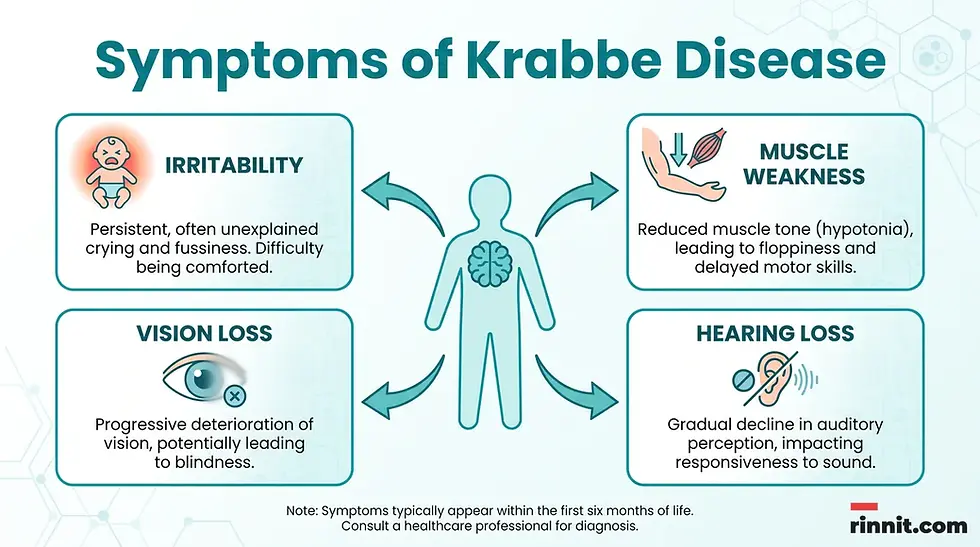
Krabbe disease, or globoid cell leukodystrophy, is a disorder caused by a GALC gene mutation that leads to an enzyme deficiency and loss of myelin in the nervous system. The most common form is infantile, with onset at 1-7 months. Symptoms include irritability, weakness and vision or hearing loss. Treatment is supportive, with stem cell transplant if early.
Feature | Details |
Medical Name | Globoid Cell Leukodystrophy [1] |
Primary Cause | GALC gene mutation (enzyme deficiency) [1] |
Main Effect | Loss of myelin (demyelination) in the nervous system [1] |
Most Common Form | Infantile (onset 1-7 months) [1] |
Key Symptoms | Irritability, muscle weakness, vision/hearing loss [1] |
Primary Treatment | Supportive care, stem cell transplant (if early) [1] |
What is Krabbe Disease?
Krabbe disease is a rare, inherited disorder that primarily affects the central and peripheral nervous systems. It belongs to a group of conditions known as leukodystrophies, which are characterized by the progressive destruction of myelin—the fatty, protective sleeve that surrounds and insulates nerve cells. When myelin breaks down, nerve signals cannot travel quickly or effectively, leading to severe neurological decline.
The condition is also marked by the presence of "globoid cells" in the brain. These are large, abnormal cells that typically contain multiple nuclei. Because Krabbe disease is degenerative, it gets worse over time and, in most cases, leads to a shortened life expectancy. It is named after Knud Krabbe, the Danish neurologist who first described the condition.

What are the symptoms of Krabbe disease?
The symptoms of Krabbe disease vary significantly depending on the age at which they first appear. The most common form is the infantile form, which typically begins before a baby is seven months old.
Infantile Krabbe Disease Stages
The infantile form usually progresses through three distinct stages:
Stage | Common Signs and Symptoms [1] |
Stage 1 | Restlessness, irritability, feeding difficulties, and unexplained fevers. |
Stage 2 | Vision changes, seizures, and severe backward arching of the neck and back. |
Stage 3 | Blindness, deafness, and a significant loss of mobility. |
Late-Onset Krabbe Disease
When the condition begins later in life—during childhood, adolescence, or adulthood—the symptoms are often milder and progress more slowly. Older children may experience tremors, difficulty walking, or vision changes. Adults might notice muscle spasticity, behavior changes, or a burning sensation in their arms and legs.
What Causes Krabbe Disease?
Krabbe disease is caused by a mutation in the GALC gene, which leads to a deficiency of an enzyme called galactocerebrosidase. This enzyme is responsible for breaking down certain fats that are essential for maintaining healthy myelin. Without enough of this enzyme, the body cannot metabolize these fats, leading to the buildup of toxic substances that destroy the myelin sheath.
The condition is inherited in an autosomal recessive pattern. This means a child must inherit two copies of the mutated gene—one from each parent—to develop the disease. Parents who carry only one copy of the mutated gene typically do not show any symptoms themselves. When both parents are carriers, each child has a 25% chance of having the disease.
How is Krabbe disease diagnosed and treated?
Early diagnosis is critical, especially since some treatments are most effective before symptoms appear. Many states in the U.S. now include Krabbe disease in their standard newborn screening protocols using a simple blood test. If the condition is suspected later in life, doctors may use an MRI to look for brain lesions or conduct genetic testing.
Current Management Strategies
While there is currently no cure for Krabbe disease, several management options are available:
Hematopoietic Stem Cell Transplant (HSCT): This procedure can slow the progression of the disease by replacing unhealthy cells with healthy ones. It is most effective when performed before symptoms begin.
Supportive Care: The primary focus for many families is comfort and quality of life. This includes muscle relaxants for spasms, anticonvulsants for seizures, and physical therapy to maintain mobility.
Nutritional Support: If swallowing becomes difficult, tube feeding may be necessary to ensure the patient receives proper nutrition.

What is the outlook for people with Krabbe disease?
Receiving a diagnosis of Krabbe disease is incredibly challenging for families. The prognosis is generally poor, but ongoing research is focused on finding new and better treatment options. A multidisciplinary care team, including neurologists, genetic counselors, and therapists, is essential for providing the best possible support.
Frequently Asked Questions
Is Krabbe disease contagious?
No. It is a genetic condition that is inherited from biological parents.
Can adults develop Krabbe disease?
Yes, though it is much rarer than the infantile form. Adult-onset symptoms typically progress more slowly.
Is there a cure for Krabbe disease?
Currently, there is no cure, but treatments like stem cell transplants can slow the disease in some cases.
How common is the condition?
Krabbe disease is rare, affecting approximately 1 in 100,000 live births in Europe and 1 in 250,000 in the United States.
What is myelin?
Myelin is a protective, fatty coating that surrounds nerve cells, allowing signals to travel quickly through the body.
Why is it called "Globoid Cell Leukodystrophy"?
The name "Globoid Cell Leukodystrophy" refers to the abnormal, large "globoid cells" that are found in the brains of those with the condition.
How is it diagnosed in newborns?
Krabbe disease is often detected through a standard blood test during newborn screening.
What is the average life expectancy for infants with Krabbe disease?
Without treatment, most infants with the condition live for about 13 months.
Can parents be tested for the gene?
Yes, genetic testing and counseling are available for parents who want to know if they are carriers.
What are the early signs to watch for in a baby?
Early signs include extreme irritability, feeding problems, and muscle weakness.
Does Krabbe disease affect intelligence?
Yes, the progressive destruction of brain cells leads to intellectual disability in most cases.
What is HSCT?
HSCT stands for Hematopoietic Stem Cell Transplant, a procedure that uses healthy donor cells to replace damaged ones.
Can physical therapy help?
Yes, physical therapy is used to help maintain mobility and manage muscle stiffness.
Are there support groups for families?
Yes, many organizations provide resources and emotional support for families affected by leukodystrophies.
What causes death in Krabbe disease?
Most often, death is caused by respiratory failure or infections like pneumonia.
Related Reading
Leukodystrophy: Symptoms, Causes, and Management explains the group of inherited white matter diseases that includes Krabbe.
Understanding Metachromatic Leukodystrophy: Causes, Symptoms, and Care covers a closely related leukodystrophy with a similar course and care.
Lysosomal Storage Diseases: Symptoms, Types, Causes, Diagnosis, and Treatment explains enzyme disorders in which waste builds up inside cells.
Stem Cell Transplant (Bone Marrow Transplant): Types, Risks, and Recovery describes the transplant treatment used for early-stage Krabbe disease.
References
Cleveland Clinic. Krabbe Disease: What It Is, Diagnosis, Symptoms & Treatment. Cleveland Clinic. Last updated August 13, 2022. https://my.clevelandclinic.org/health/diseases/6039-krabbe-disease-globoid-cell-leukodystrophy
Escolar ML, et al. Transplantation of umbilical-cord blood in babies with infantile Krabbe's disease. N Engl J Med. 2005;352(20):2069-81. PMID 15901860. https://doi.org/10.1056/NEJMoa042604
Langan TJ, et al. Evidence for improved survival in postsymptomatic stem cell-transplanted patients with Krabbe's disease. J Neurosci Res. 2016;94(11):1189-94. PMID 27638603. https://doi.org/10.1002/jnr.23787
Kwon JM, et al. Consensus guidelines for newborn screening, diagnosis and treatment of infantile Krabbe disease. Orphanet J Rare Dis. 2018;13(1):30. PMID 29391017. https://doi.org/10.1186/s13023-018-0766-x
Medical disclaimer
The information provided in this article is for educational purposes only and should not be considered medical advice. Always consult with a qualified healthcare provider for diagnosis and treatment of any medical condition.



Comments