Juvenile Dermatomyositis: A Guide for Parents and Caregivers

Updated: 2 days ago
Medically reviewed by Dr. Baraa Alnahhal, MD · Last reviewed: October 17, 2026
Quick Answer: Key Facts About Juvenile Dermatomyositis
Juvenile dermatomyositis is a rare autoimmune disease that inflames a child's skin, blood vessels and muscles, typically starting between 5 and 10 years old. Main symptoms are distinctive skin rashes and progressive muscle weakness. It is diagnosed with blood tests, MRI, EMG and muscle biopsy. Treatment reduces inflammation, and with treatment the outlook is usually positive, with possible remission.
Feature | Details |
What it is | A rare autoimmune disease causing skin, blood vessel, and muscle inflammation. [1] |
Primary Symptoms | Distinctive skin rashes and progressive muscle weakness. [1] |
Typical Onset Age | Between 5 and 10 years old. [1] |
Commonly Affected Areas | Eyelids, knuckles, knees, elbows, hips, shoulders, and neck muscles. [1] |
Diagnosis Methods | Blood tests, MRI, electromyography (EMG), and muscle biopsy. [1] |
Treatment Goals | Reducing inflammation and suppressing the overactive immune response. [1] |
Outlook | Usually positive with treatment; high survival rates and potential for remission. [1] |
What the research says
Adding methotrexate or ciclosporin to prednisone worked better than prednisone alone. In a randomized trial of 139 children with new-onset JDM, 51% (24 of 47) of those given prednisone alone reached a PRINTO 20 level of improvement at 6 months, compared with 70% (32 of 46) on prednisone plus ciclosporin and 72% (33 of 46) on prednisone plus methotrexate. The safety profile and steroid-sparing effect favored methotrexate, and no children died during the study. (Ruperto et al., Lancet, 2016) [2]
A Cochrane review rated the evidence for methotrexate in children as low certainty. In one trial of 93 children with new-onset JDM who were already taking prednisone, a higher proportion reached minimal improvement with methotrexate than with placebo (risk ratio 1.40, 95% CI 1.01 to 1.96). The review covered 16 studies and 789 participants with inflammatory myopathies overall, and the risk of bias was high or unclear in all but one study. (Raaphorst et al., Cochrane Database Syst Rev, 2025) [3]
What Is Juvenile Dermatomyositis?
Juvenile dermatomyositis (JDM) is a complex inflammatory condition that targets a child's muscles, skin, and blood vessels. It is classified as an autoimmune disease, meaning the immune system, which normally protects the body from germs, begins to attack healthy cells instead. While the exact cause remains unknown, researchers believe it may be triggered by an infection where the immune system fails to "switch off" after the virus is gone, possibly influenced by genetic factors. [1]
This condition is relatively rare, affecting an estimated 3,000 to 5,000 children in the United States. It most commonly appears in children between the ages of 5 and 10 and is nearly twice as common in females as in males. While it can affect children of any race, it is seen more often in white children. When similar symptoms develop in adults, typically in their 40s or 50s, the condition is simply called dermatomyositis. [1]
What are the early symptoms of juvenile dermatomyositis?
JDM typically presents with two primary ongoing symptoms: a specific skin rash and muscle weakness. However, parents may notice several early warning signs before these become prominent. [1]
The Characteristic Rash
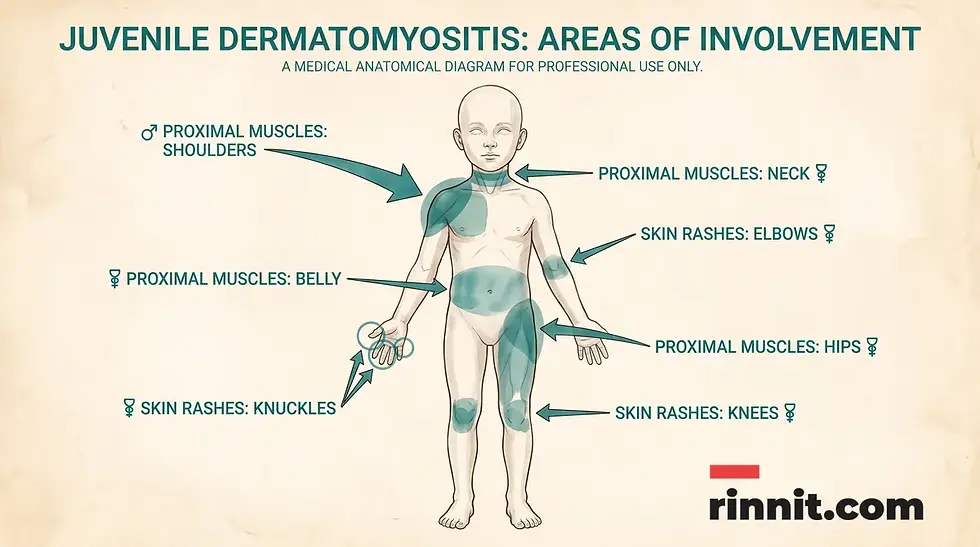
One of the first signs is often a reddish or purplish rash on the cheeks and eyelids. Because the eyelids may appear puffy, this is sometimes mistaken for common allergies. Over time, dry, inflamed patches or bumps may develop over the knuckles, knees, or elbows, resembling eczema or psoriasis. Notably, exposure to sunlight often makes these skin symptoms significantly worse. [1]
Progressive Muscle Weakness
Muscle weakness typically affects the muscles closest to the center of the body, such as the hips, shoulders, neck, and belly. A child might struggle with everyday tasks like standing up from the floor, running, or even brushing their hair. In severe cases, the muscles used for swallowing or breathing can be affected, leading to hoarseness, choking, or shortness of breath. [1]
What complications can untreated juvenile dermatomyositis cause?
Before modern treatments were available, JDM was a life-threatening condition for about one in three children. Today, more than 98% of children are alive five years after diagnosis. However, without proper management, several complications can arise: [1]
Calcinosis: The formation of firm calcium deposits under the skin, which can be painful and limit movement.
Contractures: Shortened muscles that cause joints to stay in a bent position.
Ulcers: Open sores that can develop in the skin or the gastrointestinal tract.
Severe Weakness: Impacting the ability to move, breathe, or swallow safely.
How is juvenile dermatomyositis diagnosed and treated?
Diagnosing JDM requires a combination of physical exams and specialized testing. A healthcare provider will look for the characteristic rash and test the child's muscle strength. Advanced tests like MRIs are used to spot subtle muscle swelling, while blood tests check for inflammation and specific autoantibodies. In some cases, a muscle biopsy or an electromyography (EMG) may be necessary to confirm the diagnosis and rule out other conditions like muscular dystrophy. [1]
Treatment Strategies
The primary goal of treatment is to reduce inflammation and suppress the immune system's attack. [1]
Medications: Corticosteroids are usually the first-line treatment because they work quickly. Methotrexate is often added to suppress the immune system over the long term, allowing for lower steroid doses. Other options include hydroxychloroquine for rashes and intravenous immunoglobulin (IVIG) to block harmful antibodies.
Therapies and Lifestyle: Physical therapy is essential for maintaining muscle strength and flexibility. Speech therapy may be needed for swallowing issues. Additionally, strict sun protection is important, as UV rays can make rashes worse.


Learn more. For more evidence-based health guides, visit Rinnit.com.
Frequently Asked Questions
Is juvenile dermatomyositis contagious?
No, JDM is an autoimmune disease, not an infection. It cannot be spread from person to person.
Can my child still go to school with JDM?
Most children can attend school, though they may need accommodations for physical activities or during flares.
Why is sun protection so important?
Ultraviolet (UV) light can make the skin rash worse, and adequate protection from UV rays can help reduce rashes.
Will my child ever outgrow JDM?
While children don't "outgrow" it in the traditional sense, many achieve long-term remission where they are symptom-free for years.
What are the side effects of the medications?
Steroids can cause weight gain and mood changes, which is why doctors try to reduce the dose as soon as possible.
How rare is this condition?
Experts estimate that around 3,000 to 5,000 children in the United States have juvenile dermatomyositis, which makes it a very rare condition.
Are there specific foods my child should eat?
A healthy diet rich in fruits, vegetables, lean proteins, healthy fats and whole grains can help lower inflammation and support overall health.
Can JDM affect internal organs?
In some cases, yes. JDM can affect the muscles used for swallowing and breathing and can cause ulcers in the skin or the digestive tract, which is why regular monitoring is vital.
How long does treatment usually last?
Most children require treatment for several years, though the intensity of the treatment decreases over time. Many children reach remission within two years of starting treatment and may then be able to stop their medications.
Is there a cure for JDM?
There is no cure, but treatment can lessen or even eliminate symptoms for long periods.
What causes juvenile dermatomyositis?
Experts do not know exactly why the immune system begins to attack the body's own tissues. Researchers think it may happen when the body fights an infection but does not switch off the immune response after the virus is gone, and there may also be a genetic component.
What kind of doctor treats JDM?
A pediatric rheumatologist is the primary specialist for managing JDM.
Can JDM cause permanent damage?
Without treatment, JDM can cause complications such as firm calcium deposits under the skin, shortened muscles (contractures) and severe weakness. Early and appropriate treatment is the best way to help prevent them.
Is it okay for my child to play sports?
Once the inflammation is under control, many children can return to sports, though they should follow their physical therapist's guidance.
Conclusion
A diagnosis of juvenile dermatomyositis can be overwhelming for any family, but the progress in medical care over the last few decades has transformed the outlook for these children. With early detection, a dedicated medical team, and consistent treatment, most children with JDM can successfully manage their symptoms and enjoy a high quality of life.
Related Reading
Myositis (Idiopathic Inflammatory Myopathy): Symptoms, Types, Causes, Treatment and Outlook explains the family of muscle-inflammation diseases that includes dermatomyositis.
Juvenile Idiopathic Arthritis (JIA): Symptoms, Types, Causes, Diagnosis & Treatment — Complete Guide covers the most common autoimmune joint disease in children.
Juvenile Systemic Scleroderma: Understanding Symptoms, Types, and Care explains another rare childhood autoimmune disease affecting skin and organs.
Muscle Biopsy: Diagnosing Muscle Diseases, Procedure and Recovery describes the test that checks muscle tissue for inflammation.
References
Cleveland Clinic. Juvenile Dermatomyositis. Cleveland Clinic. Last updated April 16, 2024. https://my.clevelandclinic.org/health/diseases/14808-juvenile-dermatomyositis
Ruperto N, Pistorio A, Oliveira S, et al. Prednisone versus prednisone plus ciclosporin versus prednisone plus methotrexate in new-onset juvenile dermatomyositis: a randomised trial. Lancet. 2016;387(10019):671-678. PMID 26645190. https://doi.org/10.1016/S0140-6736(15)01021-1
Raaphorst J, Gullick NJ, Shokraneh F, et al. Non-targeted immunosuppressive and immunomodulatory therapies for idiopathic inflammatory myopathies. Cochrane Database Syst Rev. 2025;8(8):CD015855. PMID 40787733. https://doi.org/10.1002/14651858.CD015855
Medical disclaimer
This article is for educational purposes only and is not intended as medical advice. Always seek the advice of your physician or other qualified health provider with any questions you may have regarding a medical condition or your child's health.



Comments