Intramuscular Lipoma: A Guide to Deep-Seated Fatty Tumors

Updated: 2 days ago
Medically reviewed by Dr. Baraa Alnahhal, MD · Last reviewed: October 2026
Quick Answer
An intramuscular lipoma is a rare, benign fatty tumor inside a muscle, making up less than 1% of lipomas and most likely in adults ages 40 to 70. It appears as a soft, movable lump that may feel firm when the muscle contracts. Imaging confirms it, and it is monitored or surgically removed. It is not known to become cancerous. [1]
What the research says
Wide excision with biopsy checks produced no recurrences in one series. A retrospective review of 27 patients (average age 54.6, average tumor size 8.2 cm, range 1.1 to 31.6 cm) treated with wide excision found no recurrences over an average of about 3 years of follow-up. One patient who was first diagnosed with an intramuscular lipoma was rediagnosed with liposarcoma, which is why the authors stress a frozen biopsy during surgery. (Han et al., Biomed Res Int, 2014)
These tumors can be hard to tell from cancer. A review of the literature notes that the clinical, microscopic and imaging features of intramuscular lipomas may resemble well-differentiated liposarcomas, which adds to the difficulty of the differential diagnosis. (McTighe and Chernev, Orthop Rev (Pavia), 2014)
What is an intramuscular lipoma?
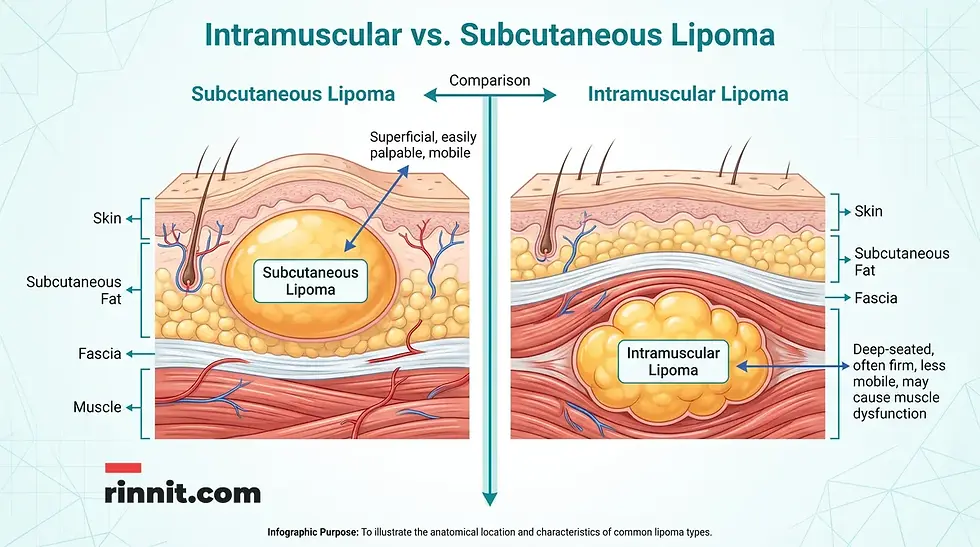
An intramuscular lipoma is a soft tissue tumor made of yellow fatty tissue that forms inside a muscle. Standard lipomas are lumps of fat found just under the skin and are the most common benign soft tissue tumors. Intramuscular versions are considered deep-seated because they form beneath the fascia, the thin sheet of connective tissue that holds muscles in place. [1] They account for less than 1% of lipomas, and adults ages 40 to 70 are most likely to develop them, although they can affect anyone. [1]
Where do these tumors typically form?
Most people have a single tumor in one muscle, but up to 15% have tumors in more than one muscle. The most common sites are deep within the muscles of the arms, chest wall, head or neck, shoulders, thighs, tongue and trunk (pelvic area). [1]
The three types of intramuscular lipoma
Providers sort these tumors by how they interact with the surrounding muscle tissue, which helps predict whether a tumor may come back after treatment. [1]
Type | Characteristics and recurrence |
|---|---|
Infiltrating | About 8 in 10 intramuscular lipomas. Muscle fibers grow through the tumor, and it may expand into nearby tendons or fascia. Recurrence after surgery is 50% to 80% |
Well-defined (well-circumscribed) | Clear origin within a muscle and distinct borders, with no infiltrating muscle fibers. These rarely grow back |
Mixed | Features both infiltrating muscle fibers and well-defined borders |
What causes an intramuscular lipoma?
Experts are not sure why some people develop them. Potential causes include chronic irritation, developmental disorders, endocrine system disorders, genetic disorders (gene mutations), metabolic syndrome, obesity, and traumatic accidents or injuries. [1]
Recognizing the symptoms
Intramuscular lipomas are slow-growing and may be smaller than half an inch (1 centimeter) or as large as 10 inches (25 centimeters). Smaller tumors do not always cause symptoms. When symptoms occur, they can include: [1]
An infiltrating intramuscular lipoma can also invade nearby tissues, tendons and muscle. [1]
How is an intramuscular lipoma diagnosed?

An orthopedist, a doctor who diagnoses and treats conditions of the musculoskeletal system, can evaluate an unexplained lump or chronic muscle pain. Providers rely on imaging scans to diagnose soft tissue tumors. [1]
Imaging scans: You may have one or more of an X-ray, ultrasound, CT scan, MRI or PET scan. MRI and CT give a detailed view of the tumor and its relationship to the muscle. [1]
Needle biopsy: A sample of tissue may be taken to confirm that the tumor is not a soft tissue cancer such as liposarcoma. [1]
Treatment and management options

You might not need treatment if the lipoma does not cause problems. Your provider may monitor it for signs of growth or changes. [1] Treatment involves surgically removing (excising) the tumor, and your provider may recommend it if the tumor:
The tumor type matters after surgery. Infiltrating tumors have a recurrence rate of 50% to 80% after removal, while well-defined tumors rarely grow back. [1] Most people with intramuscular lipomas do not need treatment, and if the tumor causes pain or other problems, surgery can remove it. [1]
Get more health insights. If you notice a new lump or unexplained muscle pain, see a healthcare provider. For more evidence-based health guides, visit Rinnit.com.
Frequently Asked Questions
Can an intramuscular lipoma turn into cancer?
No. There is no evidence of an intramuscular lipoma ever being anything other than benign. A biopsy can help confirm that a lump is a lipoma and not a cancer.
Is surgery the only way to treat a lipoma inside the muscle?
Treatment involves surgically removing the tumor, but many people do not need treatment. If the lipoma is not causing problems, your provider may simply monitor it for growth or changes.
Why does my lipoma feel firmer when I flex my muscle?
Because the tumor is inside the muscle, the lump may feel firm when you contract the muscle.
How common are these tumors?
Intramuscular lipomas are rare, accounting for less than 1% of lipomas.
What is the difference between an intramuscular and a regular lipoma?
A regular (subcutaneous) lipoma is a lump of fat just under the skin. An intramuscular lipoma forms deeper, inside a muscle. There are also intermuscular lipomas, which form between muscles.
Can I prevent an intramuscular lipoma?
No. They are rare and occur for unknown reasons, so there is no known way to prevent them.
Will the tumor grow back after surgery?
It depends on the type. Infiltrating tumors have a 50% to 80% recurrence rate after surgical removal, while well-defined tumors rarely grow back.
Does a lipoma always cause pain?
No. Smaller tumors do not always cause symptoms. Pain, cramps or nerve symptoms are more likely with larger tumors.
What kind of doctor should I see for a muscle lump?
An orthopedist, a medical doctor who diagnoses and treats conditions of the musculoskeletal system.
Can children get intramuscular lipomas?
The tumors can affect anyone, although adults ages 40 to 70 are most likely to develop them.
How large can these tumors get?
Intramuscular lipomas are slow-growing and may be smaller than half an inch (1 centimeter) or as large as 10 inches (25 centimeters).
What is a liposarcoma?
A liposarcoma is a soft tissue cancer. A needle biopsy may be done to confirm that a tumor is not a liposarcoma, because the two can be hard to tell apart.
Does obesity increase the risk of a lipoma?
Obesity is listed among the potential causes, along with metabolic syndrome, genetic disorders, chronic irritation, injuries and endocrine disorders, but experts are not sure why some people develop these tumors.
Is an intramuscular lipoma the same as a deep-seated lipoma?
Healthcare providers sometimes call this type of tumor a deep-seated lipoma because it forms under the fascia, the thin sheet of connective tissue that holds muscles in place.
Can I have more than one intramuscular lipoma?
Yes. Up to 15% of people have intramuscular lipomas in more than one muscle, but most have one tumor in one muscle.
Related Reading
Lipoma: Symptoms, Causes, Diagnosis, and Treatment explains common fatty lumps under the skin and their removal.
Liposarcoma: Symptoms, Causes, Diagnosis & Treatment — What to Know explains the rare fatty-tissue cancer doctors rule out in deep lumps.
Angiolipoma: Symptoms, Causes, and Treatment Options covers a tender lipoma type that contains small blood vessels.
Soft Tissue Sarcoma: Complete Guide to Symptoms, Types, Diagnosis, and Treatment explains cancers of muscle and fat and the warning signs of a lump.
References
Cleveland Clinic. Intramuscular Lipoma. Cleveland Clinic. Last updated July 29, 2022. https://my.clevelandclinic.org/health/diseases/23907-intramuscular-lipoma
Han HH, Choi JY, Seo BF, et al. Treatment for intramuscular lipoma frequently confused with sarcoma: a 6-year restrospective study and literature review. Biomed Res Int. 2014;2014:867689. PMID 25574469. https://doi.org/10.1155/2014/867689
McTighe S, Chernev I. Intramuscular lipoma: a review of the literature. Orthop Rev (Pavia). 2014;6(4):5618. PMID 25568733. https://doi.org/10.4081/or.2014.5618
Medical disclaimer
This article is for general educational purposes only and is not a substitute for professional medical advice, diagnosis, or treatment. Always seek the advice of your physician or other qualified health provider with any questions you may have regarding a medical condition.



Comments