Liposarcoma: Symptoms, Causes, Diagnosis & Treatment — What to Know

Updated: 2 days ago
Medically reviewed by Dr. Baraa Alnahhal, MD · Last reviewed: September 2026
TL;DR
Liposarcoma is a rare cancer that starts in fat cells, most often in the belly or in the arm and leg muscles. It typically presents as a slow-growing lump under the skin in the limbs or as belly symptoms such as pain, swelling, and early fullness. No clear risk factors are known and the cause is not fully understood — it is not linked to anything you did. Surgery to remove all the cancer cells is the main treatment, with radiation and chemotherapy used when testing shows they can help. If you notice a growing lump or persistent belly symptoms that worry you, see a doctor promptly.
Quick Answer
What is liposarcoma and how is it treated?
What it is: A rare cancer that starts in fat cells; a type of soft tissue sarcoma (connective tissue cancer).
Where it starts: Most often the belly (abdomen) or the arm and leg muscles — but it can begin in fat cells anywhere in the body.
Who gets it: Most often older adults, but it can occur at any age.
Early signs in limbs: A growing lump under the skin, pain, swelling, and weakness of the affected limb.
Early signs in the belly: Abdominal pain or swelling, feeling full sooner when eating, constipation, and blood in stool.
How it is diagnosed: Imaging tests (X-ray, CT, MRI, sometimes PET) plus a biopsy tested by pathologists.
How it is treated: Surgery to remove all cancer cells is the main treatment; radiation and chemotherapy may be used before or after surgery when they are likely to help.
What Is Liposarcoma?
Liposarcoma is a type of cancer that starts in the fat cells. It most often begins as a growth of cells in the belly (abdomen) or in the arm and leg muscles, but it can begin in the fat cells anywhere in the body.
Importantly, liposarcoma is a rare type of cancer. It happens most often in older adults, but it can happen at any age. Liposarcoma belongs to a group of cancers called soft tissue sarcomas — cancers that develop in the body's connective tissues. There are many types of soft tissue sarcoma, and liposarcoma is just one of them.
Treatment usually involves surgery to remove the cancer, and other treatments such as radiation therapy may also be used.

What Are the Early Signs of Liposarcoma?
The symptoms of liposarcoma depend on the part of the body where the cancer forms. In many cases, the first noticeable sign is a lump that grows slowly under the skin.
Signs in the Arms and Legs
Liposarcoma in the arms and legs can cause:
A growing lump of tissue under the skin
Pain
Swelling
Weakness of the affected limb
Signs in the Belly (Abdomen)
Liposarcoma in the belly can cause:
Abdominal pain
Abdominal swelling
Feeling full sooner when eating (early fullness)
Constipation
Blood in stool
Symptom | Where it appears | What to look for |
Growing lump under the skin | Arms and legs | A mass that slowly enlarges rather than staying the same size |
Pain | Arms and legs | Pain at or near the lump |
Swelling | Arms and legs | Visible or felt swelling around the affected area |
Limb weakness | Arms and legs | Reduced strength in the affected limb |
Abdominal pain | Belly | Persistent pain in the abdomen |
Abdominal swelling | Belly | Belly swelling that grows or persists |
Early fullness | Belly | Feeling full sooner than usual when eating |
Constipation | Belly | Ongoing changes in bowel habits |
Blood in stool | Belly | Visible blood in the stool |
When Should You See a Doctor?
Make an appointment with a doctor or other healthcare professional if you have any symptoms that do not go away and that worry you. This applies whether the symptom is a lump that keeps growing or belly symptoms such as persistent pain, swelling, or changes in eating and bowel habits.
What Causes Liposarcoma?
It is not clear what causes liposarcoma. What is understood is that it starts when fat cells get changes in their DNA. A cell's DNA holds the instructions that tell the cell what to do. These changes turn the fat cells into cancer cells.
The changes tell the cancer cells to grow quickly and make a lot of extra cells. The cancer cells also keep living when healthy cells would die as part of their natural life cycle. The cancer cells form a growth, called a tumor.
From there, liposarcoma can behave in two ways depending on the type. In some types, the cancer cells stay put — they continue making more cells, causing the tumor to get bigger. In other types, the cancer cells might break away and spread to other parts of the body. When cancer spreads to other parts of the body, it is called metastatic cancer.

What Are the Risk Factors for Liposarcoma?
The source material does not identify any established risk factors for liposarcoma. The cause itself is not clear, and no lifestyle, environmental, or inherited risk factors are listed among the verified sources for this article. This is reassuring information in its own right: liposarcoma is not something that can be clearly tied to anything a person did or did not do.
How Is Liposarcoma Diagnosed?
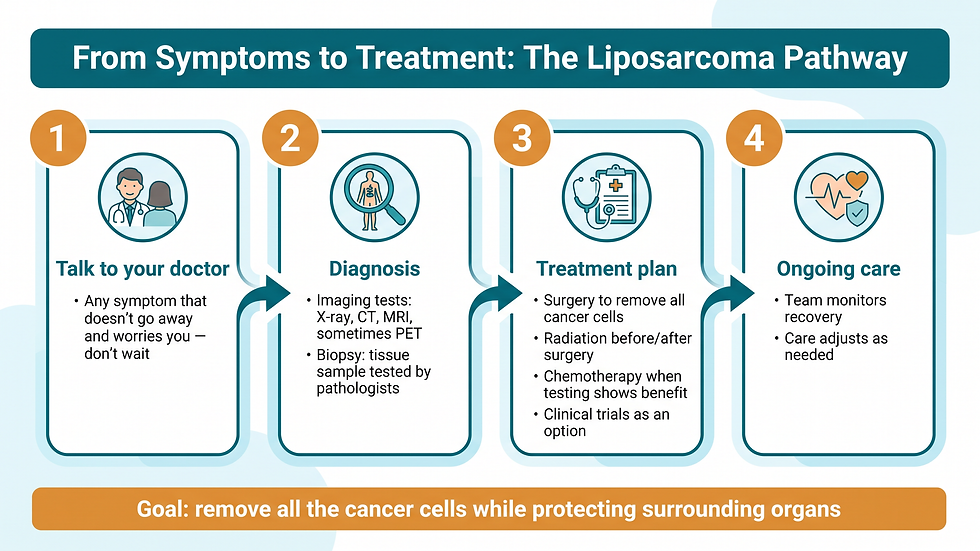
Tests and procedures used to diagnose liposarcoma include imaging tests, a biopsy, and laboratory analysis of the tissue.
Imaging Tests
Imaging tests create pictures of the inside of the body. They might help show the size of the liposarcoma. Tests may include X-ray, CT scan, and MRI. Sometimes a positron emission tomography scan (PET scan) is needed.
Removing a Sample of Tissue for Testing (Biopsy)
A procedure to remove some cells for testing is called a biopsy. The sample might be removed with a needle put through the skin, or the sample might be taken during surgery to remove the cancer. The type of biopsy depends on the cancer's location.
Testing the Cancer Cells in a Lab
The biopsy sample goes to a lab for testing. Doctors who specialize in analyzing blood and body tissue, called pathologists, test the cells to see if they are cancerous. Other special tests give more details. Your healthcare team uses the results to understand your prognosis and create a treatment plan.
Diagnostic step | What happens | Why it matters |
X-ray | Creates images of the body's structures | Helps show the size of the liposarcoma |
CT scan | Detailed cross-sectional imaging | Helps show the size and extent of the liposarcoma |
MRI | Detailed soft-tissue imaging | Helps show the size and extent of the liposarcoma |
PET scan (sometimes) | Detects areas of high cell activity | Used when other imaging is not enough |
Biopsy | Tissue sample taken with a needle through the skin or during surgery | Confirms whether cells are cancerous |
Laboratory testing | Pathologists analyze the biopsy sample | Determines prognosis and guides the treatment plan |
How Is Liposarcoma Treated?
Treatments for liposarcoma include surgery, radiation therapy, chemotherapy, and — where appropriate — participation in clinical trials.
Surgery
The goal of surgery is to remove all of the cancer cells. Whenever possible, surgeons work to remove the entire liposarcoma without damaging any surrounding organs.
If a liposarcoma grows to involve nearby organs, removal of the entire liposarcoma may not be possible. In those situations, your healthcare team may recommend other treatments to shrink the liposarcoma. That will make it easier to remove during an operation.
Radiation Therapy
Radiation therapy uses powerful energy beams to kill cancer cells. The energy can come from X-rays, protons, or other sources. Radiation may be used after surgery to kill any cancer cells that remain. Radiation also may be used before surgery to shrink a tumor to make it more likely that surgeons can remove the entire tumor.
Chemotherapy
Chemotherapy uses strong medicines to kill cancer cells. Some chemotherapy medicines are given through a vein and some are taken in pill form.
An important nuance: not all types of liposarcoma are sensitive to chemotherapy. Careful testing of your cancer cells can show whether chemotherapy is likely to help you. Chemotherapy may be used after surgery to kill any cancer cells that remain, before surgery to shrink a tumor, and sometimes it is combined with radiation therapy.
Clinical Trials
Clinical trials are studies of new treatments. These studies give you a chance to try the latest treatment options, though the risk of side effects may not be known. Ask a member of your healthcare team whether you can participate in a clinical trial.
Treatment | What it is | How it is used |
Surgery | Operation to remove the cancer | Main treatment; goal is to remove all cancer cells without damaging surrounding organs |
Radiation therapy | Powerful energy beams (X-rays, protons, or other sources) that kill cancer cells | After surgery to kill remaining cells, or before surgery to shrink the tumor |
Chemotherapy | Strong medicines (by vein or pill) that kill cancer cells | Only when cancer-cell testing shows it is likely to help; before or after surgery, sometimes with radiation |
Clinical trials | Studies of new treatments | An option to try the latest treatments; ask your healthcare team about eligibility |
How to Prepare for Your Appointment
Start by first seeing your usual doctor or other healthcare professional if you have any symptoms that worry you. If you are diagnosed with liposarcoma, you will likely be referred to a doctor who specializes in treating cancer, called an oncologist. Because appointments can be short and there is a lot to discuss, it is a good idea to be prepared.
What You Can Do
Be aware of any pre-appointment restrictions. At the time you make the appointment, ask if there is anything you need to do in advance, such as restricting your diet.
Write down any symptoms you have, including any that may seem unrelated to the reason for which you scheduled the appointment. Write down key personal information, including any major stresses or recent life changes.
Make a list of all medicines, vitamins, or supplements that you are taking. Know how much you take and when you take it, and also tell your doctor why you are taking each medicine.
Consider taking a family member or friend along. Sometimes it can be difficult to remember all the information provided during an appointment. Someone who goes with you may remember something that you missed or forgot.
Write down questions to ask. Your time with your doctor is limited, so having a list of questions can help you make the most of your time together. List your questions from most important to least important in case time runs out. In general, focus on your top three questions.
Preparation step | What to do |
Pre-appointment restrictions | Ask when booking whether you need to do anything in advance (e.g., diet restrictions) |
Symptom notes | Write down all symptoms, including ones that seem unrelated |
Personal information | Note major stresses or recent life changes |
Medication list | List all medicines, vitamins, and supplements with doses, timing, and reasons |
Support person | Consider bringing a family member or friend to remember details |
Question list | Rank questions from most to least important; focus on your top three |
Basic questions to ask for liposarcoma:
Do I have cancer?
Do I need more tests?
Can I have a copy of my pathology report?
What are my treatment options?
What are the potential risks of each treatment option?
Can any treatments cure my cancer?
Is there one treatment you think is best for me?
If you had a friend or family member in my situation, what would you recommend?
How much time can I take to choose a treatment?
How will cancer treatment affect my daily life?
Should I see a specialist? What will that cost, and will my insurance cover it?
Are there brochures or other printed material that I can take with me? What websites do you recommend?
What would happen if I choose not to have treatment?
In addition to the questions that you have prepared, do not hesitate to ask other questions during your appointment.
What to Expect from Your Doctor
Be prepared to answer some basic questions about your symptoms. Questions might include:
When did you first begin experiencing symptoms?
Have your symptoms been continuous or occasional?
How severe are your symptoms?
What, if anything, seems to improve your symptoms?
What, if anything, appears to worsen your symptoms?
Key Takeaways
Liposarcoma is a rare connective-tissue cancer that begins in fat cells, most often in the belly or the arm and leg muscles, and can occur at any age even though it is most common in older adults. Its hallmark sign is a growing lump under the skin in the limbs, while belly-based liposarcoma shows up as abdominal pain or swelling, early fullness when eating, constipation, or blood in stool.
The underlying cause is not clear — fat cells develop DNA changes that make them grow quickly and outlive healthy cells, forming a tumor that either stays in one place or, in some types, can spread. No established risk factors are identified in the verified sources, and nothing about liposarcoma is clearly tied to lifestyle choices.
Surgery to remove all the cancer cells is the cornerstone of treatment, with radiation and chemotherapy playing supporting roles when testing shows they are likely to help. If you have symptoms that do not go away and worry you, the single most important step is to make an appointment with a healthcare professional. For a broader look at how soft tissue sarcomas in general are diagnosed and treated, or how they compare with related conditions such as kidney cancer, talking with your care team can help you understand where liposarcoma fits in the bigger picture.
Talk to a doctor if you notice a growing lump or persistent belly symptoms — early evaluation gives your care team the clearest path to effective treatment.
This information is for general education only and is not a substitute for professional medical advice. For diagnosis and treatment decisions, always consult a qualified healthcare provider.
Frequently Asked Questions
What is liposarcoma and is it a type of cancer?
Yes. Liposarcoma is a type of cancer that starts in the fat cells. It is a type of soft tissue sarcoma — a cancer that develops in the body's connective tissues. It most often begins in the belly or in the arm and leg muscles, and it is a rare cancer that happens most often in older adults but can occur at any age.
Is liposarcoma a rare cancer?
Yes. Liposarcoma is a rare type of cancer. Within the soft tissue sarcoma family there are many types, and liposarcoma is just one of them.
What are the first signs of liposarcoma?
The first signs depend on where the cancer forms. In the arms and legs, liposarcoma can cause a growing lump of tissue under the skin, pain, swelling, and weakness of the affected limb. In the belly, it can cause abdominal pain, abdominal swelling, feeling full sooner when eating, constipation, and blood in stool.
Can liposarcoma spread to other parts of the body?
It can, in some types. In some types of liposarcoma, the cancer cells stay put and the tumor keeps growing in one place. In other types, the cancer cells might break away and spread to other parts of the body — this is called metastatic cancer.
What causes liposarcoma? Is it my fault?
It is not clear what causes liposarcoma, and no established risk factors are identified in the verified medical sources. What is known is that it starts when fat cells get changes in their DNA, which tell the cells to grow quickly and outlive healthy cells, forming a tumor. It is not linked to anything you did.
How is liposarcoma diagnosed?
Diagnosis involves imaging tests that create pictures of the inside of the body — X-ray, CT scan, and MRI, with a PET scan sometimes needed — to show the size of the liposarcoma. A biopsy then removes a tissue sample (with a needle through the skin or during surgery), and pathologists test the cells in a lab to confirm whether they are cancerous and to gather details that guide the treatment plan.
What is the main treatment for liposarcoma?
Surgery is the main treatment. The goal is to remove all of the cancer cells without damaging surrounding organs. Radiation therapy may be used before surgery to shrink a tumor or after surgery to kill remaining cells. Chemotherapy may be used when careful testing of the cancer cells shows it is likely to help, before or after surgery, and sometimes combined with radiation.
Can liposarcoma be treated if it involves nearby organs?
Sometimes. If a liposarcoma grows to involve nearby organs, removing the entire liposarcoma may not be possible. In those situations, the healthcare team may recommend other treatments to shrink the liposarcoma first, which makes it easier to remove during an operation.
References
Liposarcoma — Symptoms and causes — Mayo Clinic, last reviewed Dec. 04, 2024
Liposarcoma — Diagnosis and treatment — Mayo Clinic, last reviewed Dec. 04, 2024
Comments