Impulse Control Disorders: Understanding the Struggle with Self-Regulation

Updated: 2 days ago
Medically reviewed by Dr. Baraa Alnahhal, MD · Last reviewed: October 2026
Quick Answer: 5 Key Facts About Impulse Control Disorders
Impulse control disorders are conditions marked by rising internal tension before acting out, followed by relief afterward. Types include oppositional defiant disorder, conduct disorder, intermittent explosive disorder, kleptomania and pyromania, caused by genetic, environmental and brain factors. Treatment focuses on behavioral therapy, as no FDA-approved medications exist for them, and long-term risks include substance use and depression.
Fact | Clinical Detail |
Core symptom | Rising internal tension before acting out, followed by a sense of release or relief afterward. [1] |
Primary types | Oppositional defiant disorder (ODD), conduct disorder, intermittent explosive disorder, kleptomania and pyromania. [1] |
Common causes | A mix of genetic factors, environmental stressors (such as neglect or abuse), and changes in brain and hormone activity. [1] |
Treatment focus | Behavioral therapy and parent management training; the FDA does not approve any medications specifically for ICDs. [1] |
Long-term risk | A high likelihood of future substance use, depression, unemployment and relationship difficulties; intensive therapy can help keep behaviors in check. [1] |
What the research says
Parent-based behavioral therapy has the strongest evidence for disruptive behavior in children. A review of psychosocial treatments for children aged 12 and under classified two approaches, group parent behavior therapy and individual parent behavior therapy with child participation, as well-established, and 13 other treatments as probably efficacious. The authors note that results can vary between programs within the same treatment family. (Kaminski & Claussen, J Clin Child Adolesc Psychol, 2017)
CBT shows promise for adolescents with intermittent explosive disorder. In a randomized trial of 42 adolescents with IED, 12 weekly CBT sessions led to lower aggression, fewer hostile thoughts and emotion-regulation difficulties, and better impulse control and overall functioning than a wait-list group. The gains held at a 3-month follow-up. The trial was small, so larger studies are needed. (Soleimani-Rad et al., Early Interv Psychiatry, 2026)
ICD-type problems often come with ADHD. A meta-analysis of 121 studies covering 39,894 children and adolescents with ADHD found oppositional defiant disorder in 34.7% and conduct disorder in 10.7%, both higher than in the general population. (Njardvik et al., Clin Psychol Rev, 2025)
What Are Impulse Control Disorders?
Impulse control disorders (ICDs) are a group of behavioral conditions that make it difficult to control your actions or reactions. These behaviors are not merely "bad choices": they are driven by an intense internal pressure and often cause harm to others, to the person themselves, or lead to problems with the law. Signs typically begin in childhood and can continue into adulthood. [1]
Unlike anxiety or depression, where distress is usually turned inward, people with ICDs "externalize" their distress, expressing resentment and hostility outward toward authority figures, peers or society at large. [1]

Major Types of Impulse Control Disorders
The DSM-5 lists several distinct conditions under the umbrella of impulse control. Each has its own presentation. The percentages below are U.S. figures. [1]
Oppositional defiant disorder (ODD): A continuing pattern of uncooperative, defiant and sometimes hostile behavior toward people in authority. It affects about 3.3% of children and adolescents.
Conduct disorder: An ongoing pattern of aggression toward others, often with serious violations of rules and social norms at home, in school and with peers. It affects about 4% of children and adolescents.
Intermittent explosive disorder (IED): Frequent, impulsive anger outbursts or aggression that cause significant distress and are out of proportion to the situation. It affects about 2.7% of people.
Kleptomania: An overpowering, irresistible urge to steal things, even though the person knows stealing is wrong. It affects about 0.6% of people.
Pyromania: The rarest ICD: an inability to resist the urge to start fires, with tension beforehand and a sense of release afterward.
The Tension-Release Cycle
A hallmark of these disorders is a cycle: internal tension builds, the person acts on the impulse, and a sense of release or relief follows. Most people with an ICD know their behavior is inappropriate but feel unable to stop it. [1]

Causes and Risk Factors
Researchers are still learning about the causes of impulse control disorders. The development of an ICD is rarely the result of a single factor; it is thought to involve a mix of biology and environment. [1]
Genetic and biological factors: Studies show that children with ODD are more likely to have biological parents with mood disorders, while children with conduct disorder are more likely to have biological parents with schizophrenia, ADHD, substance use disorder or antisocial personality disorder. Some studies also show abnormal changes in brain or hormone (such as cortisol) activity in people with ICDs. [1]
Environmental factors: Low socioeconomic status, community violence, childhood neglect, experiencing or witnessing abuse, and having peers who engage in deviant behavior may all contribute to the development of an ICD. [1]
The Path to Diagnosis and Treatment
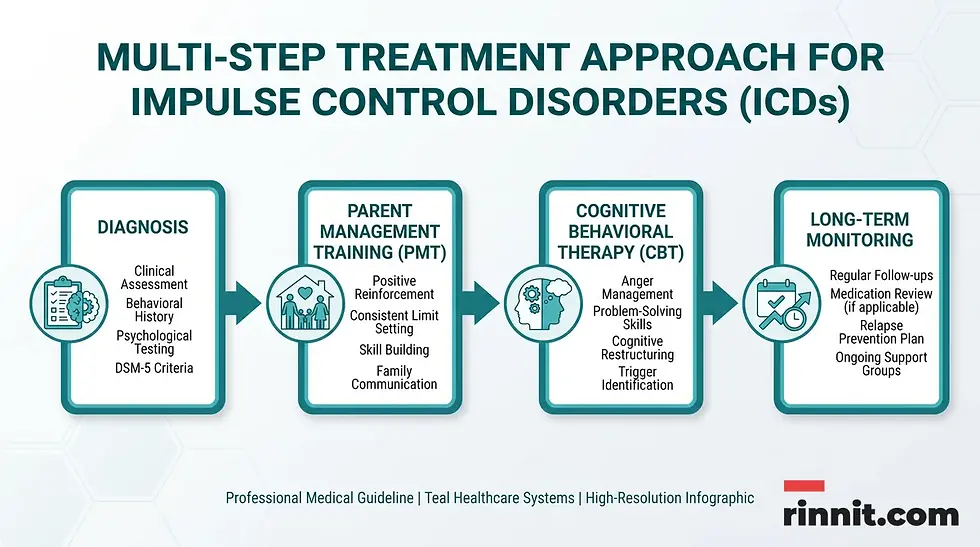
Mental health professionals diagnose impulse control disorders using the criteria in the DSM-5. Signs and symptoms usually have to be apparent for at least six or 12 months and cause significant distress that disrupts daily life. You or your child will likely need to see a psychologist or psychiatrist, who will use specially designed interview and assessment tools and often rely on reports from people close to the person, such as parents, siblings, friends and teachers. [1]
Effective Management Strategies
The FDA does not approve any medications for impulse control disorders, so treatment mainly involves therapy and adjustments to parenting strategies. [1]
Therapy Type | Focus and Methodology |
Parent management training (PMT) | Teaches parents and caregivers techniques to improve a child's behavior and build new skills, with consistent discipline and rewards for positive behavior. [1] |
Multisystemic therapy (MST) | A family-based approach that uses family strengths to encourage positive coping. A therapist works with caregivers to reinforce positive behavior, reduce negative behavior, and build accountability and problem-solving. [1] |
Cognitive behavioral therapy (CBT) | A structured, goal-oriented talk therapy that helps a person see how thoughts and emotions drive actions so they can replace unhelpful patterns with healthier ones. For children it is used alongside parent management. [1] |
Helpful parenting strategies include: [1]
Reducing positive reinforcement of undesirable behavior.
Encouraging behaviors that show empathy and concern for others (prosocial behaviors).
Using nonviolent discipline.
Making consistent, predictable parenting decisions.
Outlook and Prevention
ICDs tend to be chronic and can significantly affect the lives of the people who have them and their loved ones. People with an ICD have a high likelihood of future substance use, depression, unemployment and relationship difficulties. However, intensive therapy can help keep problematic behaviors in check. [1]
These disorders may not be entirely preventable, but early diagnosis and treatment can greatly reduce the distress that a child and family experience and help prevent the problems commonly associated with ICDs. Parents and caregivers are encouraged to seek help as soon as patterns of severe defiance or aggression become apparent. [1]
Learn more. For more evidence-based health guides, visit Rinnit.com.
Frequently Asked Questions
Is it just a phase my child will outgrow?
Many children test boundaries, but impulse control disorders involve severe, long-lasting patterns that disrupt daily life. To meet diagnostic criteria, symptoms usually need to be present for at least six to twelve months. If the behavior is persistent and causing harm, speak with a healthcare professional rather than waiting.
Can adults have impulse control disorders?
Yes. Signs typically begin in childhood and can continue into adulthood, where they may affect work, relationships and run-ins with the law.
Are there any medications that can help?
The FDA does not approve any medications specifically for impulse control disorders, so treatment relies mainly on therapy and parenting strategies. Doctors may prescribe medication for co-occurring conditions such as ADHD or depression.
What is the difference between ODD and conduct disorder?
ODD centers on defiant, uncooperative and hostile behavior toward authority figures. Conduct disorder involves a more severe pattern of aggression toward others and serious violations of rules and social norms.
How can I tell if my child's anger is normal?
Normal anger usually has an identifiable trigger and settles. Outbursts linked to an impulse control disorder tend to be frequent, impulsive and out of proportion to the situation, and they disrupt daily life. Only a mental health professional can diagnose a disorder.
Can trauma cause impulse control issues?
Trauma is not the only cause, but experiencing or witnessing abuse and childhood neglect are environmental factors that can raise the risk of developing an impulse control disorder.
Is bad parenting the cause of impulse control disorders?
No. Researchers believe these disorders arise from a mix of genetic, biological and environmental factors, so no single cause, including parenting, explains them. Parenting strategies are part of treatment because consistent, predictable routines help children learn new skills.
What is the tension-release cycle?
The tension-release cycle is a hallmark of impulse control disorders: a person feels growing internal tension before acting on an urge and a sense of release or relief afterward.
Can CBT help a young child?
CBT is used for children and adolescents with an impulse control disorder, typically alongside parent management training. A therapist helps the child understand how thoughts and emotions affect actions and build healthier ways of thinking and responding. Your child's therapist can advise how it should be adapted for their age.
What is intermittent explosive disorder?
Intermittent explosive disorder is a condition marked by frequent, impulsive anger outbursts or aggression that cause significant distress and are out of proportion to the situation.
Is stealing always a sign of kleptomania?
No. Kleptomania involves an overpowering urge to steal, often items the person does not need, with tension beforehand and relief afterward. Stealing for personal gain or out of anger is not kleptomania.
How do schools handle students with impulse control disorders?
Many schools can set up behavior support plans and work with families and clinicians to keep expectations consistent. Ask your child's school what support is available.
Are impulse control disorders related to ADHD?
Impulse control disorders and ADHD are separate conditions, but they often occur together. In a large meta-analysis of children and adolescents with ADHD, 34.7% also had oppositional defiant disorder and 10.7% had conduct disorder.
Can a person with an impulse control disorder live a normal life?
Many people can learn to keep problematic behaviors in check with intensive therapy and consistent management, although these disorders tend to be long-term.
Where can I find help for my family?
Start by speaking with your child's pediatrician or a mental health professional who specializes in behavioral disorders.
Related Reading
What Is Intermittent Explosive Disorder? A Plain-Language Guide to the Condition Behind Repeated Angry Outbursts explains repeated angry outbursts, a type of impulse control disorder.
Recognizing Pyromania: More Than Just a Fascination with Fire explains the urge to set fires and how it is treated.
Gambling Disorder (Gambling Addiction): Symptoms, Causes, Diagnosis, Treatment and Outlook — What You Need to Know explains compulsive gambling and the treatments that help.
Cognitive Behavioral Therapy (CBT): What It Is, What It Treats and What to Expect describes the talk therapy most often used for impulse problems.
References
Cleveland Clinic. Impulse Control Disorders. Cleveland Clinic. Last updated August 7, 2023. https://my.clevelandclinic.org/health/diseases/25175-impulse-control-disorders
Kaminski JW, et al. Evidence Base Update for Psychosocial Treatments for Disruptive Behaviors in Children. J Clin Child Adolesc Psychol. 2017;46(4):477-499. PMID 28459280. https://doi.org/10.1080/15374416.2017.1310044
Soleimani-Rad H, et al. Cognitive-Behavioural Therapy for Adolescents With Impulsive Aggressive Behaviour: A Randomised Controlled Trial. Early Interv Psychiatry. 2026;20(3):e70146. PMID 41797297. https://doi.org/10.1111/eip.70146
Njardvik U, et al. Psychiatric comorbidity in children and adolescents with ADHD: A systematic review and meta-analysis. Clin Psychol Rev. 2025;118:102571. PMID 40245462. https://doi.org/10.1016/j.cpr.2025.102571
Medical disclaimer
This article is for general educational purposes only and is not a substitute for professional medical advice, diagnosis, or treatment. If you are concerned about your own or a child's behavior, consult a qualified healthcare professional.



Comments