Hysterosalpingogram (HSG): Timing, What to Expect and What It Finds

Updated: 2 days ago
Written and medically reviewed by Dr. Baraa Alnahhal, MD · Last reviewed: November 2026 · How we review
Quick Answer: What is a hysterosalpingogram (HSG)?
A hysterosalpingogram (HSG) is an X-ray dye test that shows the inside of the uterus and fallopian tubes. It's used to look for causes of infertility, such as blocked tubes or an irregularly shaped uterus. It's done 7 to 10 days after the first day of your period and takes less than five minutes. Cramping is common but short-lived. [1]
What the research says
The type of dye may affect pregnancy chances. In 1,119 women having an HSG for infertility, ongoing pregnancy within six months occurred in 39.7% after oil-based contrast versus 29.1% after water-based contrast, with low and similar rates of side effects. (Dreyer et al., The New England Journal of Medicine, 2017) [2]
Flushing the tubes may help some couples conceive. A Cochrane review found that, compared with no treatment, tubal flushing with oil-based contrast may increase the chance of live birth and clinical pregnancy, though adverse events are poorly reported. (Wang et al., Cochrane Database of Systematic Reviews, 2020) [3]
Key takeaways
An HSG uses contrast dye and X-rays to outline your uterus and fallopian tubes. [1]
It mainly checks for blocked tubes and differences in the shape of the uterus. [1]
It is best scheduled 7 to 10 days after your period starts. [1]
The test usually takes less than five minutes. [1]
Cramping, light bleeding and sticky discharge for a day or two are common. [1]
What is a hysterosalpingogram?
A hysterosalpingogram (pronounced HIS-ter-roh-sal-PING-go-gram) is an X-ray dye test that lets your provider see your uterus and fallopian tubes. [1]
Your provider places contrast dye into your uterus and fallopian tubes and takes a series of X-ray images, a technique called fluoroscopy. [1]
How does an HSG work?
The dye outlines your uterus and tubes on the X-ray. If the dye flows through the tubes and spills out of their ends (the fimbriae), your tubes are open, and your body absorbs the dye without problems. If the dye meets a barrier, the tube is considered blocked. [1]
Why is an HSG done?
An HSG helps find problems that can prevent pregnancy, mainly blocked fallopian tubes or an irregularly shaped uterus. Blocked fallopian tubes are one of the leading causes of infertility. [1]
It may be ordered along with a pelvic ultrasound, hysteroscopy or MRI. It may also be done a few months after a tubal ligation to confirm the tubes are fully blocked. [1]
When is an HSG scheduled?
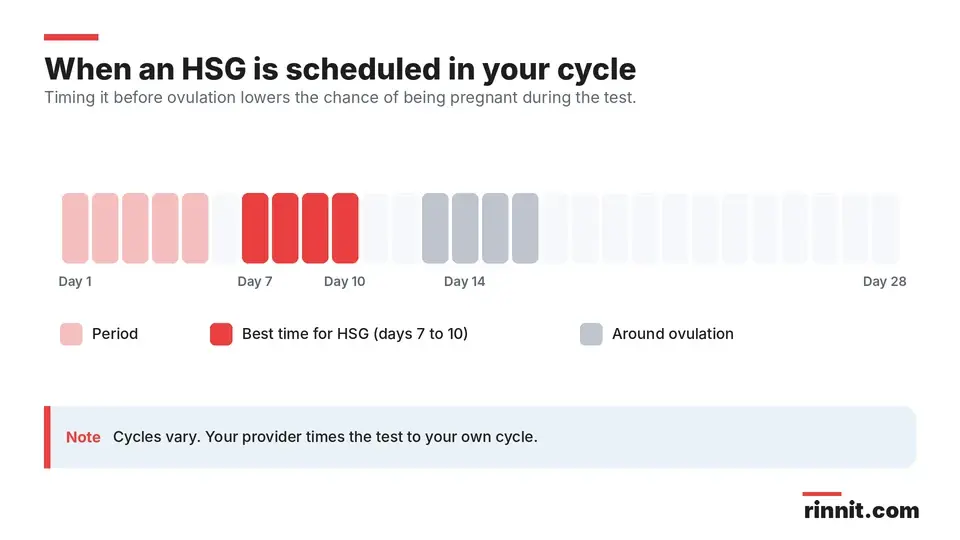
The test is ideally scheduled 7 to 10 days after the first day of your menstrual period. This is before ovulation, which lowers the chance that you are pregnant during the test. [1]
How do you prepare for an HSG?
Tell your provider if you: [1]
Are allergic to iodine or contrast dye
Have a pelvic infection or signs of a sexually transmitted infection
Have heavy vaginal bleeding
Might be pregnant
Your provider may suggest an over-the-counter pain reliever an hour before the test and may prescribe antibiotics to prevent infection. Arrange for someone to drive you home, since cramping can make driving difficult. [1]
What happens during an HSG?
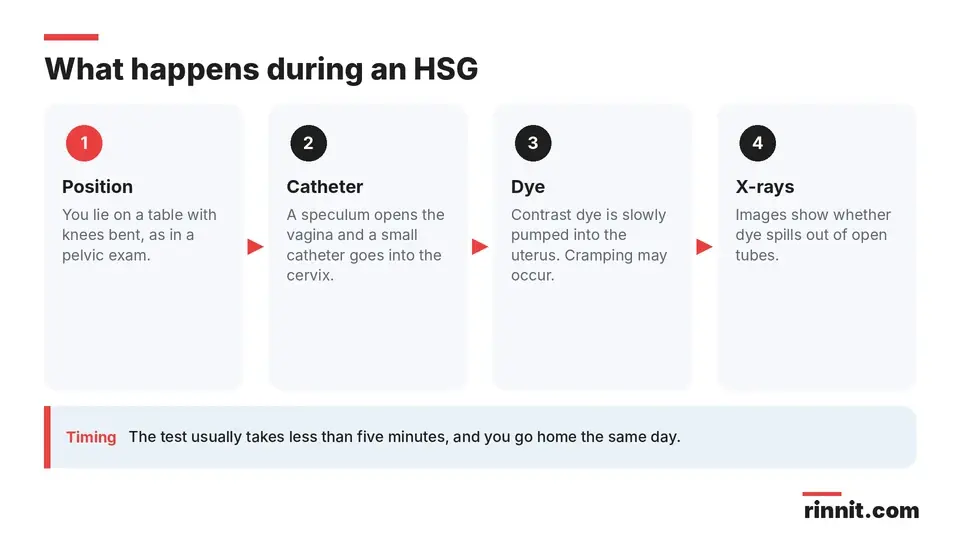
You lie on a table with your knees bent and legs apart, as in a pelvic exam. The X-ray machine sits above the table.
Your provider inserts a speculum into your vagina to reach your cervix.
Your provider cleans your cervix and inserts a small catheter.
The speculum is removed, and you straighten your legs.
Dye is slowly pumped into your uterus while a technologist takes X-ray images. You may feel cramping.
You may be asked to change position to see how the dye moves through your tubes.
Once enough images are taken, the catheter is removed.
Sources: [1]
The test usually takes less than five minutes, and you can go home the same day. [1]
Does an HSG hurt?
Mild pain or discomfort during and after the test is common. Cramping while the dye goes in may be stronger if your tubes are blocked. It can last from about five minutes to a few hours and feel mild to moderate. Over-the-counter NSAIDs may help. [1]
What is recovery like?
You may need a pad for leaking dye. The discharge is often sticky and may contain a little blood. You may also have: [1]
Cramps
Dizziness
Upset stomach or nausea
Light vaginal bleeding for a day or two
Most people return to their normal activities right away, depending on how they feel. [1]
What are the risks?
An HSG is generally safe. It uses radiation, but only a small amount. Rare complications include infection, injury to the uterus or cervix and an allergic reaction to the dye. [1]
What can an HSG find?

Finding | Examples |
Blocked or damaged tubes | Adhesions (Asherman's syndrome), endometriosis, a past ectopic pregnancy, sexually transmitted infections, tubal spasms |
Uterus shape differences | Arcuate, bicornuate, septate or unicornuate uterus, uterus didelphys, uterine agenesis |
Other uterine conditions | Adhesions, fibroids, polyps, tumors |
Sources: [1]
Abnormal results lead to more testing, treatment or both. [1]
Can an HSG improve fertility?
The dye may clear minor blockages and improve your chances of pregnancy, but more studies are needed to confirm this. Some studies of tubal flushing suggest fertility may improve, especially in the first three to six months, but these studies vary in quality. It is generally safe to try to conceive within a few days after the test, but check with your provider first. [1]
When should you call your doctor?
Call your provider if you have: [1]
Fainting
Fever or chills
Foul-smelling vaginal discharge
Heavy vaginal bleeding
Severe belly pain or cramping
Vomiting
Conclusion
An HSG is a quick X-ray test that answers two key fertility questions: are your fallopian tubes open, and is the inside of your uterus shaped normally? It takes only a few minutes, and most people are back to their usual activities the same day.
Schedule it for days 7 to 10 of your cycle, take a pain reliever beforehand if your provider suggests it and bring someone to drive you home.
Keep learning: Read our female infertility guide or our guide to hydrosalpinx. For more background, see the RadiologyInfo page on hysterosalpingography.
FAQ
What is a hysterosalpingogram?
It is an X-ray dye test that shows the inside of your uterus and fallopian tubes. [1]
Why is an HSG done?
Mainly to look for causes of infertility, such as blocked fallopian tubes or an irregularly shaped uterus. [1]
When should an HSG be done in my cycle?
Ideally 7 to 10 days after the first day of your period, before ovulation. [1]
How long does an HSG take?
Usually less than five minutes. [1]
Does an HSG hurt?
Mild to moderate cramping is common and may last from minutes to a few hours. [1]
How do I prepare for an HSG?
Take a pain reliever an hour before if advised, tell your provider about allergies or infection, and arrange a ride home. [1]
What can an HSG show?
Blocked tubes, uterine shape differences, adhesions, fibroids, polyps and tumors. [1]
What is normal after an HSG?
Sticky discharge, cramps and light bleeding for a day or two. [1]
Can an HSG unblock fallopian tubes?
The dye may clear minor blockages, but more research is needed to confirm this. [1]
When can I try to get pregnant after an HSG?
It is generally safe within a few days, but check with your provider. [1]
Related Reading
Female Infertility: Causes, Signs, and Treatment Options Explained explains the fertility workup where an HSG is a key test.
Understanding Hydrosalpinx: Causes, Symptoms, and Fertility Impact covers a blocked, fluid-filled tube an HSG can show.
What Is Asherman's Syndrome? Symptoms, Causes, and Treatment describes uterine adhesions that can appear on an HSG.
Endometriosis: Symptoms, Causes, and Treatment explains a condition that can damage the fallopian tubes.
Bicornuate Uterus: The Heart-Shaped Womb You're Born With — and Why Many People Still Have Healthy Pregnancies covers one of the uterine shapes an HSG can reveal.
References
Cleveland Clinic. Hysterosalpingogram (HSG): Preparation, Procedure & Results. Cleveland Clinic. Last updated December 11, 2025. https://my.clevelandclinic.org/health/diagnostics/22254-hysterosalpingogram
Dreyer K, van Rijswijk J, Mijatovic V, et al. Oil-Based or Water-Based Contrast for Hysterosalpingography in Infertile Women. N Engl J Med. 2017;376(21):2043-2052. PMID 28520519. https://doi.org/10.1056/NEJMoa1612337
Wang R, Watson A, Johnson N, et al. Tubal flushing for subfertility. Cochrane Database Syst Rev. 2020;10(10):CD003718. PMID 33053612. https://doi.org/10.1002/14651858.CD003718.pub5
Medical disclaimer
This article is for general education only and does not replace advice from a qualified healthcare professional. Talk to your doctor about your own diagnosis and treatment, and seek emergency care right away for severe or sudden symptoms.



Comments