Hypoplastic Aortic Arch: A Guide for Parents and Caregivers

Updated: 2 days ago
Medically reviewed by Dr. Baraa Alnahhal, MD · Last reviewed: October 2026
Quick Answer
Hypoplastic aortic arch is a congenital heart defect in which the aortic arch is underdeveloped and narrower than it should be. Symptoms include rapid breathing, pale or gray skin, trouble feeding and a weak pulse in the lower body. It often occurs with coarctation of the aorta. Imaging soon after birth diagnoses it, and treatment is heart surgery. [1]
What the research says
Repair works, but the arch can narrow again. In a review of 60 infants who had aortic arch reconstruction for arch hypoplasia with other heart defects, recoarctation (recurrent narrowing) occurred in 13 (21.6%), and 11 (18.3%) needed another procedure: balloon angioplasty in 7 or reoperation in 4. Babies who had the whole heart repaired in a single stage had better early survival than those who first had pulmonary artery banding with arch repair (early mortality 10.8% vs 34.8%). This was a single-center retrospective study. (Onalan et al., J Card Surg, 2021)
Extended end-to-end repair has a low reintervention rate in the midterm. Among 201 infants and children with coarctation treated with resection and extended end-to-end anastomosis, early mortality was 2.0% (4 patients) and 8 patients (4.0%) needed reintervention over an average follow-up of 5 years, 75% of them within the first year after surgery. A hypoplastic transverse arch was not a risk factor for reintervention, but it was associated with higher mortality. (Kaushal et al., Ann Thorac Surg, 2009)
High blood pressure can persist long after surgery. In 343 children who had coarctation repair through a left thoracotomy, only 14 (4%) needed reintervention over a median of 6 years, but 95 patients (33%) were hypertensive or still taking cardiac medications a median of 12 years after surgery. (Mery et al., Ann Thorac Surg, 2015)
What is hypoplastic aortic arch?

Hypoplastic aortic arch, also called aortic arch hypoplasia (AAH), is a congenital heart defect that affects part of a baby's aorta, the major artery that carries blood from the heart to the rest of the body. The aorta is shaped like a cane, and its curved "handle" is the aortic arch. In babies with AAH the arch is underdeveloped, so its opening (lumen) is narrower than it should be, and it is harder for blood to flow to the descending aorta and out to the body. [1]
AAH can occur on its own, but it most often occurs with coarctation of the aorta, a narrowing in the descending aorta near the ductus arteriosus (a fetal blood vessel). When both are present, doctors describe it as coarctation of the aorta with aortic arch hypoplasia, meaning the narrowing extends over a longer stretch of the aorta rather than a single point. [1]
Other heart conditions that can occur with AAH
Atrial septal defect (ASD)
Atrioventricular septal defect
Bicuspid aortic valve and aortic valve stenosis
Hypoplastic left heart syndrome (HLHS)
Patent ductus arteriosus (PDA)
Shone's complex (multilevel obstruction on the left side of the heart)
Ventricular septal defect (VSD)
Having more than one defect matters because it affects treatment: your baby may need a specific type of surgery or care plan based on their complex, unique heart anatomy. [1]
What are the symptoms of a hypoplastic aortic arch in infants?
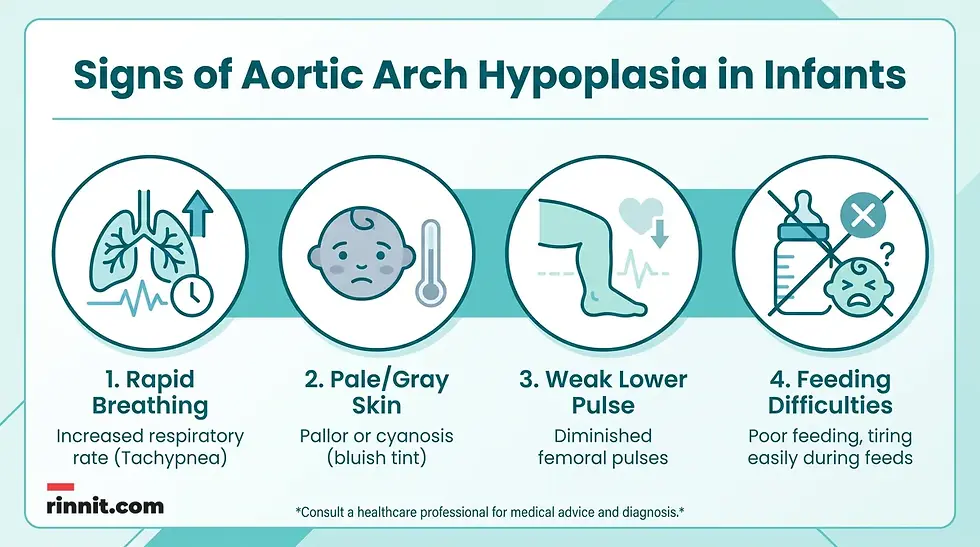
Babies who have coarctation of the aorta with aortic arch hypoplasia usually show symptoms soon after birth. [1] Signs to watch for include:
Rapid or labored breathing
A fast pulse
Fatigue and trouble with feeding
Gray or pale skin
Heavy sweating
Irritability
A weak pulse in the lower body, felt at the femoral artery in the groin
If your baby shows any of these signs, seek medical care promptly. Call 911 or go to the nearest emergency room right away if your baby is struggling to breathe, looks gray, pale or bluish, is unusually sleepy or hard to wake, or will not feed, because a severely narrowed aorta can quickly lead to shock in a newborn.
What causes a hypoplastic aortic arch, and can it be prevented?
AAH is present at birth. It happens when the aortic arch does not form properly during the early weeks of pregnancy, and researchers continue to explore why congenital heart defects occur. [1]
It may not be possible to prevent congenital heart defects like AAH, but following your healthcare provider's guidance on a healthy pregnancy can help lower the risk. In general, avoid: [1]
Alcohol
Smoking, vaping and all tobacco products, as well as secondhand smoke
Recreational drugs, especially cocaine
Attend your prenatal checkups, and work with your provider before and during pregnancy to manage any health conditions you have. [1]
How is aortic arch hypoplasia diagnosed?
Healthcare providers use imaging tests to diagnose AAH, typically soon after birth. These tests show the anatomy of the baby's heart in great detail, reveal whether other heart defects are present, and help the care team plan treatment. [1]
Diagnostic test | What it does |
Transthoracic echocardiogram (TTE) | Uses sound waves to create real-time images of the heart and blood flow. |
Cardiac CT scan | Provides detailed 3D images of the heart and aorta. |
Magnetic resonance angiogram (MRA) | Uses magnets and radio waves to show the blood vessels in detail. |
Cardiac catheterization | A thin tube is guided into the heart's vessels to examine its anatomy. |
To make the diagnosis, providers measure the diameter of the aortic arch and compare it with other parts of the aorta, such as the ascending and descending aorta, to calculate whether the arch is too narrow. [1]
Segments of the aortic arch
You may hear your baby's provider refer to different arch segments, which are named using the arteries that branch off as landmarks: [1]
Proximal transverse arch: between the brachiocephalic (innominate) artery and the left common carotid artery, the part closest to the heart.
Distal transverse arch: between the left common carotid artery and the left subclavian artery.
Aortic isthmus: between the left subclavian artery and the ductus arteriosus.
Your baby's provider will identify where the arch is narrowed and how far the narrowing extends, and this guides the treatment plan. [1]
How is a hypoplastic aortic arch treated with surgery?

Babies with a hypoplastic aortic arch need heart surgery to repair the condition. The surgical strategy depends on the anatomy of the baby's heart and any other defects that need repair, and the surgeon may operate through an incision along the left side of the chest (thoracotomy) or down the middle of the chest (sternotomy). [1]
Resection with extended end-to-end anastomosis
A common technique for babies with coarctation and arch hypoplasia is resection with extended end-to-end anastomosis. The surgeon removes the narrowed portion of the aorta and joins the lower (descending) aorta to an elongated incision in the aortic arch. This improves blood flow so the aorta can supply enough oxygen-rich blood to nourish the baby's organs and tissues. [1]
Individualized approaches
Severity ranges widely, from milder coarctation with narrowing of the isthmus to severe transverse arch hypoplasia or hypoplastic left heart syndrome, so surgical teams tailor the strategy to each baby. [5] Other techniques reported in the surgical literature include widening the arch with a patch (extended patch aortoplasty), sometimes combined with repair of other heart defects in the same operation. [2] Results of extended end-to-end repair are summarized in the research box above. [3]
What is the long-term outlook after treatment for a hypoplastic aortic arch?
The long-term outlook for a hypoplastic aortic arch depends on many factors, including other heart defects, so your baby's provider is the best person to ask. [1] In general, babies treated for AAH may later have:
Recurrent narrowing of the aorta
High blood pressure (hypertension)
Problems feeding or swallowing, due to injury to a specific nerve
Studies show that blood pressure in particular may need monitoring for years after repair. [4] Your baby's provider can explain how to manage each of these risks. [1]
Questions to ask your child's care team
How should I care for my child at home?
What medications does my child need?
Does my child need any therapies to help with physical or neurological function?
Does my child have any activity restrictions?
When is it safe for my child to go to daycare, and what instructions should I give?
Will my child need other treatments or surgeries?
Parenting a child with a heart condition brings new challenges. Ask your child's provider to connect you with resources and support groups so you can build a supportive community for your family. [1]
Frequently Asked Questions
Is hypoplastic aortic arch the same as coarctation of the aorta?
Hypoplastic aortic arch and coarctation of the aorta are related but not the same. Aortic arch hypoplasia is a narrowing of the aortic arch, the curved "handle" of the aorta, while coarctation is a narrowing in the descending aorta near the ductus arteriosus. AAH most often occurs in babies who also have coarctation.
When is hypoplastic aortic arch usually diagnosed?
Usually soon after birth. Babies with coarctation and arch hypoplasia typically show symptoms such as rapid breathing, poor feeding and a weak lower-body pulse early in life, and imaging tests confirm the diagnosis.
Does my baby need surgery?
Yes. Babies with a hypoplastic aortic arch need heart surgery to repair the narrowing. The surgeon chooses the approach based on your baby's heart anatomy and any other defects that also need repair.
What are a sternotomy and a thoracotomy?
A thoracotomy is an incision along the left side of the chest. A sternotomy is an incision down the middle of the chest through the breastbone. The surgeon chooses between them based on your baby's anatomy and other heart defects.
What is extended end-to-end anastomosis?
Extended end-to-end anastomosis is a common repair for coarctation with arch hypoplasia. The surgeon removes the narrowed section of the aorta and joins the lower (descending) aorta to a lengthened incision in the aortic arch, which widens the passage for blood flow.
Can the narrowing come back after surgery?
Yes. Recurrent narrowing (recoarctation) can develop after surgery. Rates differ between studies and techniques: 4.0% of 201 patients needed reintervention over about 5 years in one study, and 18.3% of 60 infants in another. Your child's cardiology team will monitor for it.
What other problems can occur after surgery?
Besides recurrent narrowing, high blood pressure and problems with feeding or swallowing (from injury to a specific nerve) can occur. Ask your baby's provider how these risks will be monitored and managed.
What is the aortic isthmus?
The aortic isthmus is the segment of the aortic arch between the left subclavian artery and the ductus arteriosus, a fetal blood vessel. Doctors use it as a landmark when describing where the narrowing is.
Can anything lower the risk during pregnancy?
Not every congenital heart defect can be prevented, but following your provider's guidance for a healthy pregnancy can help lower the risk. That includes avoiding alcohol, smoking, vaping and all tobacco products (including secondhand smoke) and recreational drugs, attending prenatal checkups, and managing any health conditions with your provider.
Which other heart conditions can occur with AAH?
Atrial septal defect, atrioventricular septal defect, bicuspid aortic valve and aortic valve stenosis, hypoplastic left heart syndrome, patent ductus arteriosus, Shone's complex and ventricular septal defect. Having more than one defect affects the treatment plan.
What should I ask my baby's care team after surgery?
Ask how to care for your child at home, which medications are needed, whether therapies for physical or neurological function are needed, whether there are activity restrictions, when daycare is safe, and whether other treatments or surgeries are likely.
Related Reading
Coarctation of the Aorta: Symptoms, Causes, Diagnosis, Treatment & Complete Guide explains a narrowing of the aorta that often occurs with this condition.
Hypoplastic Left Heart Syndrome (HLHS): What It Is, Symptoms, Surgery Stages, and Lifelong Care covers a serious heart defect where the left side is underdeveloped.
Fetal Echocardiogram: What It Checks, When It's Done and What Results Mean describes the ultrasound that checks a baby's heart before birth.
Congenital Heart Defects in Children: Symptoms, Causes, and Treatment reviews common heart defects in children and how they are treated.
References
Cleveland Clinic. Hypoplastic Aortic Arch. Cleveland Clinic. Last updated April 20, 2023. https://my.clevelandclinic.org/health/diseases/24920-hypoplastic-aortic-arch
Onalan MA, et al. Management of aortic arch hypoplasia in neonates and infants. J Card Surg. 2021;36(1):124-133. PMID 33225505. https://doi.org/10.1111/jocs.15212
Kaushal S, et al. Coarctation of the aorta: midterm outcomes of resection with extended end-to-end anastomosis. Ann Thorac Surg. 2009;88(6):1932-1938. PMID 19932265. https://doi.org/10.1016/j.athoracsur.2009.08.035
Mery CM, et al. Contemporary Results of Aortic Coarctation Repair Through Left Thoracotomy. Ann Thorac Surg. 2015;100(3):1039-1046. PMID 26209490. https://doi.org/10.1016/j.athoracsur.2015.04.129
Langley SM, et al. The neonatal hypoplastic aortic arch: decisions and more decisions. Semin Thorac Cardiovasc Surg Pediatr Card Surg Annu. 2013;16(1):43-51. PMID 23561817. https://doi.org/10.1053/j.pcsu.2013.01.008
Medical disclaimer
This article is for general educational purposes only and is not a substitute for professional medical advice, diagnosis, or treatment. If you are concerned about your baby's health, consult a pediatrician or pediatric cardiologist.



Comments