Hibernating and Stunned Myocardium: Symptoms, Causes, and Recovery

Updated: 2 days ago
Medically reviewed by Dr. Baraa Alnahhal, MD · Last reviewed: October 2026
Quick Answer
Hibernating and stunned myocardium are states in which heart muscle cells are alive but not contracting normally. Hibernating myocardium develops gradually from severe, chronic coronary artery disease, while stunned myocardium develops rapidly after a sudden drop in blood supply or severe stress. Unlike heart attack scar tissue, both are potentially reversible once blood flow improves. [1] [2]
What the research says
In older pooled data, viable heart muscle plus revascularization was linked to much lower mortality. In a meta-analysis of 24 observational studies (3,088 patients, average ejection fraction 32%), patients with viable myocardium who were revascularized had an annual mortality of 3.2%, versus 16% with medical therapy alone (a 79.6% reduction, P < 0.0001). Without viability, the rates were 7.7% versus 6.2% (not significant). (Allman et al., J Am Coll Cardiol, 2002)
A randomized substudy did not confirm that viability testing shows who benefits from bypass surgery. Among 601 STICH trial patients who had viability testing, viable myocardium was associated with better survival (HR 0.64, 95% CI 0.48–0.86), but the association was not significant after adjusting for other baseline factors (P = 0.21), and there was no significant interaction between viability and the effect of CABG (P = 0.53). (Bonow et al., N Engl J Med, 2011)
Adding stenting to optimal medical therapy did not reduce deaths or heart-failure hospitalizations. In REVIVED-BCIS2, 700 patients with an ejection fraction of 35% or less, extensive coronary disease and demonstrable viability were randomized. The primary outcome occurred in 37.2% with PCI versus 38.0% with medical therapy alone (HR 0.99, 95% CI 0.78–1.27), and ejection fraction was similar at 6 and 12 months. (Perera et al., N Engl J Med, 2022)
What Are Hibernating and Stunned Myocardium?
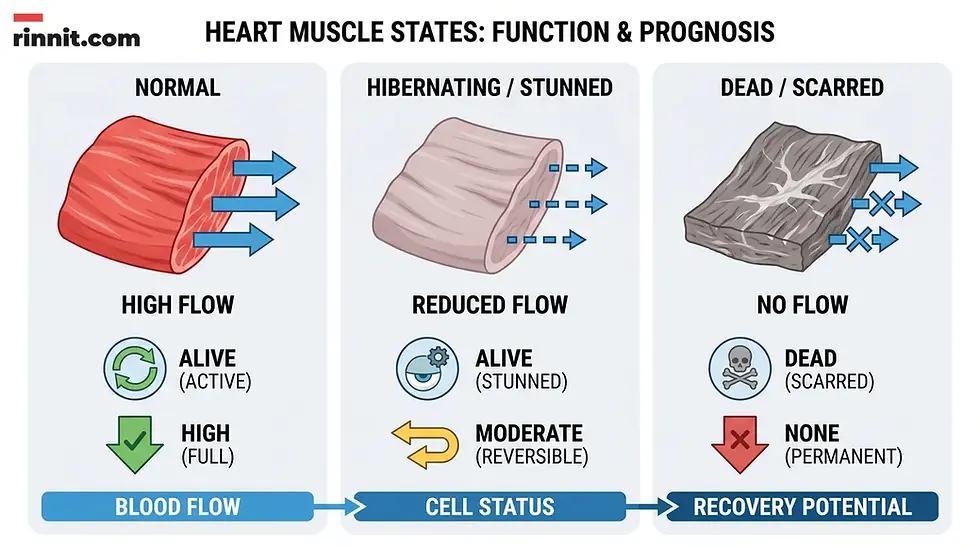
Hibernating and stunned myocardium are terms for heart muscle that has stopped contracting, so it is not helping the heart pump blood, but is still alive. They are different from a heart attack, in which heart muscle cells die and are replaced by permanent scar tissue. [1]
Hibernating myocardium occurs when a region of heart muscle does not receive enough blood flow over a long period. To survive on limited resources, the muscle essentially goes to "sleep": it stops its heavy pumping work to conserve energy for basic cell functions. This can happen over months and even years. [1]
Stunned myocardium is a more sudden event. It happens when the supply of blood or nutrients to the heart muscle drops or stops abruptly. Even after blood flow is restored, the muscle can remain "stunned" and may take days or weeks to contract normally again. [1]
Hibernating vs. Stunned vs. Heart Attack
Understanding the difference between these states is important for choosing treatment and understanding the outlook.
Condition | Muscle cell status | Pumping function | Recovery potential |
Normal myocardium | Healthy and active | Normal | Not applicable |
Hibernating myocardium | Alive but "sleeping" | Absent or weak | Potentially reversible if blood flow improves |
Stunned myocardium | Alive but "shocked" | Absent or weak | Potentially reversible over days to weeks |
Heart attack (infarction) | Dead, replaced by scar tissue | Permanent loss | Not reversible |
What Causes These Conditions?
Both conditions stem from an interruption in the heart muscle's supply of oxygen and nutrients. [1]
Causes of hibernating myocardium

Hibernating myocardium occurs in people with severe coronary artery disease (CAD). Waxy plaque builds up in the arteries and narrows them so much that the heart muscle barely gets enough blood to stay alive and cannot also contract effectively. To adapt, the muscle cells switch their metabolism, using glucose to stay alive instead of the fatty acids they normally use to contract. [1]
Causes of stunned myocardium
Stunning can follow treatment of coronary artery disease: blood flow is restored, but some areas of muscle do not recover right away. Other triggers include: [1]
Seizures: Episodes of abnormal electrical activity in the brain.
Stroke or subarachnoid hemorrhage: Sudden brain events.
Stress cardiomyopathy: Often called "broken heart syndrome," caused by intense emotional or physical stress.
Symptoms and Warning Signs
Because hibernating and stunned myocardium affect the heart's ability to pump, their symptoms overlap with those of heart failure. These include: [1]
Shortness of breath: Difficulty breathing, especially during activity.
Chest pain (angina): A feeling of pressure or discomfort in the chest.
Leg swelling: Fluid build-up caused by inefficient circulation.
How Are These Conditions Diagnosed?
Cardiologists use specialized tests to tell apart "sleeping" muscle that can be revived from scar tissue that cannot. [1]
Dobutamine stress echocardiogram: A medication called dobutamine stimulates the heart like exercise would. If the muscle contracts better as the dose increases, it is stunned or hibernating. If it does not, it is likely scar tissue.
Cardiac MRI: Uses a powerful magnet and radio waves to show the appearance and thickness of the heart wall, helping doctors identify which areas are normal, hibernating or stunned, or scarred.
Cardiac PET scan: Uses a safe level of radioactive substance and a special camera to show where heart muscle is working normally and where there is scarred or dead tissue.
Treatment and Restoring Heart Function
The main goal of treatment is to restore blood flow to the affected area, a process called revascularization. [1]

Procedures to restore blood flow
Angioplasty and stenting: A catheter is used to open clogged vessels with a balloon, and a mesh stent may be placed to keep the artery open.
Coronary artery bypass surgery (CABG): Surgeons use a healthy blood vessel from another part of the body to create a detour around the blockage.
Medical management
Treatment for stunned myocardium is similar to the standard care for coronary artery disease and heart failure. Medicines that may be prescribed include: [1]
Statins: To lower cholesterol.
Beta-blockers and ACE inhibitors (or angiotensin II receptor blockers): To reduce the heart's workload and help prevent heart failure.
Aspirin: To help prevent blood clots.
After procedures, your care may also include cardiac rehabilitation, a medically supervised exercise program. [1]
Outlook and Prevention
Because the tissue is still alive, the outlook is often better than after a heart attack. The long-term outcome depends on how much pumping function has been lost, whether medications are taken as prescribed, and whether you are a candidate for angioplasty or bypass surgery. People with coronary artery disease remain at risk of future heart problems, and muscle can hibernate again if another blockage develops. [1]
Restoring blood flow does not guarantee longer survival for everyone. In large trials of people with severe ischemic left ventricular dysfunction, stenting did not reduce deaths or heart-failure hospitalizations compared with optimal medical therapy alone, and viability testing did not reliably show who benefits from bypass surgery, so decisions are individualized with your cardiology team. [4][5]
Prevention strategies
Conclusion
Hibernating and stunned myocardium show how heart muscle can adapt to a lack of oxygen. They can cause symptoms similar to heart failure, but because the muscle is still alive they also offer a window for recovery. With careful testing and modern treatment, "sleeping" heart muscle can often regain function, although the best approach varies from person to person. [1]
Need to improve your heart health? Visit Rinnit.com for expert-reviewed health guides.
Frequently Asked Questions
Is a stunned myocardium the same as a heart attack?
No. In a heart attack, heart muscle cells die and are replaced by scar tissue. In a stunned myocardium, the cells are alive but temporarily stop contracting after a sudden drop in blood flow. [1]
How long does it take for a stunned heart to recover?
It usually takes days to weeks for the muscle to contract normally again, even after blood flow has been restored. [1]
Can hibernating myocardium lead to heart failure?
Yes. If a large enough area of the heart is "asleep," the heart cannot pump efficiently, which can cause symptoms of heart failure. [1]
Is the damage from hibernating myocardium permanent?
Not necessarily. The muscle is still alive, so it may regain function if blood flow is improved. [1]
What is the "energy switch" in hibernating heart muscle?
To stay alive on limited supplies, hibernating cells switch from burning mainly fatty acids to burning glucose. [1]
Can stress cause heart stunning?
Yes. Intense emotional or physical stress can cause stress cardiomyopathy (often called "broken heart syndrome"), which can stun the heart muscle. [1]
How do doctors know if the heart muscle is dead or just sleeping?
Doctors use specialized tests such as a dobutamine stress echocardiogram, cardiac MRI or cardiac PET scan to see whether the muscle responds to stimulation or still shows signs of living tissue. [1]
What is angioplasty?
Angioplasty is a procedure in which a thin tube (catheter) is guided to a clogged artery and a balloon is inflated to push plaque aside. A stent may be placed to keep the artery open. [1]
What is CABG?
Coronary artery bypass grafting (CABG) is a surgery that uses a healthy blood vessel from another part of the body to reroute blood flow around a blocked coronary artery. [1]
Can I prevent my heart from hibernating again?
You can lower the risk by taking good care of your heart: managing cholesterol and blood pressure, taking prescribed medicines and following a heart-healthy lifestyle. Muscle may hibernate again if a new blockage develops. [1]
Are there medications for stunned myocardium?
Treatment is similar to standard care for coronary artery disease and heart failure and may include aspirin, beta-blockers, statins and ACE inhibitors or angiotensin II receptor blockers. [1]
How common is hibernating myocardium?
Hibernating myocardium occurs in people with severe, long-term coronary artery disease. It is not a separate disease but a state of the heart muscle. [1]
Does a stunned myocardium always require surgery?
Not always. If blood flow has been restored, for example after a blocked artery is treated, the muscle may recover over time with medication and monitoring. [1]
What is cardiac rehabilitation?
Cardiac rehabilitation is a medically supervised exercise program, with education and support, that helps you build strength and fitness and adopt heart-healthy habits after procedures. [1]
What should I do if I have chest pain or shortness of breath?
Seek medical attention immediately. These can be signs of serious heart conditions, including hibernating or stunned myocardium. [1]
Related Reading
Coronary Artery Disease: Symptoms, Causes, Diagnosis, Treatment and Prevention — What You Need to Know explains the narrowed heart arteries behind most hibernating heart muscle.
Coronary Revascularization: PCI vs. Bypass Surgery, Risks and Recovery compares stenting and bypass surgery for restoring blood flow to the heart.
Dobutamine Stress Echocardiogram: How It Works, Preparation and Results explains the stress echo test that checks whether weak heart muscle is alive.
Cardiac PET Scan: Heart Blood Flow Imaging, Prep and Results describes the imaging test that measures heart blood flow and muscle viability.
References
Cleveland Clinic. Hibernating Myocardium and Stunned Myocardium. Cleveland Clinic. Last updated December 5, 2022. https://my.clevelandclinic.org/health/diseases/24506-hibernating-myocardium-and-stunned-myocardium
Kloner RA. Stunned and Hibernating Myocardium: Where Are We Nearly 4 Decades Later? J Am Heart Assoc. 2020;9(3):e015502. PMID 32013699. https://doi.org/10.1161/JAHA.119.015502
Allman KC, et al. Myocardial viability testing and impact of revascularization on prognosis in patients with coronary artery disease and left ventricular dysfunction: a meta-analysis. J Am Coll Cardiol. 2002;39(7):1151-1158. PMID 11923039. https://doi.org/10.1016/s0735-1097(02)01726-6
Bonow RO, et al. Myocardial viability and survival in ischemic left ventricular dysfunction. N Engl J Med. 2011;364(17):1617-1625. PMID 21463153. https://doi.org/10.1056/NEJMoa1100358
Perera D, et al. Percutaneous Revascularization for Ischemic Left Ventricular Dysfunction. N Engl J Med. 2022;387(15):1351-1360. PMID 36027563. https://doi.org/10.1056/NEJMoa2206606
Medical disclaimer
This article is for general educational purposes only and is not a substitute for professional medical advice, diagnosis, or treatment. Always seek the advice of your physician or other qualified healthcare provider with any questions you may have about a medical condition. Never disregard professional medical advice or delay seeking care because of something you have read here. If you think you may have a medical emergency, call your doctor or emergency services immediately.



Comments