Heart Rate Monitors: How They Work, Types, Accuracy and When to See a Doctor

Written and medically reviewed by Dr. Baraa Alnahhal, MD · Last reviewed: November 2026 · How we review
Quick Answer: What is a heart rate monitor?
A heart rate monitor is a device that shows how fast or slow your heart beats in real time, in beats per minute (bpm). Most are wearable, such as watches, arm bands and rings, and many save your data so you can review it later or share it with your provider. [1]
Monitors are generally very safe and can help you exercise at a safe intensity, but they do not replace check-ups. Call your provider if your resting rate stays above 100 bpm, drops below 60 bpm when that is unusual for you, or your watch flags atrial fibrillation (AFib). [1]
What the research says
Wearables are most accurate at rest. Testing consumer and research-grade devices, researchers found no significant accuracy difference across skin tones, but absolute error during activity was on average 30% higher than at rest, and devices differed from one another. (Bent et al., npj Digital Medicine, 2020) [2]
Smartwatch rhythm alerts are rare but meaningful. Among 419,297 people monitored for a median of 117 days, only 0.52% received an irregular pulse notification; 34% of those who returned an ECG patch had AFib, and 84% of notifications matched AFib on the patch. (Perez et al., The New England Journal of Medicine, 2019) [3]
Key takeaways
A heart rate monitor shows your heart rate in beats per minute and often stores the data. [1]
EKG monitors read your heart's electrical signals and are the gold standard; PPG monitors use light to read your pulse. [1]
PPG readings can be less accurate with AFib, tattoos, darker skin, big arm movements and high-intensity exercise. [1]
Monitors are safe, but checking numbers constantly can cause stress. [1]
Call your provider for a resting rate over 100 bpm, an unusual rate under 60 bpm, palpitations or an AFib alert. [1]
What is a heart rate monitor?
A heart rate monitor shows how fast or slow your heart is beating as it happens. It reports your heart rate in beats per minute (bpm), and many devices save the data so you can look back at it later. [1]
Most heart rate monitors are wearable. Watches, arm bands and rings can track your heart rate through the day or overnight while you sleep. [1]
What is a heart rate monitor used for?
People use heart rate monitors to: [1]
Exercise at an intensity that does not strain the heart
Reach a target heart rate zone during workouts
Track heart rate during the day, at night or while sleeping
Keep an eye on a heart condition that a provider monitors closely
A monitor is not a substitute for medical care or check-ups with your provider. You can, however, share your data with your provider. [1]
How do heart rate monitors work?
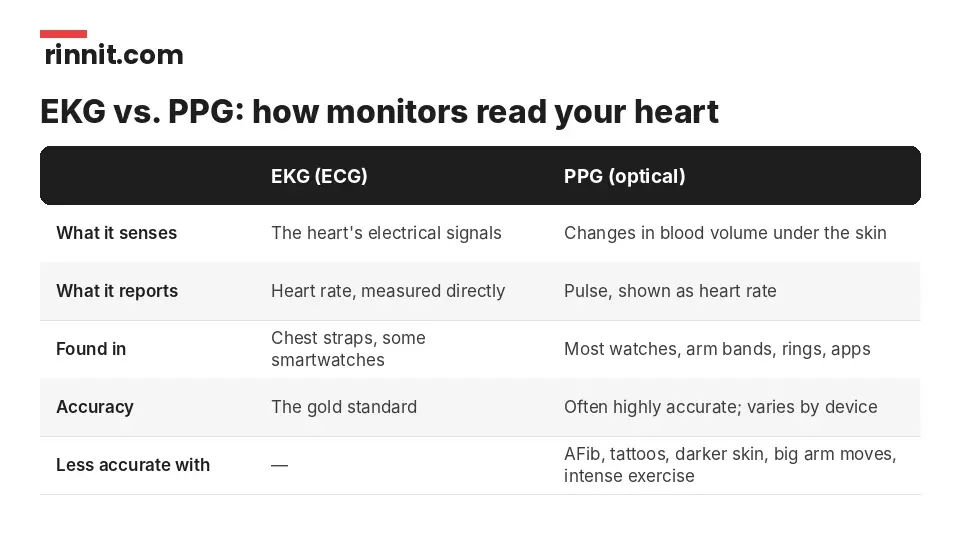
EKG reads electrical signals; PPG reads your pulse with light.
Your heart rate is how many times your heart squeezes each minute to push out blood. Your pulse rate is how many times your arteries widen and narrow in response. The two numbers are usually the same or very close, so devices that measure your pulse still call it "heart rate." Some monitors can also detect abnormal heart rhythms. [1]
Monitors use one of two technologies: [1]
Technology | How it works | Accuracy |
Electrocardiography (EKG or ECG) | Electrodes detect your heart's electrical signals and measure heart rate directly | The gold standard |
Photoplethysmography (PPG) | Light shines into your skin, and sensors detect changes in blood volume to measure your pulse | Often highly accurate, and improving |
Sources: [1]
Types of heart rate monitors
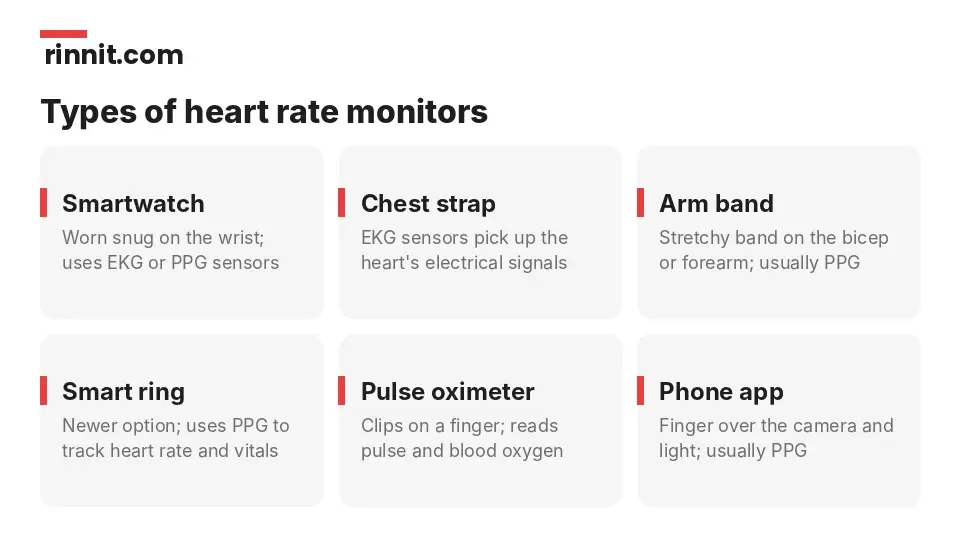
Six common ways to track your heart rate.
You can choose from several kinds of devices: [1]
Smartwatch: The most convenient option for many people. It should fit snugly but not tightly. Some use EKG and others use PPG.
Chest strap: Uses EKG sensors that pick up your heart's electrical signals. It can sync with a watch so you can see the data.
Arm band: A stretchy band worn on your bicep or forearm. It usually uses PPG and may feel more comfortable for some people.
Smart ring: A newer option that uses PPG to track heart rate and other vital signs.
Pulse oximeter: Clips onto a finger and is not wearable. It measures heart rate through your pulse along with blood oxygen.
Smartphone app: Usually uses PPG. You place a finger over the phone's camera and light to detect blood flow.
What to check before you buy one
Each device works differently, so read the manual before buying or using it. Also compare: [1]
Battery life: Some last days, others need charging daily, and using GPS shortens battery life.
Water resistance: Some are safe for swimming, some only handle rain and some should not go under water.
Cleaning: Soap, cleaning supplies and some sanitizing wipes can damage sensors or screens.
Apps and software: Your data often needs an app, which may need updates.
Extra features: Some track heart rhythm, VO2 max and sleep.
How accurate are heart rate monitors?
EKG monitors are the most accurate. PPG monitors, especially newer models, are often highly accurate too, but accuracy depends on the device, and researchers keep testing it. [1]
A monitor that reads too low can be dangerous, because it can give false reassurance and lead you to push too hard during exercise. [1]
PPG monitors may be less accurate with: [1]
Certain heart conditions: AFib, heart failure and some other conditions can cause weak beats that do not register as a pulse, so the monitor may show a lower rate than your real heart rate.
Arm tattoos: Ink interferes with the light.
Darker skin: Melanin absorbs more of the light, which may affect readings.
Large arm movements: Such as weightlifting or an elliptical with moving handlebars.
High-intensity exercise: Accuracy drops as workouts get harder, possibly from arm motion and less skin contact.
Are heart rate monitors safe?
Heart rate monitors are generally very safe and pose no risk to your health. Checking your numbers constantly or worrying about them may cause stress, though. If that happens, your provider may suggest wearing your monitor only at certain times, such as during exercise. [1]
When should you call a doctor?
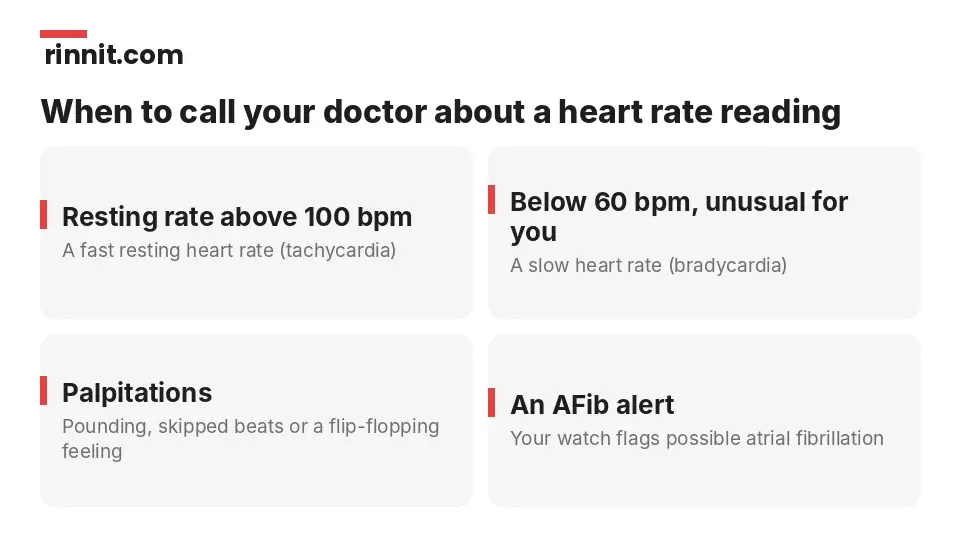
Readings that are worth a call to your provider.
Check with your provider before choosing a monitor. Call your provider if: [1]
Your resting heart rate is above 100 bpm (tachycardia)
Your heart rate is below 60 bpm and this is unusual for you (bradycardia)
You notice your heartbeat, pounding, skipped beats or a flip-flopping feeling (palpitations)
Your watch says you may have atrial fibrillation
Conclusion
A heart rate monitor is an easy way to see how your heart responds to daily life and exercise. EKG devices are the most accurate, and many PPG devices come close, though readings can slip during hard workouts or with certain heart conditions. [1]
Use your numbers as a guide, not a diagnosis. Keep up routine check-ups, share your data with your provider and call them about readings that worry you. [1]
Keep learning: Learn about a normal resting heart rate, how a Holter monitor records your heart for a day or more, or read our atrial fibrillation guide. For more background, see MedlinePlus on arrhythmia.
FAQ
What is a heart rate monitor?
A device that shows how fast your heart beats in real time, in beats per minute, and often saves the data. [1]
How does a heart rate monitor work?
EKG monitors read your heart's electrical signals; PPG monitors shine light into your skin to read your pulse. [1]
What types of heart rate monitors are there?
Smartwatches, chest straps, arm bands, smart rings, pulse oximeters and smartphone apps. [1]
Which heart rate monitor is most accurate?
EKG monitors such as chest straps are the gold standard; many newer PPG devices are also highly accurate. [1]
Are smartwatch heart rate readings accurate?
Often, but accuracy depends on the device and can drop during intense exercise or big arm movements. [1]
What can make a heart rate monitor less accurate?
AFib or heart failure, arm tattoos, darker skin, large arm movements and high-intensity exercise can affect PPG readings. [1]
Can a heart rate monitor detect AFib?
Some can detect abnormal rhythms; call your provider if your watch indicates AFib. [1]
Is it safe to wear a heart rate monitor all the time?
Yes, they are generally very safe, but constant checking can cause stress for some people. [1]
What heart rate is too high at rest?
Call your provider if your resting heart rate is above 100 bpm. [1]
What heart rate is too low?
Call your provider if it is below 60 bpm and that is unusual for you. [1]
Related Reading
Heart Palpitations: Causes, Symptoms & Treatment Guide explains the pounding or skipped-beat feelings a monitor may pick up.
Heart Arrhythmia: Symptoms, Types, Causes, Diagnosis & Treatment — Complete Guide covers the irregular rhythms some monitors can flag.
What Is Tachycardia? A Plain-Language Guide to the Fast Heartbeat, Its Causes, and Its Treatment explains a resting heart rate above 100 beats per minute.
Bradycardia: Slow Heart Rate, Symptoms, Causes, and Treatment explains a heart rate that is slower than normal.
Atrial Fibrillation (AFib): Symptoms, Causes & Treatment Guide covers the rhythm problem smartwatches may alert you to.
References
Cleveland Clinic. Heart Rate Monitors: How They Work. Cleveland Clinic. Last updated May 6, 2026. https://my.clevelandclinic.org/health/diagnostics/23429-heart-rate-monitor
Bent B, Goldstein BA, Kibbe WA, et al. Investigating sources of inaccuracy in wearable optical heart rate sensors. NPJ Digit Med. 2020;3:18. PMID 32047863. https://doi.org/10.1038/s41746-020-0226-6
Perez MV, Mahaffey KW, Hedlin H, et al. Large-Scale Assessment of a Smartwatch to Identify Atrial Fibrillation. N Engl J Med. 2019;381(20):1909-1917. PMID 31722151. https://doi.org/10.1056/NEJMoa1901183
Medical disclaimer
This article is for general education only and does not replace advice from a qualified healthcare professional. Talk to your doctor about your own diagnosis and treatment, and seek emergency care right away for severe or sudden symptoms.



Comments