HBsAg Test (Hepatitis B Surface Antigen): Purpose, Results and What a Positive Means

Updated: 2 days ago
Written and medically reviewed by Dr. Baraa Alnahhal, MD · Last reviewed: November 2026 · How we review
Quick Answer: What is an HBsAg test?
An HBsAg (hepatitis B surface antigen) test is a blood test that shows whether the hepatitis B virus (HBV) is in the blood. A confirmed positive result means you have hepatitis B and can pass it to others, while a negative result means you don't have an active infection. No preparation is needed. [1]
What the research says
Rapid HBsAg tests are accurate, but lab tests remain the reference. A review of 30 studies that tested 23,716 people in 23 countries found that rapid HBsAg tests picked up 90% of the infections found by laboratory immunoassays, with 99.5% specificity. Sensitivity was lower, at about 72%, in people living with HIV. (Amini et al., BMC Infectious Diseases, 2017) [2]
Many people with hepatitis B don't know they have it. The US Preventive Services Task Force estimates that about 862,000 people in the United States live with chronic hepatitis B and that up to 60% are unaware of their infection. It recommends screening adolescents and adults at increased risk (grade B recommendation). (US Preventive Services Task Force, JAMA, 2020) [3]
Key takeaways
The HBsAg screen is the most common test for hepatitis B virus infection. [1]
It looks for hepatitis B surface antigen, a protein found on the surface of the virus. [1]
A positive (reactive) confirmed result means you have hepatitis B and are contagious. [1]
A hepatitis B vaccine given in the past few weeks can cause a positive result, so the test may need repeating. [1]
Results usually take up to three business days, and sometimes come within 24 hours. [1]
What is an HBsAg test?
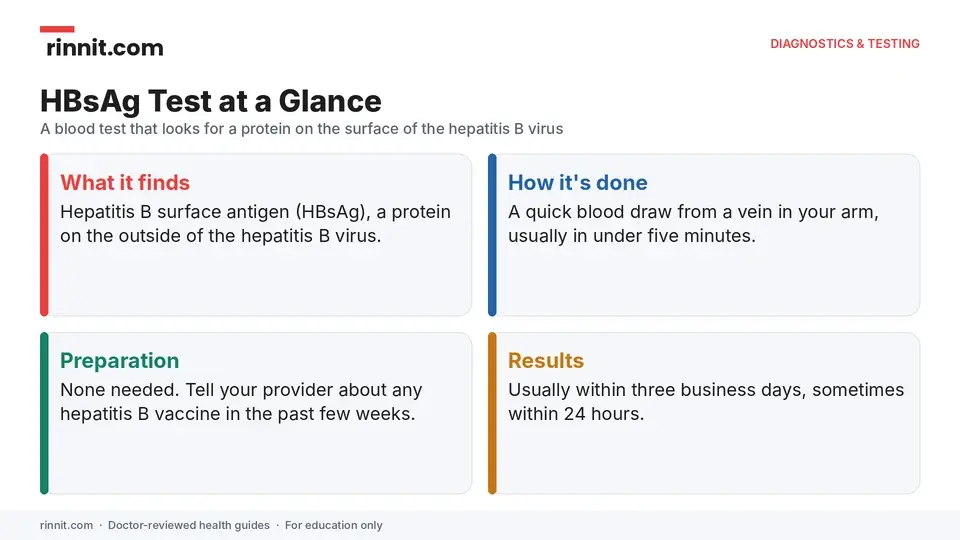
An HBsAg screen is a blood test that tells you whether you have the hepatitis B virus (HBV). HBsAg stands for hepatitis B surface antigen. It's a protein found on the surface of the virus, and the test is designed to detect it. [1]
This screening test is the most common test for hepatitis B virus infection. A positive result means you have hepatitis B and can spread it to other people. [1]
Who needs an HBsAg screen?
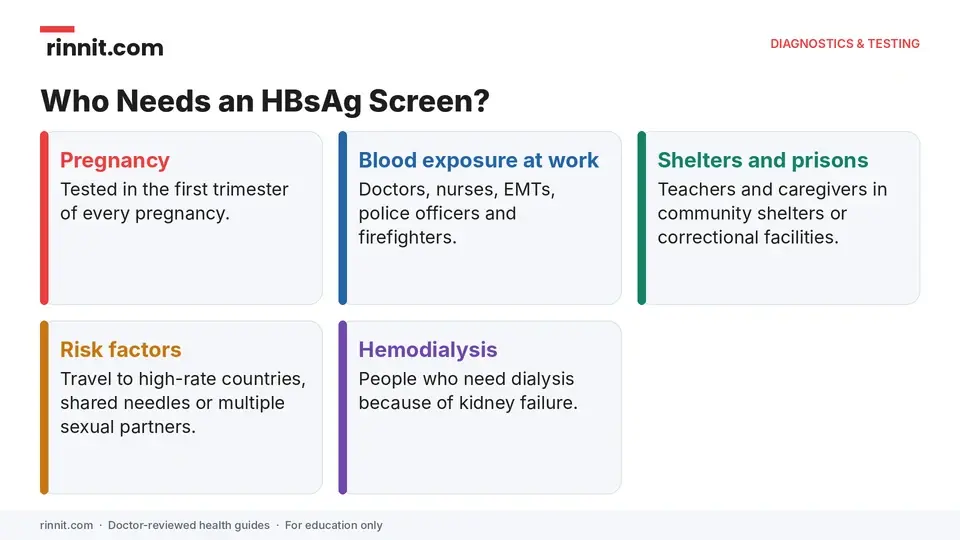
Your healthcare provider may recommend an HBsAg screen if: [1]
You're pregnant. You get this test in the first trimester of every pregnancy.
You're a doctor, nurse, EMT, police officer or firefighter, or you work in a job where you have contact with blood and bodily fluids.
You're a teacher or caregiver in a community shelter or correctional facility.
You have risk factors for hepatitis B, such as traveling to a country with high rates of the infection, sharing needles or syringes, or having multiple sexual partners.
You need hemodialysis because of kidney failure.
How does the HBsAg test work?
A healthcare provider takes a blood sample from a vein in your arm and sends it to a lab. At the lab: [1]
The test uses antibodies that bind to HBsAg if it's in your sample. The antibodies stick to the virus or its surface protein when it's present.
If the antibodies bind to HBsAg, the analyzing machine gives off a light signal. That signal triggers a positive result. No signal means the test is negative.
A positive screen sets off an automatic follow-up called a confirmatory (neutralization) test. It checks that the screening result is a true positive.
This first step is the screening level of HBsAg testing. The confirmatory step is added by the lab, so you don't need a second blood draw for it. [1]
How do you prepare for an HBsAg test?
You don't need to do anything to prepare. You may feel a prick or sting when the needle goes into your vein. The blood draw takes less than five minutes, and you can go back to your normal activities right afterward. [1]
Tell your provider if you've had a hepatitis B vaccine in the past few weeks. A recent vaccine can make the HBsAg result positive, and you'd need to repeat the test a few weeks later. [1]
Are there any risks?
There are no risks or side effects from the screening itself. Like any blood draw, you may notice bruising or discomfort where the needle went in, but this is temporary. The test doesn't expose you to the hepatitis B virus and isn't harmful to your health. [1]
What do HBsAg results mean?
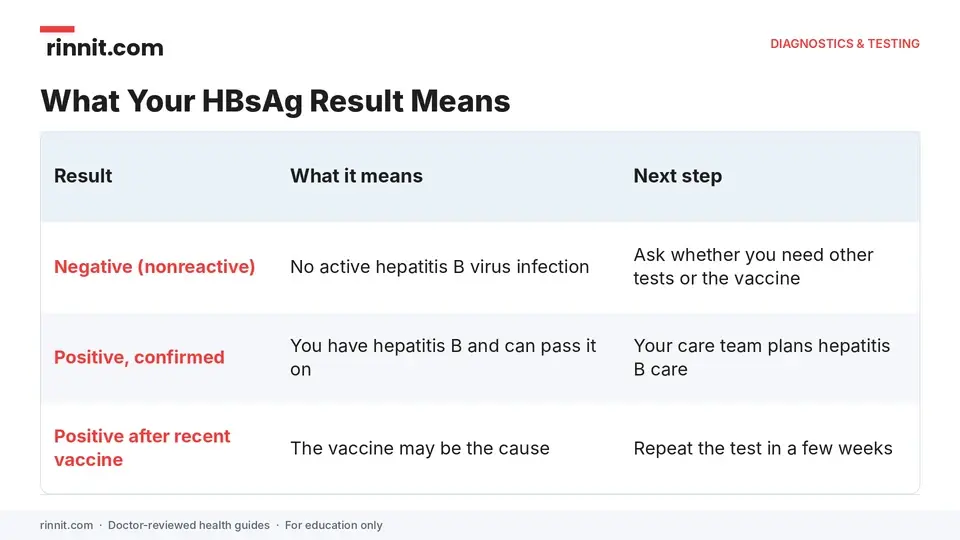
Your result will be reported as negative (nonreactive) or positive (reactive). Here's what each one means: [1]
Result | What it means | What usually happens next |
Negative (nonreactive) | No active hepatitis B virus infection was found | Your provider explains whether you need any other hepatitis B tests or the vaccine |
Positive (reactive), confirmed | The test found hepatitis B surface antigen in your blood, which means you have hepatitis B and are contagious | Your care team plans further care for hepatitis B |
Positive after a recent hepatitis B vaccine | The vaccine given in the past few weeks may be the cause | You repeat the test in a few weeks |
Sources: [1]
How long do HBsAg results take?
It can take up to three business days to get your results. Sometimes, results come back within 24 hours. Ask your provider how long you can expect to wait. [1]
When should you call your doctor?
Contact your healthcare provider if you have questions about your test results. They can explain what your result means and what comes next for your care. [1]
If you test positive, your care team can make sure you get the care you need for hepatitis B. [1]
Conclusion
An HBsAg screen is a quick, safe and very common blood test for hepatitis B. It looks for a protein on the surface of the virus, needs no preparation and has no risks beyond a small bruise. A confirmed positive result means you have hepatitis B and can pass it on, while a negative result means there's no active infection.
If you're pregnant, work around blood, have risk factors or need dialysis, ask your provider whether you should be screened. Finding hepatitis B early means you can get the right care sooner.
Keep learning: Read our guide to hepatitis B or our explainer on liver function tests. For more trusted, doctor-reviewed health guides, visit Rinnit.com.
FAQ
What is an HBsAg test?
It is a blood test that shows whether the hepatitis B virus is in your blood by detecting its surface protein.
What does HBsAg stand for?
Hepatitis B surface antigen, a protein found on the surface of the hepatitis B virus.
What does a positive HBsAg result mean?
A confirmed positive result means you have hepatitis B and can pass it to others.
What does a negative HBsAg result mean?
It means you don't have an active hepatitis B virus infection.
Who should get an HBsAg screen?
Pregnant people, health and emergency workers, people with risk factors for hepatitis B and people on hemodialysis.
Do I need to fast before an HBsAg test?
No. You don't need to do anything to prepare for the test.
Can the hepatitis B vaccine cause a positive HBsAg test?
Yes. A vaccine given in the past few weeks can cause a positive result, so you may need a repeat test.
How long do HBsAg results take?
Usually up to three business days, and sometimes within 24 hours.
Is the HBsAg test risky?
No. You may only have minor bruising or discomfort where the needle went in.
What is a confirmatory HBsAg test?
It is an automatic follow-up test the lab runs to make sure a positive screen is a true positive.
Related Reading
Hepatitis B: Symptoms, Causes, Prevention, Diagnosis and Treatment explains the liver infection that a positive HBsAg test points to, how it spreads and how it's treated.
Hepatitis D: Understanding the Delta Virus covers the virus that can only infect people who already have hepatitis B.
Hepatitis: Causes, Symptoms, and Modern Treatment Options gives an overview of the different types of hepatitis and their causes.
Cirrhosis of the Liver: What It Is, How Permanent Scarring Damages Your Liver, and What Treatment Involves describes the liver scarring that long-term hepatitis B can lead to.
Hepatocellular Carcinoma: What It Is, the 10 Risk Factors, and How Treatment Protects Your Liver explains the liver cancer for which chronic hepatitis B is a risk factor.
Serological Test (Antibody Test): Uses, Procedure and Results explains the antibody blood test for past infections and immunity.
References
Cleveland Clinic. Hepatitis B Surface Antigen (HBsAg) Screen. Cleveland Clinic. Last updated June 5, 2025. https://my.clevelandclinic.org/health/diagnostics/hbsag-screen
Amini A, Varsaneux O, Kelly H, et al. Diagnostic accuracy of tests to detect hepatitis B surface antigen: a systematic review of the literature and meta-analysis. BMC Infect Dis. 2017;17(Suppl 1):698. PMID 29143619. https://doi.org/10.1186/s12879-017-2772-3
US Preventive Services Task Force; Krist AH, Davidson KW, Mangione CM, et al. Screening for Hepatitis B Virus Infection in Adolescents and Adults: US Preventive Services Task Force Recommendation Statement. JAMA. 2020;324(23):2415-2422. PMID 33320230. https://doi.org/10.1001/jama.2020.22980
Medical disclaimer
This article is for general education only and does not replace advice from a qualified healthcare professional. Talk to your doctor about your own diagnosis and treatment, and seek emergency care right away for severe or sudden symptoms.



Comments