Hand Transplant: A Guide to Procedure and Recovery

Updated: 2 days ago
Medically reviewed by Dr. Baraa Alnahhal, MD · Last reviewed: October 2026
Quick Answer
Hand transplant surgery replaces a missing hand or part of the upper limb with tissue from a deceased donor, connecting bone, tendons, blood vessels, nerves and skin [1]. The operation can take up to 24 hours or more, followed by intensive hand therapy and lifelong anti-rejection medication [1]. It usually improves function, sensation and quality of life [1].
What the research says
Patient survival is high, but graft loss is a real risk. A worldwide update covering 107 transplanted hands and upper extremities in 72 patients found 24 known losses, including four deaths; for isolated unilateral or bilateral hand transplants in the United States and Western Europe, patient survival was 98.5% and overall graft survival was 83.1%, and published results showed improved function and quality of life (Shores et al., Plast Reconstr Surg, 2015) [2].
Trauma is the most common reason people seek a hand transplant. Among 89 inquiries about upper extremity transplantation at one U.S. academic center (2010-2015), trauma was the most common indication (55.8%); 22.5% came by physician referral and 77.5% were self-referrals, and physician referrals led to the most screened and accepted candidates (Kiwanuka et al., J Hand Surg Am, 2017) [3].
What Is a Hand Transplant?
A hand transplant (hand transplantation) replaces your hand, or part of your upper limb, with that of a donor [1]. You might consider it after an amputation. Your hands are among the most frequently used parts of your body, and a transplant can allow you to do things like write or wave hello [1]. Some recipients report that the procedure positively affected their mental and emotional well-being [1].
Hand transplants are a newer procedure and remain controversial in the medical community because of the risks involved [1]. Unlike vital organ transplants such as liver or kidney, which can extend your lifespan, a hand transplant doesn't affect survival. You can live without your hands, but a transplant can improve your quality of life [1].
Who May Need a Hand Transplant?
Each person's journey is different, but most hand transplants follow an amputation or a congenital condition.
Traumatic injury: loss of the limb due to accidents, crushing injuries, or severe burns [1].
Severe illness: amputation necessitated by life-threatening conditions such as sepsis [1].
Congenital abnormality: a condition present from birth in which a complication prevented or affected bone growth in the hands [1].
Quality of life: a desire to improve daily functioning and psychological well-being.
The Surgical Procedure
A hand transplant is an intensive operation performed under general anesthesia by a surgical team [1].
Preparation and Matching
Before surgery, you meet with a transplant coordinator and then the transplant team, who evaluate whether you're a good candidate. You'll have a physical exam, a review of your medical history, blood and imaging tests, and a mental health evaluation, because a hand transplant requires lifelong care [1]. If you're approved, you're placed on a waiting list for a deceased donor hand that matches criteria such as blood type, skin color, and age [1]. The wait is usually unpredictable, and once a donor is available, surgery follows quickly [1].
Surgical Connections
During the procedure, your surgeon makes incisions in the donor hand and your arm and connects the following parts:
Bone: secured together with plates and screws [1].
Tendons and muscles: reattached to allow future movement.
Blood vessels: connected to restore blood flow to the new hand.
Nerves: joined to enable the return of feeling and motor control.
Skin: closed with small stitches once all the pieces are connected [1].
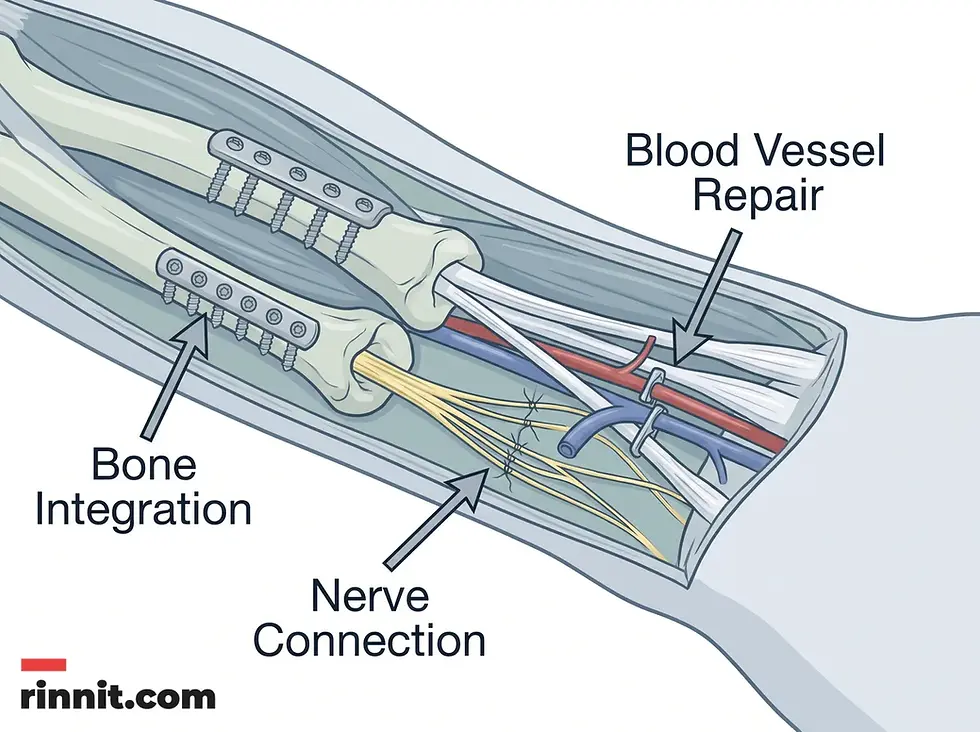
Figure 1: The surgical connections made during a hand transplant: bone fixation, nerve connection, and blood vessel repair.
Recovery and Long-Term Care
After surgery you move to a recovery area, most likely an intensive care unit (ICU), for observation [1]. You may need to stay in the hospital for up to two weeks [1]. Your providers regularly check your hand, order imaging and blood tests, and manage pain [1]. It can take time before you can move your fingers, so don't be discouraged if you can't right away [1].
The most important part of long-term care is anti-rejection medication (immunosuppressants). These medicines prevent your immune system from attacking the donor hand, and you need to take them as directed for the rest of your life [1]. You also work with a certified hand therapist to exercise your hand and increase function [1]. It could take six to eight weeks for the bone to heal, and up to eight weeks before you can use the hand for routine activities like holding an object [1]. Studies show your function and senses can keep developing for up to five years after the procedure [1].

Figure 2: The recovery journey after a hand transplant: intensive care monitoring, lifelong anti-rejection medication, and hand therapy.
Clinical Benefits and Risks
The main benefit is better function and well-being, but the procedure carries real risks.
Potential benefits
Improved hand movement and sensation [1].
Better self-esteem and self-image [1].
The ability to do daily tasks such as writing or waving [1].
In one study cited by Cleveland Clinic, all recipients could feel pain, up to 90% felt touch, over 82% felt fine touch, and an estimated 75% reported improved quality of life [1].
Potential risks and complications
Rejection: the body doesn't accept the donor hand. Acute rejection is common (approximately 85% of recipients) but treatable; chronic rejection may lead to loss of the hand [1].
Surgical risks: bleeding, infection, blood clots, loss of the transplant, and death [1].
Medication side effects: fatigue, headache, high blood pressure, nausea and vomiting, a high risk of infection, and metabolic conditions such as diabetes and Cushing syndrome [1].
Other complications: skin color variation, post-transplant lymphoproliferative disorder, skin cancer, and psychological rejection (the new hand doesn't feel like part of your body) [1].

Figure 3: Reported hand transplant survival and sensation outcomes. Figures are approximate and individual results vary.
Conclusion
Hand transplantation goes beyond physical restoration, offering some recipients a chance to regain independence and emotional well-being. It requires a lifelong commitment to medical care, anti-rejection medication, and rehabilitation, and the transplanted hand is unlikely to work as fully as a non-transplanted hand [1]. If you are living with limb loss and are interested in a hand transplant, contact a healthcare provider who can evaluate whether you're a good candidate.
Frequently Asked Questions
How common are hand transplants?
Hand transplants are rare. More than 150 have been performed around the world since 1999.
How long does the surgery take?
The procedure is long and complex. A hand transplant can take up to 24 hours and sometimes more to complete.
What is a bilateral hand transplant?
A bilateral hand transplant is a double transplant. It replaces both the left and right hands, or parts of both upper extremities, with those of a donor.
Can I feel things with a transplanted hand?
In many cases, yes. In one study cited by Cleveland Clinic, all recipients could feel pain, up to 90% felt the sense of touch, and over 82% felt fine touch such as vibration and pressure.
Why do I need anti-rejection medication?
Anti-rejection medicines (immunosuppressants) stop your immune system from treating the donor hand as a threat and attacking it. You need to take them as directed for the rest of your life.
How long will I be in the hospital?
After surgery you move to a recovery area, most likely an intensive care unit, for observation. You may need to stay in the hospital for up to two weeks.
What are the risks of immunosuppressants?
Side effects can include fatigue, headache, high blood pressure, nausea and vomiting, upset stomach, a high risk of infection, and metabolic conditions such as diabetes and Cushing syndrome.
Will the hand look exactly like my other hand?
Surgeons match the donor hand to you by criteria such as blood type, skin color, and age, but skin color variation is a possible complication and some difference in appearance is common.
Can I return to all normal activities?
Function usually improves, but it's unlikely that a transplanted hand will function as fully as a non-transplanted hand. Many people can do things like write or wave hello.
Is mental health support necessary?
Providers recommend a mental health evaluation before the transplant, and some recipients meet with a mental health professional afterward to manage the stress and challenges that can follow surgery.
How do I prepare for a hand transplant?
Before a hand transplant, you meet with a transplant coordinator and then the transplant team for an evaluation that includes a physical exam, blood tests, imaging and a mental health evaluation. [1] Your provider may ask you to quit smoking, adjust medicines or supplements, do recommended physical therapy, manage existing conditions and avoid alcohol and unprescribed drugs. [1] It also helps to build a strong support system, because once a matching donor hand is found, surgery follows quickly. [1]
Does a hand transplant hurt, and what anesthesia is used?
An anesthesiologist gives you general anesthesia, which puts you to sleep so you won't feel pain during the surgery. [1] Afterward, you recover in an area such as the intensive care unit, where you receive pain medicine for any discomfort. [1]
When should I call my doctor after a hand transplant?
Contact your care team right away if you notice skin discoloration, a skin rash, pain, swelling, loss of hand function you had regained, or a surgical site that isn't healing. [1] Acting quickly matters, because time is vital to treat complications and prevent rejection. [1]
Medical Disclaimer
The information in this article is for educational purposes only and is not a substitute for professional medical advice, diagnosis, or treatment. Always seek the advice of your physician or other qualified health provider with any questions you may have about a medical condition.
Source date: January 14, 2024.
Related Reading
Immunosuppressants: A Guide to Managing Your Immune System explains the anti-rejection medicines transplant recipients take for life.
Face Transplant: Procedure, Recovery, and Outcomes describes another complex tissue transplant and its long-term outcomes.
Prosthetic Arm: Types, Fitting and How It Works compares prosthetic arm types, an alternative after losing a hand.
Amputation Surgery: Understanding Procedures, Causes, and Long-Term Recovery covers why limbs are removed and how people recover afterward.
References
Cleveland Clinic. Hand Transplant. Cleveland Clinic. January 14, 2024. https://my.clevelandclinic.org/health/procedures/hand-transplant
Shores JT, Brandacher G, Lee WPA. Hand and upper extremity transplantation: an update of outcomes in the worldwide experience. Plast Reconstr Surg. 2015;135(2):351e-360e. PMID 25401735. https://doi.org/10.1097/PRS.0000000000000892
Kiwanuka H, Aycart MA, Bueno EM, et al. Experience with patient referrals for upper extremity transplantation at a U.S. academic medical center. J Hand Surg Am. 2017;42(9):751.e1-751.e6. PMID 28648330. https://doi.org/10.1016/j.jhsa.2017.05.016



Comments