Granuloma Inguinale (Donovanosis): What It Is, Why It Happens, and How It's Treated

Updated: 2 days ago
Medically reviewed by Dr. Baraa Alnahhal, MD · Last reviewed: October 2026
Quick Answer
Granuloma inguinale (donovanosis) is a bacterial STI caused by Klebsiella granulomatis that produces painless red bumps on the genitals that bleed easily and progress into bad-smelling sores [1]. It spreads mainly through sexual contact [1]. Standard treatment is a long course of antibiotics for at least three weeks [1] [2], and condoms and limiting partners help prevent it [1].
What the research says
Azithromycin is the recommended treatment. The 2016 European guideline describes an incubation period of about 50 days and four lesion types (ulcerogranulomatous, hypertrophic, necrotic and sclerotic), and recommends azithromycin 1 g weekly until complete healing (O'Farrell & Moi, Int J STD AIDS, 2016) [7].
Spread beyond the genitals is rare but serious. A case report and review of disseminated donovanosis found that bone involvement had been reported in only 18 cases over 55 years, including a patient who developed spinal cord compression (Paterson, Clin Infect Dis, 1998) [8].
What Is Granuloma Inguinale?
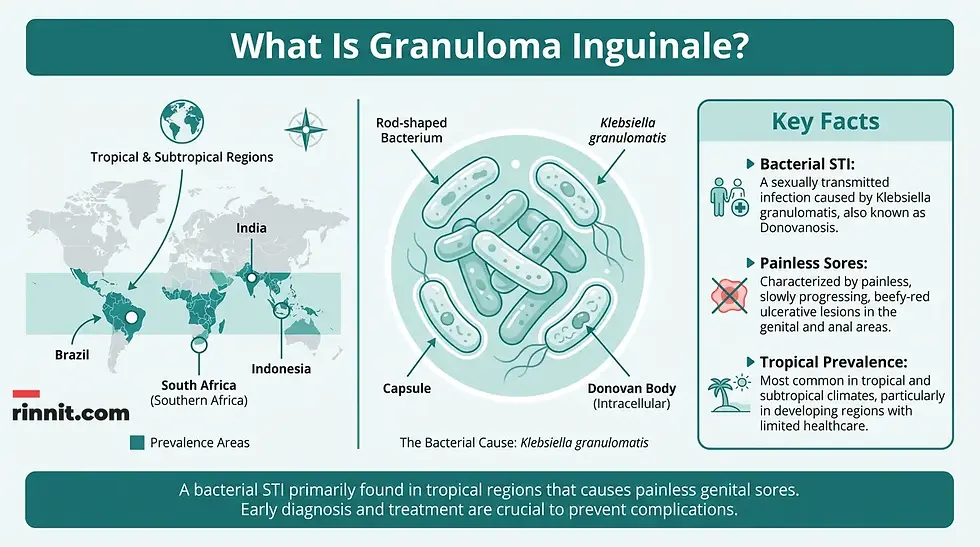
Granuloma inguinale, often referred to as donovanosis, is a bacterial infection primarily affecting the genital area. It is classified as a sexually transmitted infection (STI) caused by the Klebsiella granulomatis bacteria [1] [2]. While most cases occur in sexually active adults between the ages of 20 and 40 [1], the infection can also affect newborns and infants through nonsexual contact or during childbirth if the mother is infected [1].
The condition is relatively rare in the United States but remains prevalent in various tropical and subtropical countries [1] [2]. Without timely intervention, granuloma inguinale can worsen significantly, leading to chronic inflammation, extensive scarring, and in some cases, an increased risk of certain cancers [1].
Category | Details |
Common Name | Donovanosis |
Bacterial Cause | Klebsiella granulomatis |
Primary Risk Group | Adults aged 20–40 |
Incubation Period | 1 to 12 weeks (up to 1 year) |
Key Symptom | Painless, bleeding red sores |
What Are the Symptoms and Common Locations?
Symptoms of granuloma inguinale typically emerge between one and twelve weeks after the initial infection, though in some instances, they may not appear for up to a year [1]. The first sign is usually a small, painless red bump or lesion on or near the genitals. These bumps are often fragile and may bleed easily when touched [1].
As the infection progresses, the initial bump grows into a round, red lump with irregular edges [1]. Eventually, these lumps break down into open sores that often have a distinct, unpleasant odor [1]. While the initial sores are painless, they can become painful if a secondary infection occurs.
Common Infection Sites
The location of the sores depends on the type of sexual contact and the individual's anatomy:
Without treatment, these sores will continue to grow and spread to nearby healthy tissue, potentially causing significant damage [1].

What Causes Granuloma Inguinale?
The Klebsiella granulomatis bacteria is the sole cause of granuloma inguinale. The most common method of transmission is through vaginal or anal sex with an infected partner [1]. Although rare, the bacteria can also be passed through oral sex or direct skin-to-skin contact that does not involve intercourse [1].
Geographic location plays a significant role in the prevalence of this infection. It is most commonly found in regions such as [1]:
Argentina and Brazil
The Caribbean
India and Indonesia
Papua New Guinea
South Africa
How Is It Diagnosed and Treated?
A healthcare provider typically diagnoses granuloma inguinale through a physical examination and a review of the patient's medical and travel history [1]. Because the condition is rare in some areas, providers will often ask if the patient has visited or had contact with individuals from regions where the infection is more common [1].
Diagnostic Tests
To confirm a diagnosis, providers may use several methods:
Treatment Options
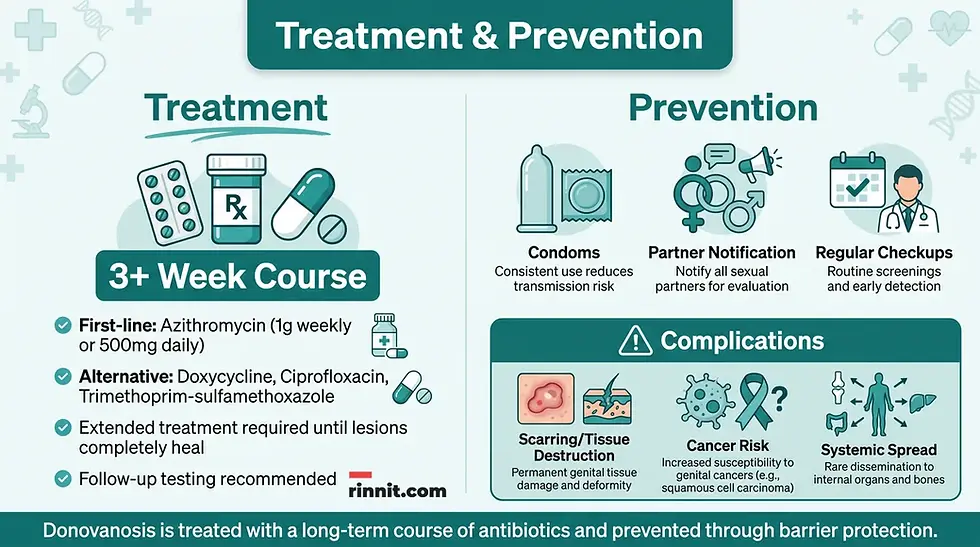
The primary treatment for granuloma inguinale is a long-term course of antibiotics. Patients are usually required to take these medications for at least three weeks [1] [2], and it is crucial to finish the entire prescription even if the sores appear to be healing [1]. In cases of extensive tissue damage, surgery may be necessary to repair the affected areas [1].
If left untreated, the infection can spread to the bones, joints, liver, and abdominal cavity [1]. Severe complications include the narrowing (stenosis) of the urethra or vagina, a massive enlargement of the genitals known as pseudo-elephantiasis, and an increased risk of penile, vulvar, or vaginal cancer [1].
Frequently Asked Questions
Q: Is granuloma inguinale the same as donovanosis?
A: Yes, donovanosis is the common name for granuloma inguinale.
Q: Are the sores from granuloma inguinale painful?
A: Initially, the red bumps and sores are painless, but they can become painful if they are not treated or if they develop a secondary infection.
Q: How long does treatment take?
A: Antibiotic treatment typically lasts for at least three weeks. It is vital to complete the full course as directed by a healthcare provider.
Q: Can granuloma inguinale return after treatment?
A: Yes, the infection can sometimes return six to eighteen months after the completion of antibiotics. Regular follow-up checkups are highly recommended.
Q: How can I prevent granuloma inguinale?
A: The most effective prevention methods include using barrier protection like condoms, limiting sexual partners, and ensuring prompt treatment for any STIs.
Q: Can it be spread through nonsexual contact?
A: While rare, it can be spread through skin-to-skin contact or from a mother to her child during birth.
Q: What should I do if I think I have an STI?
A: You should see a healthcare provider immediately for an examination and testing. Avoid all sexual activity until you receive a diagnosis and complete any necessary treatment.
Q: Should I tell my partners if I am diagnosed?
A: Yes. Any sexual partners you have had within 60 days of your symptoms appearing should be examined and treated by a healthcare provider.
Q: Does granuloma inguinale increase the risk of HIV?
A: Sores that bleed easily, such as those caused by granuloma inguinale, can increase the risk of contracting or transmitting HIV.
Q: Is there a vaccine for granuloma inguinale?
A: Currently, there is no vaccine available for this infection.
Q: Can the infection spread to other organs?
A: Yes, if left untreated, it can spread to the bones, joints, liver, and the abdominal cavity.
Q: What is pseudo-elephantiasis?
A: It is a severe complication where the genitals become massively enlarged due to chronic inflammation and scarring from the infection.
Q: Are there specific symptoms that mean the infection has spread?
A: Signs that the infection may have spread include fever, chills, fast heart rate, night sweats, and unexplained weight loss.
Q: Is granuloma inguinale common in the United States?
A: No, it is very rare in the U.S. and is primarily found in tropical and subtropical regions.
Q: Can newborns get granuloma inguinale?
A: Yes, it can be passed from an infected mother to her baby during childbirth.
Related Reading
What Is Syphilis? Symptoms, Stages, Testing, and Treatment Explained (2026 Guide) explains syphilis, another STI that causes genital sores.
Lymphogranuloma Venereum (LGV): Symptoms, Stages, Testing and Treatment covers a related STI that causes genital sores and swollen nodes.
STD Testing (STI Testing): Who Needs It, Test Types and What Results Mean explains which STI tests are available and when to get tested.
Sexually Transmitted Diseases (STDs) Guide: Symptoms, Causes, Diagnosis, and Treatment covers common STIs, their symptoms, and treatment.
Sources
Cleveland Clinic. Granuloma Inguinale (Donovanosis). Cleveland Clinic. Last updated September 30, 2022. https://my.clevelandclinic.org/health/diseases/24232-granuloma-inguinale
Centers for Disease Control and Prevention (CDC). Granuloma Inguinale (Donovanosis). Sexually Transmitted Infections Treatment Guidelines, 2021. Last reviewed July 22, 2021. https://www.cdc.gov/std/treatment-guidelines/donovanosis.htm
World Health Organization (WHO). Sexually transmitted infections (STIs). World Health Organization. September 10, 2025. https://www.who.int/news-room/fact-sheets/detail/sexually-transmitted-infections-(stis)
Mayo Clinic Staff. Sexually transmitted diseases (STDs): Symptoms and causes. Mayo Clinic. September 8, 2023. https://www.mayoclinic.org/diseases-conditions/sexually-transmitted-diseases-stds/symptoms-causes/syc-20351240
Belda Junior W. Donovanosis. An Bras Dermatol. 2020;95(6):675-683. PMID 33069513. https://doi.org/10.1016/j.abd.2020.07.002
Richens J. Donovanosis (granuloma inguinale). Sex Transm Infect. 2006;82(Suppl 4):iv21-2. PMID 17151047. https://doi.org/10.1136/sti.2006.023135
O'Farrell N, et al. 2016 European guideline on donovanosis. Int J STD AIDS. 2016;27(8):605-7. PMID 26882914. https://doi.org/10.1177/0956462416633626
Paterson DL. Disseminated donovanosis (granuloma inguinale) causing spinal cord compression: case report and review of donovanosis involving bone. Clin Infect Dis. 1998;26(2):379-83. PMID 9502458. https://doi.org/10.1086/516327
Medical disclaimer
This article is for general educational purposes only and is not a substitute for professional medical advice, diagnosis, or treatment. Always seek the advice of your physician or other qualified healthcare provider with any questions you may have about a medical condition. Never disregard professional medical advice or delay seeking care because of something you have read here. If you think you may have a medical emergency, call your doctor or emergency services immediately.



Comments