Lymphogranuloma Venereum (LGV): Symptoms, Stages, Testing and Treatment

Updated: 2 days ago
Medically reviewed by Dr. Baraa Alnahhal, MD · Last reviewed: October 2026

Lymphogranuloma venereum, usually called LGV, is a sexually transmitted infection caused by specific types of Chlamydia trachomatis. It can spread through anal, vaginal or oral sex. LGV often develops in three stages, beginning with small genital blisters and potentially progressing to swollen, painful lymph nodes and longer-term complications if it is not properly treated. [1]
If you notice symptoms that could fit LGV, contact a qualified healthcare provider promptly. Early treatment can support a full recovery.
Quick Answer: What is LGV?
Lymphogranuloma venereum is an STI caused by specific strains of *Chlamydia trachomatis*. It spreads through anal, vaginal or oral sex. The first stage may cause small, painless, fluid-filled blisters. The second stage can cause swollen lymph nodes in the groin, pelvis or near the rectum. Untreated infection can lead to complications affecting the lymphatic system, anus, rectum or genitals. [1]
What the research says
Azithromycin was an effective alternative to doxycycline in a clinical trial of LGV proctitis. In an open, non-randomized trial of 125 men who have sex with men with LGV proctitis (all also received a single dose of ceftriaxone), clinical cure at week 6 occurred in 80 of 82 (98%) who took weekly azithromycin 1 g for 3 weeks versus 41 of 43 (95%) who took doxycycline 100 mg twice daily for 21 days, with similar adverse events. The authors called for randomized trials to confirm the finding (Blanco et al., Clin Infect Dis, 2021). [2]
Many LGV infections found through screening had no symptoms. In a surveillance program at three sexually transmitted infection clinics in Alberta, Canada (2018–2022), 45 of 2,333 chlamydia-positive specimens from gay, bisexual and other men who have sex with men (1.9%) were confirmed as LGV. Among 1,374 rectal specimens, 37 (2.7%) were positive, and 51.2% (22 of 43) of cases were asymptomatic (Gratrix et al., Sex Transm Dis, 2025). [3]
What causes lymphogranuloma venereum?
LGV is caused by Chlamydia trachomatis serovars L1, L2 and L3. These are different from the D–K serovars associated with the more common form of chlamydia. LGV can spread during anal, vaginal or oral sex. [1]
LGV can affect people of any sex. Sexually active people ages 15 to 40 are identified as the group at highest risk. More cases have been reported among men who have sex with men, and people living with HIV have higher risk. [1]
How common is LGV?
LGV has the highest incidence in tropical and subtropical regions. Cases in the United States are rare, but outbreaks among men who have sex with men have been reported in North America, Europe and Australia. In 2018, 22 European countries reported a total of 2,389 LGV cases. [1]
What are the symptoms of LGV?
Symptoms usually begin 3 to 12 days after infection, but they may take as long as 30 days to appear. LGV symptoms are described in three stages, although the experience can vary from person to person.
The three stages of LGV

Stage | When it may appear | Common features |
Stage 1 | Early illness; symptoms may begin 3–12 days after infection | Small, usually painless, fluid-filled blisters on the penis or in the vagina; possible sores in the mouth or throat; blisters often heal quickly |
Stage 2 | About 2–6 weeks after stage 1 | Swollen, tender groin lymph nodes, or swollen and painful lymph nodes in the pelvis or near the rectum; possible sinus tracts that drain blood or pus |
Stage 3 | Usually when LGV has not been properly treated | Sores may heal with scars; sinus tracts may remain; abscesses, anal fistulas, rectal strictures, genital swelling and other complications may develop |
What other symptoms can happen?
LGV may also cause abdominal pain, anal pain, back or pelvic pain in women, body aches, constipation, fatigue, the feeling of needing to pass stool, headache, fever, inflammation of the rectum and anus, rectal bleeding, itching or discharge, painful urination, pain during bowel movements and unexplained weight loss. [1]
Symptoms involving the rectum may include proctitis, which means inflammation of the rectum and anus. A sinus tract is a passageway that can form when the skin over a swollen lymph node breaks down, allowing blood or pus to drain onto the skin. [1]
When should you seek medical care?
Seek medical care if you have genital blisters, swollen or painful lymph nodes, rectal pain, rectal bleeding or discharge, painful urination, fever, or other symptoms that could be related to an STI. Prompt diagnosis and treatment matter because untreated LGV can cause long-term damage.
How is LGV diagnosed?
A provider usually begins by asking about symptoms and sexual history, followed by a physical examination. If LGV is suspected, testing may include a blood test or a nucleic acid amplification test, often called a NAAT. [1]
Test or assessment | What it may involve |
Medical history | Discussion of symptoms and sexual history |
Physical examination | Examination of symptoms and affected areas |
Blood test | Looks for antibodies against Chlamydia trachomatis |
NAAT | Looks for Chlamydia trachomatis in a sample from the groin, rectum or lymph node |
Men tend to be diagnosed in earlier stages and women in later stages. Because symptoms can overlap with other conditions, a qualified provider should interpret the examination and test results. [1]
How is LGV treated?
Providers treat LGV with antibiotics. Doxycycline is usually prescribed at 100 milligrams twice daily for 21 days. Erythromycin or azithromycin may be used as alternative treatments. Doxycycline is generally avoided in pregnancy, so pregnant or breastfeeding people are usually treated with azithromycin instead. Treatment decisions should be made by a qualified clinician.
A provider may also recommend fine-needle aspiration, sometimes called an FNA, for pus-filled lymph nodes in the groin. This procedure may help relieve pain and discomfort. [1]
Do not use someone else's prescription, change an antibiotic dose or stop treatment early without speaking with a qualified healthcare provider.
Can LGV be cured?
When LGV is treated at an early stage, a person can make a full recovery. Taking doxycycline for 21 days cures more than 98.5% of LGV cases. Swelling may continue if the infection has damaged the lymphatic vessels that carry lymph fluid away from tissues. [1]
People with LGV have a higher risk of other STIs, including gonorrhea, HIV, hepatitis B, hepatitis C and syphilis. A provider may recommend testing for these and other STIs. Retesting for Chlamydia trachomatis is recommended about three months after treatment. [1]
What complications can untreated LGV cause?
Untreated or improperly treated LGV can damage the lymphatic system and nearby tissues. Possible complications include anal fistulas, blockage of lymph fluid, enlarged or substantially swollen genitals, infertility, reactive arthropathy, narrowing of the rectum and elephantiasis. [1]
LGV may also be associated with a higher risk of hepatitis and pneumonia. If fistulas or rectal strictures cause serious damage to the anus or rectum, surgery may be needed. [1]
Possible complication | Plain-language meaning |
Anal fistula | An abnormal passageway involving the anus |
Lymphatic obstruction | Blockage of lymph fluid flow |
Rectal stricture | Narrowing of the rectum |
Reactive arthropathy | Joint disease caused by infection |
Elephantiasis | Substantial swelling of the genitals |
Abscess | A collection of pus |
How can you reduce the risk of LGV?
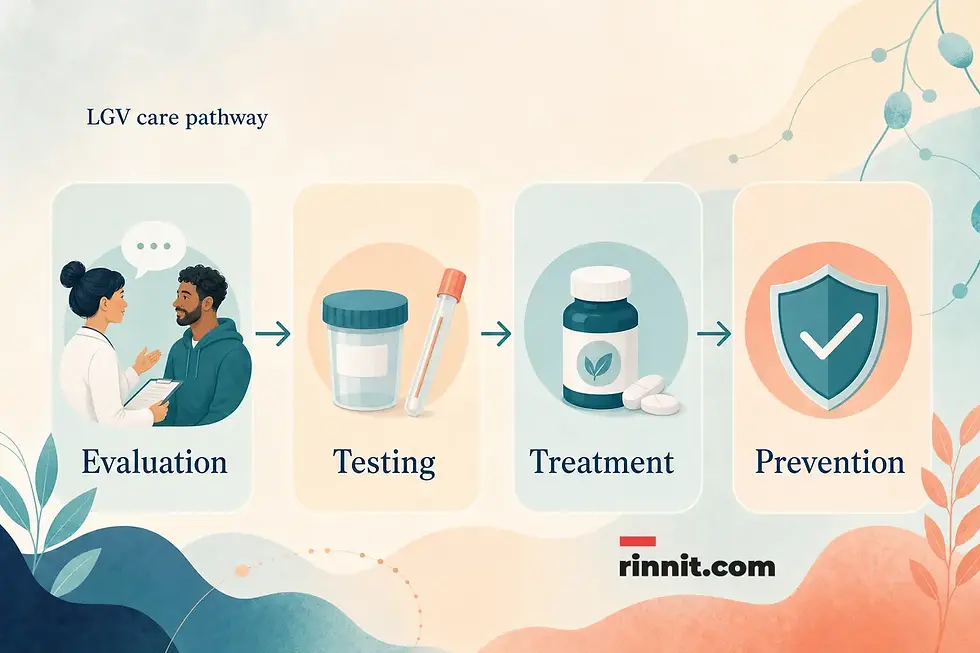
Several steps can reduce the risk of LGV: use condoms or other protection during sex, avoid unsafe sex, seek diagnosis and treatment when symptoms first occur, and inform recent sexual partners if a provider diagnoses LGV. Partners from the 60 days before diagnosis should be notified so they can be tested and treated if needed. [1]
You should refrain from sexual activity until treatment is complete. After treatment, continue practicing safer sex to reduce the chance of reinfection. [1]
Prevention step | Why it matters |
Use condoms or other protection | Reduces exposure risk during sex |
Get evaluated when symptoms first occur | Supports earlier diagnosis and treatment |
Inform recent partners | Gives partners an opportunity to seek testing and treatment |
Pause sexual activity during treatment | Helps reduce transmission while treatment is underway |
Practice safer sex after treatment | Helps reduce the chance of reinfection |
Conclusion: LGV is treatable, and early care matters
LGV is an STI caused by specific serovars of Chlamydia trachomatis. It may begin with brief genital blisters, progress to swollen lymph nodes and rectal or pelvic symptoms, and cause lasting complications when not properly treated. Testing and antibiotic treatment from a qualified healthcare provider can support recovery, while safer-sex practices and partner notification can help reduce spread and reinfection.
Concerned about symptoms or a possible exposure? Use this guide as a starting point, then contact a qualified healthcare provider or sexual-health service for confidential evaluation and testing. Rinnit.com is here to make complex health information easier to understand.
Frequently Asked Questions
Is LGV the same as regular chlamydia?
No. Both are caused by Chlamydia trachomatis, but LGV serovars L1, L2 and L3 are distinct from serovars D–K associated with the more common form of chlamydia.
Can LGV spread through oral sex?
Yes. LGV can be transmitted through anal, vaginal or oral sex.
How soon do LGV symptoms appear?
Symptoms usually begin 3 to 12 days after infection, but they may not appear for up to 30 days.
What do the first signs of LGV look like?
The first stage may cause small, usually painless, fluid-filled blisters on the penis or in the vagina. Sores may also appear in the mouth or throat, and the blisters often heal quickly.
What are buboes?
Buboes are swollen, tender lymph nodes in the groin. They are one of the possible features of the second stage of LGV.
Is LGV curable?
Early treatment can lead to a full recovery, and a 21-day course of doxycycline cures more than 98.5% of LGV cases. A clinician should decide which treatment is appropriate.
How long does LGV treatment last?
Providers usually recommend doxycycline for 21 days. Erythromycin or azithromycin may be alternatives. Follow the treatment plan provided by a qualified clinician.
Can LGV come back after treatment?
Refrain from sexual activity until treatment is complete and practice safer sex afterward to avoid future reinfections.
Should partners be notified?
Yes. If a provider diagnoses LGV, inform sexual partners from the 60 days before diagnosis so they can be tested and treated if necessary.
Who is most at risk for LGV?
LGV is most common in tropical and subtropical regions and is rare in the United States. Outbreaks have been reported among men who have sex with men in North America, Europe and Australia, but anyone who has sex can get it.
Related Reading
Chlamydia: Symptoms, Causes, Treatment, and How to Protect Yourself explains the common chlamydia infection and how it differs from LGV.
Proctitis: Complete Guide to Symptoms, Causes, Diagnosis, and Treatment covers rectal inflammation, a frequent symptom of LGV, and its causes.
Swollen Lymph Nodes in the Groin: Causes, Symptoms, and Care explains causes of groin swelling and when to see a provider.
STD Testing (STI Testing): Who Needs It, Test Types and What Results Mean describes which STI tests to get and how testing works.
References
Cleveland Clinic. Lymphogranuloma Venereum (LGV): Symptoms & Treatment. Cleveland Clinic. Last updated February 4, 2022. https://my.clevelandclinic.org/health/diseases/22465-lymphogranuloma-venereum-lgv
Blanco JL, Fuertes I, Bosch J, et al. Effective Treatment of Lymphogranuloma venereum Proctitis With Azithromycin. Clin Infect Dis. 2021;73(4):614-620. PMID 33462582. https://doi.org/10.1093/cid/ciab044
Gratrix J, Plitt S, Niruban J, et al. Prevalence, Treatment, and Follow-Up for Lymphogranuloma Venereum Serovars of Chlamydia trachomatis Among Gay, Bisexual, and Other Men Who Have Sex With Men Attending Sexually Transmitted Infection Clinics in Alberta, Canada, 2018 to 2022. Sex Transm Dis. 2025;52(12):746-750. PMID 40815293. https://doi.org/10.1097/OLQ.0000000000002199
Disclaimer
This article is for general educational purposes and is not a substitute for professional medical advice, diagnosis or treatment. Always seek the advice of a qualified healthcare professional with any questions about a medical condition or treatment.



Comments