GGT Test (Gamma-Glutamyl Transferase): Normal Range, Causes of High Levels and What Results Mean

Updated: 2 days ago
Written and medically reviewed by Dr. Baraa Alnahhal, MD · Last reviewed: November 2026 · How we review
Quick Answer
The GGT test (gamma-glutamyl transferase) is a blood test that measures an enzyme found mainly in the liver. It helps detect liver and bile duct problems and can help screen for or monitor heavy alcohol use. Don't drink alcohol for at least 24 hours beforehand. GGT alone can't diagnose a disease, so it's read with other liver tests.
What the research says
GGT tracks heart risk even within the normal range: a dose-response meta-analysis of 9 prospective studies with 527,589 people found that the highest GGT levels were linked to a 59% higher risk of cardiovascular death, and each 10 U/L increase raised the risk by about 10% (Wang J et al., PLoS One, 2017) [2]
High GGT is also linked to stroke: across 10 prospective studies and 926,497 people, high GGT levels were associated with a 28% higher risk of stroke, independently of alcohol intake (Zhang XW et al., Journal of Stroke and Cerebrovascular Diseases, 2015) [3]
Key takeaways
GGT is an enzyme found mainly in the liver; levels rise with liver and bile duct damage.
Used to investigate liver disease, explain a high ALP and help monitor alcohol use.
Avoid alcohol for at least 24 hours and tell your provider about all medicines and supplements.
Normal is often below about 50 U/L; males tend to have slightly higher levels.
A high GGT is a clue, not a diagnosis; it's interpreted with other blood tests and your history.
What is GGT?
Gamma-glutamyl transferase (also called gamma-glutamyl transpeptidase, GGTP or gamma-GT) is an enzyme found throughout the body, but mostly in the liver. It helps protect cells from damage. When the liver or bile ducts are injured, or when the liver is working hard to process alcohol or certain medicines, more GGT leaks into the blood. Sources: [1]
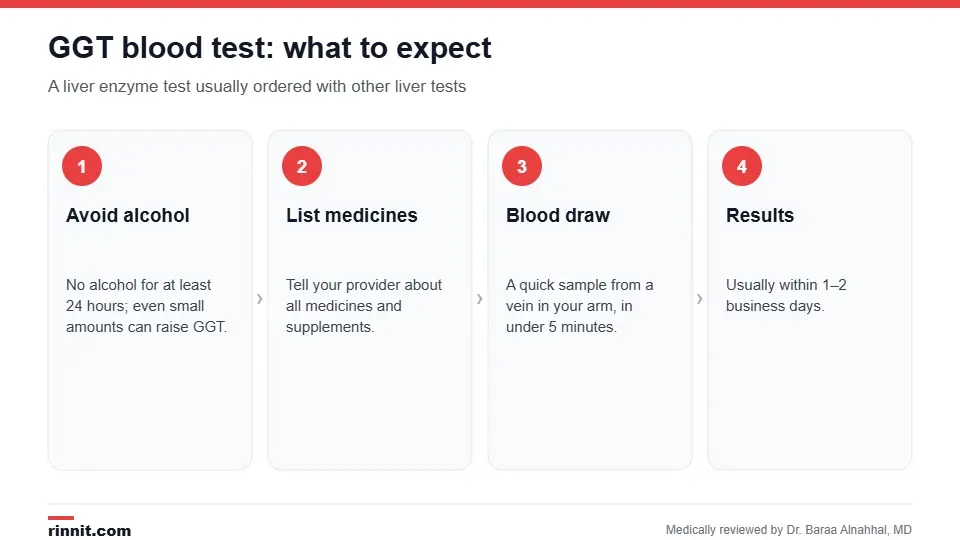
The GGT test is a quick blood draw.
Why is it done?
To help diagnose or rule out liver disease and bile duct problems.
To check symptoms such as jaundice, dark urine, itching, fatigue or belly pain.
To find the source of a high alkaline phosphatase.
To screen for alcohol use disorder or monitor treatment for it or for alcoholic hepatitis. Sources: [1]
How do I prepare?
Don't drink any alcohol for at least 24 hours before the test; even small amounts can raise GGT.
Tell your provider about all medicines and supplements, since many affect results.
Stop a medicine only if your provider tells you to. Sources: [1]
What happens during the test?
A provider draws blood, usually from a vein on the inside of your arm.
The sample goes to a lab.
Results usually come back in one to two business days. Sources: [1]
The draw takes less than five minutes. Risks are small: a slight chance of bruising or infection at the needle site. Sources: [1]
Understanding your results
A normal GGT is often below 50 U/L, but use the reference range printed on your report. Levels are, on average, slightly higher in males and can vary with age. A high result doesn't necessarily mean you have a disease. Sources: [1]
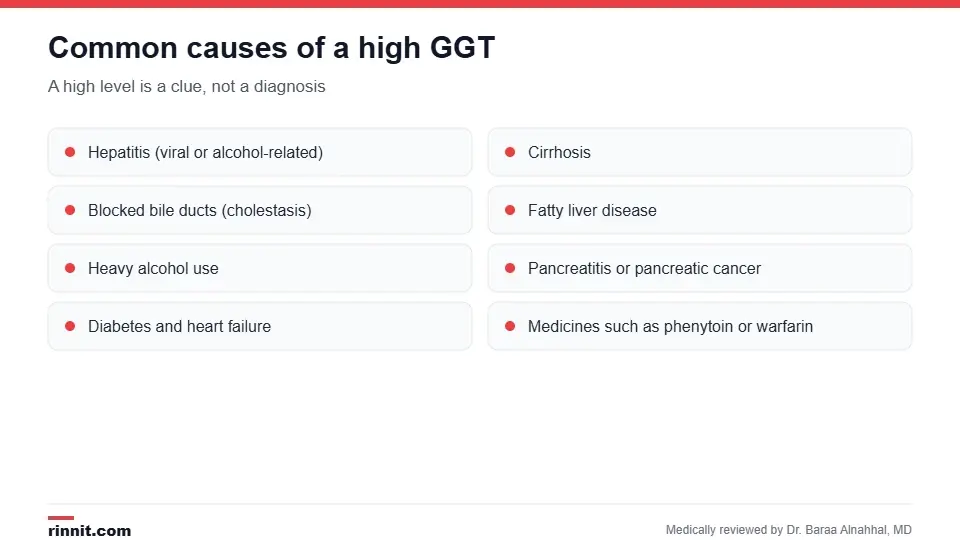
High GGT has many possible causes.
Cause | Examples |
Liver disease | Viral or alcoholic hepatitis, cirrhosis, fatty liver disease, liver tumors, reduced blood flow to the liver |
Bile duct problems | Cholestasis and blocked bile ducts |
Alcohol | Heavy drinking, or drinking shortly before the test |
Other conditions | Pancreatitis or pancreatic cancer, diabetes, congestive heart failure |
Medicines and habits | Phenobarbital, phenytoin, warfarin; smoking |
Sources: [1]
GGT and ALP together

GGT helps locate the source of a high ALP.
Both the liver and bones make alkaline phosphatase. Liver and bile duct problems usually raise both ALP and GGT, while bone conditions raise ALP but usually leave GGT normal. That makes GGT a useful tie-breaker when ALP is high on a routine panel. Sources: [1]
GGT and long-term health
Large studies link higher GGT, even within the normal range, with a higher risk of cardiovascular death and stroke. GGT isn't used on its own to predict heart disease, but a high level is another reason to look at alcohol, weight, blood sugar and blood pressure. Sources: [2, 3]
Conclusion
The GGT test is a sensitive marker of liver and bile duct stress. It's most useful alongside other liver tests, to explain a high ALP and to track alcohol-related liver injury. If your GGT is high, your provider will look for the cause, often starting with alcohol, medicines and fatty liver.
Keep learning: read about alcoholic hepatitis and primary biliary cholangitis.
Frequently asked questions
What is a normal GGT level?
Often below about 50 U/L, but ranges vary by lab, sex and age.
What causes high GGT?
Liver disease, blocked bile ducts, heavy alcohol use, fatty liver, pancreatitis, diabetes, heart failure and some medicines.
Do I need to fast for a GGT test?
Fasting isn't usually required, but avoid alcohol for at least 24 hours.
Can one drink raise my GGT?
Even small amounts of alcohol before the test can raise it.
Why test GGT with ALP?
A high GGT with a high ALP points to the liver; a normal GGT with a high ALP suggests bone.
Is GGT a test for alcoholism?
It can help screen for and monitor heavy alcohol use, but it isn't specific on its own.
Can medicines raise GGT?
Yes, including phenobarbital, phenytoin and warfarin.
How long do results take?
Usually one to two business days.
Can GGT go back to normal?
Often, once the cause, such as alcohol or a medicine, is removed.
Does high GGT mean heart disease?
Not on its own, but studies link higher GGT with higher cardiovascular risk.
Related Reading
Fatty Liver Disease (MASLD): The Silent Liver Condition Linked to Weight, Diabetes, and Metabolic Health — Causes, Testing, and Treatment a common cause of a mildly high GGT.
Alcohol Use Disorder: The Complete Guide to Recognizing, Understanding, and Recovering heavy drinking that GGT can help track.
What Is Cholestasis? Causes, Symptoms, Diagnosis and Treatment reduced bile flow that raises GGT and ALP.
Cirrhosis of the Liver: What It Is, How Permanent Scarring Damages Your Liver, and What Treatment Involves advanced liver scarring with abnormal liver tests.
Primary Biliary Cholangitis (PBC): Complete Guide to Symptoms, Causes, Diagnosis, and Treatment a bile duct disease that raises GGT.
References
Cleveland Clinic. Gamma-Glutamyl Transferase (GGT) Test: What It Is & Results. Cleveland Clinic. Last updated October 21, 2024. https://my.clevelandclinic.org/health/diagnostics/22055-gamma-glutamyl-transferase-ggt-test
Wang J, Zhang D, Huang R, et al. Gamma-glutamyltransferase and risk of cardiovascular mortality: a dose-response meta-analysis of prospective cohort studies. PLoS One. 2017;12(2):e0172631. PMID 28231268. https://doi.org/10.1371/journal.pone.0172631
Zhang XW, Li M, Hou WS, et al. Association between gamma-glutamyltransferase level and risk of stroke: a systematic review and meta-analysis of prospective studies. Journal of Stroke and Cerebrovascular Diseases. 2015;24(12):2816-2823. PMID 26372100. https://doi.org/10.1016/j.jstrokecerebrovasdis.2015.08.015
Medical disclaimer
This article is for general education only and does not replace advice from a qualified healthcare professional. Talk to your doctor about your own diagnosis and treatment, and seek emergency care right away for severe or sudden symptoms.



Comments