Understanding Genes: The Blueprints of Life

Updated: 3 days ago
Medically reviewed by Dr. Baraa Alnahhal, MD · Last reviewed: October 2026
Quick Answer: What are genes?
Genes are sections of DNA that give cells specific instructions for traits and body functions, acting as a code for making proteins that control everything from hair color to heart function [1]. Humans have approximately 20,000 coding genes, inherited in pairs from biological parents [1]. Genes interact in patterns such as dominant and recessive traits to shape physical characteristics and health.
What the research says
Height shows how many genes can shape a single trait. A review reported that genome-wide association studies have identified more than 12,000 independent signals associated with height, and that this has saturated the common-variant heritability of height in people similar to European reference populations (Conery & Grant, Ann Hum Biol, 2023) [2].
The human gene count is still an estimate. Seventeen years after the human genome was first published, researchers had still not found all of our genes, and the answer proved more complex than anyone had imagined when the Human Genome Project began (Salzberg, BMC Biol, 2018) [3].
Tools that support family-history assessment may help, but the evidence is thin. A systematic review of 8 studies of risk assessment, education, and decision aids for colorectal cancer genetic evaluation found mostly positive effects on uptake, but the studies were few and the results inconsistent, so firm conclusions could not be drawn (Li et al., Int J Nurs Stud, 2021) [4].
Anatomy and Function of Genes
A gene is a specific section of DNA packaged into chromosomes within the cell nucleus [1]. If DNA is viewed as a library, chromosomes are the books, and genes are the individual chapters that describe how the body works [1]. Scientists estimate that humans possess about 20,000 coding genes, which are responsible for producing the proteins that build and operate every part of the body [1].
Genes function by providing a template for protein synthesis. This process involves transcribing the DNA sequence into messenger RNA (mRNA), which is then translated by ribosomes into strings of amino acids [1]. These amino acids combine to form over 100,000 types of proteins that manage immune responses, muscle movement, and structural traits like height and eye color.
Component | Description |
DNA Base Pairs | Molecules carrying the fundamental instructions. |
Codon | A trio of base pairs coding for a specific amino acid [1]. |
Allele | Different versions of the same gene inherited in pairs [1]. |
Genotype | The specific genetic makeup written in your DNA [1]. |
Phenotype | The observable physical traits resulting from your genes [1]. |

Patterns of Genetic Inheritance
Inheritance is the process by which genetic information is passed from parents to offspring. Because genes come in pairs, the interaction between different alleles determines the final trait expressed. These interactions follow several distinct patterns, ranging from simple dominant-recessive relationships to complex polygenic systems.
Common Inheritance Types
Mendelian Inheritance: Involves dominant and recessive alleles. A dominant trait is expressed if at least one dominant allele is present, while a recessive trait requires two copies (e.g., earwax type) [1].
Incomplete Dominance: Offspring show a blend of parental traits, such as wavy hair resulting from one curly-haired and one straight-haired parent [1].
Codominance: Both alleles are expressed equally without blending. A primary example is the AB blood type, where both A and B antigens are present [1].
Polygenic Inheritance: Traits controlled by multiple genes, typically resulting in a wide range of variations like skin color or height [1].
X-Linked Inheritance: Genes located on the X chromosome. Conditions associated with these genes more frequently affect males because they possess only one X chromosome [1].

Genes and Health Conditions
Genetic changes, or mutations, can influence the development of various health conditions. Some disorders are inherited directly from parents, while others may be acquired throughout life due to environmental factors or errors in cell division. Understanding these risks is essential for proactive health management and clinical planning.
Inherited and Acquired Disorders
Certain alleles can lead to chronic conditions such as cystic fibrosis, sickle cell disease, or Huntington's disease [1]. X-linked conditions, including hemophilia and red-green color blindness, follow specific gender-based inheritance patterns [1]. Additionally, changes in tumor suppressor genes or proto-oncogenes can increase the risk of developing various types of cancer [1].
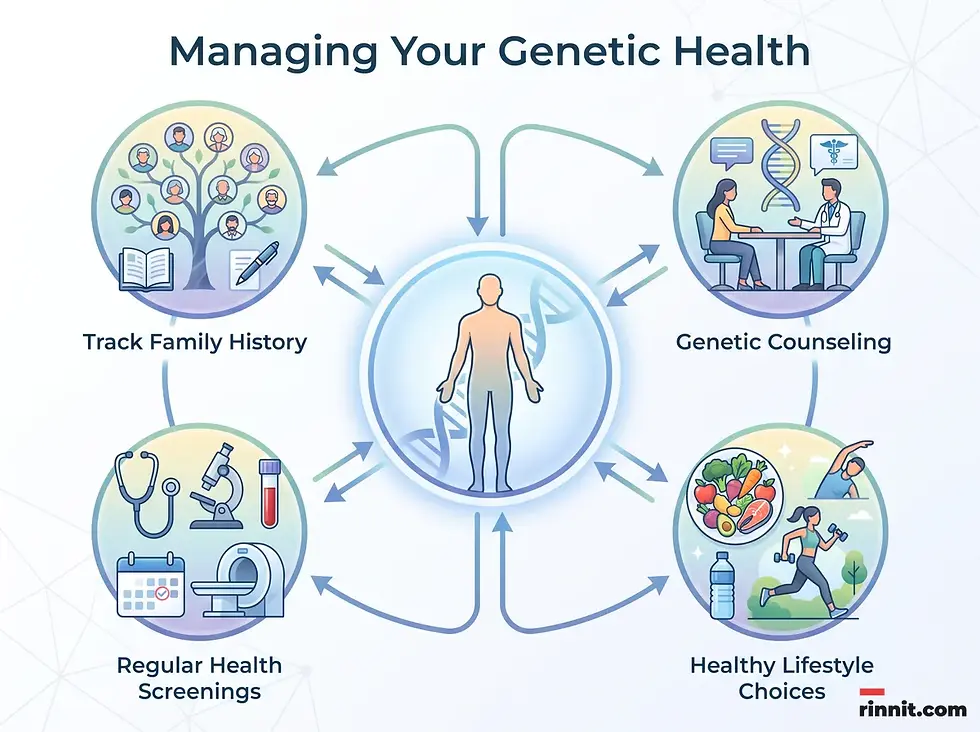
Managing Your Genetic Health
While you cannot change your underlying genetic code, understanding your family history and genetic profile can help you make informed lifestyle choices. Healthcare providers may recommend genetic counseling or specific screenings if you have a family history of certain conditions. Maintaining a healthy environment can also influence how your genes are expressed, a field known as epigenetics.
Practical Steps for Genetic Wellness
Document Family History: Keep a record of health conditions among close biological relatives.
Consult Specialists: Seek genetic counseling for personalized risk assessments.
Focus on Lifestyle: Prioritize nutrition and exercise to support healthy gene expression.
Regular Screenings: Follow recommended check-up schedules based on your risk profile.
Conclusion
Genes are the fundamental blueprints that define human biology, governing everything from physical appearance to internal organ function. By serving as the instructions for protein production, they maintain the body's structural integrity and operational efficiency. Recognizing the patterns of inheritance and the impact of genetic variations allows for a more comprehensive approach to personal health and long-term wellness.
Call to Action: If you have concerns about your family health history or potential genetic risks, schedule a consultation with a healthcare professional or genetic counselor. They can provide detailed assessments and guide you toward personalized health strategies.
This article provides general information and is not a substitute for professional medical advice. Always consult a qualified healthcare provider about your own or your family's health.
Frequently Asked Questions
What is a gene?
A gene is a segment of DNA that provides instructions for specific traits or biological processes in the body.
How many genes do humans have?
Humans are estimated to have approximately 20,000 coding genes that provide instructions for making proteins.
What are alleles?
Alleles are different versions of the same gene. You inherit one allele from each biological parent for every gene.
What is the difference between genotype and phenotype?
Genotype refers to the specific DNA sequence you possess, while phenotype is the observable physical trait that results from that sequence.
Can genes be turned on or off?
Yes, genes can be activated or deactivated based on their location in the body, current health status, or environmental influences.
What is Mendelian inheritance?
Mendelian inheritance is a pattern where traits are determined by dominant and recessive alleles, named after scientist Gregor Mendel.
Why do some genetic conditions affect males more?
X-linked conditions affect males more frequently because they have only one X chromosome, meaning a single recessive allele on that chromosome will express the trait.
What are polygenic traits?
Polygenic traits are characteristics controlled by multiple genes, such as height or skin color, leading to many possible variations.
Can you inherit a risk for cancer?
Yes, changes in specific genes like tumor suppressor genes can be inherited and may increase the likelihood of developing cancer.
What is epigenetics?
Epigenetics is the study of how your environment and behaviors can influence the way your genes work or are expressed.
Content reviewed and produced following the Rinnit editorial framework. Last updated: October 8, 2026.
Related Reading
Understanding Somatic and Germline Mutations: Origins and Health Impact explains the difference between inherited and acquired gene changes.
Genetic Testing (DNA Tests): Types, Uses, Risks and What Results Mean describes what genetic tests can show and how they are done.
Trisomy Explained: Understanding Extra Chromosomes and Genetic Health covers conditions caused by an extra copy of a chromosome.
Genetic Mutations: Understanding the Blueprint of Human Variation explains what gene mutations are and how they affect health.
References
Cleveland Clinic. Gene. Cleveland Clinic. July 9, 2025. https://my.clevelandclinic.org/health/body/gene
Conery M, Grant SFA. Human height: a model common complex trait. Ann Hum Biol. 2023;50(1):258-266. PMID: 37343163. DOI: 10.1080/03014460.2023.2215546
Salzberg SL. Open questions: how many genes do we have? BMC Biol. 2018;16(1):94. PMID: 30124169. DOI: 10.1186/s12915-018-0564-x
Li H, Chen S, Ma D, et al. Effectiveness of patient-targeted interventions to inform decision making and improve uptake of colorectal cancer genetic evaluation for at-risk individuals: a systematic review. Int J Nurs Stud. 2021;118:103928. PMID: 33848829. DOI: 10.1016/j.ijnurstu.2021.103928
Medical disclaimer
The information provided in this article is for educational purposes only and should not be used as a substitute for professional medical advice, diagnosis, or treatment. Always seek the advice of your physician or other qualified health provider with any questions you may have regarding a medical condition.



Comments