Understanding Somatic and Germline Mutations: Origins and Health Impact

Updated: 3 days ago
Medically reviewed by Dr. Baraa Alnahhal, MD · Last reviewed: October 2026
Genetic mutations are changes in the DNA sequence that occur during cell division. Germline mutations are inherited from parents through reproductive cells and can be passed to future generations [1]. In contrast, somatic mutations occur randomly after conception in non-reproductive cells and are not hereditary [1]. While most mutations are harmless, some can lead to genetic conditions or cancers. Understanding these differences is essential for assessing health risks and navigating genetic testing options.
Quick Answer
Somatic and germline mutations are changes to the DNA sequence that occur during cell replication. Germline mutations are inherited through egg or sperm, affect every cell and can pass to future generations, causing conditions like cystic fibrosis. Somatic mutations arise after conception in non-reproductive cells, are not hereditary and often lead to cancers or sporadic syndromes [1].
What the research says
Most acquired mutations are harmless, but they build up with age. A review in Science explains that as people age, their tissues accumulate an increasing number of somatic mutations, most of which have little or no functional consequence, although occasionally a mutation gives a cell a growth advantage. In the blood, this process (called clonal hematopoiesis) is highly prevalent in the elderly (Jaiswal & Ebert, Science, 2019 [2]).
Somatic mutations are tied to cancer and age-related disease. A review of acquired (postzygotic) mutations notes that they can occur in any tissue, accumulate during aging, and have classically been linked to malignant processes, with growing evidence for roles in benign age-related diseases as well (Kanagal-Shamanna et al., Annual Review of Pathology, 2024 [3]).
Errors in DNA repair and copying drive somatic mutations. Reviewers of age-related somatic mutation burden describe somatic mutations as arising from errors during genome repair and replication and accumulating in human tissues, because selective pressure has tuned repair in somatic cells mainly to pass genetic information to the next generation rather than to keep sequences intact long after reproductive age (Vijg et al., Trends in Molecular Medicine, 2023 [4]).
What are DNA mutations, and how do they occur?
A mutation represents a fundamental change in the DNA sequence, which serves as the biological instruction manual for cellular function. These alterations typically occur when cells divide and replicate their genetic material [4]. While the human body has trillions of cells that continuously replace themselves, the vast majority of DNA changes do not impact a person's genetic makeup or lead to health complications. However, specific mutations can disrupt cellular processes, resulting in various genetic conditions.
DNA itself is a complex structure composed of four chemical bases: adenine (A), cytosine (C), thymine (T), and guanine (G) [1]. These bases form specific pairs—adenine with thymine and cytosine with guanine—which connect with sugar and phosphate molecules to form nucleotides [1]. These nucleotides arrange themselves into a double helix shape, resembling a spiral staircase where the base pairs act as steps and the sugar-phosphate molecules serve as handrails [1].
What are germline and somatic mutations?
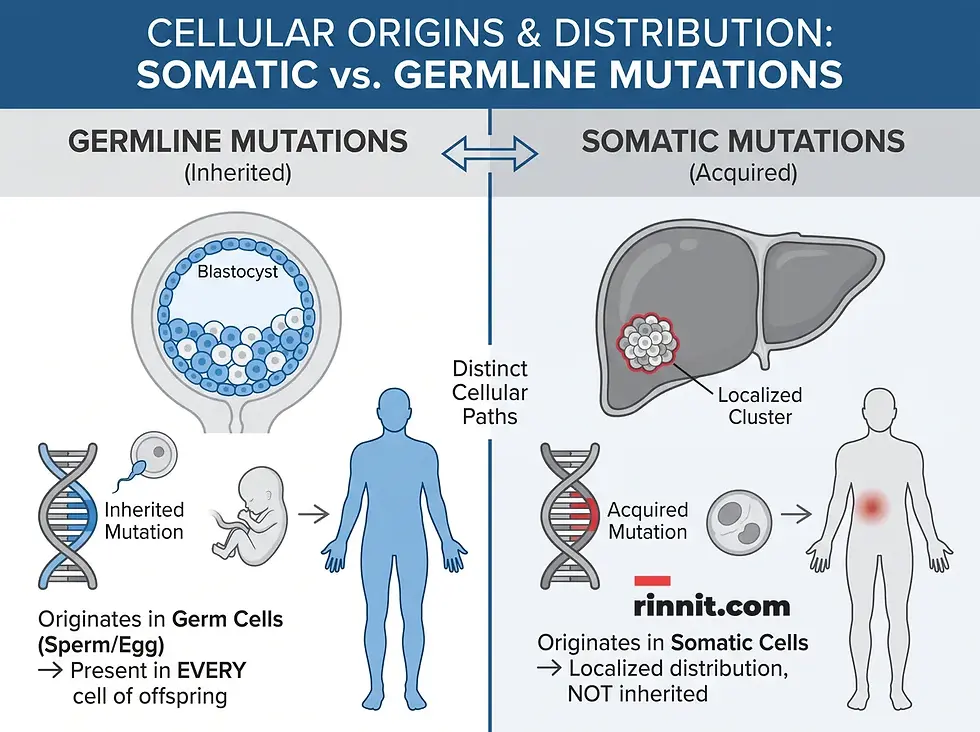
The primary distinction between mutation types lies in their origin and whether they can be passed to offspring. Germline mutations originate in a parent's reproductive cells, specifically the egg or sperm [1]. Because these cells combine at fertilization to form an embryo, the mutation is present in every cell of the resulting child's body. Consequently, germline mutations are hereditary and can be transmitted through subsequent generations [1].
Somatic mutations occur after conception in any cell of the body that is not a reproductive cell [1]. These changes happen sporadically or randomly and are not present in a person's family history. Unlike germline mutations, somatic changes are not hereditary and cannot be passed from parents to their children or to future generations [1]. If a somatic mutation occurs in a specific cell, only the cells that descend from that affected cell will carry the mutation.
Feature | Germline Mutations | Somatic Mutations |
Origin | Parent's reproductive cells (egg/sperm) | Non-reproductive cells after conception |
Hereditary | Yes (Inherited from parents) | No (Acquired randomly) |
Transmission | Can be passed to future generations | Cannot be passed to children |
Cell Distribution | Present in every cell of the body | Limited to affected cell and its descendants |
Timing | Present at fertilization | Occurs sporadically throughout life |
What health conditions can somatic and germline mutations cause?
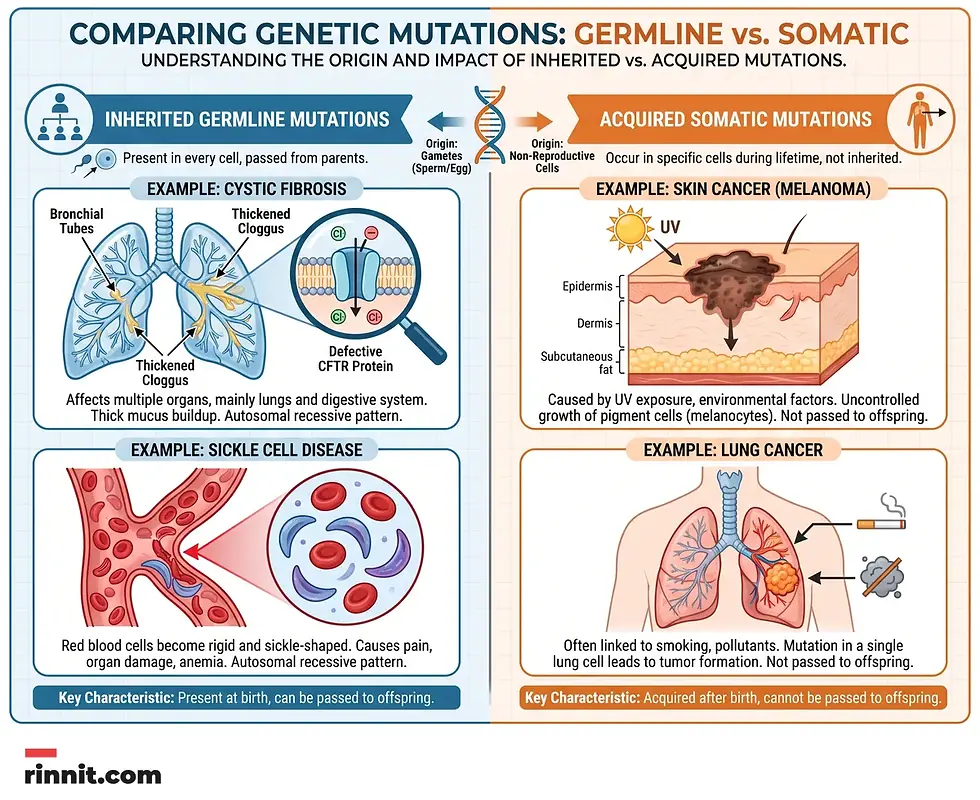
Both germline and somatic mutations can lead to significant health challenges, though they typically manifest in different types of disorders. Inherited conditions are the direct result of germline mutations. Because the mutation is present from birth in every cell, it often affects systemic development or specific metabolic pathways. Common examples include sickle cell disease, cystic fibrosis, Tay-Sachs disease, and Huntington's disease [1].
Somatic mutations are frequently associated with conditions that develop later in life or appear sporadically without a family history. These mutations are a primary driver of various cancers, as the localized DNA change can lead to uncontrolled cell growth. Notable conditions caused by somatic mutations include skin cancer, lung cancer, McCune-Albright syndrome, and Sturge-Weber syndrome [1].
How are germline and somatic mutations detected and their risks assessed?
Genetic testing serves as the primary method for detecting mutations in genes, chromosomes, or proteins [1]. These tests can pinpoint the specific location of a DNA change, helping individuals and healthcare providers understand potential health risks. For parents, genetic testing is particularly valuable for identifying the risk of passing a germline mutation to their children, especially when there is a known family history of genetic disorders [1].
While inherited germline mutations cannot be prevented, individuals can take proactive steps to reduce the risk of acquiring somatic mutations [1]. Environmental factors and lifestyle choices play a significant role in DNA stability. Protecting the body from known mutagens can help maintain cellular health and prevent the onset of acquired conditions.
What preventive care helps people with germline or somatic mutations?
Maintaining genetic health involves a combination of risk awareness and protective lifestyle habits. While germline risks are managed through counseling and testing, somatic risks are largely influenced by external exposures. Consistent adherence to safety protocols and healthy living can significantly lower the likelihood of random DNA damage.
Category | Preventive Actions |
Environmental | Use sunscreen and limit UV ray exposure |
Occupational | Wear PPE (masks/gloves) when handling chemicals |
Lifestyle | Avoid smoking and tobacco products |
Systemic | Maintain a healthy diet and exercise regularly |
Genetic | Pursue genetic testing if family history exists |

Conclusion
Somatic and germline mutations represent two distinct pathways for genetic change in the human body. While germline mutations are the foundation of hereditary conditions passed through generations, somatic mutations are acquired changes that drive sporadic diseases and cancers. By understanding the nature of these mutations and utilizing modern genetic testing, individuals can better assess their health risks and take meaningful steps toward long-term wellness and preventive care.
Next step: If there is a history of genetic conditions in your family, talk to your healthcare provider about genetic testing.
Frequently Asked Questions
What is the main difference between somatic and germline mutations?
Germline mutations are inherited from parents through reproductive cells and affect every cell in the body, whereas somatic mutations occur randomly after conception in non-reproductive cells and are not hereditary.
Can somatic mutations be passed to my children?
No, somatic mutations occur in cells other than the egg or sperm, meaning they cannot be transmitted to offspring or future generations.
Are all mutations harmful?
No, most DNA changes that occur when cells divide do not lead to health problems or affect a person's overall genetic makeup.
What are some examples of germline mutation conditions?
Common inherited conditions include cystic fibrosis, sickle cell disease, Tay-Sachs disease, and Huntington's disease.
How do somatic mutations cause cancer?
Somatic mutations are changes in DNA that happen in specific body cells; if these changes affect genes controlling cell growth, they can lead to the development of cancers like skin or lung cancer.
Can germline mutations be prevented?
No, germline mutations are inherited at conception and cannot be prevented, though genetic testing can help assess the risk of passing them to children.
How can I reduce my risk of somatic mutations?
You can lower your risk by avoiding smoking, using sunscreen, wearing protective gear when handling chemicals, and maintaining a healthy diet and exercise routine.
What role does genetic testing play in managing mutations?
Genetic testing identifies specific changes in genes or chromosomes, helping individuals understand their risk for certain conditions or the likelihood of carrying an inherited mutation.
Where does DNA exist in the body?
DNA is located within the nucleus of almost every cell in the human body, serving as the master code for all biological functions.
What does the term “sporadic” mean in somatic mutations?
In this context, sporadic means the mutation happens randomly and without any existing family history of the condition.
Related Reading
Genetic Mutations: Understanding the Blueprint of Human Variation explains what gene mutations are and how they affect health.
Genetic Testing for Cancer Risk: Who Needs It, How It Works and What Results Mean covers how genetic tests can reveal inherited cancer risk.
BRCA Testing: Who Should Get It, How It Works and What Results Mean describes testing for BRCA gene changes linked to breast and ovarian cancer.
Lynch Syndrome: Symptoms, Causes, Inheritance, Diagnosis, and Screening explains an inherited condition that raises colon and other cancer risks.
References
Cleveland Clinic. Somatic & Germline Mutations. Cleveland Clinic. Last updated May 24, 2022. https://my.clevelandclinic.org/health/body/23067-somatic--germline-mutations
Jaiswal S, Ebert BL. Clonal hematopoiesis in human aging and disease. Science. 2019;366(6465):eaan4673. PMID 31672865. https://doi.org/10.1126/science.aan4673
Kanagal-Shamanna R, Beck DB, Calvo KR. Clonal hematopoiesis, inflammation, and hematologic malignancy. Annual Review of Pathology. 2024;19:479-506. PMID 37832948. https://doi.org/10.1146/annurev-pathmechdis-051222-122724
Vijg J, Schumacher B, Abakir A, et al. Mitigating age-related somatic mutation burden. Trends in Molecular Medicine. 2023;29(7):530-540. PMID 37121869. https://doi.org/10.1016/j.molmed.2023.04.002
Medical disclaimer
The information provided in this article is for educational purposes only and should not be used as a substitute for professional medical advice, diagnosis, or treatment. Always seek the advice of your physician or other qualified health provider with any questions you may have regarding a medical condition.



Comments