Ganglioglioma: Symptoms, Diagnosis, and Treatment Options

Updated: 3 days ago
Medically reviewed by Dr. Baraa Alnahhal, MD · Last reviewed: October 2026
Source currency note: This guide reflects medical information reviewed in June 2024. Always confirm current guidance with your healthcare professional.
Quick Answer
A ganglioglioma is a rare brain tumor made of both neuronal and glial cells, most often found in children and young adults, and is typically small, slow-growing and noncancerous. Seizures are the main symptom. It is diagnosed with imaging, EEG and often a biopsy. Surgery is the usual first treatment, and five-year survival exceeds 90%. [3]
What the research says
Surgery relieves seizures in most people. A review of studies on ganglioglioma surgery found seizure freedom in 63% to 100% of patients across studies, with many follow-ups longer than 5 years. More complete resection, a shorter history of epilepsy, and younger age at surgery were linked to better seizure control (Bonney et al., World Neurosurg, 2015).
Most children do well, but recurrence can happen late. In 90 children with glioneuronal tumors (58 of them gangliogliomas), 90% of those who presented with seizures were seizure-free after surgery. Tumor recurrence-free survival was 87% at 5 years and 75.5% at 10 years, so the authors advise at least 10 years of follow-up (Tomita et al., Childs Nerv Syst, 2016).
What is a Ganglioglioma?
A ganglioglioma, also called a mixed neuronal-glial tumor, is a rare growth in the central nervous system. It is unusual because it contains two types of cells: neuronal cells, which form the neurons that carry information through the body, and glial cells, which form the structure of the central nervous system and help neurons work properly.
Feature | Description |
Prevalence | About 1% to 2% of brain tumors in children and young adults |
Primary age group | Children and young adults |
Typical nature | Low-grade, slow-growing, and benign |
Common location | Temporal lobes (near the ears) |

Types and Locations of Tumors
Gangliogliomas are found most often in the temporal lobes, but they can occur in any part of the brain, including the cerebrum, brainstem, cerebellum, thalamus, and hypothalamus. They may also occur in the spinal cord.
Special classifications
Low-grade gliomas: more than 95% of gangliogliomas. They are noncancerous and have a low risk of returning after complete surgical removal.
High-grade gangliogliomas: in rare cases, these tumors are classified as high-grade, which means they can turn cancerous. They are aggressive and have a high risk of recurrence.
Desmoplastic infantile ganglioglioma: a very rare type that occurs before age 2, in the upper part of a baby's brain.
Symptoms and Clinical Signs
Most symptoms develop slowly. Because gangliogliomas often sit near the temporal lobes, they tend to cause epilepsy.
The role of seizures
For many patients, a seizure is the first clue that a tumor is present. The tumor disrupts normal electrical activity in the brain, which can lead to sudden episodes of altered awareness or convulsions.
Other potential symptoms
Depending on the tumor's size and exact location, other signs may include:
Headaches: often worst in the morning, upon waking.
Vision and coordination: double vision, dizziness, or an unsteady walk (gait).
Physical weakness: difficulty swallowing or weakness on one side of the body.
General symptoms: fatigue, nausea, or vomiting.
Symptom | Clinical presentation |
Seizures | Sudden disturbances of the brain's electrical activity (epilepsy) |
Headaches | Persistent, often worse on waking in the morning |
Motor skills | Unsteady gait, weakness on one side of the body |
Sensory | Double vision, dizziness |

Causes and Risk Factors
Most gangliogliomas develop randomly, with no known cause. Researchers have found some genetic factors that may play a role.
Genetic mutations
A mutation in the BRAF gene is found in 10% to 60% of gangliogliomas. It also occurs in a range of other tumors, but it is a useful marker for diagnosis and for targeted treatment.
Known risk factors
Certain inherited genetic conditions raise a child's risk of glial tumors, including gangliogliomas:
Neurofibromatosis 1 (NF1)
Tuberous sclerosis
Turcot syndrome
Li-Fraumeni syndrome
von Hippel-Lindau syndrome
Brain and spinal cord tumors in general also occur more often in male children than in female children, and more often in white children than in children of other racial and ethnic groups. There is no known way to prevent a ganglioglioma.
Diagnosis and Evaluation
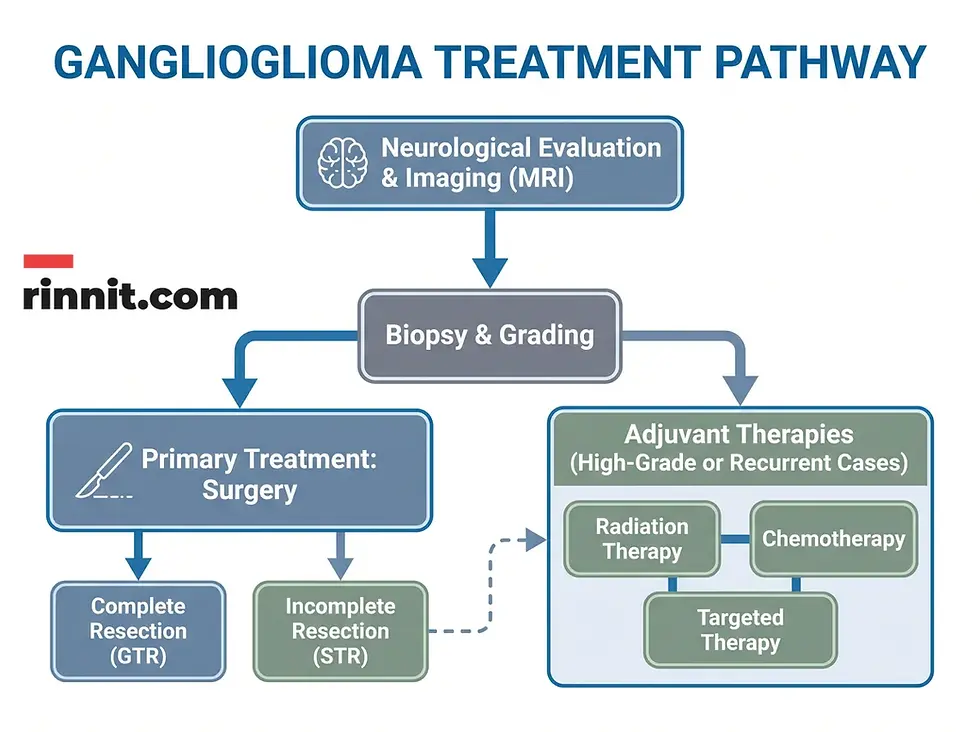
Diagnosis starts with a physical exam, a review of symptoms and medical history, and a neurological exam. Providers usually order more tests to confirm it.
Diagnostic tools
Neurological exam: tests reflexes, muscle strength, mouth and eye movement, alertness, and coordination.
MRI and CT scans: produce detailed images of the brain. MRI is the main tool for seeing the brain's structure.
EEG (electroencephalogram): measures and records the brain's electrical activity, especially when seizures are present.
Biopsy: a neurosurgeon takes a tissue sample, which a pathologist examines under a microscope and may send for genomic testing, such as for the BRAF mutation.
Treatment Strategies
The goal of treatment is to remove the tumor safely while protecting as much neurological function as possible. Care is best delivered at a pediatric medical center, by a pediatric oncologist or neuro-oncologist with experience treating gangliogliomas.
Surgical intervention
Surgery is usually the first line of treatment. Surgeons remove as much of the tumor as possible. Because most gangliogliomas are slow-growing and benign, a complete removal often cures the tumor. Surgery is sometimes limited by where the tumor sits in the brain.
Adjuvant therapies
If the tumor is high-grade, can't be fully removed, or comes back, other treatments may be needed:
Radiation therapy: high-energy X-rays and other radiation destroy tumor cells and stop them from growing and dividing. It may be recommended for progressive or recurrent tumors.
Chemotherapy: drug treatment that kills or shrinks tumor cells.
Targeted therapy: drugs that attack specific markers in the tumor, such as BRAF mutations.
Clinical trials: may be an option for children with recurrent tumors that don't respond to other therapies.
Outlook and Prognosis
The long-term outlook for children and young adults with a ganglioglioma is generally excellent. The overall five-year survival rate is more than 90%. Tumor grade, tumor location, and the child's age at diagnosis all affect individual outcomes. More than 95% of gangliogliomas are low-grade, and these are not expected to return after complete removal.
When to See a Healthcare Provider
If your child has a seizure or any other symptoms described here, see their healthcare provider for an evaluation. These symptoms can look like those of other conditions, so a proper diagnosis matters. Early diagnosis and specialized care at a pediatric medical center give the best chance of a good outcome.
Frequently Asked Questions
Is a ganglioglioma cancerous?
Most gangliogliomas (over 95%) are low-grade, noncancerous tumors. A small share are high-grade (such as grade 3), which can turn cancerous and are more aggressive.
Why do gangliogliomas cause seizures?
Gangliogliomas most often develop near the temporal lobes, so they tend to cause epilepsy. A seizure is often the first sign that a ganglioglioma is present.
Can a ganglioglioma return after surgery?
More than 95% are low-grade and are not expected to return after complete removal. Higher-grade tumors, such as grade 3, are more likely to come back, and long-term follow-up is still recommended.
What is the survival rate for ganglioglioma?
The overall five-year survival rate is more than 90%. It depends on tumor grade, the child's age, and tumor location.
How rare is this type of brain tumor?
Gangliogliomas are very rare. They account for about 1% to 2% of all brain tumors in children and young adults.
What is a mixed neuronal-glial tumor?
A mixed neuronal-glial tumor is a tumor made of two cell types: neuronal cells, which form neurons, and glial cells, which support and help neurons function. Ganglioglioma is another name for this kind of tumor.
Are there targeted treatments for ganglioglioma?
Yes. Many gangliogliomas have markers, such as BRAF mutations, that targeted therapy can attack. Providers may consider it alongside surgery, radiation, or chemotherapy.
At what age do these tumors usually appear?
Gangliogliomas mostly affect children and young adults. A very rare type, desmoplastic infantile ganglioglioma, occurs before age 2.
What is a neurological exam?
A non-invasive exam in which a provider checks reflexes, muscle strength, eye and mouth movement, alertness, and coordination to assess brain function.
How is a ganglioglioma diagnosed?
Diagnosis uses a neurological exam, MRI or CT scans of the brain, and often an EEG if seizures occur. A tissue sample from surgery or a biopsy confirms the tumor type.
Related Reading
Temporal Lobe Seizures: Symptoms, Causes, Diagnosis, and Treatment explains the seizure type gangliogliomas most often cause.
Epilepsy Surgery: Types, Tests, Risks, Recovery, and Success Rates walks through surgery options and testing for hard-to-control seizures.
Rare Benign Brain Tumors: A Guide to Gangliocytoma and Pineocytoma covers gangliocytoma, a closely related rare brain tumor.
Childhood Brain Tumors: Types, Symptoms, and Treatment Explained reviews the main brain tumor types in children and young adults.
References
Bonney PA, Glenn CA, Ebeling PA, et al. Seizure freedom rates and prognostic indicators after resection of gangliogliomas: a review. World Neurosurgery. 2015;84(6):1988-1996. PMID 26123501. https://doi.org/10.1016/j.wneu.2015.06.044
Tomita T, Volk JM, Shen W, Pundy T. Glioneuronal tumors of cerebral hemisphere in children: correlation of surgical resection with seizure outcomes and tumor recurrences. Child's Nervous System. 2016;32(10):1839-1848. PMID 27659827. https://doi.org/10.1007/s00381-016-3140-0
Cleveland Clinic. Ganglioglioma. Cleveland Clinic. June 12, 2024. https://my.clevelandclinic.org/health/diseases/ganglioglioma
Medical disclaimer
This article was prepared for general information only and is not a substitute for professional medical advice.



Comments