Childhood Brain Tumors: Types, Symptoms, and Treatment Explained

Updated: 2 days ago
Medically reviewed by Dr. Baraa Alnahhal, MD · Last reviewed: October 2026
Quick Answer
A childhood brain tumor is a growth of abnormal brain cells in a child, which can be benign or malignant. [1] Brain and spinal cord tumors are the second most common childhood cancers after leukemia. [4] [3] Warning signs include early morning headaches with vomiting, balance problems and seizures. [1] Treatment may include surgery, chemotherapy, radiation and rehabilitation, depending on the tumor.
What the research says
The time from first symptoms to diagnosis varies widely, and delay did not clearly predict survival. A systematic review of 11 studies (from 3,123 identified) found that the median interval from first symptoms to diagnosis ranged from 28 to 760.8 days and found no significant association between a longer interval and worse overall survival, though the authors stressed this should not detract from sharp clinical acumen and prompt diagnosis (Kehoe et al., Childs Nerv Syst, 2023) [5].
Behavior changes can be an early sign of some low-grade tumors. In a systematic review of children with low-grade glioma, pilocytic astrocytoma, or craniopharyngioma who had psychiatric or behavioral symptoms before diagnosis, the most common presenting symptoms were eating disorders (64 patients) and behavioral changes (49 patients), leading the authors to call for clearer criteria for neuroimaging (Sherman et al., J Psychiatr Res, 2022) [6].
Survivors often need support long after treatment. Among 202 survivors aged 8 to 21 and 262 parents followed for 12 months, patient-reported cognition and parent-reported anxiety worsened over time, and patient-reported mobility and upper-extremity function were associated with survival (Lai et al., Cancer, 2020) [7].
What Is a Childhood Brain Tumor?
A pediatric brain tumor is a growth of abnormal brain cells in a child. A brain cell becomes abnormal when it undergoes genetic changes, and the change in a specific gene can cause the cell to form a tumor. [1]
There are many types of pediatric brain tumors, and they can occur at any age: from birth to adolescence and sometimes even in adulthood. Brain tumors (neoplasms) may be malignant (cancerous) or non-malignant (benign, not cancerous). [1] A pediatric brain tumor can cause symptoms when it presses on an area of the brain.
How Common Are Brain Tumors in Children?
According to the American Cancer Society, brain and spinal cord tumors are the second most common cancers in children, after leukemia, with around 4,900 diagnosed each year in children and teens. [4] About 3 out of 4 children with brain tumors (all types combined) survive at least 5 years after diagnosis. [4]
What Are the Types of Childhood Brain Tumors?
Childhood brain tumors come in many types, and they can be benign or malignant. They're grouped by the kind of brain cell in which they develop.
Category | Benign or malignant? | Key facts |
Gliomas | Low-grade (slow) or high-grade (aggressive) | About half of all pediatric brain tumors; develop from glial cells that support and protect brain tissue [1] |
Embryonal tumors | Malignant | Start in fetal or embryonic cells; most common in babies and young children |
Pineal tumors | Both | Develop in the pineal gland in the middle of the brain, which makes melatonin |
Craniopharyngiomas | Noncancerous | Start near the pituitary gland from its embryonic tissue |
Germ cell tumors | Malignant | Begin from embryonic "germ" cells left in the brain |
Choroid plexus tumors | Both | Start in the choroid plexus lining the brain's fluid-filled ventricles |
Schwannomas | Usually benign | Develop in Schwann cells that insulate nerves, often near hearing and balance nerves |
Meningiomas | Mostly benign | Begin in the meninges (tissue around the brain); less common in children |
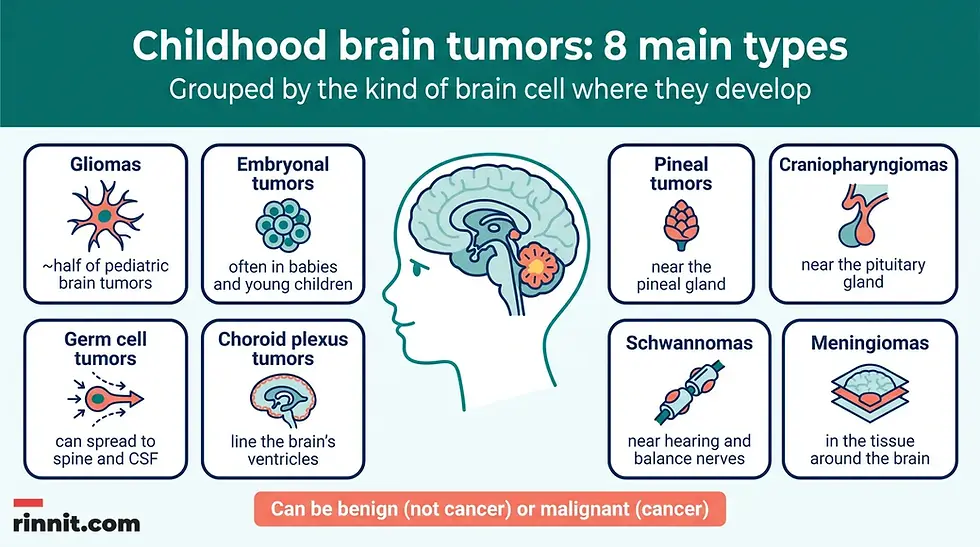
Childhood brain tumors fall into eight main types, grouped by the kind of brain cell where they develop. They can be benign (not cancer) or malignant (cancer).
Gliomas
Gliomas originate from glial cells in the brain. Glial cells support, nourish, and protect brain tissue and nerve cells (neurons). About half of all pediatric brain tumors are gliomas, and they can be low-grade (slow growing) or high-grade (aggressive and fast growing). [1]
Glioma type | Details |
Astrocytoma | Starts in astrocytes; can form in the brain or spinal cord; slow growing or aggressive |
Oligodendroglioma | Starts in oligodendrocytes; often found in the outer layer of the brain |
Neuroglial tumors | Consist of both glial and neuronal cells; occur in the brain and spine; often cause seizures |
Ependymoma | Begins in ependymal cells, which line the fluid-filled spaces of the brain |
Embryonal Tumors
Embryonal tumors start in fetal or embryonic cells in the central nervous system. These are cancerous tumors that can occur at any age, but they're most common in babies and young children. The most common type of embryonal tumor is the medulloblastoma, which starts in the cerebellum, the back part of the brain. [1] [3] A medulloepithelioma is a rare, fast-growing tumor that usually occurs in infants and young children. An atypical teratoid/rhabdoid tumor (ATRT) is a rare neoplasm that often starts in the cerebellum of very young children, and an embryonal tumor with multilayered rosettes (ETMR) is an aggressive childhood brain cancer in the central nervous system.
Pineal Tumors
A pineal tumor develops in the pineal gland, located in the middle of the brain, which secretes the hormone melatonin. There are different kinds of tumors that originate in the pineal gland, and they can be benign or malignant. A pineoblastoma is the most aggressive kind of embryonal tumor that can spread quickly to the brain and spine. Pineal parenchymal tumors are of intermediate grade and mostly confined to the pineal region if detected on time. Germ cell tumors also form from the embryonic tissue left in the pineal gland.
Craniopharyngiomas
Craniopharyngiomas are noncancerous tumors that start near the pituitary gland, arising from the pituitary's embryonic tissue. They can be solid, cystic (a sac of fluid), or mixed, and slow growing or fast growing. These tumors can press on the pituitary gland, which makes hormones that regulate growth, blood pressure, and reproduction. They also press on the hypothalamus, an important area of the brain that controls functions including body temperature, bodily fluids, and emotions, and can put pressure on the optic nerves, which can affect vision.
Germ Cell Tumors, Choroid Plexus Tumors, Schwannomas, and Meningiomas
Germ cell tumors are cancerous tumors that begin from embryonic cells called "germ" cells. During development, germ cells migrate outside of the brain to form ovaries or testes. The germ cells that remain in the brain can become cancerous and form germ cell tumors, which can spread into the spine and cerebrospinal fluid (CSF).
Choroid plexus tumors start in the choroid plexus, which lines the ventricles (fluid-filled cavities) of the brain. These tumors can be noncancerous (like choroid plexus papilloma) or cancerous (like choroid plexus carcinoma). Atypical choroid plexus papillomas are intermediate-grade tumors that can become malignant if not removed.
Schwannomas are tumors that start in the Schwann cells, which insulate nerves in the brain. This type usually grows near the nerve that manages hearing and balance. It may also form near the spinal cord, causing weakness and problems with the senses. Although schwannomas are usually benign, they can be malignant.
Meningiomas are another type of brain tumor, but they're less common in children. They begin in the meninges, a layer of tissue around the brain, and can press on the brain and spinal cord. The majority of meningiomas are benign, but they can grow large enough to be life-threatening.
What Causes Brain Tumors in Children?
A neoplasm forms when healthy cells multiply and grow out of control. [1] Scientists don't understand what causes cells to grow uncontrollably, but it may relate to genetic changes in a cell, inheritance of cancer-forming genes, or prior radiation exposure (for another type of cancer). [1]
There's a link between some pediatric brain tumors and cancer syndromes, which are collections of seemingly related health issues, though experts don't fully understand this link yet. Associated cancer syndromes include Li-Fraumeni, neurofibromatosis type I, neurofibromatosis type II, tuberous sclerosis, Von-Hippel-Lindau disease, nevus basal cell carcinoma syndrome (Gorlin syndrome), Cowden syndrome, familial adenomatosis polyposis (FAP), and Lynch syndrome.
What Are the Symptoms of a Brain Tumor in a Child?
Signs and symptoms of a brain tumor in a child vary widely depending on the tumor type, severity, rate of growth and location. [3] They may include:
Symptom | What to look for |
Excessive sleepiness | More drowsiness than usual for your child [1] |
Morning headaches | Headaches early in the morning that go away after your child vomits |
Head size increase | Increase in the size of an infant's head [1] |
Nausea and vomiting | Usually associated with headaches and without diarrhea |
Vision, hearing, or speech issues | New problems with seeing, hearing, or talking [1] |
Balance issues | Trouble staying steady [1] |
Lack of coordination | Clumsiness or difficulty with coordinated movement [1] |
Behavior changes | Sudden changes in behavior [1] |
Weakness | Weakness in your child's arm, leg, or on one side of their body [1] |
Seizures | New seizures [1] |

Symptoms appear when the tumor presses on an area of the brain. If you notice these signs, have your child evaluated promptly.
How Is a Pediatric Brain Tumor Diagnosed?
If a healthcare provider suspects a brain tumor, your child will have several exams and tests.
A physical exam checks general health, and the provider asks about your child's symptoms, personal medical history, and family medical history. A neurological exam includes questions and tests to check how your child's brain is working: mental state, balance, coordination, the senses, reflexes, and more. [1]
Imaging tests take detailed pictures of your child's brain and/or spine, such as an MRI, CT scan, or PET scan. [1] The test may include an injection of a substance into the bloodstream first, which helps cancer cells show up on the scan.
A blood test called a serum marker test can measure substances in your child's body linked to cancer (called tumor markers). A biopsy involves taking a tissue sample from the tumor so scientists can look at the cells under a microscope. During a spinal tap (lumbar puncture), a healthcare provider inserts a special needle into your child's lower back to collect fluid that circulates around their brain and spinal cord, then tests it for abnormal cells. [1]
How Are Childhood Brain Tumors Graded?
If the tests discover abnormal cells, the healthcare team will determine whether the neoplasm is noncancerous or malignant. They also may give the brain tumor a grade to help define how serious it is and how likely it is to grow.
How Are Brain Tumors in Children Treated?
If a brain tumor is cancerous or causes troubling symptoms, your child may need treatment. Treatment depends on the type of tumor, where it is, and how quickly it might spread. Options may include surgery to remove part or all of the tumor or to drain fluid that's causing pressure; chemotherapy, targeted therapy, immunotherapy, or other medications to kill the cancer cells or help symptoms; radiation therapy; and rehabilitation to help your child function better (if the tumor affects speech, balance, or other abilities).
Treatment | What it does |
Surgery | Removes part or all of the tumor, or drains fluid causing pressure [1] |
Chemotherapy | Drugs that kill cancer cells [1] |
Targeted therapy | Medications aimed at specific cancer-cell features [1] |
Immunotherapy | Treatments that help the immune system fight cancer [1] |
Other medications | Drugs that help with symptoms |
Radiation therapy | Radiation aimed at the tumor [1] |
Rehabilitation | Helps your child function better if the tumor affected speech, balance, or other abilities |

From diagnosis to treatment: the tests your child may have, the treatment options, and how tumors are graded. Treatment depends on tumor type, location, and growth speed.
What Is the Outlook?
The outlook for children with brain tumors varies widely, depending on the child's age and general health, the location of the tumor, the size of the tumor, the tumor grade, the type of tumor, the success of treatment in removing some or all of the tumor, and whether the tumor has spread. [1] A large, aggressive tumor can be life-threatening, but advances in diagnosis and treatment have helped more and more children survive. [1] The American Cancer Society reports that about 3 out of 4 children with brain tumors (all types combined) survive at least 5 years after being diagnosed. [4]
Can a Childhood Brain Tumor Return After Treatment?
A pediatric brain tumor can come back (recur) during childhood or adulthood. Recurrence means that a new and different neoplasm may develop. Or the same tumor can grow again if any abnormal cells remained after treatment. [1]
Can Childhood Brain Tumors Be Prevented?
Because scientists don't fully understand what causes brain tumors, there aren't any proven ways to prevent them.
What Should Parents Ask Their Healthcare Provider?
Parents of a child with a brain tumor can ask where the tumor is, whether it is benign or malignant, what grade it is and which treatments are recommended.
Where is the brain tumor? Is it pressing on any nearby structures?
Is it benign or malignant?
Has it spread to any other areas, or will it spread?
What grade is the tumor?
What treatments do you recommend? What are the risks and side effects of those options?
How likely is it to come back after treatment?
Does my child have a cancer syndrome that may cause other health issues?
Learning that your child has a brain tumor can be scary. You may wonder where to turn for support and answers. There are many resources available, including local and online support groups. Talking with other families who are going through the same thing can be beneficial during this trying time. Although some tumor types can be life-threatening, advances in diagnosis and treatment have helped many children survive.
Conclusion
A childhood brain tumor diagnosis is every parent's worst fear, but the facts are more hopeful than many assume. Brain and spinal cord tumors are the second most common cancers in children, and they span eight main categories from gliomas (about half of cases) to embryonal, pineal, craniopharyngioma, germ cell, choroid plexus, schwannoma, and meningioma tumors. Symptoms such as morning headaches that ease after vomiting, excessive sleepiness, vision or hearing problems, balance issues, behavior changes, and seizures all stem from the tumor pressing on areas of the brain. Modern diagnosis pairs physical and neurological exams with MRI, CT, and PET imaging, serum marker blood tests, biopsy, and spinal tap, then grades the tumor 1 through 4 to guide treatment. Surgery, chemotherapy, targeted therapy, immunotherapy, radiation, and rehabilitation are used in combinations tailored to your child. While some tumors are life-threatening, advances in diagnosis and treatment have helped more and more children survive, and support groups mean no family has to go through it alone. If you notice any of the warning signs in your child, trust your instincts and have them evaluated promptly.
Looking for clear, plain-language answers about your child's health? Explore more trusted guides at Rinnit.com, your everyday companion for understanding conditions, treatments, and staying healthy.
Frequently Asked Questions
What is a pediatric brain tumor?
A pediatric brain tumor is a growth of abnormal brain cells in a child. A brain cell becomes abnormal when it undergoes genetic changes, and a change in a specific gene can cause the cell to form a tumor.
How common are brain tumors in children?
Brain and spinal cord tumors are the second most common cancers in children, after leukemia. The American Cancer Society reports around 4,900 diagnosed each year in children and teens. They can occur at any age, from birth to adolescence.
Are childhood brain tumors cancerous?
They may be malignant (cancerous) or non-malignant (benign, not cancerous). Many categories include both benign and malignant forms.
How many types of childhood brain tumors are there?
There are many types, grouped into eight main categories by the kind of brain cell where they develop: gliomas, embryonal tumors, pineal tumors, craniopharyngiomas, germ cell tumors, choroid plexus tumors, schwannomas, and meningiomas.
What is the most common type?
Gliomas, which are tumors that originate from glial cells that support, nourish, and protect brain tissue and nerve cells, account for about half of all pediatric brain tumors.
What is a medulloblastoma?
A medulloblastoma is the most common type of embryonal tumor. It's cancerous and starts in the cerebellum, the back part of the brain. Embryonal tumors are most common in babies and young children.
What is a craniopharyngioma?
A craniopharyngioma is a noncancerous tumor that starts near the pituitary gland, arising from the pituitary's embryonic tissue. It can be solid, cystic (a sac of fluid), or mixed, and can press on the pituitary gland, hypothalamus, and optic nerves, potentially affecting growth hormones, body temperature, emotions, and vision.
What causes a brain tumor in a child?
A neoplasm forms when healthy cells multiply and grow out of control. Scientists don't fully understand why, but it may relate to genetic changes in a cell, inheritance of cancer-forming genes, or prior radiation exposure from treating another cancer. Some pediatric brain tumors are linked to cancer syndromes such as Li-Fraumeni, neurofibromatosis, and tuberous sclerosis.
What are the symptoms?
Symptoms include excessive sleepiness; early morning headaches that go away after your child vomits; increase in an infant's head size; nausea and vomiting usually associated with headaches and without diarrhea; issues with vision, hearing, or speech; balance issues; lack of coordination; sudden changes in behavior; weakness in an arm, leg, or one side of the body; and seizures.
When should I contact my child's doctor?
Contact your child's healthcare provider if they have early morning headaches that ease after vomiting, excessive sleepiness, an enlarging head (in infants), new vision or hearing problems, balance or coordination issues, sudden behavior changes, one-sided weakness, or seizures.
How is a pediatric brain tumor diagnosed?
With a physical exam, a neurological exam (mental state, balance, coordination, senses, reflexes), imaging tests such as an MRI, CT scan, or PET scan (sometimes with a substance injected so cancer cells show up), a serum marker blood test, a biopsy, and possibly a spinal tap (lumbar puncture) to test the fluid around the brain and spinal cord for abnormal cells.
What does tumor grade mean?
Grade helps define how serious the tumor is and how likely it is to grow. Grade 1 tumors are slow growing with cells that look almost normal. Grade 2 tumors grow slowly and are less likely to spread, with somewhat abnormal cells. Grade 3 or 4 tumors are malignant, more aggressive, likely to spread within the brain, and have distinctly abnormal cells.
How are brain tumors in children treated?
Treatment depends on the tumor type, location, and how quickly it might spread. Options include surgery to remove part or all of the tumor or drain pressure-causing fluid; chemotherapy, targeted therapy, immunotherapy, or other medications; radiation therapy; and rehabilitation to help your child function better.
Can a childhood brain tumor come back after treatment?
Yes. A pediatric brain tumor can recur during childhood or adulthood, either as a new and different neoplasm, or as the same tumor growing again if any abnormal cells remained after treatment.
Can childhood brain tumors be prevented?
Because scientists don't fully understand what causes brain tumors, there aren't any proven ways to prevent them.
What questions should I ask my child's healthcare team?
Ask where the tumor is, whether it's pressing on nearby structures, whether it's benign or malignant, whether it has or will spread, what grade it is, what treatments are recommended (and their risks and side effects), how likely it is to come back, and whether your child has a cancer syndrome that may cause other health issues.
Related Reading
Content reviewed and produced following the Rinnit editorial framework. Last updated: October 13, 2026.
This article is for general informational purposes only and is not a substitute for professional medical advice, diagnosis, or treatment. Always consult a qualified healthcare provider about your child's symptoms, and seek prompt evaluation for early morning headaches with vomiting, seizures, sudden weakness, or an enlarging head in an infant.
References
Cleveland Clinic. Brain Tumor in Children. Cleveland Clinic. Last updated February 23, 2023. https://my.clevelandclinic.org/health/diseases/6148-brain-tumor-childhood
National Cancer Institute. Childhood Brain and Spinal Cord Tumors Treatment Overview (PDQ®)–Patient Version. National Cancer Institute. Updated January 12, 2021. Archived copy (original page retired), captured July 29, 2023. https://web.archive.org/web/20230729235602/https://www.cancer.gov/types/brain/patient/child-brain-treatment-pdq
American Cancer Society. Brain Tumors in Children. American Cancer Society. Last revised February 9, 2026. https://www.cancer.org/cancer/types/brain-spinal-cord-tumors-children.html
American Cancer Society. Key Statistics for Brain Tumors in Children. American Cancer Society. Last revised February 9, 2026. https://www.cancer.org/cancer/types/brain-spinal-cord-tumors-children/key-statistics.html
Kehoe K, Sivaguru H, Coulter I, et al. Delay in the diagnosis of paediatric brain tumours: a systematic review. Childs Nerv Syst. 2023;39(8):2053-2063. PMID 37336792. https://doi.org/10.1007/s00381-023-06022-y
Sherman SJ, Tanaka R, Qaddoumi I. Psychiatric symptoms in children with low-grade glioma and craniopharyngioma: a systematic review. J Psychiatr Res. 2022;148:240-249. PMID 35149436. https://doi.org/10.1016/j.jpsychires.2022.01.056
Lai JS, Beaumont JL, Kupst MJ, et al. Symptom burden trajectories experienced by patients with brain tumors. Cancer. 2020;126(14):3341-3351. PMID 32374469. https://doi.org/10.1002/cncr.32879



Comments