The Frontal Lobe: The Command Center of the Human Brain

Updated: 2 days ago
Medically reviewed by Dr. Baraa Alnahhal, MD | Last reviewed: October 17, 2026
Quick Answer
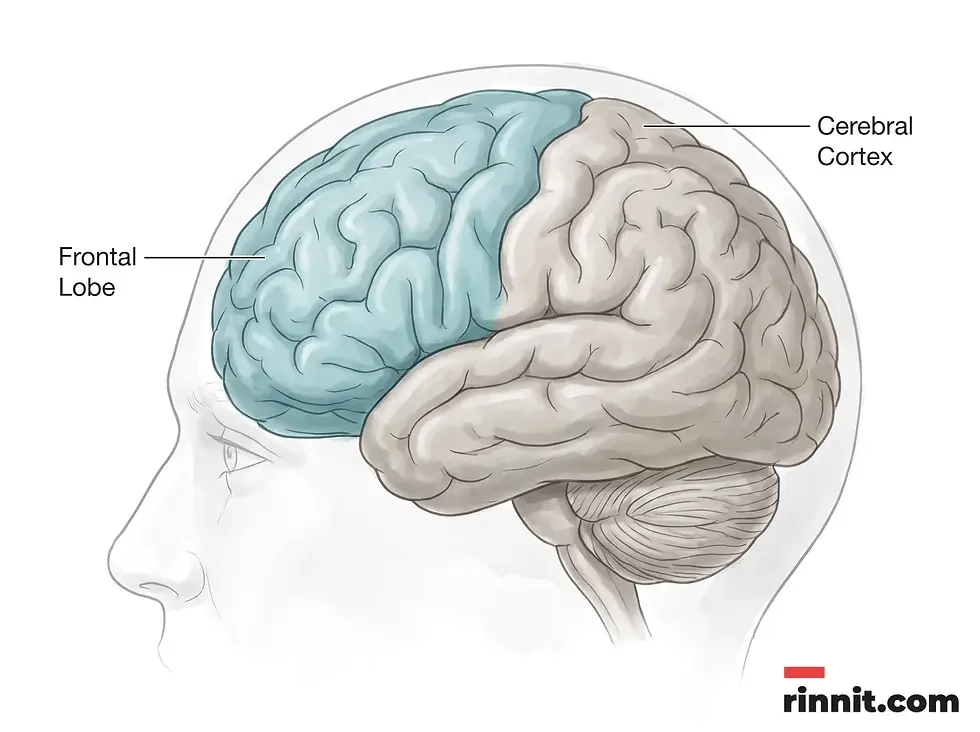
The frontal lobe is the largest of the brain's lobes, located directly behind the forehead [1]. It is the hub for executive functions such as logic, judgment and self-control [1], and it directs voluntary movement and speech. By processing new information and retrieving memories, it supports decision-making and social interaction, which is why it is often called the brain's command center.
What the research says
Executive functions are broader than one lobe. A 2019 review defines executive functions as working memory, inhibitory control, cognitive flexibility, planning, reasoning and problem solving. They have traditionally been tied to the frontal lobe, but newer evidence shows posterior and subcortical regions also play a crucial role. (Cristofori et al., Handb Clin Neurol, 2019) [2]
Different frontal regions do different jobs. A 2021 review describes the lateral prefrontal cortex in working memory, attention and planning, the medial prefrontal cortex in motivation and emotional regulation, and the orbitofrontal cortex in personality, inhibition and social reasoning [3]. (Jones and Graff-Radford, Continuum, 2021)
Dysexecutive symptoms can have several causes. The same review notes that executive dysfunction can follow frontal lobe injury but can also arise from degenerative disease affecting large brain networks, including an atypical form of Alzheimer disease [3]. (Jones and Graff-Radford, 2021)
Cognitive control links to impulsivity and mental health. A 2022 review ties the prefrontal cortex to cognitive control, finding that its common component is closely related to response inhibition, and discusses impairments as possible causes and consequences of psychiatric symptoms. (Friedman and Robbins, Neuropsychopharmacology, 2022) [4]
Based on articles retrieved from PubMed.
Anatomical Location and Composition
At the very front of the skull, the frontal lobe makes up an estimated 25% to 40% of the brain's cerebral cortex [1]. Its wrinkled outer surface, the cortex, is a dense network of specialized cells that communicate rapidly across the nervous system and work closely with other brain regions to turn thoughts into actions and sensations into understanding.
Frontal lobe tissue consists mainly of neurons and glial cells [1]. Neurons are the active communicators, sending electrical and chemical signals. Glial cells provide structural support, deliver nutrients and clear waste [1] so neurons can work well.
Component | Role in the Frontal Lobe |
Neurons | Relay electrical and chemical signals for thinking and movement. |
Glial Cells | Provide structural support, nutrients, and waste management. |
Cerebral Cortex | The outer wrinkly surface where complex processing occurs. |

Core Functions and Executive Control
The frontal lobe supports a wide range of mental and physical abilities. Its best-known role is managing "executive functions," including attention span, working memory and impulse control [1]. These let people plan ahead, stay on task and follow social norms.
It is also the primary site of voluntary movement, from walking and reaching to the fine muscle control needed for clear speech. The lobe is also involved in memory, helping with the initial learning of information and its later retrieval [1].
Ability Category | Specific Functions |
Reasoning | Logic, judgment, decision-making, and creativity [1]. |
Social Skills | Understanding social norms and regulating behavior. |
Motor Control | Voluntary muscle movements and speech production. |
Memory | Learning new information and retrieving stored data. |
Conditions Affecting the Frontal Lobe
Because the frontal lobe handles so many abilities, conditions that affect it can cause varied and significant symptoms. Neurodegenerative diseases such as Alzheimer's disease and frontotemporal dementia often involve this region, leading to progressive decline in personality and judgment. Developmental conditions such as ADHD and autism also involve frontal lobe function.
External factors including traumatic brain injury (such as concussion), stroke, and toxins like heavy metals can damage the frontal lobe. When it is compromised, people may develop "executive dysfunction," with trouble organizing tasks, paying attention or controlling emotional impulses [1].
Condition Type | Examples |
Neurodegenerative | Alzheimer's disease, frontotemporal dementia, Pick's disease [1]. |
Developmental | ADHD, autism spectrum disorder [1]. |
Acute Injury | Stroke, concussion, traumatic brain injury (TBI) [1]. |
Toxins/Infections | Carbon monoxide poisoning, heavy metal poisoning, encephalitis [1]. |
Signs of Frontal Lobe Dysfunction
Recognizing early signs matters for getting timely medical care. Symptoms can start subtly, as slight shifts in personality or small lapses in judgment, and become more pronounced as a condition progresses. Common signs include:
Personality changes: unexplained shifts in mood, temperament or social behavior.
Executive dysfunction: difficulty planning, organizing or switching between tasks [1].
Impulse control issues: saying or doing things without considering the consequences [1].
Motor difficulties: trouble coordinating voluntary movements or speaking clearly.
Memory problems: difficulty recalling learned information.
Diagnostics and Brain Care
Healthcare providers use several tests to assess the frontal lobe. MRI and CT scans show brain structure, EEG measures electrical activity, and neuropsychological testing evaluates abilities such as reasoning and memory [1].
Protecting the frontal lobe takes a proactive approach. Helmets and seatbelts are the most direct way to prevent traumatic injury [1], and a balanced diet, regular exercise and blood pressure control support the circulation the brain needs.

The Bottom Line: What You Need to Know About the Frontal Lobe
The frontal lobe underlies much of what makes each person who they are, from basic movement to complex social interaction. Understanding its role and caring for it supports cognitive vitality and emotional well-being throughout life.
If you or a loved one has personality changes, trouble with complex tasks or persistent difficulty focusing, see a neurologist for a full evaluation. Sudden weakness, face drooping, trouble speaking or sudden confusion can signal a stroke, so call 911 right away. Early testing is key to managing brain health and preserving executive function.
Frequently Asked Questions
Where is the frontal lobe located?
It sits at the front of the brain, directly behind the forehead.
What is the main role of the frontal lobe?
It acts as the brain's command center for reasoning, personality and movement.
How does the frontal lobe affect personality?
It regulates social behavior and impulse control, which are core parts of personality.
What are executive functions?
High-level thinking processes such as planning, organizing and self-control.
Can a stroke affect the frontal lobe?
Yes. A stroke in this area can cause paralysis, speech problems or personality changes.
What is Broca's aphasia?
A condition in which a person knows what they want to say but struggles to speak the words.
How much of the brain is the frontal lobe?
It makes up approximately 25% to 40% of the brain's cerebral cortex.
What are glial cells?
Support cells that provide nutrients and structural stability to neurons.
Can the frontal lobe be damaged by toxins?
Yes. Heavy metals and carbon monoxide can damage frontal lobe tissue.
What is executive dysfunction?
Difficulty managing time, paying attention and organizing tasks.
How is frontal lobe health tested?
Through imaging (MRI/CT), electrical tests (EEG) and neuropsychological assessments.
Is the frontal lobe involved in memory?
Yes. It helps with learning new information and retrieving it later.
Can exercise help the frontal lobe?
Regular physical activity improves circulation, which supports brain health.
What are the signs of a frontal lobe seizure?
They can include sudden, unusual movements or brief lapses in consciousness.
How can I prevent frontal lobe injuries?
Wear helmets during sports and seatbelts while driving to help prevent TBI.
Related reading on Rinnit
Understanding Grey Matter: The Brain's Essential Processing Center
Frontal Lobe Seizures: Symptoms, Causes, and How They're Treated When Medicine Isn't Enough
Post-Concussion Syndrome: Symptoms, Causes, and Treatment — What to Do When Concussion Symptoms Last
Aphasia Explained: Causes, Types, Symptoms, and How Speech Therapy Helps You Find Your Words Again
Sources
Cleveland Clinic. Frontal Lobe. Cleveland Clinic. Last updated December 8, 2022. https://my.clevelandclinic.org/health/body/24501-frontal-lobe
Cristofori I, Cohen-Zimerman S, Grafman J. Executive functions. Handb Clin Neurol. 2019;163:197-219. PMID 31590731. https://doi.org/10.1016/B978-0-12-804281-6.00011-2
Jones DT, Graff-Radford J. Executive Dysfunction and the Prefrontal Cortex. Continuum (Minneap Minn). 2021;27(6):1586-1601. PMID 34881727. https://doi.org/10.1212/CON.0000000000001009
Friedman NP, Robbins TW. The role of prefrontal cortex in cognitive control and executive function. Neuropsychopharmacology. 2022;47(1):72-89. PMID 34408280. https://doi.org/10.1038/s41386-021-01132-0
Medical disclaimer
This article is provided for general educational purposes only and is not a substitute for professional medical advice, diagnosis or treatment. Always seek the advice of a qualified health provider with any questions regarding a medical condition.



Comments